

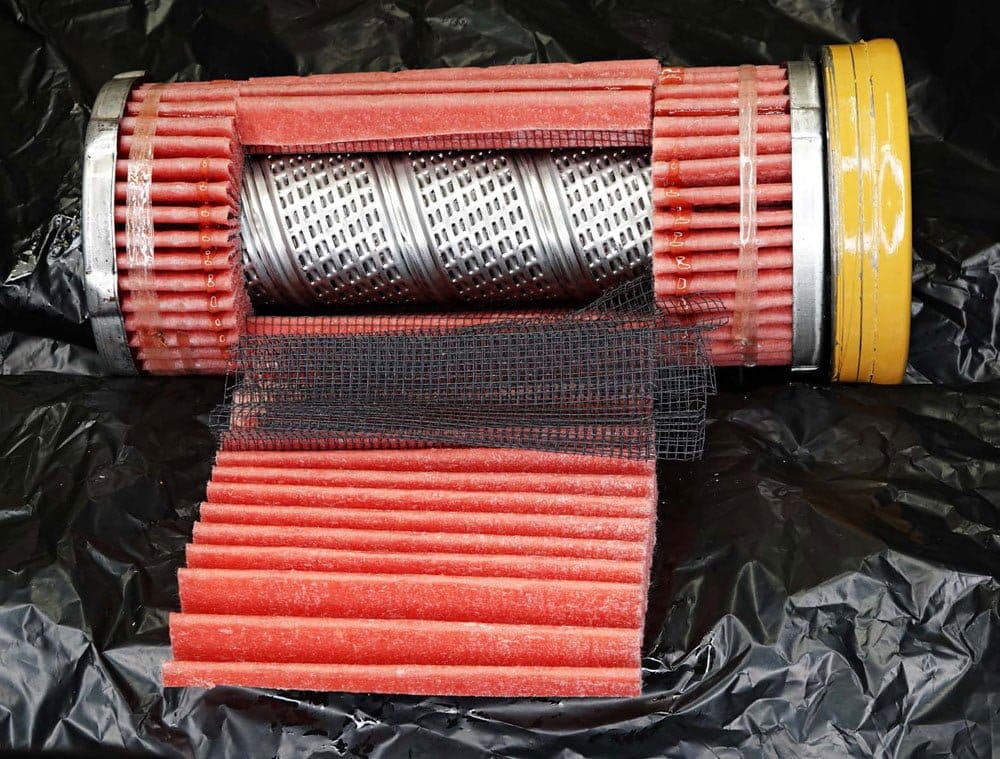
Why did your critical gearbox suffer a catastrophic failure when last month’s laboratory report gave the lubricant a clean bill of health? It’s a costly paradox that many industrial operators face when standard oil analysis fails to detect the large, jagged wear particles that precede a mechanical breakdown. To truly secure your infrastructure, you need Filter Debris Analysis: Predicting Failure Before It Happens, a forensic methodology that captures the critical data traditional sampling misses.
We understand that unscheduled downtime can cost millions and that justifying maintenance budgets to upper management requires concrete evidence. By integrating Filter Debris Analysis (FDA) into your reliability strategy, you can identify specific failing components without an invasive teardown. This article details how capturing these metallic signatures allows you to transition from reactive repairs to a proactive maintenance model. You’ll discover how the Australian Oil Filtration Specialists at BioKem leverage 70 years of specialist experience to help you extend asset life beyond 2026 while maintaining rigorous ISO 16889 standards. We provide a logical sequence for implementing these advanced diagnostics to ensure long term ecological and operational health.
Key Takeaways
- Learn why standard fluid sampling often misses the large-scale wear particles that signal imminent mechanical breakdown, and how forensic filter analysis bridges this critical detection gap.
- Discover the technical advantages of Filter Debris Analysis: Predicting Failure Before It Happens, allowing you to identify specific failing components without the need for an invasive equipment teardown.
- Understand how decoding particle shapes, such as spheres and spirals, provides a clear window into active failure modes within your industrial assets.
- Explore the strategic integration of FDA during critical phases like lube oil system commissioning and scheduled shutdowns to ensure operational reliability beyond 2026.
- Gain insights into how BioKem leverages 70 years of specialist experience to provide national support for proactive maintenance and asset life extension.
The Detection Gap: Why Standard Oil Analysis Isn’t Enough
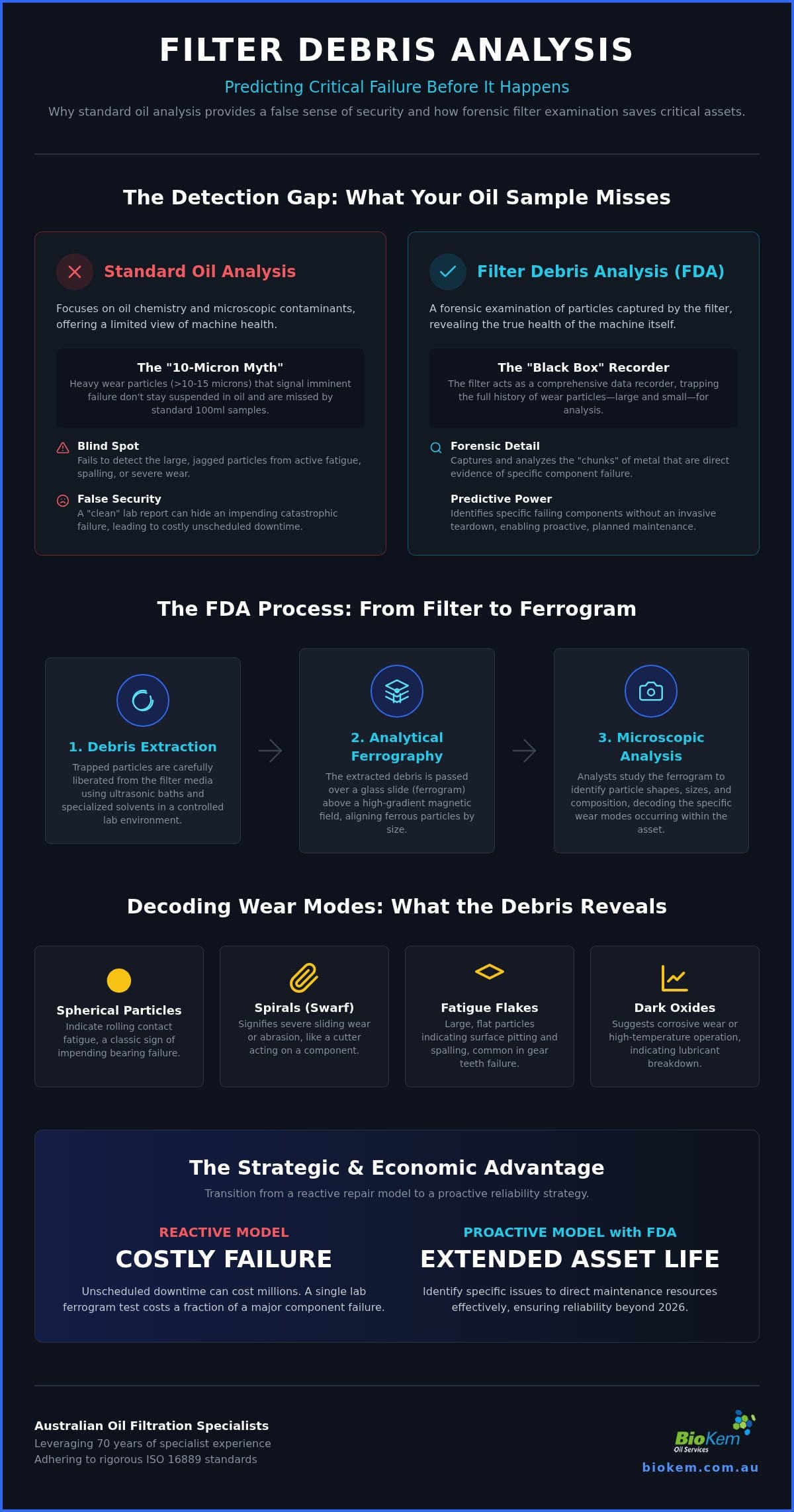
Standard oil analysis is a foundational element of industrial maintenance, yet it possesses a blind spot that can lead to catastrophic mechanical failure. Most operators rely on laboratory reports that measure elemental ppm (parts per million) and ISO cleanliness codes. While these metrics provide an overview of lubricant chemistry and fine silt, they often fail to detect the “critical mass” particles that signal a system is on the verge of collapse. This is where Filter Debris Analysis: Predicting Failure Before It Happens becomes essential. It’s a forensic tool that examines the actual wear particles captured by the system’s filtration media, providing a level of detail that fluid sampling simply cannot reach.
The “10-Micron Myth” explains why many reports look healthy even as a gearbox or turbine fails. Large wear particles, typically those exceeding 10 to 15 microns, are the primary indicators of active fatigue, spalling, or severe sliding wear. Because these particles are heavy, they don’t remain suspended in the oil column long enough to be captured in a standard 100ml sample bottle. Instead, they settle in the bottom of reservoirs or are immediately trapped by the filter. Consequently, a “clean” ISO 4406 report may offer a false sense of security while the system’s filter acts as a “black box” recorder, silently accumulating evidence of an impending disaster.
Fluid Sampling vs. Filter Analysis
Fluid sampling focuses on the health of the oil itself, identifying oxidation, additive depletion, and microscopic contaminants. In contrast, Filter Debris Analysis (FDA) focuses on the health of the machine. By extracting and analyzing the “chunks” of metal trapped in the pleated filter media, specialists can identify active component fatigue that standard oil analysis misses. Relying solely on particle counts can be misleading; a system might have low particle counts but contain large, jagged steel shards that indicate a bearing is shredding its race.
The Economics of Predictive Failure
The financial justification for advanced diagnostics is clear. A laboratory Filter Ferrogram costs a fraction of the expense associated with a major turbine bearing failure or an unscheduled plant shutdown. BioKem, as the Australian Oil Filtration Specialists, utilizes 70 years of specialist experience to integrate FDA into a broader Reliability-Centred Lubrication (RCL) strategy. This approach ensures that maintenance resources are directed toward specific components showing signs of distress rather than arbitrary schedule-based teardowns. Filter Debris Analysis serves as the ultimate predictive tool for high-speed rotational assets by providing a forensic window into the physical wear mechanisms of the system.
The Science of FDA: From Filter Media to Ferrograms
The transition from raw waste to actionable data begins with the meticulous extraction of debris from pleated filter media. Unlike standard oil samples that require minimal preparation, filter analysis demands a controlled laboratory environment to prevent external contamination. Specialists use ultrasonic baths and specialized solvent washes to liberate trapped particles from the deep folds of the filter fibers. This process ensures that every piece of evidence, from microscopic silt to large fatigue flakes, is recovered for examination. By capturing the full spectrum of wear, Filter Debris Analysis: Predicting Failure Before It Happens provides a forensic record that fluid sampling alone cannot replicate.
Analytical Ferrography serves as the technical heart of this diagnostic process. Once the debris is extracted, the fluid is passed over a glass slide positioned above a high-gradient magnetic field. This magnetic pull aligns ferrous particles into distinct “strings” based on their size and mass. Larger particles settle at the entry point, while smaller ones travel further down the slide. This logical arrangement allows analysts to view a chronological map of component wear. BioKem utilizes best of breed international equipment to ensure these ferrograms are prepared with the highest degree of precision, leveraging 70 years of specialist experience to interpret the results for Australian industrial operators.
Understanding the Ferrogram
A ferrogram is more than just a slide of metal; it’s a historical record of the system’s internal environment. While ferrous debris like steel and iron aligns in predictable strings, non-ferrous materials such as copper, bronze, or lead settle randomly across the slide. This distinction is vital for identifying which specific component is under distress. If an analyst sees a surge in copper particles alongside steel strings, it likely indicates a failing bushing or thrust washer. This level of specificity allows maintenance teams to target repairs without performing a full system teardown.
The Role of Micro-Imaging
Microscopic examination brings the data to life. Using 100x to 500x magnification, specialists observe particle morphology to determine the exact type of wear occurring. For example, “Red Oxides” appear as distinct orange-red clusters, signaling moisture-related corrosion within the system. Conversely, “Black Oxides” suggest inadequate lubrication or localized overheating. By identifying these signatures, BioKem’s Filter Ferrogram Analysis service provides the technical insights needed to rectify the root cause before a breakdown occurs. If you’re concerned about the hidden health of your high-speed assets, you can speak with our technical team to arrange a forensic review of your system filters.
Decoding Wear Modes: What the Debris is Telling You
Analyzing the morphology of particles is where the diagnostic value of Filter Debris Analysis: Predicting Failure Before It Happens truly shines. While a simple particle count indicates the quantity of debris, the specific shape and metallurgy reveal the exact source and mechanism of the wear. Normal rubbing wear typically produces fine, plate-like particles that represent the expected interaction of surfaces in a healthy system. However, when these particles increase in size or change in geometric complexity, the system has transitioned into an active failure phase. Identifying these signatures early allows maintenance teams to intervene before a minor component issue escalates into a total system collapse.
Metallurgy pinpointing allows analysts to determine which internal component is under distress without an invasive teardown. For instance, high concentrations of chrome and alloy steel often point to bearing race fatigue, while the presence of copper or lead suggests that bushings or thrust washers are shedding material. This forensic precision is also an essential tool for validating the effectiveness of recent hot oil flushing procedures. By performing a forensic review of the filters after a flush, operators can confirm that all construction debris or legacy wear has been successfully purged, ensuring the system is truly clean before it returns to service.
Fatigue vs. Abrasive Wear
Fatigue spalling is characterized by large, flat platelets that indicate subsurface material stress. These particles are often the first sign that a bearing or gear tooth is reaching the end of its fatigue life. In contrast, abrasive wear, or cutting wear, appears as long, curly “shavings” similar to those found on a machinist’s lathe. This occurs when a hard contaminant or a broken component fragment gouges a softer surface. BioKem’s root cause approach focuses on stopping these wear mechanisms by identifying the specific debris type and remediating the environment before wear accelerates beyond repair.
Severe Sliding and Heat Discolouration
Severe sliding wear indicates a critical breakdown in the lubrication film, allowing direct metal-to-metal contact under high loads. Sliding wear particles appear as long, striated ribbons under a microscope, often showing signs of significant physical deformation. When these surfaces interact without adequate lubrication, localized friction generates intense heat. Analysts recognize this through “tempering colours” on the metal debris, where particles exhibit straw, blue, or purple hues. These thermal signatures are a definitive warning of localized overheating, signaling that the current lubrication strategy or component alignment requires immediate adjustment to prevent catastrophic seizure.
Implementing a Predictive FDA Program in 2026
Implementing a proactive strategy in 2026 requires more than just reactive sampling; it demands a structured schedule that aligns with the operational lifecycle of your machinery. We recommend a frequency that includes quarterly baseline checks, mandatory reviews during major shutdowns, and forensic analysis during the commissioning of lube oil systems. By establishing these checkpoints, you ensure that Filter Debris Analysis: Predicting Failure Before It Happens is not a one-off event but a continuous data stream. This longitudinal data allows you to track wear trends over time, providing the necessary evidence to justify maintenance interventions to stakeholders.
For maximum impact, integrate your FDA results directly into your Computerised Maintenance Management System (CMMS). This allows you to correlate metallic debris findings with other diagnostic indicators like vibration analysis and thermography. For instance, if a vibration report shows a slight increase in frequency at a specific bearing, a corresponding ferrogram showing fatigue spalling provides the evidence needed to order a replacement. This multi-layered approach transforms maintenance from a guessing game into a precise science, reducing the risk of unscheduled downtime. BioKem leverages 70 years of specialist experience to help you synthesize these complex data points into actionable maintenance tasks.
How to Sample a Filter for Lab Analysis
The integrity of your diagnostic report depends heavily on the quality of the sample provided. When removing a filter for analysis, it’s vital to protect the media from atmospheric contamination during transport. Use a clean, lint-free container and ensure the sample is clearly labelled with the system’s total hours run, the specific oil type, and the date of removal. A common mistake is attempting to “clean” or wash the filter media before shipment to remove excess oil. You should never do this; the residual oil and the debris embedded in the pleats contain the very data our specialists need to perform an accurate forensic review.
Interpreting the BioKem FDA Report
A BioKem report provides far more depth than a simple traffic-light status. We focus on technical recommendations based on the Wear Particle Concentration (WPC) index, which quantifies the volume of wear debris relative to the amount of oil processed. This index, combined with morphological analysis, identifies whether a system is in a state of normal rubbing wear or active failure. Our Oil Filter Debris Analysis Service delivers a comprehensive breakdown of metallurgy and wear modes, allowing you to schedule remediation during planned windows. To begin building your 2026 reliability roadmap, contact our technical team today for a consultation on your specific asset requirements.
BioKem Oil Services: Australia’s Experts in Reliability-Centred Lubrication
BioKem Oil Services serves as the Australian Oil Filtration Specialists, bridging the gap between forensic laboratory data and practical onsite engineering. We leverage 70 years of specialist experience to ensure that every diagnostic insight translates into a tangible increase in asset reliability. We don’t just identify wear; we provide the technical roadmap to eliminate it. By utilizing Filter Debris Analysis: Predicting Failure Before It Happens, our team provides the critical foresight necessary to protect high-value infrastructure across the continent. Our holistic approach ensures that every forensic discovery in the lab is met with a practical, onsite solution that protects your bottom line and your equipment’s longevity.
Our operational framework follows a logical “Advise, Mobilise, Work” process designed for transparency and efficiency. Once an FDA report identifies a concern, such as the presence of red oxides or severe sliding wear discussed in previous sections, we advise on the most effective remediation strategy. BioKem Oil Services then mobilises specialist equipment and expert technicians to your site to perform the necessary work. This often involves transitioning from a diagnosis of moisture contamination to active remediation through Vacuum Dehydration. This seamless integration of analysis and action is why we maintain a reputation for excellence in the most demanding industrial environments.
Safety and regulatory compliance are the cornerstones of our service delivery. BioKem Oil Services is proud to maintain a safety record of Zero Lost Time Injuries (LTI) since establishment in 2012. This commitment to responsibility ensures that our technical expertise is delivered without compromising the health of your personnel or the surrounding environment. We align our filtration standards with ISO 16889, ensuring that our results are both scientifically rigorous and locally dependable.
Turnkey Solutions for Industrial Assets
BioKem Oil Services is the preferred partner for the Energy, Mining, and Gas Compression sectors due to our ability to handle complex, large-scale lubrication challenges. As the Australian distributor for Filters S.p.A. and Swift Filters, we provide access to world-class filtration technology that meets specific regional requirements. Whether you’re managing a scheduled shutdown or an emergency intervention, our Equipment Hire service provides the temporary filtration rigs and specialist tools needed to maintain system cleanliness during critical windows.
The BioKem Oil Services Advantage
Our national mobilisation capability allows BioKem Oil Services to respond rapidly to abnormal FDA reports, regardless of your asset’s location. We provide professional, technical, and reliability-focused support that empowers your maintenance teams to make data-driven decisions. We don’t just provide a report; we provide a partnership rooted in long term ecological and operational health. If you’re ready to move beyond standard oil sampling, you can contact BioKem Oil Services for a professional review of your latest lab reports and discover the forensic difference.
Securing Your Assets with Forensic Precision
Relying on chemical trends alone leaves your critical machinery vulnerable to sudden, catastrophic breakdown. By adopting Filter Debris Analysis: Predicting Failure Before It Happens, you gain a forensic window into the physical wear mechanisms that standard fluid sampling simply cannot detect. This methodology identifies specific component fatigue, allowing your team to intervene before a minor issue evolves into a million-dollar failure. We understand that asset reliability is the foundation of your operational success.
BioKem brings 70 years of specialist experience and a safety record of Zero Lost Time Injuries (LTI) since establishment in 2012 to every diagnostic partnership. Our ISO 16889-certified filtration standards ensure that your assets receive the highest level of protection available in the Australian industrial landscape. It’s time to transition from reactive repairs to a reliability-centred strategy to secure your operational future. Request an Oil Filter Debris Analysis Quote today to start protecting your high-value assets. We’re ready to help you achieve long term mechanical health and operational efficiency.
Frequently Asked Questions
What is the difference between oil analysis and filter debris analysis?
Standard oil analysis measures elemental concentrations and ISO cleanliness codes, while Filter Debris Analysis: Predicting Failure Before It Happens examines the physical particles trapped in the filter media. This forensic approach captures the larger wear signatures that fluid samples often miss due to particle settling. BioKem Oil Services uses this data to bridge the gap between simple oil monitoring and true root cause diagnosis of mechanical issues before they escalate.
Can Filter Debris Analysis identify which specific component is failing?
Yes, by analyzing the metallurgy and morphology of the recovered particles, our analysts can pinpoint the source component. For example, the presence of specific alloy steels might indicate a bearing race failure, while copper-based alloys point toward bushings. BioKem Oil Services leverages this forensic precision to help maintenance teams target specific repairs, avoiding the costs and risks associated with unnecessary equipment teardowns.
How often should I perform FDA on critical turbines or compressors?
For high-speed rotational assets like turbines and compressors, BioKem Oil Services recommends a quarterly analysis frequency as part of a Reliability-Centred Lubrication strategy. Additionally, performing FDA during the commissioning phase and major shutdowns provides a critical baseline for asset health. This structured schedule ensures that wear trends are identified early, allowing for planned interventions rather than reactive emergency repairs.
Does FDA require me to shut down my system to take a sample?
No, Filter Debris Analysis: Predicting Failure Before It Happens is designed to be a non-invasive diagnostic tool. Samples are typically collected during scheduled filter element changes or via dedicated sampling ports while the system remains operational. BioKem Oil Services provides guidance on proper handling and labelling to ensure the integrity of the sample, protecting the filter media from atmospheric contamination during its transit to our laboratory.
What are the common wear modes identified through ferrography?
Ferrography identifies several distinct wear mechanisms, including normal rubbing wear, fatigue spalling, and abrasive cutting wear. We also detect severe sliding wear and thermal signatures, such as tempering colours on metallic particles. Identifying these modes allows BioKem Oil Services to determine if a system is operating within design parameters or if it has transitioned into an active failure phase that requires immediate attention.
Can BioKem Oil Services provide onsite remediation if the FDA report shows high contamination?
BioKem Oil Services provides a full suite of onsite remediation options if analysis reveals abnormal contamination levels. Once a report identifies issues like moisture or high particle counts, we can mobilise specialized equipment for Vacuum Dehydration or Hot Oil Flushing. This integrated approach ensures that the diagnostic findings lead directly to an operational result, restoring system cleanliness to ISO 16889-certified standards.
Is FDA suitable for hydraulic systems as well as lubrication systems?
FDA is highly suitable for hydraulic systems, particularly those with close-tolerance valves and high-pressure pumps. These systems are extremely sensitive to the large-scale wear particles and silt that standard sampling might overlook. BioKem Oil Services applies the same forensic rigour to hydraulic filters, identifying internal component erosion and seal degradation to prevent the catastrophic seizure of critical control elements in fixed or mobile plants.
How long does it take to receive a BioKem Oil Services Filter Ferrogram report?
BioKem Oil Services prioritizes technical accuracy and provides detailed reports that align with your maintenance windows. While the duration depends on the complexity of the ferrogram and the volume of debris, we ensure that our findings are delivered with actionable recommendations. Every report includes high-magnification imaging and a Wear Particle Concentration index, providing the technical evidence needed to justify maintenance decisions to your management team.

Article by
James McAllister
James McAllister is an industry professional with BioKem Oil Services, specialising in lubrication reliability, oil filtration, contamination control and asset performance. Drawing on BioKem's extensive field experience across turbines, compressors, hydraulic systems and critical rotating equipment, James writes practical, insight-driven articles that help maintenance and reliability teams improve equipment performance, extend asset life and reduce operational risk.
Disclaimer
The information contained in this article is provided by BioKem Oil Services for general informational and educational purposes only. While every effort has been made to ensure the accuracy and relevance of the information at the time of publication, BioKem Oil Services makes no representations or warranties, express or implied, regarding its completeness, accuracy, reliability, suitability or availability.
Readers should seek professional advice before making maintenance, operational, engineering or investment decisions based on the content of this article. BioKem Oil Services accepts no liability for any loss, damage or consequential loss arising from the use of, or reliance upon, the information presented.
Unless otherwise stated, all content, including text, graphics, images and technical information, is the property of BioKem Oil Services and is protected by applicable copyright and intellectual property laws. No part of this publication may be reproduced, copied, distributed, republished, stored, transmitted, modified or used in any form without the prior written permission of BioKem Oil Services.
© BioKem Oil Services. All rights reserved.