

New oil isn’t necessarily clean enough for critical equipment. Why does new lubricating oil need to be filtered before it goes into the machine? Particles and moisture can enter during production, storage or handling, potentially accelerating wear and affecting performance. Filtration removes these contaminants, while a cleanliness check shows whether the oil meets the equipment’s target.
It’s reasonable to expect unused oil to be ready for service, but its condition matters more than whether it’s new or used. Understanding why new lubricating oil needs filtering before it enters a machine means considering contamination and the lubricant’s formulation. This article explains how oil is treated, how particles and water are removed, and how cleanliness is assessed against equipment requirements.
Key Takeaways
- New oil can pick up particles and moisture during production, storage or handling, so its condition matters more than whether it has been used.
- Pre-filtration and the right treatment method help remove contaminants while accounting for the lubricant’s additives.
- Oil analysis can assess cleanliness against the equipment’s ISO target and help determine whether treated oil is ready for use.
- Professional filtration and services such as vacuum dehydration can help address contamination and moisture in industrial lubricating oil.
Oil collection, pre-filtration and quality checks
Oil treatment starts with collecting the lubricant in clean, suitable equipment and protecting it from further contamination. Pre-filtration removes larger debris before finer filtration, helping prevent coarse particles from overloading downstream media. Additives may settle when oil sits in tanks or drums, so the treatment method should account for the lubricant’s condition and intended use.
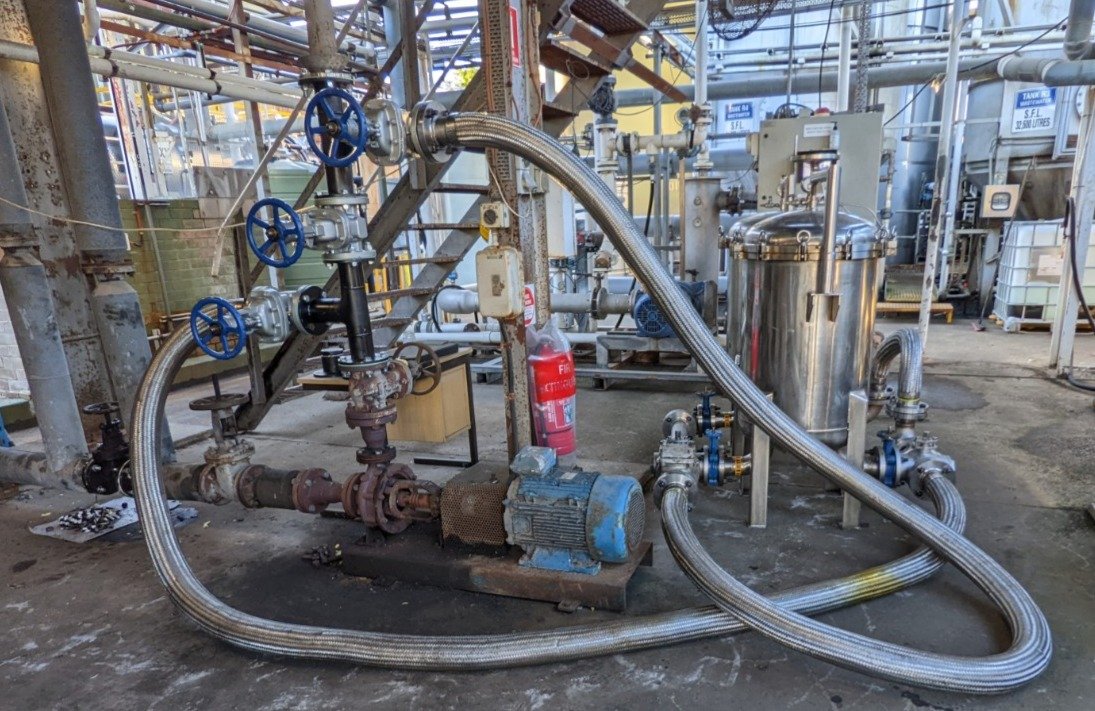
For oil in a delivery drum, a drum-top filtration unit can transfer it through filter media into a clean container. A portable filter cart can circulate oil through a separate loop, enabling offline filtration while equipment remains in service. By reducing particles that could score surfaces, restrict clearances or obstruct lubrication passages, filtration helps protect machine components and support reliable operation.
How is cleanliness verified? A representative sample taken after filtration can undergo particle-count testing, with results reported as an ISO cleanliness code. Testing can also assess moisture when water contamination is a concern. Comparing the results with the machine’s specified cleanliness goal shows whether the oil is ready for use or needs further treatment.
Cleaner oil can also reduce consumption by extending lubricant service life and avoiding premature replacement. In one filtration programme, annual oil consumption across four gearboxes fell from 61 gallons to zero, saving 427 gallons over seven years. If an oil assessment points to varnish deposits as a separate concern, understanding varnish in lubricating oil can help clarify the next treatment consideration.
Filtering new and used oil to remove particulate contamination and moisture
Filtration decisions depend on the oil’s condition, machine design and lubricant formulation. Professionals assess these factors before choosing a treatment method for new or circulating oil.
Comparing New Oil with Oil in Machinery
Yes, new oil can be dirtier than oil already in machinery. Particles can enter during production, transport, storage or transfer, while operating oil may have passed through machine filters. Used oil can still contain wear debris and moisture, so age alone doesn’t indicate cleanliness. The reason new lubricating oil needs filtering before it goes into a machine is that its condition may not meet the equipment’s cleanliness goal.
Removing Particles and Moisture
Mechanical filtration passes oil through a physical barrier that captures particles. A three-micron beta 200 filter is one example for systems seeking low ISO codes. Magnetic filtration targets ferrous debris, while vacuum filtration can remove fine contaminants and water. The method must also preserve additives. Gear oil containing molybdenum disulfide additive sized at ten microns shouldn’t be filtered at that level or finer, as filtration may remove the additive.
Filtering New Lubricating Oil Before Use
Why does new lubricating oil need filtering before it goes into the machine? Filtering helps prevent particles and moisture from circulating through bearings, pumps and lubrication passages, where contaminants can accelerate wear or restrict flow. Professionals select a filtration method based on the oil, contaminants and equipment requirements. For system-specific treatment, professional oil filtration can help prepare oil for use; discuss your filtration requirements.
Oil cleanliness goals and ISO code monitoring
An ISO cleanliness goal gives oil treatment a measurable endpoint. The right target depends on the equipment and its operating requirements.
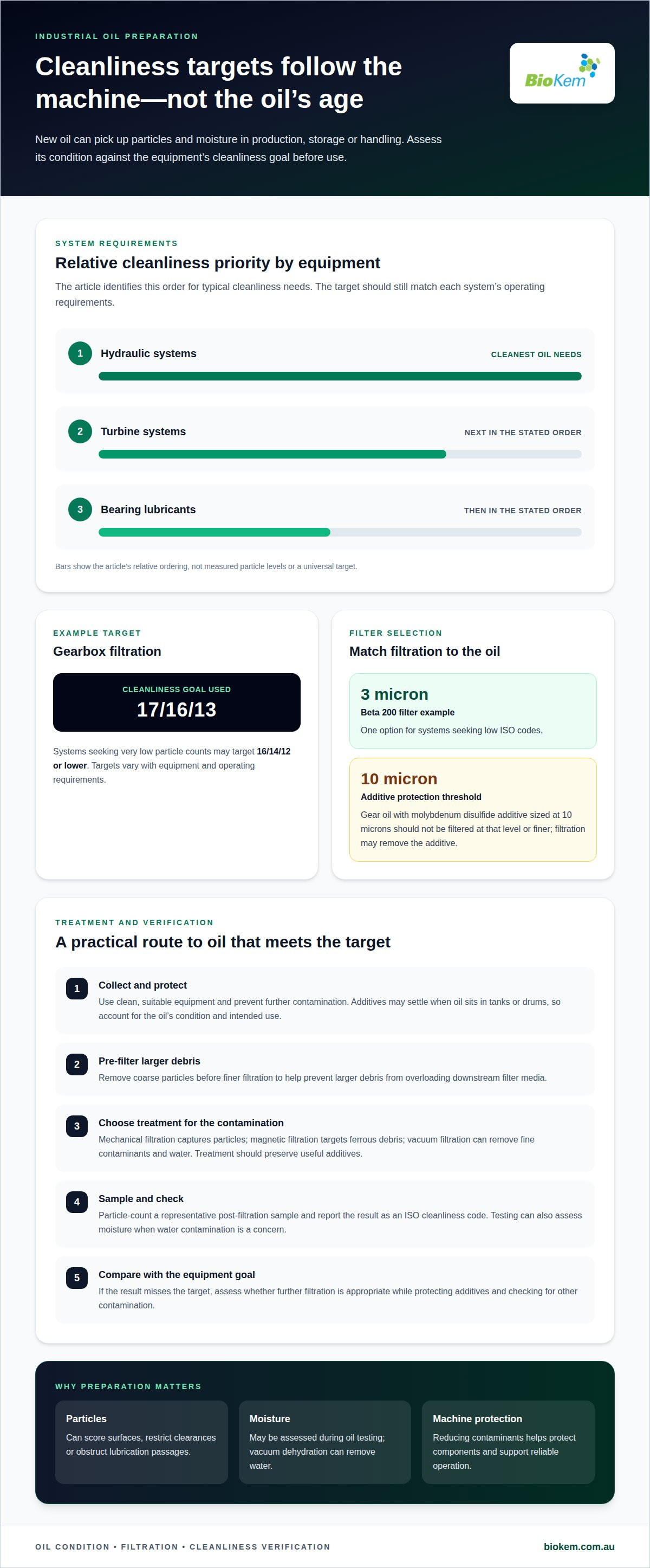
For Australian industrial machinery, ISO cleanliness codes provide a practical way to specify and report particle levels. The target should match the system rather than assume one code fits every asset. Hydraulic systems typically need the cleanest oil in a facility, followed by turbine systems and bearing lubricants. A gearbox filtration program has used a goal of 17/16/13, while systems seeking very low particle counts may target 16/14/12 or lower.
There isn’t one micron rating that suits every lubricant and machine. A professional selects filtration based on the required cleanliness, the oil’s formulation and the contaminants present. A three-micron beta 200 filter is one example for systems seeking low ISO codes. Finer filtration isn’t automatically better: gear oil containing molybdenum disulfide additive sized at ten microns should not be filtered at that level or finer, because the process can remove the additive.
After treatment, a representative sample is particle-counted and its ISO code compared with the equipment’s target. If the result misses the goal, the professional can assess whether further filtration is appropriate, while protecting additives and checking for other contamination. Batch oil filtration and certification can provide a documented cleanliness outcome for oil prepared before use. Discuss batch oil filtration and certification for your equipment’s cleanliness requirements.
For industrial machinery in Australia, ISO cleanliness codes provide a practical way to specify and report particle levels. Select the target for the equipment and its operating requirements, rather than applying one code to every asset.
BioKem Oil Services
BioKem Oil Services helps industrial operators assess lubricant condition and address contamination before it affects critical equipment. Oil analysis can provide insight into cleanliness and oil condition, supporting decisions about treatment and use. Where moisture is present, vacuum dehydration removes water from oil. Hot oil flushing and varnish mitigation address other lubrication-system concerns when operating conditions or deposits call for them.
The appropriate approach depends on the oil, contamination and equipment requirements. This makes professional assessment useful when new oil needs preparation, an ISO cleanliness goal must be evaluated, or moisture is a concern. Contact BioKem Oil Services to discuss your lubricating oil requirements.
Make Oil Preparation Part of Asset Care
Understanding why new lubricating oil needs to be filtered before it goes into a machine can strengthen asset-care planning. Treat oil preparation as part of commissioning and maintenance, considering the cleanliness target and lubricant requirements alongside equipment needs. If contamination or oil condition calls for further work, BioKem Oil Services provides hot oil flushing, varnish mitigation and vacuum dehydration as part of its industrial oil services.
The right next step is to discuss the application, lubricant and operating concerns, so the treatment can be matched to the system rather than chosen by habit. Discuss your oil requirements with BioKem Oil Services and take a considered step towards dependable equipment care.
Frequently Asked Questions
What contaminants are commonly found in new lubricating oil?
New oil may contain solid particles and moisture picked up during manufacture, transport or handling. Examples include dust, fibres and debris from containers or transfer equipment. These contaminants may be present even when the oil looks clear, because small particles aren’t necessarily visible. Additives can also settle during extended storage, so oil condition involves more than visible dirt.
What ISO 4406 cleanliness codes are recommended for industrial machinery oil?
There isn’t one ISO 4406 code for every machine. A gearbox programme may use 17/16/13, while systems requiring very low particle counts may target 16/14/12 or lower. The equipment’s design and operating requirements guide the target. An ISO code describes particle cleanliness; it doesn’t establish moisture content or whether oil additives remain active.
How do oil transfer and storage introduce contamination?
Contamination can enter when drums are opened, transfer hoses or pumps carry residue, or oil is exposed to the surrounding environment. A reused container may also introduce remnants into a fresh batch. During storage, moisture can accumulate and additives may settle if the oil remains undisturbed. Keeping transfer equipment clean and containers closed helps limit these pathways.
How do professionals filter new lubricating oil before filling a machine?
Before selecting compatible filtration, assess the oil type, equipment cleanliness target and potential contaminants. A closed transfer circuit can move oil through suitable filter stages into a clean reservoir or machine. A representative sample taken after treatment can then be assessed against the target. Filter selection should also account for additives that finer media could remove.
What damage can contaminated lubricating oil cause to bearings, pumps and valves?
Particles can abrade bearing surfaces and pump components, increasing wear and reducing operating efficiency. Debris can obstruct narrow passages or valve clearances, disrupting oil flow and control. Moisture can undermine lubricant condition and contribute to equipment problems. Consequences depend on the contaminant and machine, but severe contamination can contribute to component damage or system failure.

Article by
James McAllister
James McAllister is an industry professional with BioKem Oil Services, specialising in lubrication reliability, oil filtration, contamination control and asset performance. Drawing on BioKem's extensive field experience across turbines, compressors, hydraulic systems and critical rotating equipment, James writes practical, insight-driven articles that help maintenance and reliability teams improve equipment performance, extend asset life and reduce operational risk.