

A bearing problem can damage more than the bearing itself: it can turn oil into a pathway for wear. The answer to how you can tell whether a bearing problem is contaminating your oil is to look for visible metal particles, a milky appearance, or changes in the oil’s colour, consistency or level, alongside rising noise or vibration. These signs point to a problem, but oil analysis is needed to identify contaminants and assess wear.
Oil appearance and equipment behaviour both matter, but neither alone confirms the source of contamination. Metal, dirt and water can disrupt the lubricating film, allowing friction and wear to spread to other engine parts.
This guide explains visible clues, what professional oil analysis can reveal about bearing wear, and how contaminated oil can worsen lubrication before a warning light appears. You’ll have a clearer basis for deciding when an oil sample and condition assessment are warranted.
Key Takeaways
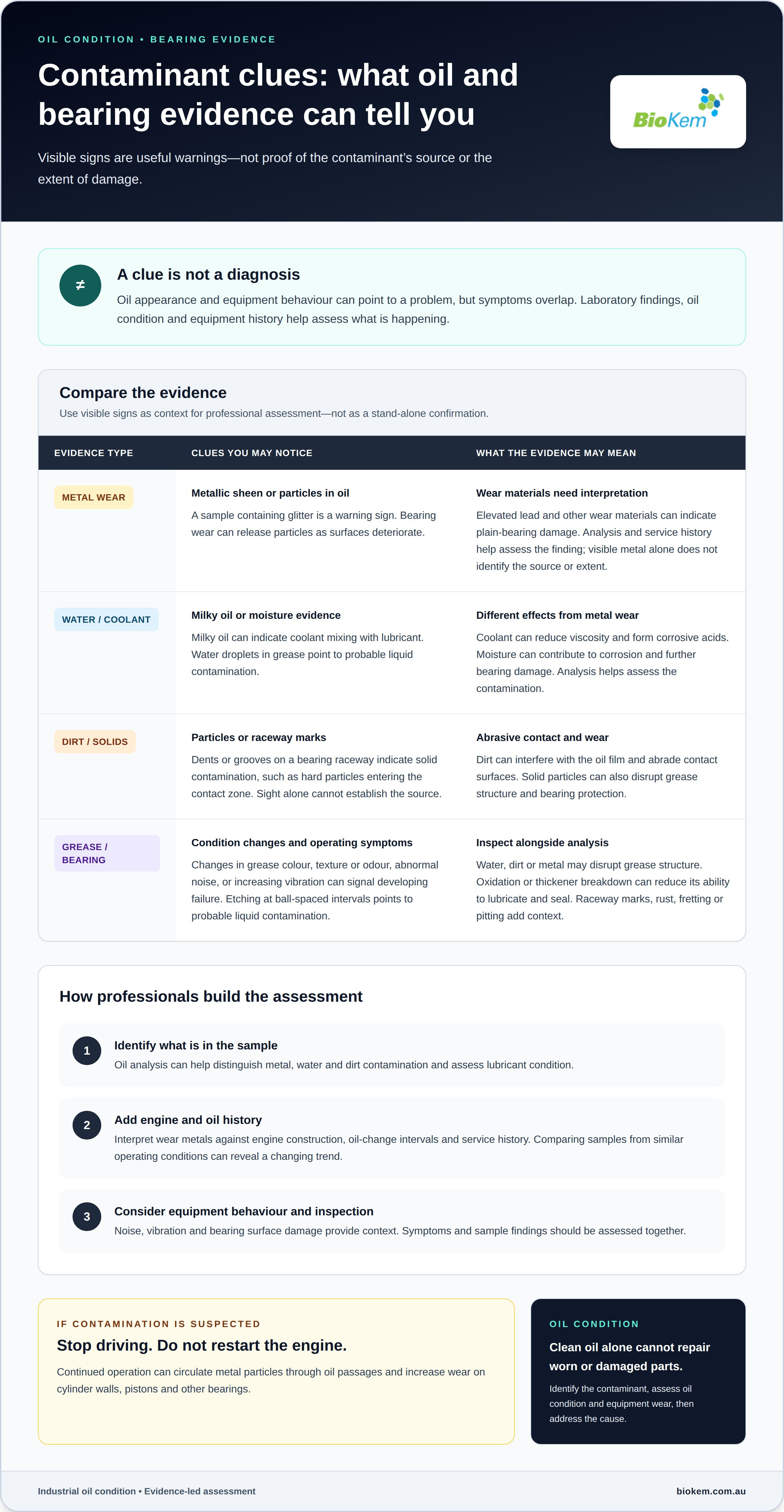
- Metal particles, milky oil, and changes in colour or consistency can signal contamination, but appearance alone can’t identify its source.
- Noise, vibration, and bearing surface damage can add context to signs of wear and help guide a professional assessment.
- Oil analysis can distinguish metal, water, and dirt contamination and help assess the condition of the lubricant.
- Contaminants can weaken lubrication and accelerate wear across engine components, so identifying the cause matters before damage spreads.
Engine damage caused by circulating metal particles
No. If oil contamination is suspected, stop driving and don’t restart the engine. Continued operation can circulate metal particles through oil passages, increasing wear on cylinder walls, pistons and other bearings.
Bearing wear can release particles into the oil as surfaces deteriorate. In plain bearings, elevated lead and other wear materials in used oil can indicate damage. Oil analysis helps identify these materials and assess whether bearing wear may be contributing to contamination. A visible metallic sheen or particles are warning signs, but they don’t establish the source or extent of damage.
Grease contamination can also compromise bearing protection. Water, dirt or metal particles may disrupt grease structure, while oxidation or thickener breakdown can reduce its ability to lubricate and seal. Changes in grease colour, texture or odour, along with abnormal noise or increasing vibration, can signal developing failure. For example, water droplets in grease point to probable liquid contamination.
Raceway marks provide further clues. Dents or grooves on a bearing raceway indicate solid contamination, such as hard particles entering the contact zone. Etching at ball-spaced intervals points to probable liquid contamination. Rust, fretting or pitting on bearing surfaces can also accompany grease failure. These marks show different damage patterns, so consider inspection findings alongside oil or grease analysis.
Not every oil problem is metallic wear. For example, microbial contamination of lubricant oil is a separate contamination concern. Distinguishing the contaminant matters: circulating metal can abrade additional engine components, while moisture can contribute to corrosion and further bearing damage.
How professionals detect water, dirt, and metal particles in oil
Professionals combine laboratory results with oil condition and equipment history to assess contamination. If you’re asking how you can tell whether a bearing problem is contaminating your oil, the sample needs context as well as testing.
Distinguishing Contaminant Symptoms
Contamination symptoms can help distinguish bearing wear from coolant, fuel or dirt in oil. Metal debris may point to wear, while milky oil can indicate coolant mixing with lubricant. Dirt can appear as solid particles, but sight alone cannot establish the source. Because symptoms can overlap, laboratory findings and engine history help identify which explanation best fits the evidence.
Wear-Metal Levels and Variation
Interpret wear-metal results against the engine and oil’s service history. There isn’t one reading that defines normal for every engine. Oil-change intervals affect how much material accumulates in a sample, while engine construction affects which metals may be present. For example, elevated lead alongside other materials can indicate plain-bearing damage. Comparing samples from similar operating conditions can reveal a changing trend.
Responding to Bearing Metals or Glitter
If analysis identifies bearing metals or a sample contains glitter, treat the finding as a reason for prompt assessment, not proof of one failed component. Stop driving and don’t restart the engine if contamination is suspected. To understand how you can tell whether a bearing problem is contaminating your oil, a professional can interpret the result alongside engine details and symptoms. In Australia, contact the oil-analysis service for its sampling requirements before collection; the correct sample depends on the analysis. Discuss professional oil analysis with the engine type, oil details and maintenance history available.
Effects of contaminated oil on lubrication
Oil protects moving surfaces by separating them with a lubricating film. Contamination weakens that barrier, increasing friction where components move under load. In an engine, disrupted lubrication can turn a local bearing issue into wear across connected parts.
Metal particles can become abrasive debris. As oil carries them through galleries, particles may pass between close-fitting surfaces and score them, including cylinder walls and bearing surfaces. Those marks can create more debris, feeding a cycle of wear. A filter may capture some material, but it cannot undo damage already caused.
Water and coolant affect oil differently. Coolant contamination can reduce viscosity, making it harder for oil to maintain the film that protects loaded components. It can also form corrosive acids that damage engine parts. Milky oil is one clue that coolant may have mixed with lubricant, but analysis helps assess the contamination.
Dirt introduces solid particles that can interfere with the oil film and abrade contact surfaces. Water can also impair lubrication and promote corrosion, especially where moisture reaches bearing surfaces. The effect depends on the contaminant, its amount and operating conditions such as load and temperature. For example, a machine under heavy load relies on a stable film to separate moving surfaces.
Restoring oil cleanliness alone won’t repair worn or damaged parts. The practical sequence is to identify the contaminant, assess oil condition and equipment wear, then address the cause before returning equipment to service. If testing also shows unsuitable viscosity, request an oil-condition assessment to discuss whether viscosity correction and oil reconditioning fit the findings.
BioKem Oil Services
BioKem Oil Services helps assess oil contamination and identify suitable oil-condition treatment. Its Oil Analysis can help clarify whether metal, water or other contaminants are present, while results provide context for deciding what should happen next.
Where findings support treatment, options include Vacuum Dehydration for moisture concerns, Hot Oil Flushing to address contamination in oil systems, or Varnish Mitigation where varnish is identified. These treatments address oil or system condition; they don’t repair a physically damaged bearing. The appropriate response depends on the analysis and equipment condition.
If test results show contamination or you need help interpreting them, contact BioKem Oil Services to discuss the findings and next steps.
Make the next maintenance decision count
Knowing how to tell whether a bearing problem is contaminating your oil is most useful when it informs a clear maintenance decision. Treat each analysis result as part of an equipment condition record, alongside operating symptoms and relevant maintenance history. Over time, that context can help your team recognise changes and decide what needs closer attention.
A practical next step is to document what action follows each finding and review whether later assessments show a change. This creates a more consistent basis for planning maintenance, rather than relying on isolated observations. If you’re ready to discuss an oil concern, contact BioKem Oil Services to talk through your next step. A well-informed assessment can help your team move forward with greater clarity.
Frequently Asked Questions
What oil test results indicate bearing wear or bearing material contamination?
Elevated wear metals, especially lead alongside other materials, can indicate plain-bearing damage. A professional interprets results against the engine type, oil service history and previous samples, rather than treating one reading as a diagnosis. A rising trend across comparable samples can strengthen concern and guide further inspection of the affected components.
How can oil analysis identify copper, lead, tin, aluminium, or iron from worn bearings?
Laboratory oil analysis can measure elements present in a sample, including copper, lead, tin, aluminium and iron. Their significance depends on the engine’s materials and construction, so an element alone doesn’t identify a failed part. The analyst considers the combination of metals, sample history and equipment details to assess whether bearing wear is a plausible source.
What signs in oil, an oil filter, or an oil-pressure reading suggest bearing failure?
Metallic debris in oil or trapped in filter media can support concern about internal wear, while a change in oil pressure may signal a lubrication problem. Neither sign identifies bearing failure by itself: pressure readings depend on operating conditions and system condition. A professional weighs these observations with laboratory results and engine symptoms before determining the next diagnostic step.
How can a professional inspect an oil filter for bearing metal safely?
A professional inspects the filter and its media using equipment suited to the filter design, then assesses captured debris without assuming every particle came from a bearing. Debris can be examined for appearance and composition, with further laboratory analysis helping identify its material. The filter type, engine details and oil sample provide useful context for interpreting the findings.
What causes bearing material to enter engine oil, and how quickly can damage progress?
Bearing material can enter oil as bearing surfaces wear or become damaged, allowing debris to circulate through the lubrication system. Damage progression depends on factors such as operating load, oil condition and the amount of wear; there’s no single timeline that applies to every engine. Continued operation can spread particles to other components, so suspected contamination needs prompt assessment.

Article by
James McAllister
James McAllister is an industry professional with BioKem Oil Services, specialising in lubrication reliability, oil filtration, contamination control and asset performance. Drawing on BioKem's extensive field experience across turbines, compressors, hydraulic systems and critical rotating equipment, James writes practical, insight-driven articles that help maintenance and reliability teams improve equipment performance, extend asset life and reduce operational risk.