

Varnish removal depends on whether oil degradation products remain dissolved or have deposited on turbine surfaces. How you remove varnish from a turbine lubrication system depends on the contamination: professional treatment may remove precursors from the oil, while established deposits need to be addressed in the system. Temperature matters because varnish solubility changes around 130 to 135 degrees Fahrenheit.
Varnish can form as turbine oil degrades and interfere with components when deposits build up on metal surfaces. This guide explains what varnish is, how it forms, why temperature affects its solubility and how those differences shape removal. It also explains why reducing varnish in the oil does not necessarily clear deposits already attached to system surfaces.
Key Takeaways
- Varnish solubility shifts around 130 to 135 degrees Fahrenheit, so temperature influences whether degradation products stay in the oil or deposit on components.
- Understanding how oxidation, heat and contamination contribute to varnish helps identify conditions that may need attention.
- Removing varnish while a turbine operates can dislodge deposits unevenly, creating a risk of re-deposition or blocked filters after restart.
- Oil analysis can indicate varnish precursors, but assessing existing deposits requires a broader view of the system.
Temperature-dependent varnish solubility
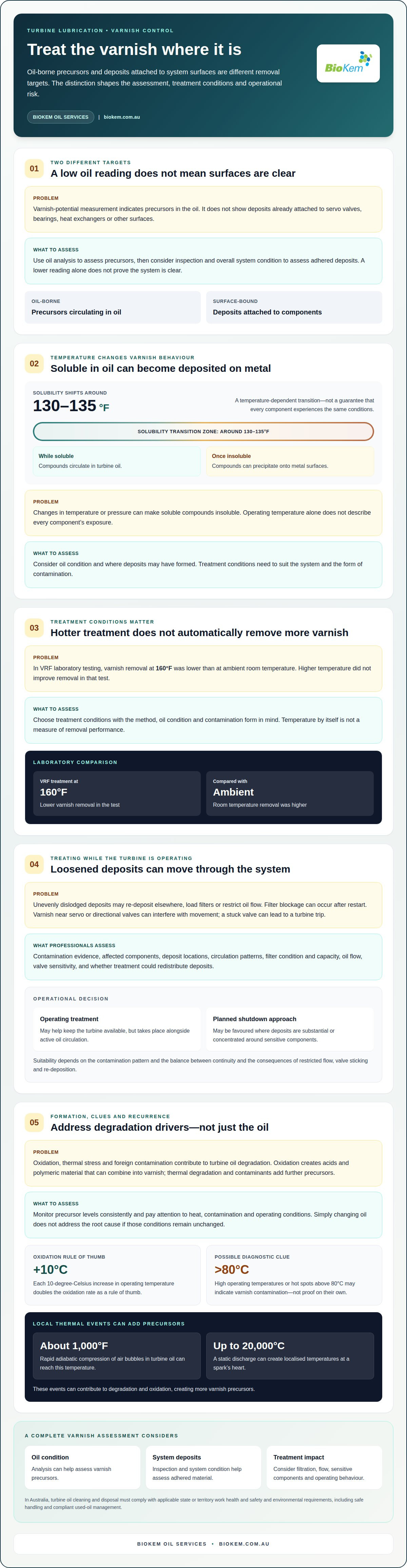
Varnish behaviour depends on whether degradation products remain dissolved or separate from the oil. Solubility can change around 130 to 135 degrees Fahrenheit. While soluble, compounds circulate in turbine oil; once insoluble, they can precipitate onto metal surfaces. That distinction matters because oil-borne precursors and attached deposits are different removal targets.
Operating temperature alone does not describe every component’s exposure. Changes in temperature or pressure can make soluble compounds insoluble, allowing deposits to form on servo valves, bearings and heat exchangers. A varnish-potential measurement indicates precursors in the oil, not deposits already spread through the system. Lower readings therefore do not prove that surfaces are clear.
Removal performance can also vary with treatment temperature. In VRF laboratory testing, varnish removal at 160 degrees Fahrenheit was lower than at ambient room temperature. This result shows that hotter treatment doesn’t automatically improve removal. The method, oil condition and form of contamination all affect the outcome. Treatment conditions need to suit the system.
Local thermal events add another complication. Rapid adiabatic compression of air bubbles in turbine oil can reach about 1,000 degrees Fahrenheit. Static discharge can create localised temperatures up to 20,000 C at a spark’s heart. These events can contribute to degradation and oxidation, creating more varnish precursors. Effective varnish removal planning considers both oil condition and existing deposits. Oil analysis helps assess precursors, while deposits must also dissolve and be removed from the system.
Varnish formation in turbine lubrication systems
Turbine oil degrades through oxidation, thermal stress and foreign contamination. Each 10-degree-Celsius increase in operating temperature doubles the oxidation rate as a rule of thumb. Oxidation creates acids and polymeric material that can combine into varnish. Thermal degradation and contaminants add further precursors, so formation may reflect several operating conditions rather than one fault.
Varnish can coat filters, valves, piping and heat exchangers. Its film can trap particles and allow deposits to accumulate. Build-up may congest oil-flow strainers, filters and orifices, while directional valves can stick or respond poorly. On bearings, deposits can contribute to metal surface wear. On heat exchangers, the insulating layer reduces heat transfer and can increase friction, heat and energy use.
High operating temperatures or hot spots above 80°C may indicate varnish contamination. That temperature is a diagnostic clue, not proof on its own. Oil analysis can reveal varnish precursors, while inspection and system condition help assess deposits already attached to surfaces. Prevention depends on controlling the degradation drivers and monitoring precursor levels consistently over time. Simply changing oil doesn’t address the root cause if operating conditions remain unchanged.
In Australia, turbine oil cleaning and disposal must comply with applicable state or territory work health and safety and environmental requirements. The controls depend on the work and waste involved, including safe handling during cleaning and compliant management of used oil.
After cleaning, ongoing oil analysis and attention to heat, contamination and operating conditions help limit renewed varnish formation. For support interpreting turbine oil condition and planning mitigation, discuss oil analysis and varnish control.
What are the risks when a professional removes varnish while a turbine is operating?
Removing varnish while a turbine is operating may help keep it available, but treatment then takes place alongside active oil circulation. A professional must consider how the chosen method interacts with the oil, deposits and filtration path. If treatment loosens deposits unevenly, material may move through the system and settle elsewhere, creating contamination in components that were previously less affected.
Filter blockage is a key concern. Dislodged deposits can load filters, restrict oil flow or cause a blockage after the turbine restarts. Deposits near servo or directional valves also need attention, since varnish-related sticking can interfere with valve movement. A stuck valve can lead to a turbine trip. The risk depends on deposit location, circulation patterns and how treatment changes the material.
Before treating an operating turbine, professionals assess the contamination evidence, affected components and the method’s likely interaction with the system. They consider filter condition and capacity, oil flow, valve sensitivity and whether treatment could redistribute deposits. Oil analysis can help track varnish precursors, but a lower reading alone does not show that adhered deposits have been removed. Post-treatment assessment should consider both oil condition and operational behaviour.
Operating treatment isn’t automatically suitable for every turbine or contamination pattern. Where deposits are substantial or concentrated around sensitive components, the operational risks may favour a planned shutdown approach. The decision weighs continuity against the consequences of restricted flow, valve sticking and re-deposition. For a professional assessment of turbine varnish risks and mitigation options, contact the lubrication specialists.
BioKem Oil Services: Varnish Mitigation
BioKem Oil Services provides Varnish Mitigation for turbine lubrication systems affected by varnish precursors or deposits. Oil Analysis helps assess lubricant condition and inform the response. Depending on the system’s needs, Hot Oil Flushing or Vacuum Dehydration may also form part of the maintenance approach. These services address different aspects of oil and system cleanliness, so the appropriate combination depends on the condition being treated.
Consider professional support when oil analysis indicates varnish concerns, deposits affect components, or varnish returns after cleaning. A focused assessment can help distinguish oil-borne precursors from existing deposits and guide a suitable mitigation plan. Contact BioKem Oil Services to discuss turbine varnish mitigation.
Plan for reliable turbine operation
The next decision is how varnish control fits into the turbine’s maintenance plan, rather than treating each oil issue in isolation. Knowing how to remove varnish from a turbine lubrication system helps frame that decision. The lasting priority is to align treatment with the equipment’s operating history and ongoing condition monitoring. This gives maintenance teams a clearer basis for scheduling intervention and assessing whether the conditions that contributed to contamination have changed.
Set a clear objective for the work before the next maintenance window: define the condition that needs correction, the evidence that will guide the intervention, and how post-treatment findings will inform future maintenance. This keeps varnish management linked to operational decisions, not just a one-off cleaning task. Contact BioKem Oil Services to discuss the next step and build a maintenance plan suited to your turbine.
Frequently Asked Questions
What is varnish?
Varnish is a thin, persistent deposit formed from degraded turbine-oil compounds, including polymers and acids. It can adhere to internal metal surfaces, unlike loose dirt that ordinary filtration can readily capture. For example, a film inside a heat exchanger can affect heat transfer, while deposits around a valve may interfere with its movement.
How do oil changes and flushing fall short?
An oil change replaces the lubricant but does not remove the conditions that caused varnish, so it may continue to form if those conditions persist. Flushing can loosen material, but deposits may shift and collect elsewhere. Treatment must also suit the contamination: lowering varnish precursors in a sample does not prove deposits throughout the system are gone.
How do professionals remove varnish from lubrication systems?
To explain how you remove varnish from a turbine lubrication system, professionals first assess oil condition, system contamination and operating constraints. The best method for removing varnish from a turbine lubrication system depends on whether the main concern is oil-borne precursors or deposits already on internal surfaces. Follow-up oil analysis helps assess lubricant condition after treatment and inform ongoing maintenance.
What are the most common varnish removal methods?
Common approaches include adsorption media, chemical flushing and electrostatic separation. Adsorption uses high-surface-area media to capture varnish precursors from oil. Chemical flushing softens deposits so circulating fluid can carry them away. Electrostatic methods encourage particles to agglomerate but do not dissolve deposits already adhered to metal surfaces. Each method addresses different contamination, so one approach may not remove every form of varnish.
What causes varnish in turbine lubrication systems?
Varnish develops as turbine oil degrades through oxidation, thermal stress or foreign contamination. Heat can accelerate oxidation, while contamination provides another pathway for oil breakdown. Local events such as electrostatic discharge or high-temperature arcing can also contribute to thermal degradation. The resulting compounds may remain in the oil or accumulate on internal surfaces, depending on system conditions.

Article by
James McAllister
James McAllister is an industry professional with BioKem Oil Services, specialising in lubrication reliability, oil filtration, contamination control and asset performance. Drawing on BioKem's extensive field experience across turbines, compressors, hydraulic systems and critical rotating equipment, James writes practical, insight-driven articles that help maintenance and reliability teams improve equipment performance, extend asset life and reduce operational risk.