

If you could see the sub-micron contaminants circulating through your turbine bearings at 10,000 RPM, would you still trust a standard filter to prevent a total system seizure? Most industrial operators understand that lubrication is essential, but few realize that why clean oil actulally matters in high speed rotational assets goes far beyond simple friction reduction. It’s about the structural integrity of the fluid itself under extreme centrifugal stress and thermal load.
We agree that it’s incredibly frustrating to experience unscheduled downtime or varnish-related valve sticking despite following a strict oil change schedule. You need a maintenance strategy that translates into measurable reliability and lower overheads. BioKem Oil Services positions itself as the technical partner that closes the loop between oil analysis and corrective action. This article demonstrates how microscopic oil cleanliness dictates the thermal efficiency and operational lifespan of your most critical machinery. We’ll explore the technical mechanisms of fluid degradation and how advanced processes like hot oil flushing and varnish mitigation can reduce your total cost of ownership while helping you meet 2030 sustainability targets by reducing oil waste.
Key Takeaways
- Understand the physics of the “wedge effect” and how lubricant film thickness, measured in microns, determines the survival of high-speed turbines and compressors.
- Discover why “clear and bright” oil is a deceptive metric and how to interpret ISO 4406 cleanliness codes to protect precision tolerances.
- Learn the critical difference between nominal and absolute filter ratings to prevent sub-micron particles from bypassing standard filtration systems.
- Establish a proactive maintenance strategy that identifies why clean oil actulally matters in high speed rotational assets to extend component life toward 2030.
- Explore how specialist interventions like hot oil flushing and varnish mitigation reduce total cost of ownership while supporting environmental sustainability targets.
The Physics of High-Speed Rotation and Lubricant Film Integrity
High-speed rotational assets including gas turbines, centrifugal compressors, and high-ratio gearboxes operate under mechanical conditions that differ fundamentally from standard industrial equipment. In these environments, the lubricant acts as a critical structural component rather than a simple additive. This technical reality highlights why clean oil actulally matters in high speed rotational assets. These machines rely on the “wedge effect,” a hydrodynamic principle where the rotation of the shaft draws oil into the narrowing bearing clearance, creating a pressurized film that prevents metal-to-metal contact.
Dynamic Load and the Micron Gap
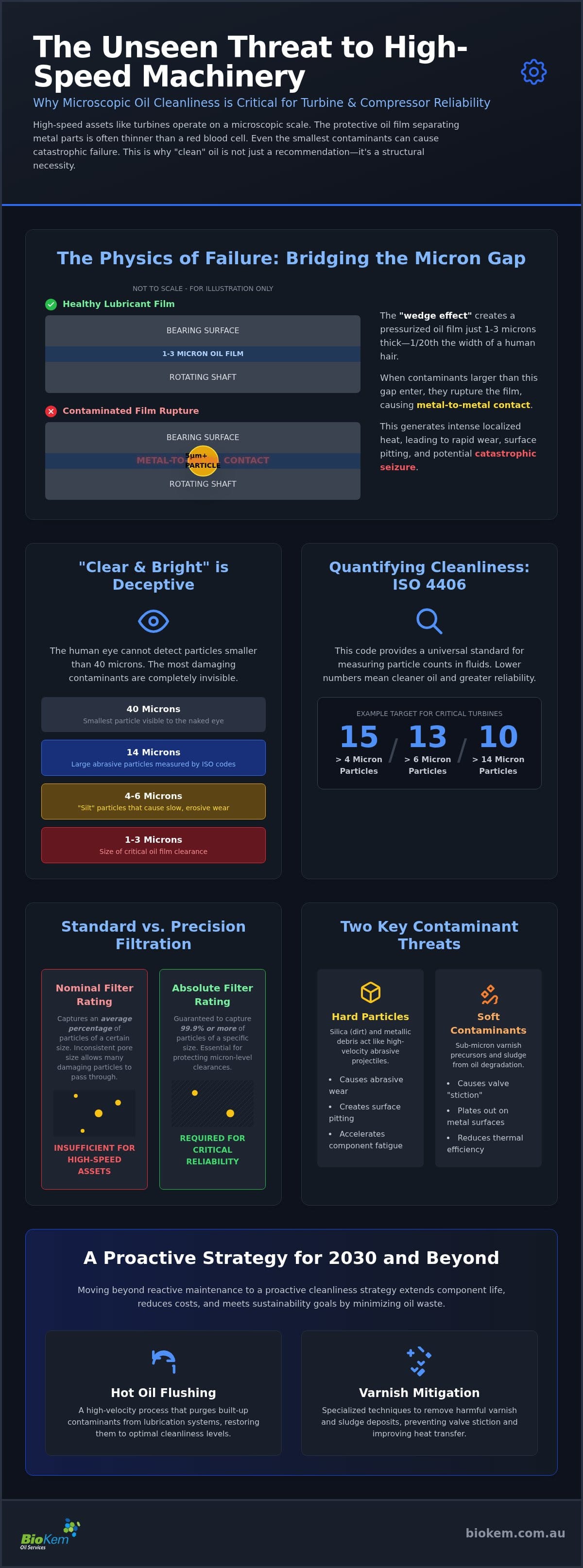
In high-precision systems, the lubricant film thickness is often as thin as 1 to 3 microns. When microscopic contaminants enter this space, they bridge the gap between the stationary and rotating components, leading to fluid film rupture. Once the film breaks, the resulting metal-to-metal contact creates localized heat spikes that can trigger rapid thermal runaway. Elasto-hydrodynamic lubrication refers to the process where high pressure in the contact zone causes metal surfaces to elastically deform and lubricant viscosity to increase, maintaining a protective layer under extreme rotational loads.
Centrifugal Force as a Contamination Catalyst
Rotation speeds exceeding 10,000 RPM introduce intense centrifugal forces that dictate how contaminants behave within the system. Unlike low-speed machinery where particles might remain suspended, high-speed assets sling heavier hard particles toward the outer diameter of the flow path. This concentrates debris directly against critical bearing surfaces. The increased kinetic energy turns microscopic grains of silica or metal into high-velocity abrasive projectiles, causing rapid surface pitting. Clean oil maintains the chemical stability required to withstand this shear stress without prematurely separating additives from the base stock.
Looking toward 2026, the industrial shift toward higher power densities means modern turbines are smaller, faster, and more sensitive than their predecessors. These tighter tolerances leave no room for error. Utilizing high-performance Filters S.p.A. products and regular hot oil flushing is no longer an optional maintenance task; it’s a structural requirement for asset survival. Understanding why clean oil actulally matters in high speed rotational assets is the first step in ensuring these precision machines reach their intended 2030 operational lifespan.
Micro-Contamination: The Invisible Enemy of Precision Tolerances
Visual inspection often fails the modern engineer. While “clear and bright” oil is a common field metric, it’s dangerously insufficient for high-speed machinery. The human eye cannot detect particles smaller than 40 microns, yet the critical clearances in your turbine bearings are frequently less than 3 microns. This invisible micro-contamination is precisely why clean oil actulally matters in high speed rotational assets. When 1-3 micron “silt” accumulates, it acts as a polishing paste, slowly eroding the precision tolerances of high-pressure hydraulic control systems.
Standardization is key to managing this invisible threat. Reliability teams must look to ISO 4406 oil cleanliness codes to quantify risk accurately. As we move toward 2026 reliability standards, critical assets increasingly require cleanliness levels of 15/13/10 or better. These codes represent the quantity of particles at the 4, 6, and 14-micron levels. Maintaining these stringent levels ensures that even the smallest abrasive elements are removed before they cause subsurface fatigue or catastrophic component failure.
Hard Particles vs. Soft Contaminants
It’s vital to distinguish between hard silica or metallic debris and soft contaminants like varnish precursors. While hard particles cause abrasive wear, soft contaminants are responsible for “stiction” in high-speed governor valves. These precursors are sub-micron in size and often bypass standard filters. Over time, they plate out on metal surfaces, leading to the sticky residue that causes unscheduled turbine trips. Implementing a dedicated varnish mitigation program is the only way to arrest this chemical degradation before it compromises operational availability.
Water and Aeration in High-Speed Systems
Contamination isn’t limited to solids. Moisture and air are equally destructive in high-RPM environments. Micro-bubbles circulating through high-speed oil pumps cause cavitation, where the sudden collapse of bubbles creates localized shockwaves that pit metal surfaces. Simultaneously, dissolved water reduces the load-carrying capacity of the lubricant film, increasing the risk of the film rupture discussed in the previous section. The 2026 approach to moisture control involves advanced vacuum dehydration, especially for sensitive EHC fluids. For those looking to verify their current fluid health, BioKem Oil Services offers comprehensive oil analysis and ferrogram services to identify these hidden risks early.
Beyond Standard Filtration: Why Conventional Methods Fail High-Speed Assets
Relying on standard filtration for a high-speed turbine is a significant operational risk. Most off-the-shelf filters use nominal ratings, which only indicate a percentage efficiency at a specific micron size. For precision assets, a 10-micron nominal filter is insufficient because it allows a large volume of the most damaging particles to pass through. This is why clean oil actulally matters in high speed rotational assets; you need absolute-rated media with high Beta ratios to ensure consistent fluid purity. An absolute rating signifies that the filter will capture 99.9% of particles at the specified micron size, providing the predictable performance required for critical machinery.
The shift from traditional cellulose media to high-density synthetic micro-glass represents a vital evolution in lubricant maintenance. Cellulose fibers are inconsistent in size and tend to swell when exposed to moisture, which restricts flow and reduces efficiency. In contrast, synthetic micro-glass offers uniform pore structures and superior dirt-holding capacity. Utilizing Filters S.p.A. products ensures that high-flow systems maintain low differential pressure while capturing the fine silt that conventional filters ignore. This specialized media is essential for managing the high-velocity fluid streams found in modern industrial gearboxes and compressors.
The Limits of On-Machine Filtration
On-machine filters provided by OEMs are typically designed as “last chance” protection to prevent catastrophic failure from large debris. They aren’t intended to “polish” the oil to the ultra-clean ISO codes required for long-term reliability. High flow rates in turbines can also cause “element pleat bunching” in low-quality filters. This occurs when the pressure forces the filter folds together, effectively bypassing the media and allowing contaminants to circulate freely. Implementing kidney-loop filtration allows for continuous, low-pressure polishing that maintains the oil at peak performance levels without taxing the primary lubrication pump.
Varnish Precursors and the Solubility Gap
Standard mechanical filtration is fundamentally incapable of trapping dissolved varnish precursors. These contaminants exist in a state of temperature-dependent solubility. When the oil is hot, these soft contaminants remain dissolved and invisible to standard filters. As the oil cools in stagnant areas or during shutdowns, the varnish precipitates out and plates onto surfaces. To combat this, specialized resins and electrostatic separators are required to “strip” these precursors from the fluid before they can form solid deposits. This proactive approach is a cornerstone of understanding why clean oil actulally matters in high speed rotational assets, moving beyond simple particle removal to total fluid chemistry management.
Implementing a Proactive Oil Cleanliness Strategy for Maximum Reliability
Transitioning from the theoretical physics of lubrication to a functional maintenance framework requires a commitment to the “Clean, Cool, and Dry” philosophy. This strategy begins with establishing baseline targets that reflect the specific RPM and criticality of the asset. A turbine operating at 12,000 RPM requires far more stringent thresholds than a standard industrial gearbox. BioKem Oil Services facilitates this transition by implementing rigorous oil analysis to track these baselines over time. This data-driven approach is exactly why clean oil actulally matters in high speed rotational assets; it transforms raw data into actionable intelligence, allowing for corrective interventions before microscopic wear translates into a system-wide failure.
The Role of Hot Oil Flushing in System Resets
When high-speed systems undergo commissioning or recover from a significant contamination event, a standard fluid change is insufficient. BioKem Oil Services utilizes hot oil flushing to address the internal pipework where debris typically settles. This process leverages the “Turbulent Flow” principle, ensuring the fluid’s Reynolds Number is high enough to scour the internal walls of the lubrication circuit and dislodge silt trapped in stagnant zones. By utilizing paddle flushing screens, technicians can physically verify the removal of contaminants, providing a clean baseline for the asset’s next operational cycle.
Condition Monitoring: The Digital Twin of Oil Health
Modern reliability strategies are shifting toward a “digital twin” approach, where real-time particle counting is integrated with sophisticated lab-based ferrogram analysis. Looking toward 2026, AI-driven monitoring will increasingly identify shifts in particle morphology to predict degradation long before it manifests as abnormal vibration data. This continuous oversight reinforces why clean oil actulally matters in high speed rotational assets by providing a live health status of the lubricant’s structural integrity. To ensure these strategies are executed with precision, it’s vital to partner with specialists like BioKem Oil Services who can perform the necessary flushing and analysis to maintain peak system health.
BioKem’s Precision Solutions: Engineering Cleanliness for Australian Industry
BioKem operates as the authoritative partner for Australian industrial sectors requiring precision fluid management. Our approach moves beyond simple maintenance by treating lubricants as critical assets that demand specialized care. Understanding why clean oil actulally matters in high speed rotational assets allows us to design interventions that address the root causes of mechanical wear. By maintaining ultra-low ISO cleanliness codes, we ensure that your high-speed turbines and compressors operate at peak thermal efficiency while avoiding the catastrophic costs of premature failure.
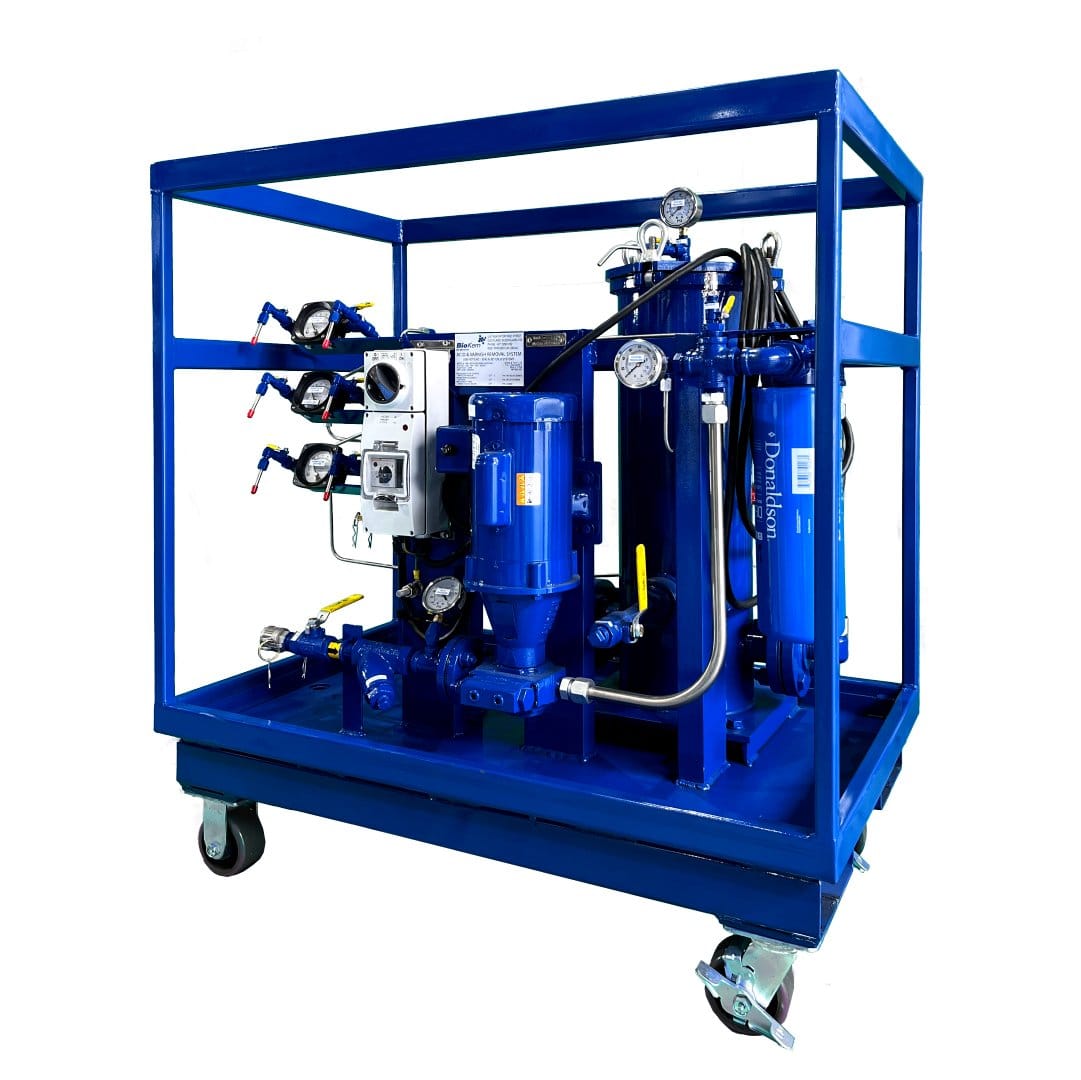
As the sole Australian distributor for Filters S.p.A. products, we provide access to world-class filtration technology designed specifically for high-flow, high-stress environments. These products offer the absolute-rated performance necessary to trap the sub-micron silt and varnish precursors discussed in previous sections. Utilizing these high-performance filters is a foundational step in closing the gap between standard operation and maximum reliability.
The economic case for oil life extension is as strong as the environmental one. Disposing of thousands of liters of contaminated oil is a significant waste of resources and a burden on corporate sustainability targets. Our onsite capabilities, including vacuum dehydration and varnish mitigation, allow us to restore fluid to as-new condition. This circular approach helps facilities meet their 2030 environmental targets while significantly reducing the total cost of ownership. The reality of why clean oil actulally matters in high speed rotational assets is found in the years of trouble-free operation following a BioKem intervention.
National Service Excellence
We deploy specialized technicians and advanced machinery across Australia to handle the most complex industrial projects. Whether it’s a planned shutdown or an emergency intervention, our team provides customized maintenance packages for turbines, centrifugal compressors, and high-pressure hydraulic systems. We ensure every project complies with the latest international reliability standards, providing the localized expertise needed to navigate regional regulatory requirements and environmental conditions.
Closing the Loop on Reliability
BioKem’s value lies in our ability to close the loop between analysis and corrective action. While analysis identifies the problem, our physical services, such as large-scale hot oil flushing, deliver the solution. For teams managing their own maintenance, we offer flexible equipment hire options for emergency filtration and planned outages. We invite you to contact our technical team for a consultation to discuss the specific cleanliness requirements of your high-speed assets and how we can extend their operational lifespan through precision engineering.
Securing the Future of High-Speed Industrial Assets
Preserving the operational integrity of turbines and compressors requires a shift from standard filtration to precision fluid engineering. We’ve explored how microscopic cleanliness maintains the vital lubricant film and why absolute-rated media is essential to stop sub-micron silt from eroding precision tolerances. Understanding why clean oil actulally matters in high speed rotational assets transforms your maintenance approach from reactive repair to a strategic reliability program. By prioritizing ISO cleanliness targets, you extend the life of your machinery toward 2030 while significantly reducing environmental waste through oil life extension.
BioKem stands as a reliable partner in this transition. As the sole Australian distributor for Filters S.p.A., we combine world-class hardware with specialist varnish mitigation systems and certified hot oil flushing technicians. Our team provides the technical expertise needed to close the loop between analysis and corrective action; this ensures your critical assets remain resilient under extreme stress. Protect your high-speed assets with BioKem’s specialist oil services and secure the long-term efficiency of your industrial operations. We look forward to helping you achieve a cleaner, more reliable future.
Frequently Asked Questions
What is the difference between standard filtration and oil polishing?
Standard filtration is designed to remove larger debris that could cause immediate mechanical failure. Oil polishing goes deeper by targeting sub-micron contaminants and silt that standard OEM filters often miss. This process typically uses kidney-loop systems and high-density synthetic media to reach the ultra-clean ISO codes required for high-speed precision assets.
How often should I perform hot oil flushing on a high-speed turbine?
Hot oil flushing is usually a corrective or commissioning action rather than a calendar-based task. You should perform it during initial system starts, after major overhauls, or when oil analysis reveals significant internal pipework contamination. It’s the most effective way to reset the system’s baseline cleanliness by dislodging trapped silt through turbulent flow.
Why does my oil analysis show high varnish potential even if the oil is new?
New oil can pick up residual varnish and chemical precursors left behind in the pipework and reservoir from the previous batch. This phenomenon is a primary reason why clean oil actulally matters in high speed rotational assets; fresh fluid isn’t always pure fluid. We recommend a system flush or varnish mitigation during oil changes to ensure the new charge remains stable.
Can clean oil actually reduce vibration levels in rotating equipment?
Yes, maintaining high oil purity can directly lead to lower vibration levels by preserving the integrity of the lubricant film. When microscopic particles bridge the gap in high-speed bearings, they cause surface pitting and irregular clearances. These mechanical defects manifest as increased vibration, which clean oil prevents by ensuring smooth, metal-to-metal separation.
What ISO 4406 code is recommended for a high-speed centrifugal compressor?
Reliability standards for high-speed centrifugal compressors generally demand an ISO 4406 code of 15/13/10 or better. Reaching these levels ensures that the 4, 6, and 14-micron particle counts are low enough to protect precision bearings and seals. Consistently meeting these targets is essential for preventing subsurface fatigue and maintaining the pressurized oil wedge at high RPMs.
How does water contamination specifically affect high-speed bearings?
Water reduces the load-carrying capacity of the oil film, leading to film rupture and metal contact. In high-speed environments, dissolved water also causes micro-cavitation and hydrogen embrittlement, which can lead to sudden bearing failure. Utilizing vacuum dehydration is the most effective way to remove both free and dissolved water from these sensitive lubrication circuits.
Does BioKem provide onsite oil analysis services across Australia?
BioKem provides comprehensive onsite oil analysis and specialized ferrogram services throughout Australia. Our technicians use advanced equipment to identify wear debris and chemical degradation in real-time. This localized expertise allows industrial operators to make immediate decisions regarding hot oil flushing or varnish mitigation without waiting weeks for external lab results.
Is it more cost-effective to clean oil or replace it in 2026?
Cleaning oil is significantly more cost-effective and environmentally responsible than replacement as we move toward 2026 sustainability standards. Purifying fluid via varnish mitigation and vacuum dehydration avoids high disposal fees and the rising cost of new synthetic lubricants. This proactive approach demonstrates why clean oil actulally matters in high speed rotational assets by maximizing fluid life and reducing total cost of ownership.