

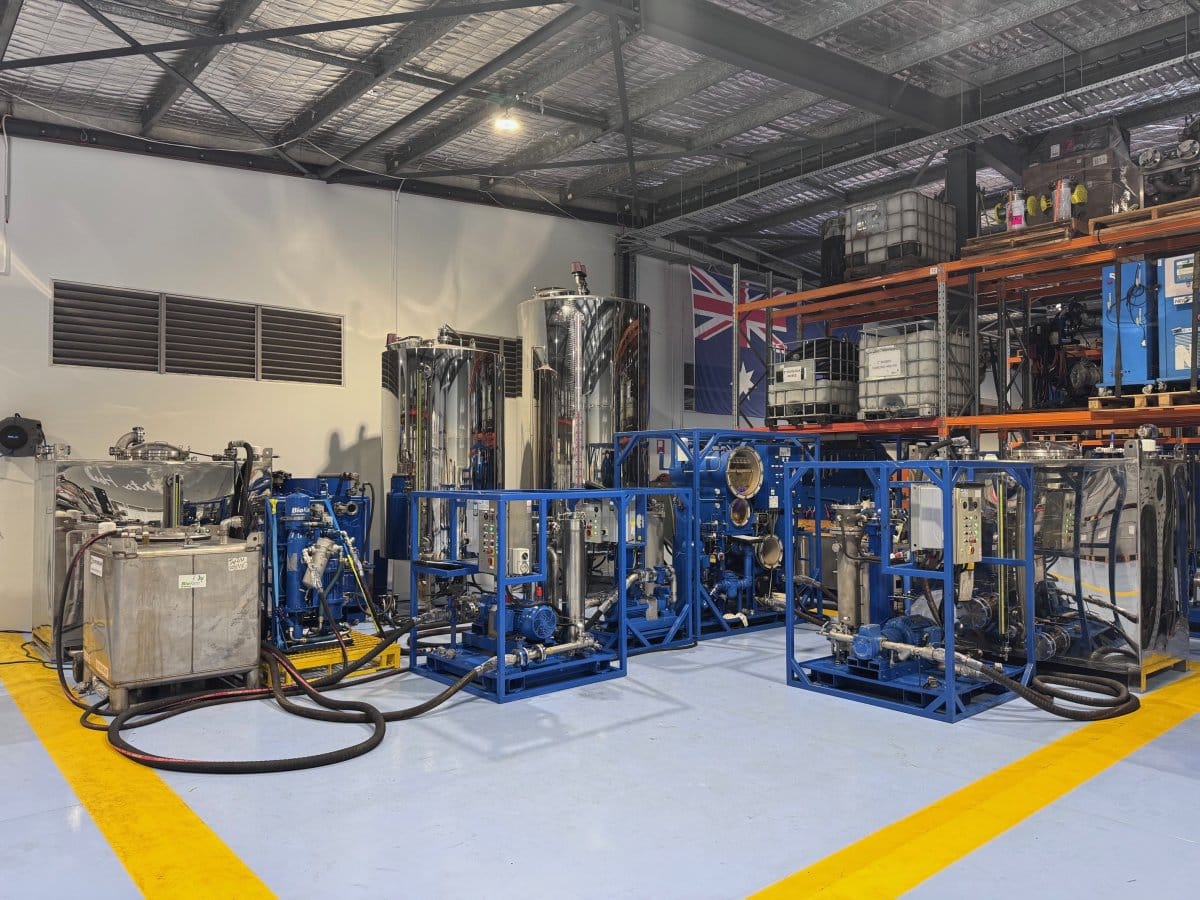
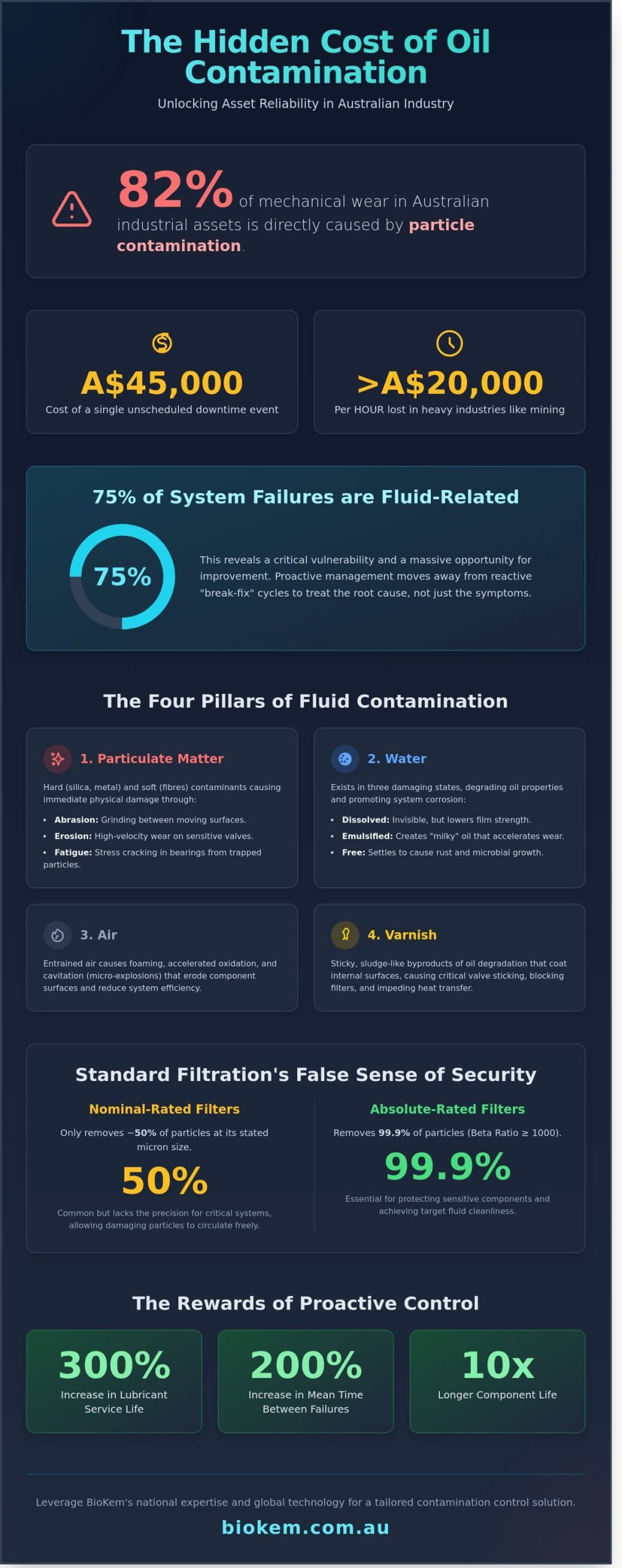
Did you know that 82% of mechanical wear in Australian industrial assets is directly caused by particle contamination? For many maintenance managers, the reality of oil contamination control is a constant battle against A$45,000 unscheduled downtime events and the persistent frustration of varnish-related valve sticking in critical turbines. It’s a costly cycle that often results in premature oil changes and unnecessary waste.
You likely know that fluid health is the lifeblood of your machinery, yet standard filtration often fails to address the root causes of hydrocarbon degradation. This guide empowers you to master the technical frameworks required to eliminate fluid-borne wear and extend the life of your critical assets. We will detail how to verify oil cleanliness to ISO 4406 standards, implement proactive moisture management, and significantly reduce your environmental footprint by extending lubricant service life by up to 300%.
Key Takeaways
- Understand why 75% of system failures are fluid-related and how proactive management extends the lifecycle of critical Australian industrial assets.
- Master the technical pillars of oil contamination control to effectively identify and mitigate the risks posed by particulates, water, air, and varnish.
- Transition from outdated visual inspections to the ISO 4406:2021 standard for precise, data-driven fluid analysis and cleanliness verification.
- Implement a robust two-stage strategy focusing on contamination exclusion through advanced breathers and high-precision removal via specialized filtration.
- Leverage BioKem Oil Services’ local technical expertise and exclusive access to global Filters S.p.A. technology for onsite purification and scheduled outage support.
Table of Contents
- Understanding Oil Contamination Control in Industrial Systems
- The Four Pillars of Fluid Contamination: Particulate, Water, Air, and Varnish
- Measuring Success: ISO 4406 and Fluid Analysis
- Implementing a Proactive Contamination Control Strategy
- The BioKem Approach: National Expertise and Global Technology
Understanding Oil Contamination Control in Industrial Systems
Effective oil contamination control represents the proactive management of fluid cleanliness levels to ensure industrial machinery operates at peak efficiency. It’s a fundamental shift in how we view lubricants. They’re no longer just consumables; they’re vital components of the machine itself. Industry data from Noria Corporation indicates that 75% of hydraulic and lubrication system failures are contamination-related. This statistic highlights a massive opportunity for operational improvement. Australian site managers are increasingly moving away from reactive “break-fix” cycles. They’re adopting reliability-centred maintenance (RCM) protocols that treat the root cause of wear rather than just the symptoms. This transition is essential for meeting modern ESG targets. By extending oil life and reducing component turnover, facilities significantly lower their environmental footprint and comply with tightening Australian environmental regulations. Contamination control serves as the technical foundation for these sustainability efforts.
The Financial Impact of Fluid Neglect
The financial consequences of fluid neglect are often underestimated. In Australian heavy industries like mining or Tier 1 manufacturing, the true cost of unplanned downtime often exceeds A$20,000 per hour. This figure includes A$280 per hour for emergency technician labor and the high cost of replacement parts sourced on short notice. Contamination accelerates component degradation through three primary mechanisms:
While proactive maintenance is the first line of defence against these physical failures, managing the significant financial exposure is a parallel business challenge. To explore comprehensive protection against these high-stakes operational risks, you can discover AllCover Insurance Brokers.
- Abrasion: Hard particles like silica or metal shavings grind between moving surfaces.
- Erosion: Fine silt at high velocity wears down sensitive valve orifices and pump vanes.
- Fatigue: Particles trapped in bearing raceways cause localized stress and surface cracking.
Systemic reliability is the operational state where fluid cleanliness is maintained at levels that prevent the initiation of these wear modes across the entire machine circuit. When a system reaches this state, the mean time between failures (MTBF) typically increases by over 200%.
Why Standard Filtration Often Fails
Standard filtration setups often provide a false sense of security. Nominal-rated filters are common but lack precision; they might only remove 50% of particles at their specified micron rating. Absolute-rated elements are necessary for critical systems because they provide a Beta ratio of 1000 or higher, ensuring 99.9% efficiency. Another hidden danger is the filter bypass valve. During cold starts or high-pressure surges, these valves open to protect the filter housing, but they allow raw, contaminated oil to bypass the media entirely. This often goes unnoticed during routine checks because the machine continues to run. Managers must prioritize total system cleanliness over simple component protection. Oil contamination control requires implementing off-line filtration or “kidney loop” systems that constantly scrub the oil, even when the main system is idle. This approach ensures that microscopic “silt” build-up, which standard 10-micron filters miss, doesn’t accumulate and cause silent damage to sensitive proportional valves.
The Four Pillars of Fluid Contamination: Particulate, Water, Air, and Varnish
Oil degradation isn’t a single event; it’s a cumulative process driven by four distinct categories of contaminants. Managers who master oil contamination control can extend component life by up to 10 times, significantly reducing the A$20,000 or more typically spent on unplanned pump replacements. These contaminants work in tandem to degrade the lubricant’s chemical properties and the machine’s physical surfaces.
Particulate matter consists of hard and soft materials. Hard contaminants, such as silica or metallic wear debris, cause immediate physical damage. Soft contaminants, including fibres and elastomers, often originate from seals or external ingress. While they don’t always cause immediate abrasion, they’re primary contributors to filter plugging and additive depletion.
Particulate Wear Mechanisms
Abrasive wear occurs when small particles act as a grinding paste between moving surfaces, stripping away protective layers. Surface fatigue is caused by repeated particle impingement on bearings, leading to micro-cracking and eventual spalling. Particles sized between 1 and 5 microns are particularly lethal. These clearance-sized particles enter the tightest gaps in hydraulic pumps. They bridge the lubricant film, causing catastrophic failure without warning. In Australian mining operations, data from 2023 indicates that 75% of hydraulic failures were directly linked to particulate levels exceeding ISO 4406 cleanliness codes standards.
Water exists in three states: dissolved, emulsified, and free. Dissolved water is invisible at low concentrations. Once the oil reaches its saturation point, water becomes emulsified, giving the fluid a milky appearance. Free water eventually settles at the bottom of reservoirs. All three states accelerate oxidation and promote microbial growth. While industrial standards focus on internal machine health, businesses must also align with international benchmarks like the EPA oil spill prevention regulations to ensure external environmental safety and regulatory compliance.
The challenge of removing unwanted substances like water from oil highlights a broader principle in fluid management: the need for specialized filtration to target specific contaminants. This is just as true for ensuring the safety of residential water supplies, where different contaminants like PFAS and microplastics are a concern. For those interested in how advanced filtration is applied in this context, you can learn more about Tradewinds Water Filtration.
This principle of specialized management extends to other demanding contexts, such as the marine industry, where understanding foundational terminology is the first step to proper equipment handling. For a helpful primer on this topic, see bivo.com.au.
Entrained air is a common issue in high-flow systems, especially those with undersized reservoirs. It reduces the oil’s bulk modulus and destroys film strength, leading to metal-to-metal contact. When air bubbles are compressed in high-pressure zones, they generate heat through micro-dieseling. This process rapidly oxidises the fluid, turning a healthy oil charge into a degraded liability. This thermal stress is a precursor to the most difficult contaminant to manage: varnish.
The Chemistry of Oil Varnish
Varnish is the silent killer of modern high-speed turbines and precision hydraulic systems. It forms when oil molecules break down through thermal degradation and oxidation, creating insoluble polar compounds. These compounds remain in suspension while the oil is hot but plate out onto cooler surfaces when the system rests. This residue coats servo valves, clogs heat exchangers, and reduces bearing clearances. Varnish is notoriously difficult to remove via standard mechanical filtration. Implementing a dedicated varnish removal system is a critical mitigation technology for any facility operating critical assets.
This focus on preventing chemical degradation through precision finds parallels in other industries focused on quality. For example, premier specialty coffee roasters like Caffeine Lab meticulously control the roasting process to prevent the degradation of flavour compounds, ensuring a high-quality result through technical expertise.
Effective oil contamination control requires a proactive stance rather than a reactive one. By identifying these four pillars early, managers can prevent the chemical “death spiral” that leads to total fluid failure. If you’re seeing signs of cloudiness or valve stickiness, it’s time to consult with a specialist to restore your fluid’s integrity.
Measuring Success: ISO 4406 and Fluid Analysis
Effective oil contamination control relies on empirical data rather than subjective visual inspection. The traditional “Clear and Bright” standard is a relic of 20th-century maintenance. It fails to detect particles smaller than 40 microns, which is the lower limit of human vision. Modern hydraulic components and high-pressure systems often have internal clearances as tight as 1 to 5 microns. Relying on the naked eye means missing the silt-sized particles that cause 80 percent of mechanical wear. Managers must adopt quantitative metrics to protect high-value assets and reduce environmental waste caused by premature oil changes.
Interpreting ISO 4406 Cleanliness Codes
The ISO 4406 cleanliness codes standard uses a three-tier code to represent the number of particles per millilitre at 4µm, 6µm, and 14µm. For example, a code of 18/16/13 indicates a specific concentration range for each size category. Each increment in the code represents a doubling of the particle count per millilitre. Because the ISO scale is logarithmic, a seemingly small numerical shift represents a massive change in the physical reality of the fluid’s cleanliness. Setting a Target Cleanliness Level (TCL) is essential for operational longevity.
- High-Pressure Hydraulics: Target a TCL of 16/14/11 to prevent valve stiction and pump cavitation.
- Industrial Gearboxes: A TCL of 18/16/13 is generally acceptable for heavy-duty drives in mining or manufacturing.
- New Oil Delivery: Fresh oil from a drum often arrives at 21/19/16, which is significantly dirtier than the requirements of modern machinery.
Onsite Testing and Sampling Techniques
Data accuracy depends entirely on sampling quality. Taking a sample from a “dead leg” or the bottom of a reservoir provides misleading results that don’t reflect the oil in circulation. Technicians should pull samples from “live zones” where oil is turbulent, such as a primary return line or a dedicated sampling port. For immediate visual verification, many Australian sites utilise patch test kits. These kits provide a baseline for varnish and particulate matter before the sample is even packed for the laboratory.
For high-frequency monitoring, the Particle Pal range offers real-time digital data directly in the field. This technology allows maintenance teams to identify contamination spikes within seconds, rather than waiting 7 to 10 days for external lab results. It enables proactive oil contamination control during critical operations, ensuring that filtration systems are functioning at peak efficiency before a component fails.
Beyond simple particle counting, chemical health markers determine the fluid’s remaining life. The Total Acid Number (TAN) tracks oxidation levels, while the Remaining Useful Life Evaluation Routine (RULER) measures specific antioxidant concentrations. For turbine operators, Membrane Patch Colorimetry (MPC) is essential for quantifying varnish potential, which is a leading cause of unplanned shutdowns in Australian power generation facilities. Integrating these chemical markers into a monthly reporting cycle ensures compliance with environmental standards and extends the lifespan of the lubricant, directly reducing the facility’s total carbon footprint.
Implementing a Proactive Contamination Control Strategy
Effective oil contamination control requires a shift from reactive maintenance to a disciplined, four-step engineering strategy. Industrial operations in Australia that adopt proactive fluid management often see a 35% reduction in unplanned downtime within the first 12 months. This approach focuses on the lifecycle of the lubricant, ensuring it remains within specified cleanliness limits from the moment it arrives on-site until it’s eventually recycled.
- Step 1: Contamination Exclusion. It’s significantly cheaper to keep a particle out than to remove it later. High-quality seals and desiccant breathers act as the first line of defence, blocking moisture and silica at the point of entry.
- Step 2: Contamination Removal. Even with the best exclusion methods, internal wear generates debris. Selecting filtration systems with the correct Beta ratio ensures that particles are captured before they reach critical clearances in pumps or valves.
- Step 3: Verification. You can’t manage what you don’t measure. Establishing a monthly or quarterly sampling schedule allows managers to track ISO 4406 cleanliness codes and identify abnormal wear patterns early.
- Step 4: Training. Human error accounts for a large portion of fluid ingress. Training site personnel on proper decanting techniques and the use of dedicated transfer containers prevents cross-contamination between different oil types.
Advanced Removal: Hot Oil Flushing and Dehydration
During the commissioning of new hydraulic systems, “built-in” contaminants like welding slag and casting sand pose an immediate threat to sensitive components. Managers should utilise hot oil flushing to achieve turbulent flow conditions, which dislodges stubborn particles that standard filtration misses. For systems struggling with moisture, vacuum dehydration remains the gold standard. It removes dissolved, emulsified, and free water by lowering the boiling point of water within the oil, preserving the chemical integrity of the lubricant without heat damage.
Contamination Exclusion Techniques
Upgrading to desiccant breathers is a cost-effective way to manage the ingress of Australian dust and high humidity. These units use silica gel to strip moisture from incoming air, preventing the hydrolysis of additives. Furthermore, implementing closed-loop oil transfer systems ensures that “new” oil, which is often surprisingly dirty, is filtered before it enters the reservoir. To confirm the success of a cleaning cycle, paddle flushing screens provide a visual and physical verification of system cleanliness, capturing any remaining bypass debris during high-velocity flushes.
A proactive strategy isn’t just about technical hardware; it’s an investment in the longevity of the asset. By maintaining oil at an ISO 16/14/11 level rather than a standard 22/20/18, companies can extend the life of hydraulic components by up to four times. This reduces the frequency of component replacement and lowers the total cost of ownership for heavy machinery. Using biological-friendly filtration methods also aligns these operational gains with environmental compliance standards required in the Australian resource sector.
Consult with Biokem to develop a customised contamination control plan
The BioKem Approach: National Expertise and Global Technology
BioKem bridges the gap between international engineering innovation and local operational requirements. As the sole Australian distributor for Filters S.p.A., we bring Italian precision to the demanding environments of Australian heavy industry. This partnership ensures that local facilities access the same high-tier technology used in European power generation and petrochemical sectors without the logistical hurdles of international procurement. We don’t just supply parts; we integrate global standards into the Australian regulatory framework.
Effective oil contamination control requires a dual strategy of rapid response and long-term stability. BioKem provides onsite technical interventions tailored to specific site conditions. During a 2023 emergency purification project at a Queensland power station, BioKem technicians restored turbine oil to ISO 4406 cleanliness standards within 48 hours. This intervention prevented an estimated A$250,000 in daily production losses. Whether it’s a critical emergency or a 12-month scheduled outage, our mobile units deploy rapidly to maintain system integrity.
Facility managers often weigh the benefits of equipment hire against comprehensive service contracts. Hire models suit short-term remediation or trial phases. However, 82% of our long-term partners choose service contracts. These agreements embed BioKem’s technical expertise into the facility’s maintenance schedule. This model ensures consistent fluid performance and shifts the responsibility of compliance and equipment maintenance to our specialists, allowing your internal teams to focus on core production. For managers evaluating the strategic benefits of industrial oil filtration equipment hire versus purchase decisions, understanding the technical specifications and deployment flexibility becomes crucial for maintaining ISO 4406 cleanliness targets without long-term capital commitments.
Our commitment to nature-based solutions sets a new benchmark for environmental compliance in Australia. Traditional chemical flushes often create secondary waste streams that are difficult and expensive to treat. BioKem utilizes microbial technology to break down hydrocarbons at the molecular level. This biological approach reduces the environmental footprint of industrial cleaning by 65% compared to solvent-based methods, aligning your operations with modern ESG (Environmental, Social, and Governance) requirements.
Specialised Filtration Hardware
BioKem provides high-performance Swift Filters designed for critical applications where microscopic particles cause catastrophic failure. We design custom-engineered filtration skids that handle flow rates from 10 to 2,200 liters per minute. Accessing these world-class oil filtration systems in Australia means shorter lead times and local technical support that understands AS 1940-2017 standards for storage and handling. Our hardware is built to survive the heat and dust of the Pilbara or the humidity of North Queensland.
Partnering for Long-Term Asset Health
Proactive oil contamination control delivers measurable financial returns that far outweigh the cost of implementation. A Western Australian mining client reduced hydraulic component failures by 38% over an 18-month period by implementing a BioKem-managed filtration program. We begin every partnership with a BioKem ‘Cleanliness Audit’. This process involves deep-level fluid analysis across national industrial sites to identify hidden risks before they trigger downtime. We provide a clear roadmap for fluid recovery and maintenance that extends asset life by up to 50%.
Ready to protect your infrastructure? Contact BioKem today for a comprehensive lubrication audit and ensure your facility meets the highest standards of cleanliness and efficiency.
Securing Industrial Reliability Through Proactive Fluid Management
Achieving peak operational efficiency requires more than just reactive maintenance. It demands a rigorous commitment to oil contamination control to mitigate the risks posed by particulates, water ingress, and varnish. By adhering to ISO 4406 standards and implementing proactive fluid analysis, Australian industrial operations can extend component life by up to 300% and significantly reduce unplanned downtime. This shift toward precision care isn’t just about saving money; it’s about ensuring the long-term health of your infrastructure, a principle that applies just as much to personal wellness as it does to industrial machinery. This holistic approach to well-being is expertly practiced by centers such as Battersea Park Clinic, which focuses on long-term health solutions.
BioKem provides the technical expertise and infrastructure needed to maintain these standards across the continent. As the sole Australian distributor for Filters S.p.A. and an ISO 9001 certified organisation, we deliver world-class filtration technology to the most demanding environments. Our national deployment capability ensures that even remote mining sites in the Pilbara receive the same high-tier service as metropolitan hubs. We’ve built our reputation on helping partners implement sustainable, technical solutions that protect both the bottom line and the environment. Your machinery deserves a precision-engineered future.
Request an Onsite Oil Cleanliness Audit from BioKem
Frequently Asked Questions
What is the most common source of oil contamination?
External ingress through breathers and seals accounts for 80% of all contaminants found in industrial systems. In the dry Australian outback, silica dust is particularly aggressive. It’s common for a single unsealed hatch to allow 5 grams of dust into a 1,000-litre tank every week. This abrasive material accelerates component wear and degrades the oil’s chemical integrity, necessitating robust exclusion strategies. The same principle applies on a different scale in HVAC systems, where experts like BulletProof Air focus on robust filtration and maintenance to protect equipment from airborne contaminants and ensure system efficiency.
How often should I perform an oil analysis for my hydraulic system?
Critical hydraulic systems require oil analysis every 500 operating hours or at 90 day intervals. This frequency helps you maintain strict oil contamination control by catching spikes in particle counts before they cause damage. For non-critical equipment, a 6-month schedule is often sufficient. Consistent testing allows managers to track wear trends and predict component failure with 85% accuracy based on metallurgical data.
Can I use standard filters to remove water from oil?
Standard particulate filters won’t remove dissolved water because they’re designed for solid debris. You’ll need specialized super-absorbent polymer filters or vacuum dehydration units to address moisture. When water levels exceed 200 parts per million, the risk of hydrogen embrittlement in bearings increases by 50%. Effective moisture management preserves the oil’s additive package and prevents the formation of corrosive acids.
What is the difference between ISO 4406 and NAS 1638?
ISO 4406 is the current international standard that reports particle counts at 4, 6, and 14 microns, whereas NAS 1638 is an older system that categorizes particles by total mass. While NAS 1638 was officially retired in 2001, it’s still used in some Australian legacy sectors. ISO 4406 provides a more precise representation of the fine silt that causes 90% of modern hydraulic valve failures.
Is new oil clean enough to put straight into my machine?
New oil is typically dirtier than what your machine requires, often arriving with an ISO 21/19/16 cleanliness rating. High-performance systems usually need a much cleaner 16/14/11 rating to operate reliably. We recommend pre-filtering all new oil through a 3-micron kidney loop system. This simple step can reduce initial wear rates by 60% and prevents the introduction of refinery scale or drum condensation.
How does varnish mitigation differ from standard oil filtration?
Standard filtration captures hard particles, but varnish mitigation removes the soft, sticky oxidation by-products that cause valve sticking. These sub-micron contaminants are too small for traditional 10-micron mechanical filters. Using electro-magnetic or resin-based technology prevents varnish from coating internal components. This process can lower operating temperatures by 5 degrees Celsius and significantly reduce the A$12,000 annual cost of unplanned downtime for a typical turbine.
What are the signs that my system needs a hot oil flush?
A hot oil flush is necessary when particle counts exceed your target ISO code by two levels despite routine filtration. If you’ve experienced a catastrophic pump failure, a flush is the only way to remove the 95% of debris trapped in the pipework. Look for a 15% drop in heat exchanger efficiency or visible sludge in the reservoir. These signs indicate that internal surfaces are fouled and require high-velocity turbulent cleaning.
Can contamination control really extend oil life indefinitely?
Rigorous oil contamination control won’t make oil last forever, but it can extend its service life by up to 500%. By keeping particles and moisture below critical thresholds, you prevent the catalytic reactions that cause oil to oxidize. Many Australian plants have successfully used the same hydraulic charge for over 10 years by combining high-efficiency filtration with regular chemical top-ups. This approach slashes lubricant procurement costs and supports environmental sustainability.