

A safety work method statement (SWMS) for tank cleaning is required in Australia when the work is classified as high-risk construction work. Even when a SWMS is not required, documented risk controls must address hazards under applicable WHS requirements, site procedures and contractor management systems.
Safe tank cleaning involves more than controlling entry. Chemicals, sludge and other waste need careful management, and cleaning results must be verified without confusing cleanliness with mechanical integrity. A clear plan links these practical controls to the worksite’s safety requirements.
This guide explains how to manage chemical exposure, waste containment and cleaning verification, and how confined-space permits and rescue arrangements fit into the process. It also covers Australian compliance considerations that shape a SWMS, including when high-pressure water jetting requires its own plan.
Key Takeaways
- Train workers in cleaning equipment and chemicals, and document controls for exposure, manual handling and work at height.
- Plan confined-space entry around permits, atmospheric monitoring and rescue arrangements, assessing tank work against AS 2865 and applicable WHS requirements.
- Determine whether the work is high-risk construction work; where it is, prepare a SWMS, and retain documented risk controls for the worksite.
- Consider BioKem Oil Services’ Hot Oil Flushing when the task involves flushing oil systems, with oil analysis available to assess fluid condition.
How Are Chemicals, Waste And Cleaning Results Controlled?
Tank-cleaning controls should connect worker protection, waste handling and measurable acceptance criteria. Training helps workers follow equipment and chemical procedures consistently.
Chemical handling and waste containment
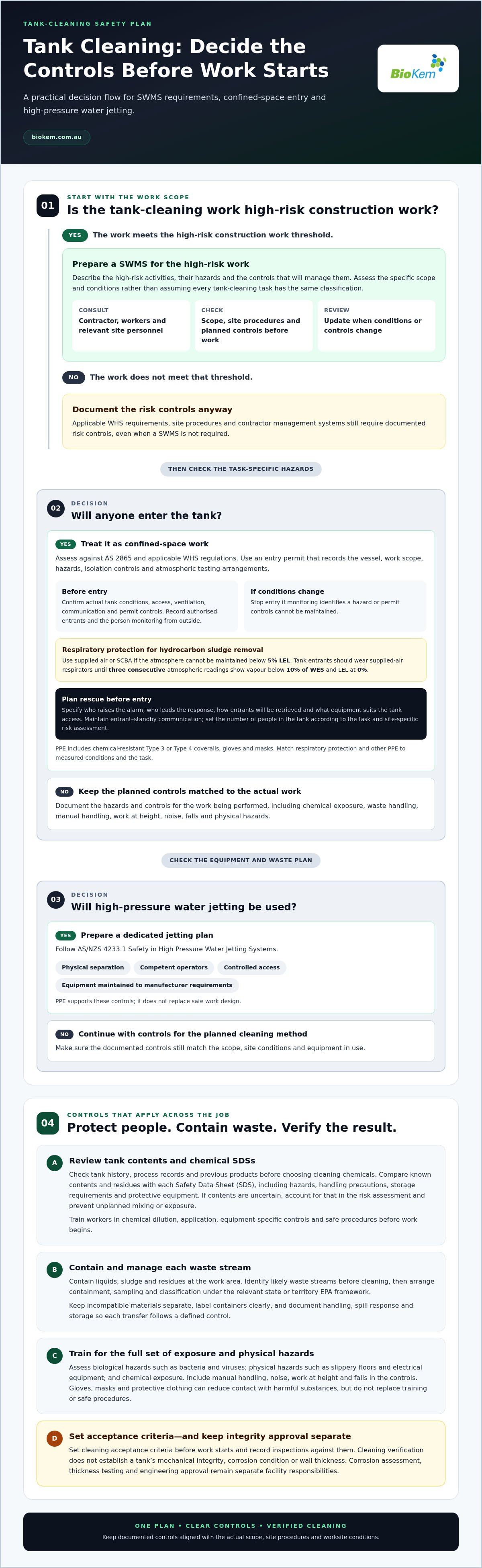
Contain liquids, sludge and residues at the work area to prevent them spreading. Identify likely waste streams before cleaning, then arrange containment, sampling and classification under the relevant state or territory EPA framework. Keep incompatible materials separate and label containers clearly. Document handling, spill response and storage arrangements so each transfer follows a defined control.
Tank contents and SDS review
Review tank history, process records and previous products before selecting cleaning chemicals. Compare known contents and residues with each chemical’s Safety Data Sheet (SDS), including its hazards, handling precautions, storage requirements and protective equipment. Train workers in dilution, application and equipment-specific controls before work begins. If contents are uncertain, account for that in the risk assessment and prevent unplanned mixing or exposure.
Training should also cover safe manual handling and work-at-height procedures. Assess biological hazards such as bacteria and viruses, physical hazards such as slippery floors and electrical equipment, and chemical exposure. Include controls for noise and falls from heights. Gloves, masks and protective clothing can reduce contact with harmful substances, but do not replace training or safe procedures.
Set cleaning acceptance criteria before work starts, then record inspections against them. Keep cleaning verification separate from mechanical-integrity approval: a clean tank does not establish its corrosion condition or wall thickness. Corrosion assessment, thickness testing and engineering approval remain separate facility responsibilities. This distinction prevents cleaning results from being treated as clearance for every operational purpose.
Confined-space entry permits and rescue arrangements
Storage tank cleaning involving entry is confined-space work under the model WHS Regulations. Assess the task against AS 2865 and applicable WHS regulations. PPE includes chemical-resistant Type 3 or Type 4 coveralls, gloves and masks. Use supplied-air respirators or SCBA if sludge removal conditions can’t maintain the atmosphere below 5% LEL.
Confined-space entry permits
The entry permit records the vessel, work scope, identified hazards, isolation controls and atmospheric testing arrangements. Before entry, confirm that the permit conditions match the tank’s actual state, including access, ventilation, communication and the work being performed. Record who is authorised to enter and who is monitoring from outside. Stop entry if conditions change, monitoring identifies a hazard or permit controls cannot be maintained.
Rescue arrangements and equipment
Plan rescue before entry, not after an incident. Specify in the rescue plan who raises the alarm, who leads the response, how entrants will be retrieved and what equipment suits the tank access. Maintain communication between entrants and the standby person. Set the number of people in the tank according to the task and site-specific risk assessment.
For hydrocarbon sludge removal, use supplied air or SCBA if the atmosphere can’t be maintained below 5% LEL. Tank entrants should wear supplied-air respirators until three consecutive atmospheric readings show vapour below 10% of WES and LEL at 0%. Match respiratory protection and other PPE to measured conditions and the task. Include rescue equipment checks and response steps in the pre-entry briefing. To discuss tank-cleaning requirements, talk with the team.
Australian workplace safety compliance
A SWMS is required when tank cleaning is high-risk construction work. Documented risk controls are still needed under applicable WHS requirements, site procedures and contractor management systems when a SWMS is not required.
High-risk construction work and SWMS
Whether a safety work method statement (SWMS) for tank cleaning is required depends on whether the specific work is classified as high-risk construction work. Assess the scope and conditions rather than assuming every tank-cleaning task has the same classification. If the work meets that threshold, describe the high-risk activities, their hazards and the controls that will manage them.
SWMS preparation, consultation and review
Prepare a safety work method statement (SWMS) for tank cleaning with input from the contractor carrying out the work, the workers performing it and relevant site personnel. Site procedures should specify who reviews the document, who authorises its use and who updates it when conditions or controls change.
Before work starts, compare the SWMS with the actual scope, site procedures and planned controls. An ISO 45001 system can retain evidence of contractor competency, risk controls, corrective actions and pre-start reviews, linking the written plan to worksite practice.
Align documented controls with site contractor-management requirements. Discuss tank-cleaning requirements.
BioKem Oil Services: Hot Oil Flushing
BioKem Oil Services provides Hot Oil Flushing for industrial oil systems. This may be a relevant next step when maintenance extends beyond tank cleaning to flushing an oil circuit. Keep the scopes distinct: tank-cleaning controls address vessel hazards and cleaning outcomes, while oil-system flushing addresses a separate maintenance task.
Oil Analysis can help assess oil condition as part of maintenance planning. If varnish or moisture is a concern, BioKem Oil Services also provides Varnish Mitigation and Vacuum Dehydration. The appropriate service depends on the system issue and maintenance objective.
For support with an oil-system maintenance requirement, contact BioKem Oil Services.
Turn Cleaning Outcomes Into the Next Maintenance Decision
Use the close of cleaning work to turn recorded outcomes into a clear maintenance decision. Keep tank-cleaning acceptance separate from assessments of connected oil systems, as each addresses a different operational question. This helps teams scope follow-on work and assign responsibilities before equipment returns to service.
A safety work method statement (SWMS) for tank cleaning should remain useful as site conditions or task controls change. Carry its practical control logic into planning for related maintenance, rather than treating documentation as an endpoint. BioKem Oil Services provides Hot Oil Flushing, Varnish Mitigation and Vacuum Dehydration for oil-system maintenance.
To discuss how an oil-service requirement fits your maintenance plan, contact BioKem Oil Services. A considered next step helps keep asset care moving forward.
Frequently Asked Questions
How Are Tanks Isolated And Made Safe For Cleaning?
Isolate the tank from product, connected pipework and electrical energy before cleaning begins. Valves alone may not provide positive isolation; blanks, spades, spectacle blinds or disconnected pipework may be needed to prevent product entering the vessel. Apply lockout/tagout procedures to electrical equipment. Record the isolation boundaries so the work team can identify which connections and energy sources are controlled.
How Does Safe Tank Cleaning Protect Planned Shutdowns?
Safe tank cleaning supports shutdown coordination by clarifying the work scope, access needs and handover points before work starts. For example, define when isolation must be complete, when cleaning can begin and what evidence the facility requires before restart. This helps operations and maintenance teams coordinate related tasks, identify schedule conflicts early and avoid treating cleaning completion as automatic approval to resume production.
What Must A Tank Cleaning Plan Establish Before Shutdown?
Before shutdown, define the tank and work boundaries, known contents, cleaning method and acceptance criteria. Assign responsibility for isolation, entry controls, waste decisions and restart sign-off. Identify interfaces with nearby work, such as shared pipework or access routes. This gives planners a practical basis for sequencing tasks and resolving dependencies before the vessel is taken out of service.
What Must Be Signed Off Before Production Restarts?
The facility’s authorised site representative should lead restart sign-off before product is introduced. The handover should confirm that cleaning acceptance criteria have been met, the work area is ready and relevant records are available. Keep this approval separate from mechanical-integrity decisions: cleaning verification does not certify corrosion condition or tank thickness. The facility remains responsible for those engineering assessments.
When Do Confined-Space And High-Pressure Controls Apply?
Apply confined-space controls when tank cleaning requires entry, assessing the work against AS 2865 and applicable WHS regulations. High-pressure water jetting needs a dedicated plan under AS/NZS 4233.1. If a task involves both tank entry and jetting, address the hazards together in the work plan, including access control, physical separation and operator competency.

Article by
James McAllister
James McAllister is an industry professional with BioKem Oil Services, specialising in lubrication reliability, oil filtration, contamination control and asset performance. Drawing on BioKem's extensive field experience across turbines, compressors, hydraulic systems and critical rotating equipment, James writes practical, insight-driven articles that help maintenance and reliability teams improve equipment performance, extend asset life and reduce operational risk.