


What if a single metric on a laboratory report could prevent an unplanned turbine outage costing upwards of $50,000 per day? For many reliability engineers, RPVOT – Understanding what this means is the difference between a controlled maintenance schedule and a catastrophic mechanical failure. You likely recognize that turbine oil is the lifeblood of your high-value assets, yet the chemical complexities of oxidation often remain obscured by dense technical jargon. It’s frustrating to face the high costs of premature oil replacement simply because a test result is difficult to interpret.
This article provides a clear path to mastering the Rotating Pressure Vessel Oxidation Test, enabling you to predict oil end-of-life with scientific precision. We will examine the current ASTM D2272-22 standards and the 22% reproducibility factor that defines modern testing accuracy. By the end of this guide, you’ll have the technical justification needed to implement proactive solutions like varnish mitigation or hot oil flushing. This approach ensures your lubricants remain functional while reducing environmental waste through strategic oil life extension.
Key Takeaways
- Identify the chemical stability of turbine lubricants by using RPVOT as a predictive tool for oxidation resistance and asset protection.
- Master the transition from raw lab data to actionable insights through RPVOT – Understanding what this means for calculating the remaining useful life of your oil.
- Learn why the ASTM D2272 test procedure uses high temperatures and copper catalysts to simulate years of service in a controlled laboratory environment.
- Recognize the necessity of integrating RPVOT with Membrane Patch Colorimetry (MPC) to gain a complete profile of both oxidation stability and varnish potential.
- Reduce environmental waste and operational costs by using oxidation data to justify targeted onsite solutions such as varnish mitigation or hot oil flushing.
What is RPVOT? Defining the Rotating Pressure Vessel Oxidation Test
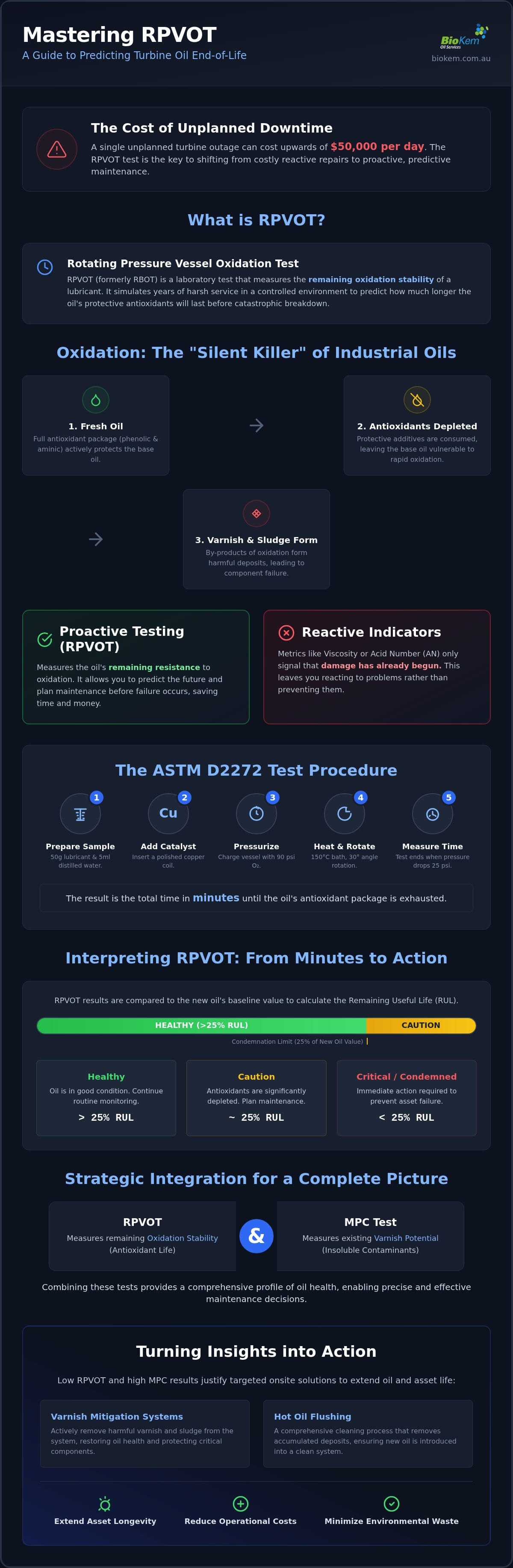
RPVOT, or the Rotating Pressure Vessel Oxidation Test, serves as a critical diagnostic tool for industrial maintenance. Formerly known as the Rotating Bomb Oxidation Test (RBOT), this method evaluates the chemical stability of a Lubricant under extreme stress. It’s a fundamental component of proactive asset management. RPVOT is a measure of a lubricant’s remaining oxidative induction time. For reliability teams, RPVOT – Understanding what this means provides a clear window into the future health of their machinery.
Oxidation is the “silent killer” of industrial oils. This chemical degradation occurs when oxygen molecules react with the base oil, leading to a permanent change in molecular structure. To combat this, modern formulations rely on a complex package of antioxidants, primarily phenolic and aminic compounds. These additives act as sacrificial shields. They neutralize free radicals and prevent the chain reaction of oil breakdown. Once these antioxidants are depleted, the oil’s resistance collapses, leading to the formation of sludge and varnish.
The Difference Between Proactive and Reactive Testing
Traditional oil analysis often focuses on reactive indicators like viscosity changes or a rise in the Acid Number (AN). While these metrics are useful, they only signal that damage has already occurred. RPVOT differs because it measures the oil’s remaining resistance rather than its current state of decay. Measuring resistance is inherently more valuable for long-term planning. It allows engineers to schedule maintenance before the oil reaches a critical failure point. RPVOT – Understanding what this means for your specific application helps shift the focus from merely reacting to problems to actively preventing them. In industries like power generation, mining, and heavy manufacturing, where turbine downtime can cost thousands per hour, this proactive insight is non-negotiable.
The Core Mechanism: How Oxidation Occurs
Oil degradation isn’t an overnight event; it’s a gradual process accelerated by environmental factors. Heat, oxygen, and moisture form a destructive trio. Several key factors drive this process:
- The Arrhenius rate rule: The rate of chemical oxidation doubles for every 10°C increase in temperature.
- Atmospheric Oxygen: Constant exposure in reservoirs and high-pressure zones promotes molecular breakdown.
- Catalytic Metals: Copper and iron accelerate reactions by lowering the activation energy required for oxidation.
This exponential relationship means even minor cooling system inefficiencies can drastically shorten oil life. Metal catalysts further accelerate these reactions, often creating a feedback loop where breakdown products lead to further metal corrosion. Implementing a varnish removal system becomes essential when these chemical processes begin to deposit insolubles on critical components, ensuring that the asset remains protected even as the oil ages.
The ASTM D2272 Test Procedure: How RPVOT is Conducted
The ASTM D2272-22 standard outlines the specific methodology for executing this high-stress simulation. To begin, a laboratory technician prepares a 50-gram sample of the lubricant, mixing it with 5 millilitres of distilled water. A polished copper coil is then inserted into the mixture. This copper coil serves as a vital catalytic agent, mimicking the metallic surfaces found within turbine systems that naturally accelerate oil breakdown. The entire mixture is placed inside a sealed pressure vessel, which is subsequently charged with pure oxygen to 90 psi (620 kPa).
The physical orientation of the vessel is just as critical as the chemical components. During the test, the vessel rotates at a 30-degree angle within a bath heated to 150°C. This specific angle and rotation ensure that the oil, water, and copper catalyst maintain constant contact, maximizing the reaction surface area. The high temperature of 150°C is designed to accelerate what would normally take years of operation into a matter of hours. This induction period provides a quantifiable baseline to compare against new oil specifications.
Understanding Test Reproducibility and Error
Precision in laboratory testing is rarely absolute. The current ASTM D2272 standard acknowledges a reproducibility margin of 22%. This means that two different laboratories testing the same oil sample could produce results that vary significantly while still being considered “accurate” within the standard’s limits. For example, a 2,000-minute result should be viewed as a range between 1,560 and 2,440 minutes, not a fixed point.
Because of this inherent variability, a single RPVOT result is far less valuable than a multi-year trend. Reliable asset management depends on tracking the rate of decline over several testing cycles. If you’re seeing a consistent downward trend, it may be time to consider professional oil analysis to determine if internal wear or contamination is accelerating the depletion of your antioxidant package. RPVOT – Understanding what this means in the context of your specific equipment history allows for more accurate predictions of lubricant end-of-life, reducing the risk of unexpected turbine downtime.
Interpreting RPVOT Results: Minutes vs. Remaining Useful Life
Interpreting laboratory reports requires more than a cursory glance at the “minutes” column. To gain true insight, you must first establish a new oil baseline. This initial value represents 100% of the lubricant’s potential oxidative stability. RPVOT – Understanding what this means for your asset depends on comparing current test results against this starting point. The Remaining Useful Life (RUL) is calculated by dividing the in-service result by the new oil value. For example, if a new oil starts at 2,000 minutes and the current sample returns 1,000 minutes, the RUL is 50%.
It’s a common misconception that a higher starting RPVOT minute count always equates to a “better” oil. Some high-performance lubricants utilize advanced antioxidant chemistries that may yield lower initial RPVOT values but offer superior long-term stability in real-world turbine environments. This is why the rate of decline is a far more reliable indicator than the absolute number. Industry standards, such as ASTM D4378-20, suggest that a warning limit is reached when the RPVOT value drops to 25% of the new oil’s baseline. If this decline is accompanied by a rising Acid Number (AN), the situation is critical and requires immediate intervention to prevent chemical collapse.
The Danger of Rapid RPVOT Decline
A sudden drop in RPVOT minutes indicates an external catalyst is at play. Water ingress, excessive thermal loading, or the presence of wear metals can deplete antioxidants faster than operational hours would suggest. This rapid depletion is a primary precursor to varnish formation. As the oil loses its ability to hold oxidation byproducts in solution, these sub-micron particles begin to precipitate onto cooler surfaces. This leads to sticky valves and bearing failures, often necessitating expensive repairs that could have been avoided with earlier detection.
Trending: The Key to Predictive Maintenance
Plotting RPVOT data over a 5-year asset lifecycle transforms raw numbers into a predictive maintenance roadmap. Consistent trending allows reliability teams to forecast the exact point of lubricant failure. This foresight is invaluable for scheduling a hot oil flushing during a planned outage rather than reacting to an emergency trip. When stability drops below 50%, increase sampling frequency to quarterly to monitor the acceleration of decay. RPVOT – Understanding what this means in a historical context ensures that you justify maintenance costs based on data rather than guesswork.
Strategic Integration: Using RPVOT with MPC and RULER
While RPVOT provides an excellent simulation of long-term oxidative stress, it doesn’t exist in a vacuum. Relying solely on a single metric can lead to blind spots in your maintenance strategy. Effective reliability programs utilize a “Lubrication Health Matrix” that combines RPVOT with Membrane Patch Colorimetry (MPC) and Remaining Useful Life Evaluation Routine (RULER) testing. This holistic approach ensures you aren’t just measuring how long the oil lasts, but also the specific chemical risks it currently poses to your assets.
MPC testing is essential because RPVOT doesn’t quantify the byproducts of oxidation, such as insolubles or sludge. A lubricant might still show a healthy RPVOT minute count while simultaneously precipitating varnish that threatens to seize a critical valve. In contrast, RULER uses linear sweep voltammetry to identify the exact concentrations of phenolic and aminic antioxidants remaining in the fluid. For maintenance managers, RPVOT – Understanding what this means in conjunction with RULER allows for a precise “gap analysis” between the oil’s chemical inventory and its actual performance in the field.
RPVOT vs. RULER: Which One Matters More?
The choice between these tests depends on your specific operational goals. RULER measures the underlying chemistry, the antioxidants themselves, whereas RPVOT measures the ultimate result, the oil’s performance under pressure. Because RULER is faster and requires a smaller sample size, it’s often preferred for routine monthly monitoring. However, RPVOT remains the gold standard for large-volume steam turbine reservoirs where the 22% reproducibility margin is outweighed by the need for a high-stress performance baseline. Using both tests allows you to see if your antioxidant package is depleting at a linear rate or if a sudden environmental catalyst has compromised the fluid’s stability.
From Analysis to Action
Data without action is merely overhead. When laboratory reports indicate a low RPVOT score or a high MPC value, it provides the necessary justification for onsite varnish mitigation. Implementing these systems proactively prevents the accumulation of sticky deposits on bearings and heat exchangers. Additionally, addressing the root causes of oxidation involves improving your oil contamination control through high-efficiency filtration and vacuum dehydration. These interventions stop the bleed, extending the life of the lubricant and reducing the environmental footprint of your facility. RPVOT – Understanding what this means for your equipment allows you to transition from being a consumer of oil to a steward of asset health. To ensure your assets are protected by a comprehensive testing strategy, contact the specialists at BioKem for a detailed oil analysis consultation.
Extending Asset Longevity: BioKem’s Approach to Oil Health
BioKem bridges the gap between laboratory data and onsite industrial reality. While a report might indicate declining stability, the true value lies in the subsequent technical response. We provide onsite solutions that address the physical and chemical root causes of lubricant degradation. The financial and environmental benefits of cleaning oil rather than replacing it are undeniable. Frequent oil changes aren’t just expensive; they’re often unnecessary if the base oil remains structurally sound. By utilizing comprehensive industrial oil analysis, we pinpoint the exact moment intervention is required. This allows us to deploy high-quality Filters S.p.A. products to restore fluid cleanliness to levels that exceed original specifications.
Maintaining extreme cleanliness is the primary defense against antioxidant depletion. RPVOT – Understanding what this means for your facility involves recognizing that clean oil lasts longer because there are fewer catalysts to trigger oxidation. Our approach focuses on removing the catalysts, such as water, air, and metal particles, before they can compromise the lubricant’s induction period. This strategy preserves the integrity of your high-value assets like turbines and compressors while significantly reducing the total cost of ownership. When unplanned outages can cost upwards of $50,000 per day, the justification for these onsite interventions becomes clear.
Sustainable Lubrication Management
Extending the service life of lubricants is a direct way to reduce the carbon footprint of Australian industrial operations. Every thousand litres of oil kept in service represents a significant reduction in manufacturing energy and transport emissions. We integrate vacuum dehydration into our maintenance protocols to extract dissolved water and gases that would otherwise accelerate chemical breakdown. This commitment to sustainability isn’t just about ethics; it’s about meeting stringent regional environmental standards. BioKem’s processes ensure that your facility remains compliant while maximizing the utility of every drop of oil.
Partnering for Reliability
Technical expertise is the most critical component of any reliability program. RPVOT – Understanding what this means in the context of the 22% reproducibility margin requires a partner who knows how to read between the lines of a laboratory report. BioKem’s national reach allows us to provide this expertise onsite, ensuring that critical asset maintenance is performed to the highest standards. We don’t just provide data; we provide the onsite solutions, from varnish mitigation to hot oil flushing, that the data demands. Partnering with an innovative specialist ensures your maintenance strategy is both scientifically sound and operationally efficient. For a thorough evaluation of your lubricant’s current state, contact BioKem for a comprehensive oil health audit.
Securing the Future of Your Industrial Assets
Mastering the nuances of oxidation testing allows you to transition from reactive repairs to a strategy of proactive asset stewardship. By integrating RPVOT data with MPC and RULER metrics, you build a robust defense against chemical degradation and the high costs of unexpected downtime. RPVOT – Understanding what this means for your specific turbine or compressor is the first step toward significant operational savings and reduced environmental waste. This predictive approach ensures you only replace oil when it’s scientifically necessary, preserving both your budget and the planet’s resources.
BioKem serves as a reliable partner in this journey, operating as the sole Australian distributor for Filters S.p.A. and providing the high-efficiency components required to maintain lubricant integrity. Our team specializes in onsite hot oil flushing and varnish mitigation, delivering technical reports that move beyond raw data to provide clear, actionable maintenance recommendations. We anchor global scientific standards in a dependable, local context to keep your machinery running at peak efficiency. Maximise your asset reliability with BioKem’s expert oil analysis and onsite services. Protecting your high-value machinery starts with a commitment to scientific precision and sustainable practices.
Frequently Asked Questions
What is a ‘good’ RPVOT result for a new turbine oil?
A “good” result for new turbine oil varies by formulation but typically ranges from 1,000 to over 2,000 minutes. High-quality mineral oils often sit at the lower end while advanced synthetic blends can exceed 2,500 minutes. It’s vital to establish this baseline immediately after a fresh fill. RPVOT – Understanding what this means for your specific lubricant allows you to track the percentage of remaining useful life accurately as the oil ages in service.
How often should I perform an RPVOT test on my hydraulic system?
RPVOT is typically performed annually on large oil reservoirs, such as steam turbines or critical hydraulic systems with capacities exceeding 10,000 gallons. For smaller or less critical systems, biennial testing may suffice unless routine analysis shows a rising Acid Number. Testing frequency should increase if you observe rapid antioxidant depletion. This proactive monitoring ensures you identify potential chemical collapse before it results in expensive component failures or unplanned system downtime.
Can RPVOT predict when varnish will start to form?
RPVOT predicts the risk of varnish by measuring antioxidant depletion, but it does not quantify existing varnish or sludge. As antioxidants fail, the oil loses its ability to hold oxidation byproducts in solution, leading to precipitation. To get a complete picture, you must combine RPVOT with Membrane Patch Colorimetry (MPC). This combination allows you to see both the remaining stability and the current level of insoluble contaminants within the system.
Is RPVOT the same as the RBOT test?
Yes, RPVOT is simply the modern designation for the Rotating Bomb Oxidation Test (RBOT). The industry transitioned to the new name to more accurately describe the test equipment, which is a rotating pressure vessel rather than a “bomb.” While the name has evolved, the core objective remains the same: simulating years of operational stress in a matter of hours to determine the lubricant’s resistance to chemical breakdown and oxidation.
Why did my RPVOT result drop so significantly after only six months?
A rapid decline in RPVOT minutes often points to external catalysts like water ingress, high thermal loading, or the presence of catalytic wear metals like copper and iron. If your result drops significantly within six months, it’s a sign that your antioxidant package is working overtime to neutralize these stressors. In such cases, RPVOT – Understanding what this means involves investigating your filtration efficiency or checking for cooling system leaks that might be accelerating degradation.
What is the difference between RPVOT and the TOST test?
The primary difference is the time required to complete the simulation. RPVOT (ASTM D2272) is an accelerated test that provides results in hours by using high heat and pressure. The Turbine Oil Stability Test or TOST (ASTM D943) is a much slower process that can take thousands of hours to reach a conclusion. While TOST is useful for initial oil qualification, RPVOT is the preferred method for routine in-service monitoring.
Do I need to change my oil as soon as the RPVOT hits the warning limit?
Reaching a warning limit, typically 25% of the new oil baseline, doesn’t mandate an immediate oil change. Instead, it serves as a trigger for corrective actions like varnish mitigation or hot oil flushing. These interventions can remove the byproducts of oxidation and extend the fluid’s service life. You should only consider a full oil replacement if the Acid Number has also risen significantly, indicating that the base oil has begun to chemically fail.
How does water contamination affect my RPVOT minutes?
Water acts as a powerful catalyst that significantly accelerates the oxidation process. In the presence of heat and metal surfaces, moisture promotes the formation of free radicals that rapidly consume the oil’s antioxidant additives. This leads to a much lower RPVOT minute count than expected. Using vacuum dehydration to maintain moisture levels well below the saturation point is essential for preserving the oxidative stability and extending the overall life of your lubricants.