

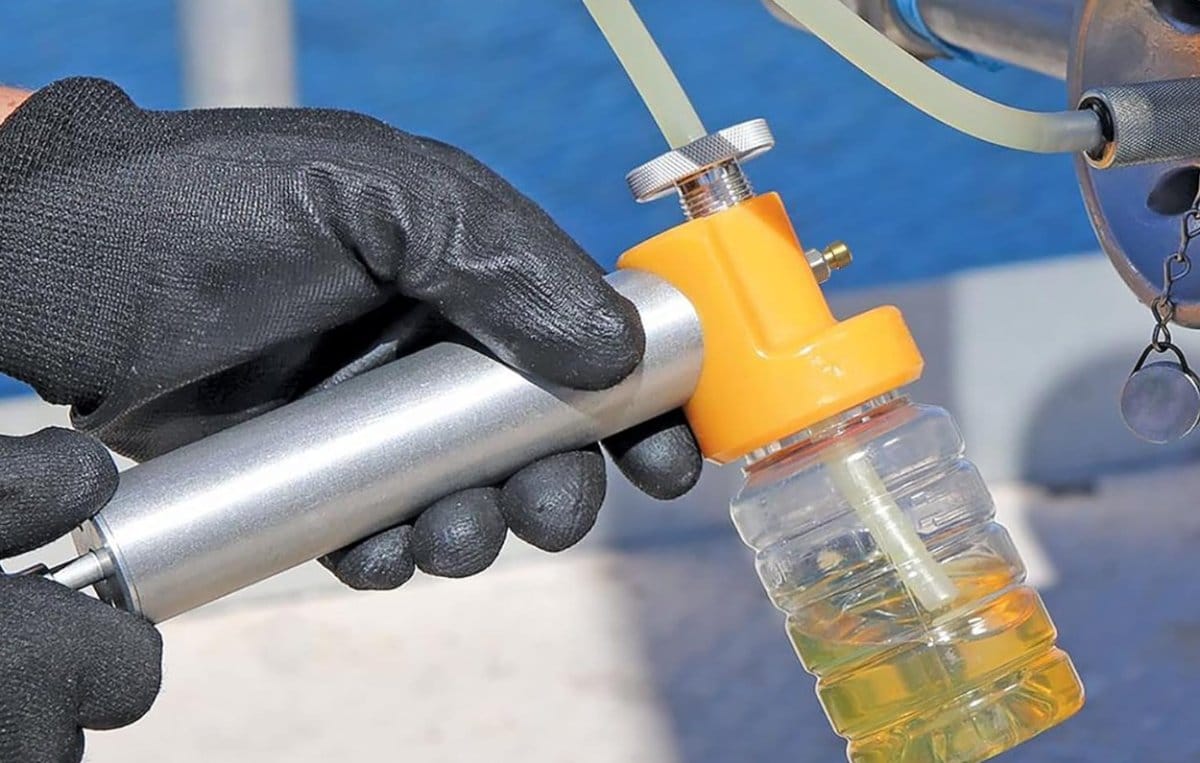
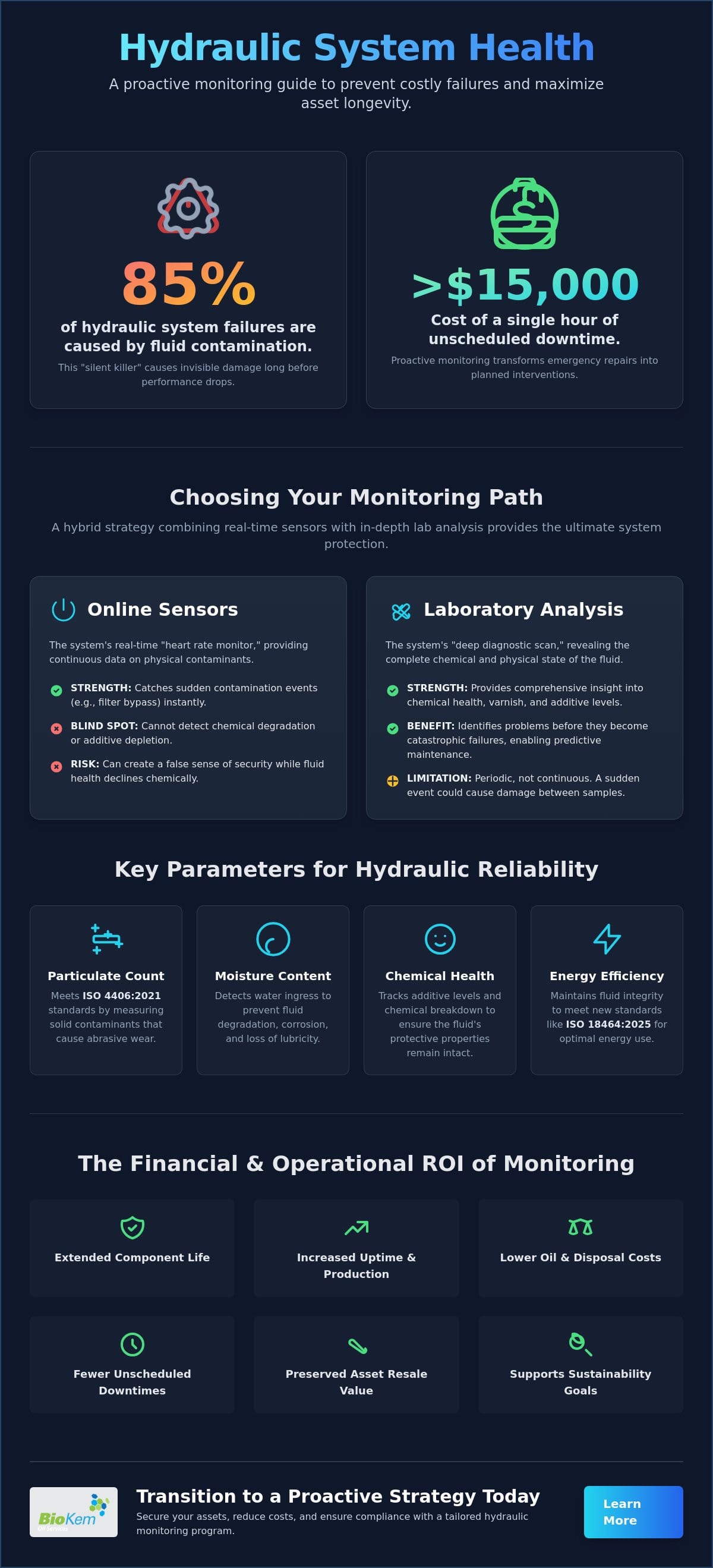
An estimated 85% of machine operation problems are caused by contaminated hydraulic fluid, with a single hour of unscheduled downtime for a hydraulic press costing upwards of $15,000. These figures highlight a critical reality: sophisticated hydraulic oil monitoring is the primary indicator of your system’s longevity and operational health. You’ve likely faced the frustration of sticking valves, the high costs of frequent oil changes, and inconsistent lab reports that offer little clarity for your maintenance strategy.
This guide explains how to transition from reactive repairs to a proactive strategy by implementing a robust monitoring program. By aligning real-time data with rigorous laboratory analysis, you’ll learn to secure predictive alerts and maintain strict compliance with ISO 4406:2021 cleanliness standards. We’ll examine the technical mechanisms for achieving extended component life, the latest standards like ISO 18464:2025 for energy efficiency, and how to interpret complex fluid diagnostics to ensure long-term ecological and mechanical health.
Key Takeaways
- Understand how assessing fluid health prevents the “silent killer” of contamination from causing invisible damage to critical industrial assets.
- Evaluate the strengths and limitations of online sensors versus laboratory oil analysis to ensure you don’t miss chemical degradation or additive depletion.
- Identify the vital parameters to track, such as ISO 4406 particulate codes and moisture content, to meet modern reliability and energy efficiency standards.
- Follow a logical step-by-step process to implement a robust hydraulic oil monitoring program tailored to your specific asset criticality.
- Learn how integrating specialist filtration hardware and technical services can extend component life while supporting regional environmental regulations.
Table of Contents
What is Hydraulic Oil Monitoring and Why is it Critical?
Hydraulic oil monitoring is the systematic process of evaluating fluid health through continuous or periodic assessment. This practice involves checking for physical and chemical changes in the lubricant while identifying external contaminants that compromise system integrity. It’s the technical foundation of a proactive maintenance strategy. Instead of waiting for a component to fail, technicians use data to intervene early, ensuring that the system operates within its designed parameters.
Industry data indicates that approximately 85% of hydraulic system failures are directly linked to fluid contamination. This issue is often called the "silent killer" because microscopic particles and chemical degradation are invisible to the naked eye. By the time an operator notices a change in machine performance, internal damage is often irreversible. Robust oil analysis identifies these threats long before they manifest as mechanical breakdowns, allowing for planned interventions rather than emergency repairs.
To better understand the parameters involved in this process, watch this technical breakdown of oil test reports:
Transitioning from a reactive "fix-on-fail" mindset to condition-based maintenance aligns operational efficiency with environmental responsibility. Extending the life of your hydraulic fluid directly reduces the frequency of oil procurement and the volume of hazardous waste generated. This shift supports corporate sustainability goals by minimizing the ecological footprint of industrial operations. It ensures that fluids remain within the strict specifications outlined in standards like ISO 15380:2023, which governs environmentally acceptable hydraulic fluids. By maintaining fluid integrity, you’re choosing a path of long-term ecological health over the immediate, synthetic interventions of frequent oil replacements.
The Consequences of Neglecting Fluid Health
Neglecting the state of your lubricant leads to accelerated wear in high-pressure pumps and sensitive proportional valves. Contaminants act as abrasive agents, scouring metal surfaces and increasing internal leakage. This degradation forces the system to work harder, resulting in significantly higher energy consumption and decreased precision. In extreme cases, contaminated fluid can lead to catastrophic component failure, creating immediate safety risks for onsite personnel and potential regulatory compliance issues.
Economic Value of a Monitoring Program
A structured hydraulic oil monitoring program offers clear financial returns that extend beyond simple maintenance savings. By extending drain intervals, companies significantly lower their annual oil expenditure and disposal fees. More importantly, it prevents the loss of production revenue. A single hour of downtime for a hydraulic press can cost upwards of $15,000, making early detection a high-ROI activity. Implementing a program often involves specialized services like hot oil flushing to restore system cleanliness, which preserves the long-term resale value of heavy industrial machinery by maintaining verifiable service records.
While technical monitoring ensures operational ROI, many industrial firms also look to optimize their business growth through specialized partners; for instance, ROI Performance provides performance-driven lead generation to help companies in various sectors reach new clients and maximize their commercial potential.
Online Sensors vs. Laboratory Analysis: Choosing the Right Path
Effective hydraulic oil monitoring requires a balance between immediate feedback and deep chemical insight. Online sensors act as the system’s heart rate monitor, providing continuous data on particulate levels and moisture content. These devices are invaluable for catching sudden ingress events or filter bypass situations before they escalate. However, sensors have distinct blind spots. While they excel at detecting solid particles, they rarely identify chemical degradation, varnish precursors, or the depletion of vital additives. Relying solely on sensors can lead to a false sense of security, as the fluid may appear "clean" while its lubricating properties are chemically failing.
For critical Australian industrial assets, a hybrid approach is the gold standard for reliability. This strategy combines the real-time vigilance of sensors with the comprehensive diagnostic power of professional laboratory analysis. By utilizing both, maintenance teams can ensure their fluids meet international hydraulic oil standards while optimizing the timing of oil changes to support sustainability goals. During high-risk periods like system commissioning or following a major component replacement, many facilities utilize equipment hire to implement intensive, temporary monitoring without the capital expense of permanent installations.
When to Use Online Condition Monitoring
Online monitoring is essential for critical assets where a single component failure causes an immediate plant-wide shutdown. It’s also the most practical solution for remote locations where manual sampling is logistically difficult or infrequent. Systems prone to rapid moisture ingress, such as those operating in humid environments or near water-intensive processes, benefit from the instant alerts provided by high-quality hardware like the Particle Pal range. These sensors allow for immediate intervention, preventing the formation of acids and sludge that occur when water reacts with the base oil.
The Role of Professional Laboratory Oil Analysis
Laboratory analysis provides the "blood test" for your machinery. It includes comprehensive wear metal analysis, which identifies specific failing components by detecting microscopic traces of iron, copper, or lead. Beyond simple contamination, the lab measures the Remaining Useful Life (RUL) of the fluid through antioxidant monitoring. This data is often a mandatory requirement for warranty compliance and insurance audits, providing a formal document of care. Detailed reports allow you to make informed decisions about whether to continue using a fluid or to initiate corrective actions like varnish mitigation or vacuum dehydration.
Key Parameters to Track for Hydraulic Reliability
Precision in hydraulic oil monitoring depends on tracking specific physical and chemical indicators that define fluid integrity. While basic inspections might identify large debris, a professional reliability program focuses on microscopic and molecular changes. By monitoring these key parameters, maintenance teams can identify the onset of component wear or fluid degradation before they result in operational failure. This technical oversight ensures that industrial assets remain within the rigorous specifications required for modern, high-pressure operations.
Particulate contamination remains the primary focus of most programs. The industry utilizes the ISO 4406:2021 standard to code the level of solid particles in the fluid. Beyond particles, moisture content is a critical metric. Water is the second leading cause of hydraulic failure, often entering systems through breathers or seal leaks. For a typical ISO VG 46 hydraulic oil, a healthy state is generally indicated by a moisture content below 100 ppm. When water levels exceed this threshold, the risk of additive dropout and oil oxidation increases significantly, leading to the formation of acids and sludge.
Understanding ISO 4406 Cleanliness Standards
The ISO 4406 standard uses a three-number code, such as 18/16/13, to represent the quantity of particles larger than 4, 6, and 14 microns per milliliter of fluid. Each increase in a code number represents a doubling of the particle count. High-pressure systems with sensitive proportional valves typically require much cleaner fluid, often targeting levels as low as 16/14/11. Maintaining these targets is essential for preventing the abrasive wear that destroys pump tolerances. For a deeper technical breakdown of these metrics, refer to our ISO 4406 Cleanliness Codes guide.
Monitoring for Varnish and Oxidation
Standard particle counters often miss the sub-micron precursors of varnish because these contaminants are soluble at operating temperatures. As the oil cools or becomes saturated, these precursors precipitate out, coating internal surfaces and causing valves to stick. Membrane Patch Colorimetry (MPC) is the specialized test used to detect these risks by measuring the color of a patch after filtering a solvent-diluted oil sample. This is particularly vital for high-performance hydraulic systems and turbines where precision is paramount. If monitoring reveals high MPC levels, implementing Varnish Mitigation is the necessary corrective action to restore system reliability.
Tracking viscosity and oxidation levels provides insight into the chemical breakdown of the base oil. Viscosity must remain within a narrow range to ensure proper film thickness and pump efficiency. Oxidation, driven by heat and catalysts like copper or water, leads to an increase in the oil’s Total Acid Number (TAN). By monitoring these chemical shifts, you can accurately determine the Remaining Useful Life (RUL) of the fluid, supporting corporate sustainability goals by avoiding premature oil changes while protecting critical assets from corrosive damage.
Implementing a Proactive Monitoring Strategy
Establishing a robust hydraulic oil monitoring program requires more than occasional testing. It demands a structured, five-step framework that aligns technical data with operational reality. Start with a comprehensive audit. Categorize every hydraulic asset based on its criticality to the production line. High-pressure systems or those with sensitive servo-valves require more frequent oversight than low-pressure auxiliary units. This prioritization ensures that resources are focused where the risk of unscheduled downtime is highest.
Once assets are categorized, establish baseline fluid health. You can’t measure improvement without knowing your starting point. Use this data to set realistic target cleanliness levels. Define your sampling points and frequencies next. While critical systems may benefit from real-time sensors, others might only require monthly or quarterly laboratory analysis. Effective programs also prioritize personnel training. If a technician uses poor sampling techniques, they introduce external contamination, rendering the resulting data useless. Finally, shift your focus from isolated reports to data trends. Reviewing the failure curve over time allows you to predict when a component will reach its limit, enabling a planned intervention before the breakdown occurs.
Setting Target Cleanliness Levels
Target levels shouldn’t be arbitrary. They must reflect the specific requirements of your most sensitive components. Setting targets that are too strict leads to unnecessary filtration costs and premature element changes. Conversely, targets that are too loose result in excessive abrasive wear and shortened asset life. Utilize the Designing a Proactive Maintenance Strategy framework to balance these variables. This approach ensures you maintain the tight tolerances required for system efficiency while supporting corporate sustainability by maximizing fluid and hardware longevity.
Sampling Techniques for Accurate Data
Data accuracy depends entirely on the quality of the sample. Adhere to the "Live Zone" sampling rule. Never take samples from stagnant tank bottoms or dead-end pipes; these areas collect settled debris and provide false, overly pessimistic data. Instead, take samples from a turbulent area of the active fluid stream while the machine is at normal operating temperature. Using dedicated sampling valves ensures repeatability and safety for the operator. For immediate onsite verification, Patch Test Kits provide a visual confirmation of particulate levels between formal lab reports. To ensure your program begins with accurate data, consider our professional hot oil flushing and filtering services to establish a clean, verifiable baseline for your critical assets.
Advanced Solutions: BioKem’s Approach to Hydraulic Health
BioKem positions itself as a specialized partner in managing complex industrial lubrication systems across Australia. We integrate onsite technical expertise with high-end laboratory reporting to provide a holistic view of fluid health. This approach ensures that hydraulic oil monitoring is more than a data collection exercise; it’s a strategic tool for operational continuity and environmental stewardship. By combining local expertise with global scientific standards, we help businesses meet regional regulatory requirements while optimizing asset performance. Our technicians understand that data only has value when it leads to precise, effective maintenance actions.
Managing large-scale industrial assets requires a balance of sophisticated diagnostics and practical mechanical solutions. We provide national expertise that covers everything from initial audits to the deployment of specialized hardware. Whether you’re managing a single critical press or a national fleet of heavy machinery, our methodology remains the same. We identify the technical mechanism of the challenge, explain the solution clearly, and deliver an operational result that supports both your bottom line and your sustainability goals.
Specialized Monitoring Equipment and Hardware
Maintaining fluid integrity requires access to industry-leading technology. BioKem serves as the Australian distributor for world-class hardware, including the Particle Pal range. These portable units allow for real-time, onsite analysis, giving technicians immediate insight into particulate and moisture levels without waiting for external lab results. To maintain target cleanliness, we provide high-performance Swift Filters designed for the rigorous demands of modern hydraulic circuits. When monitoring reveals systemic contamination that standard filtration cannot resolve, we deploy Hot Oil Flushing as a corrective action. This process removes built-up debris and restores the system to its baseline cleanliness, ensuring long-term reliability for sensitive components.
Partnering for Long-Term Reliability
Effective maintenance isn’t about reacting to failure; it’s about managing the life cycle of your assets. BioKem technicians provide more than raw data. They offer actionable maintenance paths based on decades of experience in large-scale industrial environments. We also offer equipment hire for emergency purification or intensive monitoring during critical phases like system commissioning. This flexibility allows facilities to access vacuum dehydration or varnish removal systems without the burden of capital expenditure. Through customized service agreements, we support national fleet and asset management, ensuring that every hydraulic system operates at peak efficiency while minimizing its ecological footprint.
Contact BioKem for a comprehensive oil analysis and monitoring audit to secure the future of your critical industrial assets and ensure compliance with the latest international standards.
Securing Industrial Longevity Through Precision Monitoring
BioKem provides the technical expertise and hardware necessary to implement a world-class hydraulic oil monitoring program. As an authorized Australian distributor for Filters S.p.A. and a national specialist in varnish mitigation and hot oil flushing, we offer localized solutions for your most critical industrial assets. Our team delivers more than just raw data; we provide the actionable maintenance paths required to navigate complex operational challenges. Take the next step in safeguarding your infrastructure and enhancing system efficiency.
Optimise Your Hydraulic Reliability with BioKem Analysis
Frequently Asked Questions
How often should I monitor my hydraulic oil?
Monitoring frequency depends on asset criticality and the severity of the operating environment. Critical systems that drive plant productivity generally require monthly sampling, while auxiliary units may only need quarterly assessment. If your baseline data shows high variability or rapid contamination ingress, increasing the frequency helps establish a reliable failure curve for predictive maintenance.
Can I rely solely on online sensors for hydraulic oil monitoring?
No, online sensors are insufficient for comprehensive hydraulic oil monitoring because they primarily detect particulates and moisture. They cannot identify chemical degradation, varnish precursors, or additive depletion. A professional laboratory oil analysis is necessary to assess the molecular integrity and remaining useful life of the fluid, ensuring that chemical health matches physical cleanliness.
What is the most important parameter in a hydraulic oil analysis report?
The ISO 4406 cleanliness code is the most vital parameter because approximately 85% of hydraulic failures are linked to particulate contamination. However, the Total Acid Number (TAN) is also essential for identifying the onset of oil oxidation. Both metrics must be monitored together to provide a holistic view of the system’s mechanical and chemical stability.
Does monitoring hydraulic oil help in reducing carbon footprint?
Yes, extending the service life of hydraulic fluid directly reduces your carbon footprint by minimizing the frequency of oil procurement and hazardous waste disposal. Proactive monitoring supports corporate sustainability goals by ensuring fluids remain within functional specifications for longer periods. This reduces the energy and resources required for the production and transport of synthetic lubricants.
What is the difference between ISO 4406 and NAS 1638?
ISO 4406 is the modern international standard that uses a three-number code to represent particle counts at 4, 6, and 14 microns. NAS 1638 is an older standard that assigns a single cleanliness class based on particle counts across five different size ranges. Most modern industrial facilities have transitioned to ISO 4406 because it provides better precision for high-pressure systems.
How do I know if my hydraulic oil needs to be changed or just filtered?
Oil requires filtration if it meets chemical specifications but exceeds particulate or moisture limits. If the Total Acid Number has risen significantly or additives have depleted, filtration will not restore the fluid’s lubricating properties. In these scenarios, a full oil change or specialized varnish mitigation is necessary to protect critical components from corrosive damage and sticking.
Can monitoring detect pump failure before it happens?
Yes, periodic analysis can detect the onset of pump failure by tracking specific wear metals like iron, copper, and lead. An upward trend in these elements suggests internal component degradation long before a mechanical breakdown occurs. This allows maintenance teams to schedule a planned replacement, avoiding the $15,000 per hour cost of unscheduled downtime.
Why is moisture so damaging in hydraulic systems?
Moisture is damaging because it catalyzes oil oxidation and leads to the formation of corrosive acids and sludge. It also causes additive dropout and can lead to hydrogen embrittlement in high-strength steel components. Maintaining water content below 100 ppm is essential for preventing these chemical reactions and preserving the overall efficiency of the hydraulic circuit.