


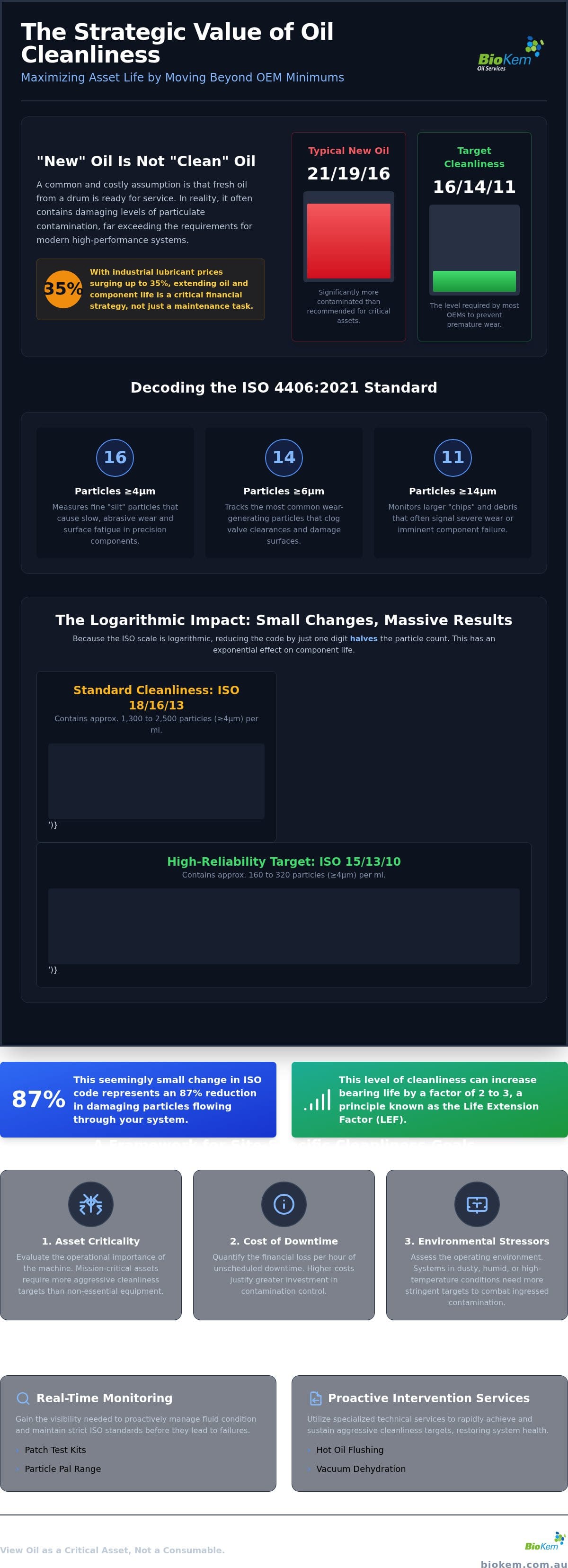
Did you know that a fresh drum of oil typically enters your facility with a cleanliness level of 21/19/16? This is significantly more contaminated than the 16/14/11 target required by most OEMs. Setting oil cleanliness targets isn’t just a maintenance checkbox; it’s a critical financial strategy in an era where industrial lubricant prices have surged by up to 35% in early 2026. You’ve likely felt the frustration of premature component failure or the confusion that stems from conflicting manufacturer standards versus your actual operating environment.
We understand that maintaining asset reliability requires more than just regular oil changes. This guide provides a technical framework to move beyond guesswork and establish precision targets that extend machine life while eliminating unscheduled downtime. You’ll learn how to implement a repeatable process for oil analysis and reporting that aligns with the latest ISO 4406:2021 standards. We’ll examine how to balance asset criticality with environmental stressors to ensure your lubrication program delivers a measurable return on investment and supports long term ecological health.
Key Takeaways
- Understand the Life Extension Factor (LEF) to quantify how cleaner oil directly correlates to increased component longevity and reduced wear rates.
- Master the technical mechanics of ISO 4406:2021 to interpret contamination codes and leverage the logarithmic nature of particle counts.
- Implement a site-specific framework for setting oil cleanliness targets that prioritizes asset criticality and the specific cost of unscheduled downtime.
- Discover how real-time monitoring tools like Patch Test Kits and the Particle Pal range provide the visibility needed to maintain strict ISO standards.
- Learn how onsite services, including Hot Oil Flushing and Vacuum Dehydration, provide the technical mechanism to achieve and sustain aggressive reliability goals.
The Strategic Importance of Setting Oil Cleanliness Targets
Setting oil cleanliness targets serves as the technical foundation for any proactive maintenance program. Rather than treating lubrication as a simple consumable, high-reliability organizations view oil as a critical machine component. By establishing a measurable standard for fluid purity, you shift from reactive “fix-on-failure” cycles to a Reliability-Centered Maintenance (RCM) model. This approach relies on the Life Extension Factor (LEF). This metric quantifies how reducing particle counts directly multiplies the remaining useful life of your assets.
A common “silent assumption” in industrial facilities is that new oil arriving in drums is ready for service. In reality, new oil often carries a contamination code of 21/19/16. This contains significantly more particulate matter than the 16/14/11 levels required for modern high-pressure hydraulics. Adhering to contamination control principles ensures that these initial contaminants don’t enter your system. It prevents immediate wear from the moment of fluid exchange.
Effective contamination control also extends to the physical environment surrounding your assets; for those seeking professional help in maintaining a high-standard industrial workspace, check out Optimal Janitorial.
The True Cost of Contamination in Critical Systems
Particle contamination acts as a “death by a thousand cuts” for precision components. Silt-sized particles, often between 1 and 5 microns, are particularly destructive. They’re small enough to enter the tight clearances of servo-valves, bearings, and pumps. Once inside, they cause abrasive wear and surface fatigue. This leads to gradual performance degradation that often goes unnoticed until catastrophic failure occurs. Target Cleanliness is defined as the optimal balance between the cost of maintenance interventions and the replacement value of the industrial asset.
Moving Beyond OEM Recommendations
Original Equipment Manufacturer (OEM) cleanliness standards are frequently designed as minimum requirements to satisfy warranty periods. They rarely represent the optimum levels needed for maximum asset longevity in harsh operating environments. Relying on generic industry averages can be a critical error for bespoke industrial applications. Site-specific targets drive better accountability. Setting oil cleanliness targets that reflect your specific duty cycles and environmental stressors ensures your filtration strategy is proactive. It moves the focus from “changing the oil” to “managing the fluid quality.”
Decoding ISO 4406 and the Mechanics of Particle Contamination
The ISO 4406:2021 standard provides the technical vocabulary for fluid cleanliness. It uses a three-digit code to represent the quantity of particles sized ≥4μm, ≥6μm, and ≥14μm per milliliter of fluid. Understanding these specific thresholds is essential when setting oil cleanliness targets for high-pressure systems. While the first two digits (4μm and 6μm) track the “silt” that causes long term abrasive wear, the third digit (14μm) monitors the larger “chips” that often signal imminent catastrophic failure. A holistic target must also account for moisture levels, measured in parts per million (ppm). Excess water accelerates chemical oxidation and can lead to additive dropout, compromising the fluid’s protective film.
The scale is logarithmic, meaning each code represents a range where the upper limit is double the lower limit. If your system moves from an ISO code of 18 to 19, you haven’t just seen a marginal increase; you’ve effectively doubled the number of contaminants in your oil. Conversely, dropping just one digit halves the particle count. This mathematical reality makes precision filtration a high-leverage activity for maintenance teams. For those managing critical assets, conducting regular oil analysis is the only way to verify these codes and identify the specific morphology of wear debris.
The Logarithmic Scale: Why One Digit Matters
To visualize the impact of the ISO scale, consider the actual particle mass in a sample. Moving from a standard code to a high-reliability target results in a massive reduction in the physical volume of abrasive material passing through your bearings.
- ISO 18/16/13: Contains approximately 1,300 to 2,500 particles (≥4μm) per ml.
- ISO 15/13/10: Contains approximately 160 to 320 particles (≥4μm) per ml.
This shift represents an 87% reduction in particles. Reducing the particle count by this magnitude can lead to an exponential increase in bearing life, often doubling or tripling the mean time between failures (MTBF) for critical pumps and motors.
The Invisible Threat: Varnish and Sub-Micron Contaminants
Standard ISO 4406 counts often fail to detect sub-micron soft contaminants. These particles are too small for traditional optical counters but are the primary precursors to varnish. Varnish settles on cool surfaces, causing “sticky” valves and restricted heat transfer in EHC systems. To address this, setting oil cleanliness targets should include Membrane Patch Colorimetry (MPC) testing. This measures the varnish potential of the fluid before it plates out on your hardware. Integrating Varnish Removal Systems into your maintenance framework ensures that these chemical byproducts are managed alongside physical particulates, providing a truly comprehensive approach to fluid health.
A Multi-Factor Framework for Determining Site-Specific Cleanliness Goals
Moving from a generic industry average to a site-specific standard requires a structured assessment of your operational reality. BioKem utilizes a multi-factor framework that adjusts base ISO codes according to the specific stressors of each asset. Setting oil cleanliness targets shouldn’t be a static exercise. It must account for the financial, mechanical, and environmental variables that define your facility. By weighing these factors, you ensure that your maintenance budget is allocated to the assets where fluid purity provides the highest return on investment.
- Asset Criticality: This evaluates the total cost of the machine being offline. A primary production turbine in a power plant demands a much tighter target than a standalone backup pump because the hourly revenue loss is significantly higher.
- Contaminant Tolerance: Higher system pressures and tighter component clearances reduce a system’s ability to process particles. Servo-valves with 5-micron clearances are far more vulnerable to “silt” than a heavy-duty industrial gearbox.
- Environmental Severity: This is a critical factor for Australian operations. Sites in the Pilbara face extreme ambient dust, while coastal facilities deal with high humidity. These external ingress points require more aggressive filtration to maintain the same internal cleanliness.
- Safety and Environmental Risk: Assets containing large volumes of fluid or those operating near ignition sources require strict targets to prevent failures that could lead to fires, spills, or regulatory breaches.
Calculating Your Target ISO Code
The calculation begins with a base code determined by the most sensitive component in the system. For high-pressure hydraulic systems operating above 3000 psi, this base code is usually tightened by at least one or two points. High pressure accelerates the velocity of particles, turning them into abrasive projectiles that erode valve seats and seals. Operating temperature also plays a role. Sustained high temperatures accelerate fluid oxidation and varnish formation. Utilizing high-performance Filters S.p.A. products allows you to maintain these tighter site-adjusted codes even under extreme thermal stress.
Case Study Logic: Turbine vs. Gearbox Targets
A comparison between a high-speed steam turbine and a heavy-duty industrial gearbox illustrates the need for bespoke targets. Turbines require exceptionally low moisture targets, often below 100 ppm, to prevent the hydrolytic degradation of EHC fluids. In contrast, a gearbox might tolerate slightly higher moisture but requires a strict focus on larger wear particles that signal gear tooth fatigue. The “Optimal Cleanliness Zone” is the specific ISO range where the incremental cost of advanced filtration is perfectly balanced by the savings generated through maximum asset uptime and reduced component replacement costs.
Bridging the Gap: Moving from Theoretical Targets to Measurable Results
Establishing a framework is only the first step. Setting oil cleanliness targets remains a theoretical exercise until you implement a rigorous sampling and monitoring program. You must distinguish between “Exclusion” and “Extraction.” Exclusion involves preventing the entry of contaminants through high-quality breathers and seals. Extraction focuses on removing existing particles that have bypassed those defenses. For new or overhauled systems, initial cleanliness is rarely achieved through standard filtration alone. A comprehensive Hot Oil Flushing service is necessary to remove built-in contaminants like welding slag and casting sand, ensuring the system starts at its required base level.
Real-time visibility is vital for maintaining these standards. Tools like Patch Test Kits provide immediate visual confirmation of fluid health on-site. For more sophisticated data, the Particle Pal Range offers digital particle counting that allows for trend analysis. This data enables you to catch deviations before they lead to component wear. If you’re ready to verify your current fluid health, our professional oil analysis provides the technical clarity needed to proceed.
Effective Oil Sampling Techniques
The accuracy of your ISO counts depends entirely on your sampling technique. Drawing fluid from a secondary port or a stagnant zone in a tank will produce skewed data that doesn’t reflect the fluid currently protecting your bearings. Primary sampling ports should be located on return lines or before filters to capture the most representative data. You must also guard against “bottle contamination.” Even a new sample bottle can contain enough dust to throw off a 4μm count. We recommend reviewing specialized guides on oil sampling techniques to ensure your laboratory results are actionable and precise.
Advanced Filtration and Dehydration
Achieving aggressive targets requires hardware that outperforms standard consumables. High-efficiency glass media filters provide superior beta ratios and dirt-holding capacity compared to traditional cellulose options. When moisture levels exceed your site-specific ppm target, Vacuum Dehydration becomes the primary mechanism for water removal. This process removes dissolved water without harming the oil’s additive package. As the Australian distributor for Filters S.p.A., BioKem provides access to the high-performance filtration technology required to sustain these aggressive cleanliness goals.
Partnering for Precision: How BioKem Sustains Your Cleanliness Targets
BioKem serves as the technical partner that transforms theoretical standards into operational reality. Setting oil cleanliness targets is a foundational step, but sustaining those targets requires a combination of specialized hardware and onsite expertise. For complex system cleaning projects, onsite service fees cover the deployment of advanced filtration units and the specialized knowledge of technicians who understand the nuances of EHC fluid maintenance and varnish mitigation. This approach prioritizes the restoration of fluid chemistry and physical purity, aligning with our commitment to environmental responsibility. By choosing purification over disposal, industrial facilities significantly reduce their hazardous waste footprint while mitigating the impact of the 35% increase in base oil prices observed in 2026.
If a system experiences an unexpected contamination event, our Equipment Hire options provide a rapid response for emergency target recovery. This flexibility allows maintenance managers to address sudden spikes in particle counts without the capital expenditure of permanent hardware upgrades. Our focus remains on creating a circular economy within your facility, where oil is treated as a long term asset rather than a disposable commodity. This steady, logical approach to fluid management ensures that your reliability goals are met through scientific intervention rather than synthetic replacements.
From Laboratory Analysis to Onsite Action
BioKem’s Laboratory Testing services provide the empirical evidence required for precise target adjustment. These technical reports do more than just list ISO codes; they offer a forensic look at wear patterns and contaminant morphology. This level of detail is essential for regulatory compliance and insurance audits, where proof of proactive maintenance is often a prerequisite for coverage. The “BioKem Advantage” lies in this transition from data to deployment. We don’t just identify a problem; we deploy the specific Hot Oil Flushing or Vacuum Dehydration technology needed to resolve it, ensuring your assets remain within their optimal operating parameters.
Next Steps: Auditing Your Current Cleanliness Strategy
The most effective way to begin is by performing a gap analysis. Compare your current fluid health against the new, site-specific goals established in your reliability framework. This often reveals that existing filtration is insufficient for the environmental stressors of the site, such as the high dust levels found in Australian mining operations. Additionally, staff training is vital. Even the most advanced filtration system can’t compensate for poor habits during oil top-ups or component repairs. Once you’ve committed to setting oil cleanliness targets, maintaining them becomes a repeatable process that protects both your assets and your operational budget. Consult with BioKem’s specialists to set your 2026 cleanliness targets.
Advancing Your Asset Reliability Strategy
BioKem provides the technical infrastructure needed to achieve these aggressive standards. As the sole Australian distributor for Filters S.p.A., we combine high-performance hardware with expert onsite technical deployment. Our comprehensive oil analysis and reporting services give you the evidence required to make informed maintenance decisions. You don’t have to manage these complex challenges alone. Optimize your asset reliability with BioKem’s specialist oil services. We’re ready to help you transform your lubrication program into a high-performance reliability engine that supports both your operational goals and environmental responsibilities.
Frequently Asked Questions
What is the most common ISO cleanliness target for industrial hydraulic systems?
Most industrial hydraulic systems require a cleanliness level of ISO 16/14/11. This code ensures that sensitive components like servo-valves and high-pressure pumps are protected from abrasive wear. However, systems operating above 3,000 psi often demand even tighter targets, such as 15/13/10. Your specific target should be based on the most sensitive component in the circuit to prevent premature failure and ensure consistent performance.
How often should I sample my oil to ensure targets are being met?
Critical assets should be sampled monthly to ensure your fluid health remains within established parameters. For less sensitive systems, quarterly sampling is often sufficient. Regularity is key to identifying trends before they lead to catastrophic failure. Frequent analysis allows you to verify if your strategy for setting oil cleanliness targets is actually delivering the expected reduction in wear rates over time.
Can I achieve a target of ISO 14/12/9 with standard off-the-shelf filters?
Achieving an aggressive target like ISO 14/12/9 is difficult with standard off-the-shelf cellulose filters. These targets typically require high-efficiency glass media filters with superior beta ratios. We recommend utilizing high-performance Filters S.p.A. products to reach these levels. Standard filters often lack the dirt-holding capacity and precision necessary to remove the fine silt-sized particles that define these ultra-clean codes.
What happens if my oil analysis shows I am consistently missing my cleanliness targets?
If you are consistently missing your goals, you must audit your system for external ingress points like faulty breathers or seals. If the fluid is already heavily contaminated, standard onboard filtration may not be enough to recover the system. In these cases, onsite services like Hot Oil Flushing or Vacuum Dehydration are necessary to restore the fluid to its baseline cleanliness without requiring a full oil change.
Does new oil from a drum meet standard industrial cleanliness targets?
No, new oil directly from a drum often has a cleanliness level of approximately 21/19/16. This is significantly dirtier than the 16/14/11 target required by many modern industrial systems. You should always filter new oil through a high-efficiency transfer pump before it enters your reservoir. This prevents “built-in” contamination from the manufacturing and transport process from reaching your critical components and causing immediate wear.
What is the difference between particle count targets and moisture (ppm) targets?
Particle count targets focus on physical abrasive wear caused by solid contaminants. Moisture targets, measured in parts per million (ppm), address the chemical stability of the oil. High water content leads to oxidation, additive depletion, and hydrogen embrittlement in bearings. A holistic approach to setting oil cleanliness targets must include both metrics to ensure the fluid provides both physical protection and chemical longevity.
How does temperature affect the ability to maintain oil cleanliness targets?
High operating temperatures accelerate the oxidation process, leading to the formation of sub-micron varnish precursors that optical particle counters might miss. Conversely, cold starts can cause high pressure drops across filters, potentially triggering bypass valves and allowing unfiltered oil into the system. Maintaining a stable operating temperature is essential for ensuring your filtration system functions at its peak efficiency to meet aggressive ISO codes.
Is it worth setting aggressive targets for older, legacy equipment?
Yes, setting aggressive targets for legacy equipment is often a cost-effective way to extend its remaining useful life. While older machines may have wider clearances, they are often more prone to leaks and internal erosion when subjected to contaminated fluid. Implementing strict cleanliness standards reduces the total cost of ownership by delaying the need for expensive overhauls or complete asset replacement in aging industrial facilities.

Article by
James McAllister
James McAllister is an industry professional with BioKem Oil Services, specialising in lubrication reliability, oil filtration, contamination control and asset performance. Drawing on BioKem's extensive field experience across turbines, compressors, hydraulic systems and critical rotating equipment, James writes practical, insight-driven articles that help maintenance and reliability teams improve equipment performance, extend asset life and reduce operational risk.