

Could a reservoir with a modest tank volume still need a high-capacity breather? Breather design and sizing for lube oil reservoirs depends on how quickly air must move in and out, not tank volume alone. Oil-level changes and temperature shifts affect that demand. If a breather cannot pass enough air, pressure or vacuum may exceed the asset’s limits.
Reservoir volume and a breather’s capacity rating are useful starting points, but they are not enough to make a selection. You also need operating data, the manufacturer’s flow ratings and the reservoir’s allowable pressure and vacuum limits. This guide explains how to assess breathing demand, compare breather capacity with that demand and document the assumptions for technical review. It also covers how breather selection fits into a wider oil cleanliness plan alongside filtration and oil analysis.
Key Takeaways
- Base breather design and sizing for lube oil reservoirs on operating-cycle data and expected air exchange, not tank volume alone.
- Account for oil-level movement and temperature changes, and record the assumptions behind your airflow estimate.
- Compare the selected breather’s manufacturer-rated capacity with calculated demand and the asset’s pressure and vacuum limits.
- Include environmental exposure and required oil cleanliness in the design review, using filtration and oil analysis where appropriate.
How lube oil reservoirs breathe, and why breather design matters
A reservoir breather provides a path for air to enter and leave the space above the oil. As the oil level changes or the air temperature shifts, headspace volume and pressure change. Air moves through the breather to help equalise pressure. During intake, airborne particles and moisture can enter with the air, so the breather is part of the system’s oil-cleanliness boundary.
Tank capacity alone does not describe the breathing demand. Two reservoirs of similar size may require different airflow because their oil-level ranges, operating cycles, headspace and temperature conditions differ. Breather design and sizing for lube oil reservoirs should therefore start with the rate and conditions of air exchange, not just the total volume of oil the tank can hold. An engine’s crankcase breather is a useful, though not identical, comparison: both manage air movement and relate to oil contamination, as outlined in this explanation of the Oil Catch Tank.
For a visual example of an engine breather, watch this short video:
What operating changes create breathing demand?
When oil returns to a reservoir or equipment draws oil from it, the liquid level rises or falls. A rising level compresses the headspace and pushes air out. A falling level expands the headspace and draws air in. Both the amount and rate of level change matter. Record the operating cycle and the maximum level movement rather than estimating demand from static tank volume.
Temperature is another factor. Warming can expand the air and oil, increasing pressure and pushing air out. Cooling can contract the contents and create a vacuum that draws air inward. The balance depends on the actual operating conditions. Consider ambient temperature changes as well as heat generated during operation, and include moisture exposure in your oil-condition review. If testing indicates a concern, microbial contamination in lube oil can be part of the wider cleanliness assessment.
How to size a lube oil reservoir breather from operating demand
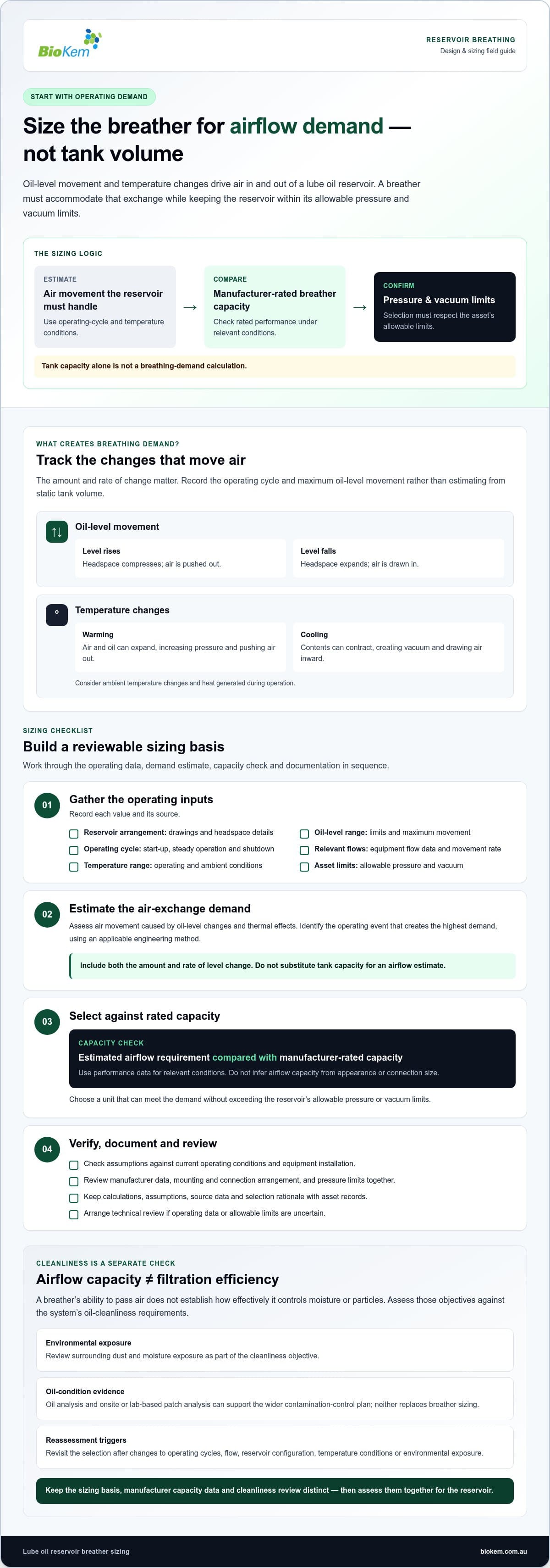
Build the sizing basis around the asset’s actual operating cycle. Estimate the greatest air movement the reservoir must accommodate, then compare it with the breather manufacturer’s performance data and the reservoir’s allowable pressure and vacuum limits. Breather design and sizing for lube oil reservoirs should leave a clear record of the inputs, assumptions and points requiring review.
Which data should the sizing calculation use?
Gather reservoir drawings and headspace details, the oil-level range, operating flow data, and temperatures during start-up, steady operation and shutdown. Record the maximum rate and duration of oil-level movement, not only the total volume displaced. Use the manufacturer’s performance data for the proposed breather and include the asset’s allowable pressure and vacuum limits. Do not infer airflow capacity from a product’s appearance or connection size.
- Gather inputs: Record the reservoir arrangement, oil-level limits, operating cycle, relevant equipment flows and temperature range. Note the source of each value.
- Estimate demand: Assess air movement associated with oil-level changes and thermal effects. Identify the operating event that creates the highest demand, using an applicable engineering method rather than tank capacity as a substitute.
- Select capacity: Compare the estimated airflow requirement with the manufacturer’s rated capacity under relevant conditions. Select a unit that can meet the demand without exceeding the reservoir’s pressure or vacuum limits.
- Verify and document: Review the assumptions, manufacturer data, installation arrangement and pressure limits together. Arrange technical review if operating data or allowable limits are uncertain.
Keep airflow capacity separate from filtration efficiency. A breather’s ability to pass air does not establish how effectively it controls moisture or particles. Assess those objectives against the system’s cleanliness requirements. BioKem Oil Services provides lubrication oil filtration and oil analysis to support a broader cleanliness strategy. For help considering filtration and oil condition alongside reservoir requirements, discuss your lubrication-system needs with BioKem Oil Services.
How to verify breather selection and protect reservoir oil cleanliness
A sizing result is useful only if the selected breather can meet the estimated airflow demand under the asset’s operating conditions. Review its manufacturer-rated capacity and applicable limits alongside the reservoir’s allowable pressure and vacuum. Confirm that the documented design basis still reflects how the equipment is installed and operated.
What should a design review confirm?
Check the breather’s rated capacity against the estimated demand, and verify that the reservoir remains within its specified pressure and vacuum limits. Review the connection and mounting arrangement, as well as surrounding exposure to dust or moisture that may affect the cleanliness objective. Keep the calculation, manufacturer data, assumptions and selection rationale with the asset records for maintenance and future reviews.
- Confirm the operating basis: Compare the design assumptions with current oil-level movement, operating flow and temperature conditions.
- Review cleanliness evidence: Use oil analysis and onsite or lab-based patch analysis as part of the wider contamination-control plan. These are not substitutes for breather sizing.
- Record review triggers: Reassess the selection after changes to operating cycles, flow, reservoir configuration, temperature conditions or environmental exposure.
Breather performance is one part of reservoir cleanliness. A suitable selection can help manage air exchange, while oil analysis and filtration provide other ways to monitor and control contamination. BioKem’s lubrication oil filtration services can support this broader reliability approach.
For an industrial lubrication concern involving oil cleanliness or condition, discuss it with BioKem.
Keep reservoir reliability aligned with changing conditions
Use maintenance and asset reviews to connect reservoir design records with the condition of the oil in service. Breather design and sizing for lube oil reservoirs is most useful when its assumptions remain visible as equipment duty, environment or operating strategy changes. This helps teams decide when an engineering reassessment is warranted and how cleanliness monitoring can inform the response.
A breather is one part of a wider reliability plan. BioKem provides lubrication oil filtration and lube oil analysis, including onsite and lab-based patch analysis to help assess oil condition and contamination. Use those findings to identify changes that may warrant attention, rather than relying only on a historic specification.
For support with the broader lubrication challenge, discuss your industrial lubrication requirements with BioKem. Share the asset’s operating conditions and oil-condition information to support an informed conversation about next steps.
Frequently Asked Questions
Can a lube oil reservoir breather be sized using tank volume alone?
No. Tank volume provides context, but it does not show how quickly air must move during operation. For Breather design and sizing for lube oil reservoirs, use operating data to account for level movement, thermal effects and changes in duty. Then compare the estimated demand with the breather’s rated capacity and the reservoir’s pressure and vacuum limits. Keep the source and date of key operating data with the calculation.
What happens if a reservoir breather is undersized?
An undersized breather may not equalise pressure as intended. The consequences depend on the reservoir arrangement, operating cycle and equipment limits. If you suspect a mismatch, compare the unit’s rated performance with the estimated airflow demand and review the asset’s pressure or vacuum information. Record operating changes that may affect demand so the current design basis can be reviewed.
Does every lube oil reservoir need a desiccant breather?
No. The appropriate breather depends on operating conditions, exposure to moisture and airborne contamination, and the required oil cleanliness. A desiccant unit may suit a design where reducing moisture entering with intake air is an objective. Consider the reservoir’s location and operating pattern, then assess the unit’s type and capacity against manufacturer specifications and the system’s cleanliness requirements.

Article by
James McAllister
James McAllister is an industry professional with BioKem Oil Services, specialising in lubrication reliability, oil filtration, contamination control and asset performance. Drawing on BioKem's extensive field experience across turbines, compressors, hydraulic systems and critical rotating equipment, James writes practical, insight-driven articles that help maintenance and reliability teams improve equipment performance, extend asset life and reduce operational risk.