

Yes, there are warning signs that a bearing is about to fail. A worn wheel bearing often hums or growls more loudly as road speed rises, while vibration, looseness or less responsive steering can signal worsening wear. The noise may also change when the vehicle turns.
It’s easy to mistake a gradual change for tyre or road noise. Noting when the sound occurs can help distinguish a developing bearing problem from other faults. Loud grinding or worsening vibration needs immediate attention.
This article explains the warning signs to watch for, how bearing noise can change with speed and turning, and how condition monitoring can help detect wear in industrial equipment. It also covers why changes in vibration, temperature and lubricant condition matter when assessing bearing health.
Key Takeaways
- Looseness, vibration, steering changes and uneven tyre wear can point to a failing wheel bearing, though other faults may cause similar symptoms.
- Notice whether humming or growling changes with road speed or when turning; these patterns can help distinguish bearing noise from other sounds.
- For industrial equipment, track vibration, operating temperature and lubricant condition over time to identify developing wear.
- When lubrication condition or contamination is a concern in industrial systems, BioKem Oil Services’ oil analysis and hot oil flushing can support assessment and maintenance.
What are the Warning Signs of a Failing Wheel Bearing?
Yes. A failing wheel bearing can cause wheel play, steering vibration, vague steering, persistent uneven tyre wear or inefficient braking. Uneven wear can also result from suspension or alignment problems, so it isn’t proof of bearing failure. A nearby wheel-speed sensor may misread signals if a loose bearing causes the ABS warning light to appear. On a safely raised vehicle, rocking the wheel at the 12 and 6 o’clock positions can reveal looseness. Severe wear can lead to excessive play or seizure, affecting handling and braking.
For industrial bearings, increased vibration, rising temperature, lubricant leakage and metal particles in grease or oil are important symptoms. Poor fitting, poor lubrication or contamination cause over 70% of bearing failures. Misalignment and friction can also contribute to damage. Darkened, gritty or metallic-contaminated grease may point to oxidation, overheating or abrasive particles. These conditions can damage rolling surfaces and reduce equipment reliability.
Noise can offer clues about a bearing’s failure mode. Grinding or growling may indicate metal-to-metal contact or spalling; intermittent clicking may point to cage fracture or contamination. Knocking under load can signal severe spalling or brinelling. A low rumble that rises with speed may reflect early raceway or rolling-element damage. If noise grows louder during a turn, the bearing on the opposite, more heavily loaded side is usually implicated.
How quickly can a bearing fail after warning signs appear? There is no fixed countdown: progression depends on the damage, load, speed, lubrication and contamination. Some defects remain subtle, while advanced wear can cause a rapid temperature rise and severe vibration. A noisy bearing generally worsens rather than recovering on its own. If a vehicle develops loud grinding or worsening vibration, pull over and arrange a tow.
Unusual noises and changes in noise with speed
A hum or rumble that rises with road speed is a useful warning sign. Grinding may indicate metal-to-metal contact or spalling, while intermittent clicking can point to cage damage or contamination. Note whether the sound follows wheel speed rather than engine revs. Vibration through the steering wheel or vehicle structure is another clue, especially if it increases as the vehicle accelerates.
Compare the noise with engine and accessory operation. Belt noise follows engine RPM and accessory drive speed, and may change when the air-conditioning or alternator load changes. It may ease after warm-up. Bearing noise usually persists or worsens as temperature rises. This comparison can help distinguish possible bearing symptoms from belt noise, but sound alone is not a diagnosis.
If you’re asking whether there are warning signs of when a bearing is about to fail, note how the sound responds to directional loading. A failing wheel bearing can become noisier through a turn as one side carries more load. A mechanic can spin and rock each wheel on a hoist to help locate the source. Suspension wear or alignment problems can also contribute to vibration, so the full inspection matters.
For industrial equipment, record noise and vibration alongside changes in load, speed and temperature. Comparing observations across operating conditions gives maintenance teams more context for assessing a developing fault. Persistent symptoms alongside lubricant concerns warrant a condition-focused discussion. Discuss industrial bearing symptoms when those changes need investigation.
Condition monitoring and predictive maintenance
Condition monitoring tracks changes in bearing vibration, temperature and lubricant to identify developing wear. Trend data helps maintenance teams plan an inspection before damage becomes severe.
Monitoring Bearing Condition
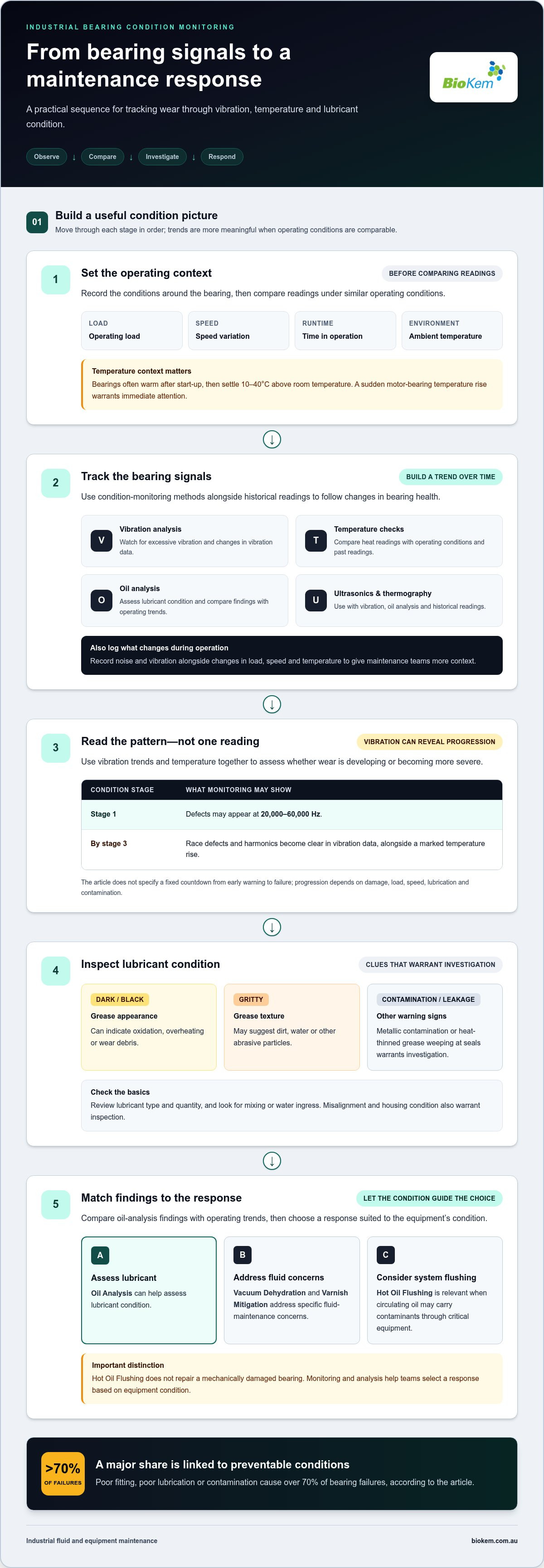
Condition monitoring combines vibration analysis, oil analysis, ultrasonics and thermography with historical readings to track bearing health. Stage 1 defects may appear at 20,000-60,000 Hz; by the third stage, race defects and harmonics become clear in vibration data, alongside a marked temperature rise. Compare trends under similar loading and operating conditions. This inspection supports predictive maintenance by helping teams identify deterioration before components reach severe damage or require replacement.
Operational Stress and Environmental Conditions
Operational stress describes the combined effects of load, speed variation, runtime and ambient temperature on a bearing. These variables affect measured heat, so compare readings under similar conditions rather than attributing every rise to friction. Bearings often warm after start-up, then settle 10-40 degrees Celsius above room temperature. A sudden motor-bearing temperature rise warrants immediate attention. Excessive vibration or squealing adds evidence of changing condition, while misalignment and housing condition also warrant inspection.
Grease and Lubricant Condition
Grease and lubricant condition shows whether bearing surfaces remain protected or face contamination and wear. Darkened or black grease can indicate oxidation, overheating or wear debris; gritty grease suggests dirt, water or other abrasive particles. Metallic contamination, leakage and heat-thinned grease weeping at seals also warrant investigation. Check lubricant type and quantity, and look for mixing or water ingress. Compare oil-analysis findings with operating trends, then discuss lubricant condition concerns.
BioKem Oil Services: Hot Oil Flushing
BioKem Oil Services provides Hot Oil Flushing for industrial lubrication systems where circulating oil may carry contaminants through critical equipment. This service is relevant when monitoring points to lubricant contamination or deposits, but it does not repair a mechanically damaged bearing. Oil Analysis can help assess lubricant condition, while Vacuum Dehydration and Varnish Mitigation address specific fluid-maintenance concerns. Findings from monitoring and analysis help maintenance teams choose a response suited to the equipment’s condition and operating needs.
For industrial bearing and lubrication concerns, contact BioKem Oil Services to discuss the issue.
Make the Next Maintenance Decision With Confidence
If you’re asking whether there are warning signs of when a bearing is about to fail, the useful next step is to turn observations into a maintenance decision. Record when symptoms occur, the operating conditions, and any changes in vibration, temperature or lubricant. Comparing those records over time can help your team decide whether to inspect, monitor or plan equipment work.
For industrial lubrication systems, BioKem Oil Services offers Hot Oil Flushing, Varnish Mitigation and Vacuum Dehydration. These services address oil and system maintenance concerns, not the mechanical replacement of a damaged wheel bearing. Matching the response to the equipment and the evidence keeps maintenance focused and responsible.
Contact BioKem Oil Services for support with industrial lubrication concerns and take a clear next step for your equipment.
Frequently Asked Questions
Chapter 1 – What Is Bearing Failure?
Bearing failure occurs when damage or wear prevents a bearing from supporting smooth, controlled rotation. It can develop through rolling-surface damage, lubricant breakdown, contamination or excessive clearance. For example, pitting on a motor bearing can progress into spalling, while overheating can degrade both the lubricant and bearing components. Identifying the failure mode helps determine whether maintenance can address the cause or the bearing needs replacement.
The Bearing Failed, Now What?
If a vehicle bearing fails and there is loud grinding or worsening vibration, pull over and arrange a tow. For industrial machinery, document the conditions when the failure occurred, including load and operating temperature, then arrange an inspection. Pitting, spalling, fluting, overheating or seizure in a motor bearing calls for prompt replacement because sudden failure is imminent.
What Are the Common Reasons Bearings Fail?
Common causes include poor fitting, inadequate or excessive lubrication, and contamination. Lubrication problems can also result from using the wrong lubricant, mixing incompatible lubricants, or allowing water or foreign particles into the lubricant. These issues can increase friction or abrade rolling surfaces. Reviewing installation, lubricant selection and contamination controls can help identify the cause and guide corrective maintenance.
What Happens If You Ignore a Failing Bearing?
Ignoring a damaged bearing can allow wear to spread to adjoining components. Shaft scoring and galling may follow, potentially requiring shaft replacement or more extensive repair. A bearing seizure in a production asset can also interrupt operation. A mechanic or maintenance team should assess the damage and its cause rather than treating persistent noise as something that will resolve on its own.
What are the common warning signs of a failing bearing?
In vibration monitoring, the pattern and frequency of a signal can help indicate how a fault is progressing. In the second stage of bearing failure, a signal around 500 to 2,000 hertz, the bearing’s natural frequency, begins to ring. This is more specific than a general change in sound. Comparing measurements over time can help maintenance teams recognise developing damage and plan an appropriate response.

Article by
James McAllister
James McAllister is an industry professional with BioKem Oil Services, specialising in lubrication reliability, oil filtration, contamination control and asset performance. Drawing on BioKem's extensive field experience across turbines, compressors, hydraulic systems and critical rotating equipment, James writes practical, insight-driven articles that help maintenance and reliability teams improve equipment performance, extend asset life and reduce operational risk.