

The most dangerous threats to your machinery are often the ones your laboratory reports won’t catch until it’s too late. You likely recognize the frustration of waiting for oil health data while subtle signs of varnish or moisture quietly compromise your equipment’s reliability. With hydraulic fluids representing 27% of industrial lubricant demand in 2026, the operational stakes for maintaining fluid integrity have never been higher. Conducting a quick site lubrication system inspection is your most effective strategy for identifying these “invisible” killers before they trigger a catastrophic failure.
It’s clear that inefficient inspection routes often miss the early indicators of contamination that lead to unscheduled downtime. This article provides a structured, sensory-driven checklist designed to help you identify critical lubrication failures in just a few minutes. You’ll learn how to interpret visual and tactile cues to maximize equipment life and understand exactly when to call for specialized interventions like vacuum dehydration or varnish mitigation. By the end, you’ll have a reliable framework to maintain regulatory compliance and operational efficiency without relying solely on the lab.
Key Takeaways
- Utilize a structured sensory checklist to detect early signs of oxidation and aeration through visual and olfactory cues.
- Identify the specific visual signatures of varnish, such as golden-brown films on sight glasses, to mitigate micro-particulate damage.
- Streamline your reliability program by conducting a quick site lubrication system inspection mapped to asset criticality and failure history.
- Enhance diagnostic accuracy by integrating hardware aids like 3-D sight glasses and paddle flushing screens into your daily walk-around.
- Determine the precise threshold where professional interventions, such as hot oil flushing, are necessary to restore fluid cleanliness.
The Strategic Value of Rapid Lubrication System Assessments
Reliability isn’t a static state; it’s a result of continuous vigilance. In a professional reliability programme, “quick” doesn’t equate to “shallow.” Instead, it represents a high-frequency, tactical approach to data capture. Conducting a quick site lubrication system inspection allows maintenance teams to identify anomalies that occur between scheduled laboratory tests. While lab reports offer deep chemical insights, they’re often historical snapshots. Frequent onsite assessments provide real-time visibility into the current operational environment.
The primary objective is to reduce the Mean Time to Detect (MTTD). When you shorten the interval between inspections, you minimize the window during which a fault can escalate. This approach is a cornerstone of a proactive maintenance strategy. It ensures that technicians apply fundamental lubrication principles to every asset, regardless of its position in the sampling cycle. Rapid assessments aren’t intended to replace monthly analysis; they act as a filter to determine which assets require immediate, deeper investigation.
The Real Cost of Overlooked Red Flags
In the Australian mining and power sectors, unscheduled downtime can cost operations tens of thousands of dollars per hour in lost productivity and emergency repair fees. Minor issues like moisture ingress or slight particulate increases quickly manifest as bearing seizures, valve sticking, and pump cavitation. These mechanical failures are often the final stage of a long-term degradation process that went unnoticed by the naked eye during routine rounds.
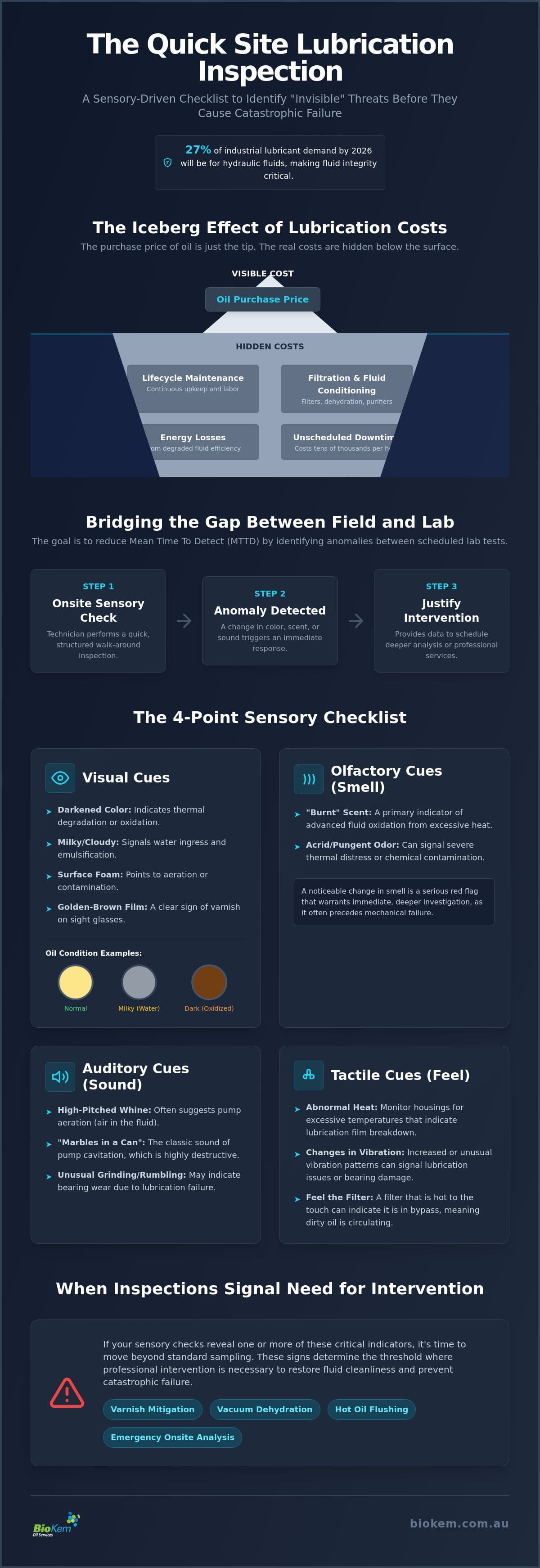
We often refer to the “Iceberg Effect” of lubrication costs. The purchase price of the oil is merely the visible tip. The submerged, larger portion of the cost involves lifecycle maintenance, filtration, and the energy losses associated with degraded fluid. By identifying red flags early, you address the root causes before they impact the bottom line or compromise safety standards.
Bridging the Gap Between Field and Lab
Field inspections serve as a critical bridge to laboratory analysis. If a technician notices a change in oil colour or a burnt scent during their walk-around, they shouldn’t wait for the next scheduled sample date. Conducting a quick site lubrication system inspection provides the immediate data needed to justify an out-of-cycle intervention. These early warning indicators should trigger immediate onsite oil analysis to quantify the threat.
Documenting these trends over time creates a predictive model for component end-of-life. When you consistently record sensory data alongside lab results, you gain a clearer picture of how specific assets behave under load. This allows for more precise scheduling of interventions like varnish mitigation or vacuum dehydration, ensuring that maintenance is performed based on actual fluid condition rather than arbitrary calendar dates.
The 4-Point Sensory Checklist for Onsite Inspections
Effective reliability isn’t just about managing digital data; it’s about the physical interaction between the technician and the machine. While modern sensors provide constant streams of information, they don’t always perceive the subtle environmental shifts that a trained eye or ear can detect. Conducting a quick site lubrication system inspection relies on four primary sensory inputs to catch failures in their infancy before they escalate into costly repairs.
- Visual: Look for changes in clarity, colour shifts, or the presence of surface foam and “cloudiness” in sight glasses.
- Olfactory: A “burnt” or acrid scent often indicates advanced fluid oxidation or thermal distress.
- Auditory: Listen for high-pitched pump whines or “marbles in a can” sounds that signal aeration or cavitation.
- Tactile: Monitor housings for abnormal heat signatures or changes in vibration patterns that suggest lubrication film breakdown.
Visual Indicators and What They Reveal
Visual cues are often the first line of defence. When oil begins to darken significantly, it usually points toward thermal degradation or the onset of oxidation. If the fluid takes on a milky, opaque appearance, you’re likely dealing with water ingress and subsequent emulsification. While a “Crackle Test” can confirm the presence of free water in the field, a visual inspection of the reservoir’s bottom or sight glass remains the most efficient method for immediate detection. Persistent foam on the surface is equally concerning, as it suggests the oil’s air-release properties have been compromised, possibly due to additive depletion or external contamination.
Auditory and Tactile Red Flags
Sound and heat provide critical context that sight alone might miss. In hydraulic systems, aeration typically produces a high-pitched whine, whereas cavitation often sounds like gravel moving through the pump. These auditory markers indicate that air or vapour bubbles are collapsing under pressure, which can erode metal surfaces in seconds. By consistently conducting a quick site lubrication system inspection, technicians can hear these shifts in frequency before mechanical damage becomes irreversible.
Tactile inspections should be validated with infrared thermometers to identify specific “hot spots” on bearing housings or gearboxes. A sudden, sharp rise in operating temperature is often the final warning before a total component seizure occurs, signaling that the lubricant’s film strength has completely failed. If your sensory inspection reveals these red flags, utilizing patch test kits can provide a quick, onsite confirmation of particulate or varnish levels before you escalate to full laboratory analysis.
Identifying Critical Contamination and Varnish Indicators
While basic sensory checks identify obvious failures, detecting the early stages of chemical degradation requires a more nuanced eye. One of the most significant threats to modern machinery is oil varnish. This soft contaminant often appears as a characteristic “golden” or “brownish” film on sight glasses and internal surfaces. It’s a byproduct of oil oxidation and thermal stress that standard mechanical filters typically cannot capture. Because these sub-micron particles are too small for conventional filtration, they remain in the fluid until they precipitate onto cooler metal surfaces, leading to catastrophic component failure.
Conducting a quick site lubrication system inspection should always include a check for these surface deposits. If you notice a change in the clarity of the sight glass or a staining of the glass itself, it’s a clear signal that the fluid’s chemistry is shifting. To validate these findings without waiting for a lab report, technicians can use patch test kits. These kits provide a rapid, onsite particulate assessment, allowing you to see the actual contamination levels and varnish potential in real-time. This immediate feedback is essential for maintaining effective oil contamination control.
Varnish: The Silent Killer of Turbines and Hydraulics
Varnish is particularly destructive in precision systems where clearances are tight. It causes solenoid valves to stick and sensors to provide inaccurate readings, which can lead to sudden, unexplained trips in turbine systems. During a tank inspection, look for “sludge” or sticky residues in the corners of the reservoir or on the baffle plates. There’s a direct relationship between oil temperature and varnish precipitation; as the oil cools in low-flow areas or during shutdown, the varnish drops out of the solution and coats the metal. This makes the “cold” areas of your system the best places to look for early indicators during your walk-around.
Water and Particulate Contamination
Beyond varnish, “free water” represents a severe risk in high-pressure hydraulic systems. It compromises film strength and promotes corrosion. When interpreting ISO 4406 cleanliness codes in the field, remember that a single-digit increase in the code represents a doubling of the contaminant level. If your inspection reveals hazy oil, the saturation point has likely been exceeded. Often, the entry point for this moisture and atmospheric dust is a failed breather. Conducting a quick site lubrication system inspection must include a physical check of these breathers to ensure they haven’t reached their capacity or become damaged, as they’re the primary line of defence against the external environment.
Optimising Your Inspection Route for Maximum Efficiency
Efficiency in a reliability programme isn’t merely about speed; it’s about the strategic allocation of technical resources. Conducting a quick site lubrication system inspection requires a structured workflow that prioritises assets based on their criticality to production and their historical failure patterns. By mapping a logical path through the facility, technicians can maximise their coverage while focusing on the components most likely to exhibit early warning signs.
Standardisation is the second pillar of an optimised route. Every machine should have a clearly defined “Normal” state, documented through visual aids and baseline data. This makes any deviation immediately obvious to the technician. To facilitate this, maintenance teams should follow a structured four-step optimisation process:
- Step 1: Map the critical path based on asset criticality and failure history.
- Step 2: Install hardware aids like 3-D sight glasses and paddle flushing screens to enable rapid visual confirmation of fluid health.
- Step 3: Standardise the “Normal” state for every machine using reference photos or limit markers.
- Step 4: Use a digital log to capture sensory data and photos, allowing for year-over-year comparison and trend analysis.
Designing the Inspection Path
The reservoir should always serve as the primary stop on any inspection route. As the central hub of the lubrication system, it acts as a settling tank where contaminants like water and heavy particulates are most visible. Technicians should also prioritise checking filter differential pressure gauges. A sudden drop in pressure might indicate a bypassed or ruptured element, while a sharp increase signals that the system is actively fighting a contamination event. Daily walk-arounds are essential for high-criticality assets, while weekly deep-dives are sufficient for secondary systems.
Hardware Upgrades to Simplify Inspections
Investing in modern monitoring tools significantly reduces the time required for manual checks. The installation of permanent particle pal units allows for real-time monitoring of ISO cleanliness codes and water content without pulling a manual sample. Similarly, upgrading to high-performance Filters S.p.A. housings with clear, integrated indicators ensures that filter health is visible at a glance. High-quality desiccant breathers further simplify the process by preventing moisture and dust ingress, which directly reduces the frequency of required oil changes and tank cleanings.
If you’re looking to enhance your facility’s diagnostic capabilities, consider exploring our full range of specialist oil filters and monitoring hardware to streamline your next inspection.
When Quick Inspections Signal the Need for Professional Intervention
A structured walk-around is the first line of defence, but it’s equally important to recognise when a problem exceeds the capacity of onsite maintenance teams. Determining the “Point of No Return” involves identifying anomalies that standard filtration and top-ups cannot rectify. If conducting a quick site lubrication system inspection reveals persistent emulsified water, high-load particulate contamination, or significant varnish plating, the system has likely crossed the threshold into a critical failure state. At this stage, continuing operation without professional intervention risks catastrophic component damage and prolonged downtime.
BioKem provides a logical, technical pathway for system recovery that prioritises fluid longevity and mechanical reliability. Our approach integrates advanced purification technologies with deep technical expertise to restore assets to their optimal baseline. By addressing the root cause of contamination rather than just the symptoms, we ensure long-term operational health and regulatory compliance. This structured flow mirrors the scientific processes required to solve complex industrial challenges.
Advanced Remediation Techniques
When internal system surfaces are coated in debris or varnish, simple oil changes are insufficient. Hot oil flushing is the industry standard for restoring system cleanliness after a major contamination event or overhaul. This process utilizes high-velocity, turbulent flow to lift and remove stubborn deposits that normal fluid circulation misses. For critical turbine assets, dedicated varnish mitigation is essential to prevent solenoid sticking and ensure precise control response.
If your facility requires temporary capacity for large-scale water removal, vacuum dehydration is the most effective mechanism for restoring dielectric strength and preventing corrosion. These systems are available through our equipment hire services, providing a practical solution for short-term purification projects. By conducting a quick site lubrication system inspection and identifying these needs early, you can deploy these advanced technologies before component wear becomes irreversible.
Partnering with BioKem Oil Services
BioKem offers nationwide support across Australia, serving critical sectors like mining, power generation, and heavy manufacturing. We understand that every industrial challenge is unique, which is why we provide turnkey solutions from initial analysis to final execution. Our specialists don’t just supply hardware; they deliver comprehensive fluid management strategies that anchor global scientific standards in a dependable, local context.
Our commitment to sustainability and technical excellence makes us a reliable partner for solving your most complex lubrication issues. If your recent inspections have raised concerns about fluid integrity or system reliability, it’s time to seek expert guidance. Contact BioKem for a professional system audit and oil analysis to secure the future of your critical assets.
Securing Asset Reliability Through Proactive Vigilance
A structured approach to fluid management transforms routine walk-arounds into a powerful diagnostic tool. By mastering the sensory indicators of oxidation and varnish, you bridge the critical gap between monthly lab reports and real-time operational shifts. Conducting a quick site lubrication system inspection ensures that “invisible” contaminants like sub-micron particulates don’t lead to unscheduled downtime or costly component seizures. Precision hardware, such as 3-D sight glasses and paddle flushing screens, further streamlines this process by making anomalies obvious at a glance.
When sensory red flags indicate that a system has reached its saturation point, professional intervention is the only path to full recovery. BioKem stands as the sole Australian distributor for Filters S.p.A. products and remains a leader in high-velocity hot oil flushing and varnish mitigation. Whether you require comprehensive laboratory analysis or onsite technical support, our team delivers the expertise needed to restore your machinery to its peak baseline. Request an onsite oil analysis or system audit from BioKem today to safeguard your critical industrial infrastructure. Proactive maintenance is your most sustainable path toward long-term equipment health.
Frequently Asked Questions
How often should I conduct a lubrication system inspection?
High-criticality assets require daily walk-arounds to identify rapid shifts in fluid condition or mechanical performance. Secondary or non-critical systems can typically follow a weekly inspection schedule. The exact frequency should be determined by your facility’s specific asset criticality ranking and historical failure data, ensuring that resources are focused where the risk of unscheduled downtime is highest.
What is the most common sign of oil contamination I can see with the naked eye?
A milky or hazy appearance is the most frequent visual indicator of contamination, signaling that water has entered the system and become emulsified. You might also notice the oil darkening significantly, which suggests advanced oxidation or thermal degradation. If you see surface foam in the reservoir, it’s a sign that the oil’s air-release properties have been compromised by contaminants or additive depletion.
Can I rely solely on visual inspections for my hydraulic systems?
Visual checks are an essential filter but they aren’t a replacement for comprehensive laboratory analysis. While conducting a quick site lubrication system inspection identifies obvious water ingress or foaming, it can’t detect sub-micron varnish precursors or the depletion of critical chemical additives. You must integrate these sensory walk-arounds with periodic professional oil analysis to maintain a complete understanding of your system’s internal health.
What does it mean if my oil smells like it is burning?
An acrid or “burnt” scent is a definitive indicator of advanced fluid oxidation or severe thermal distress. This chemical shift happens when the lubricant is exposed to temperatures beyond its design limits, causing the base oil and additives to break down. This process often leads to the formation of sludge and varnish, which can quickly compromise the reliability of precision components like solenoid valves.
How do I know if I need a professional hot oil flush or just a filter change?
A filter change is a routine maintenance task designed to remove suspended solids from the fluid stream. You require a professional hot oil flush when inspections reveal internal plating, heavy sludge deposits, or after a catastrophic component failure where debris has permeated the entire circuit. High-velocity flushing utilizes turbulent flow to lift and remove contaminants that standard filtration and circulation simply cannot reach.
What is the difference between free water and emulsified water in oil?
Free water has exceeded the oil’s saturation point and physically separates, typically settling at the bottom of the reservoir where it’s easily drained. Emulsified water remains chemically suspended within the fluid, giving it a cloudy or milky appearance. While free water is a serious risk, emulsified water is often more destructive and requires advanced remediation techniques like vacuum dehydration for effective removal.
Is varnish visible in a standard oil sample?
Varnish is rarely visible in a standard oil sample because it’s a soft contaminant that tends to precipitate onto cooler metal surfaces rather than staying in suspension. You’re more likely to spot it as a golden-brown film on sight glasses or internal housings during a physical check. Detecting varnish before it plates out requires specialized laboratory tests, such as Membrane Patch Colorimetry, which quantifies the fluid’s varnish potential.
What tools do I need for a quick site lubrication inspection?
Effective inspections require a combination of sensory skill and simple diagnostic tools. Technicians should use high-intensity flashlights to inspect sight glasses and infrared thermometers to validate thermal anomalies on bearing housings. Conducting a quick site lubrication system inspection is further improved by permanent hardware like 3-D sight glasses and onsite patch test kits, which provide immediate confirmation of particulate levels without the delay of laboratory shipping.