

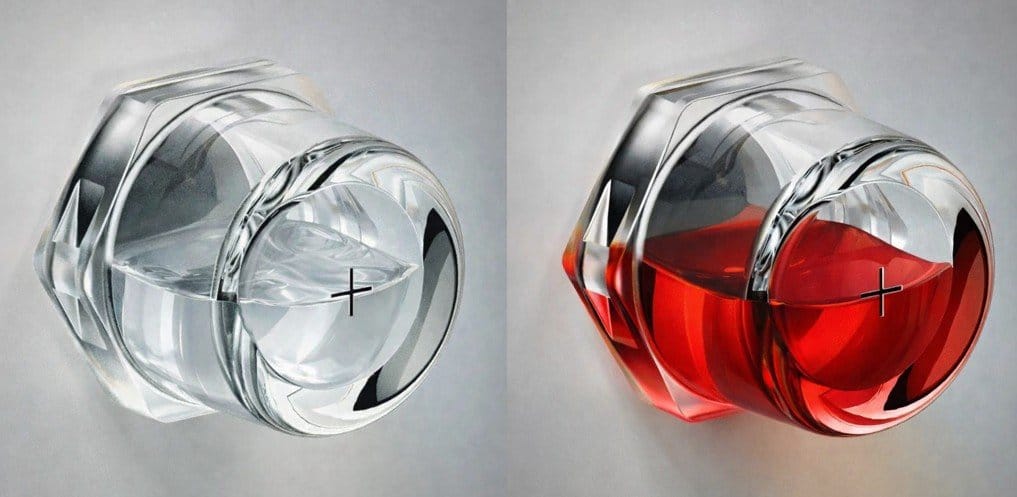
A lubricant you cannot see is a liability you cannot manage. In high-stakes industrial environments, the dyeing of lubricants to allow for observation in level gauges and tank bullet level indicators isn’t just about visual convenience; it’s a proactive strategy for asset protection. You’ve likely felt the tension of inspecting a sight glass in poor lighting, unsure if the clear fluid is at the correct level or if a leak has gone unnoticed. This uncertainty often leads to a valid concern that a simple visual error might cause a catastrophic mechanical failure or costly unplanned downtime.
We understand that while visibility is vital, you’re rightfully concerned about additive compatibility and maintaining fluid chemistry. This article provides a technical roadmap for safely enhancing lubricant visibility without compromising your equipment’s reliability. You’ll learn about precise dosing rates, which typically range from 50 to 200 ppm for liquid oils, and how to ensure your modifications align with ASTM D1500 color standards. We will outline the best practices for selecting oil-soluble dyes that ensure your critical assets remain monitored, protected, and fully compliant with modern oil analysis standards.
Key Takeaways
- Understand why visual confirmation remains the gold standard for backup monitoring and how to eliminate the risk of “phantom levels” in your indicators.
- Identify the technical differences between oil-soluble tinctorial agents used for visibility and standard fluorescent dyes used for leak detection.
- Learn the precise protocols for the dyeing of lubricants to allow for observation in level gauges and tank bullet level indicators without causing fluid over-saturation.
- Discover how to maintain the accuracy of your oil analysis results, including ISO 4406 particle counts and elemental analysis, after introducing dyes.
- Establish a clear standard operating procedure to integrate lubricant dyeing into a comprehensive proactive maintenance and contamination control program.
Table of Contents
The Critical Role of Lubricant Visibility in Asset Protection
Visual confirmation remains the primary line of defense in industrial fluid management. While electronic sensors provide essential data, they don’t offer the immediate, undeniable clarity of a physical sight glass. In Australian industrial environments, where extreme temperatures and high dust loads are standard, the dyeing of lubricants to allow for observation in level gauges and tank bullet level indicators serves as a critical fail-safe. It eliminates the dangerous ambiguity that often plagues maintenance teams during routine inspections, transforming a difficult task into a precise observation.
To better understand how these indicators function in a real-world setting, watch this helpful video:
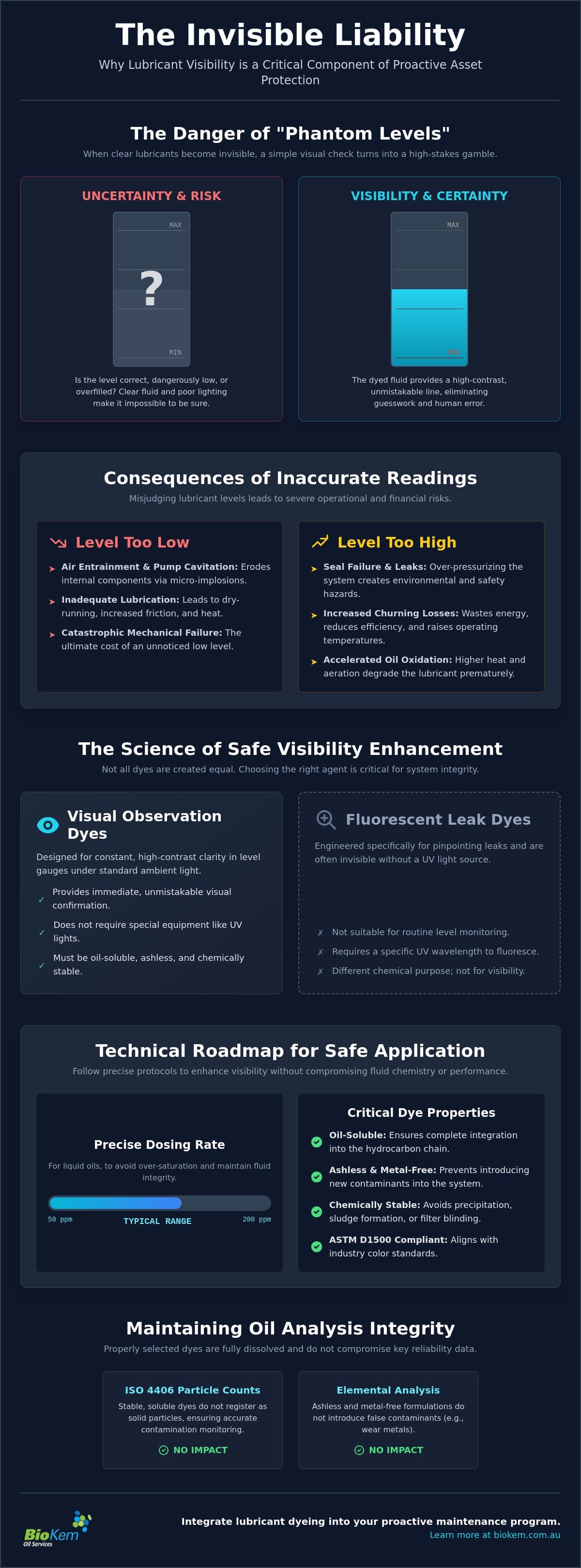
One of the most persistent risks in fluid monitoring is the "phantom level." This occurs when a lubricant is so clean and clear that it becomes invisible within a glass or plastic indicator, leading an operator to believe the reservoir is empty. Conversely, if a gauge is stained or the oil is severely darkened, it may appear full even when the level has dropped dangerously low. The dyeing of lubricants to allow for observation in level gauges and tank bullet level indicators provides the high contrast necessary to spot these discrepancies instantly. This immediate visibility facilitates faster leak detection, allowing teams to intervene before a minor drip becomes a catastrophic failure.
Challenges in Monitoring Clear or Dark Lubricants
Modern synthetic lubricants often possess a high viscosity index and exceptional clarity. This purity, while beneficial for performance, creates a "disappearing oil" effect within clear sight tubes. Conversely, as lubricants age, thermal stress and oxidation cause the fluid to darken significantly. This opacity obscures the meniscus, making it nearly impossible to distinguish between a full reservoir and an empty one. Environmental factors like grime and low-light conditions in plant rooms further exacerbate these visibility issues, making a simple check a source of significant error.
Consequences of Inaccurate Level Readings
Inaccurate readings carry severe operational and financial risks. A low oil level that goes undetected leads to air entrainment and pump cavitation, which physically erodes internal components through high-pressure micro-implosions. On the other hand, overfilling creates hazards such as seal failure and increased churning losses, which diminish energy efficiency and increase operating temperatures. Integrating reliable visual indicators into your proactive maintenance strategies ensures that assets operate within designed parameters, preventing dry-running and supporting long-term asset health.
The Science of Lubricant Dyes: Enhancing Observation Safely
Lubricant dyes are highly concentrated, oil-soluble tinctorial agents designed for hydrocarbon compatibility. While fluorescent leak detection dyes require an ultraviolet light source to function, visual observation dyes provide constant, high-contrast clarity under standard ambient conditions. This distinction is critical for plant reliability. The dyeing of lubricants to allow for observation in level gauges and tank bullet level indicators should be treated as a technical fluid modification. Choosing an incompatible agent can lead to chemical fallout or compromised additive performance. To maintain system integrity, formulations must be ashless and metal-free, ensuring they do not introduce contaminants that could skew oil analysis results or react with the lubricant’s existing additive package.
Chemical stability is the most vital attribute of a professional-grade dye. If a dye is not properly integrated into the hydrocarbon chain, it may precipitate out of the solution. This fallout creates a fine sludge that accumulates in low-flow areas or prematurely blinds specialist oil filters. Using high-quality, stable dyes ensures that the colour remains uniform throughout the fluid’s service life, providing reliable visual data without the risk of internal component fouling.
Solubility and Compatibility Requirements
Water-based dyes are strictly prohibited in industrial lubrication systems because they introduce moisture, leading to emulsions and accelerated oxidation. Effective dyes must demonstrate total solubility in mineral oils, Polyalphaolefins (PAO), and Group III synthetics. Beyond solubility, it is essential to monitor the impact on foaming characteristics. High-quality dyes are formulated to ensure they do not alter the fluid’s surface tension, which prevents air entrainment and maintains the efficiency of high-performance filtration components.
Selecting the Right Colour Spectrum
Red, blue, and green are the primary choices for industrial contrast. Red is often used to denote high-heat applications, whereas blue provides a sharp meniscus line against the metallic internals of a tank bullet indicator. These colours must remain stable under various lighting sources, including modern LED fixtures and natural sunlight, to ensure operators can verify levels without hesitation. This visual clarity is a cornerstone of effective fluid management, allowing for immediate identification of the correct fluid during top-ups.
Application Guide: Dyeing Lubricants for Level Indicators
The dyeing of lubricants to allow for observation in level gauges and tank bullet level indicators requires a calculated approach to treat rates. Achieving visual clarity does not necessitate over-saturation, which can lead to unnecessary costs or potential filter loading. For most liquid lubricants, a dosing rate between 50 and 200 ppm is sufficient to provide a distinct, readable meniscus. If you are treating greases or heavier waxes, this rate may increase toward 500 ppm to overcome the natural opacity of the base stock. The objective is to achieve a professional balance where the fluid is easily identified without becoming so dark that it obscures the internal graduation marks of the gauge.
Successful implementation depends on the mixing method. Direct injection into a large reservoir often results in poor distribution, leading to inconsistent colour zones. A more reliable method is pre-dilution. By mixing the concentrated dye into a smaller volume of the parent lubricant first, you create a mother-liquor that disperses rapidly when added to the main system. This ensures the colour remains uniform across the entire fluid volume, which is essential for accurate monitoring in high-pressure or high-flow environments.
It’s also necessary to monitor dye intensity over the fluid’s lifecycle. Industrial lubricants often face significant thermal stress, which can cause organic dye molecules to degrade or "fade" over time. If a once-vibrant blue or red fluid begins to lose its tint, it may serve as a secondary indicator of high operating temperatures or oxidation. Regular visual inspections should note these changes as part of a broader condition monitoring program.
Dyeing for High-Volume Reservoirs
Systems exceeding 10,000 litres, such as those found in bulk storage or large-scale heat transfer systems, present unique challenges. In these high-volume "bullet" tanks, ensuring uniform distribution is vital for the dye to be effective in the external level indicator. Operators should introduce the dye at a point of high turbulence, such as a pump suction or return line, to facilitate rapid blending. This ensures that the fluid visible in the sight glass accurately reflects the state of the entire reservoir.
Integration with Level Gauge Hardware
The interaction between dyed fluids and gauge materials must be considered to prevent long-term maintenance issues. High-quality dyes are formulated to be non-staining on borosilicate glass and industrial-grade polycarbonates. However, if a gauge is poorly maintained or already fouled with varnish, the dye may cling to existing deposits. Additionally, when using magnetic floats or flap-style indicators, ensure the dye’s concentration doesn’t affect the fluid’s specific gravity, though at standard treat rates, this impact is negligible. Clean, well-maintained gauges are the only way to ensure the dye remains a reliable visual tool for your team.
Managing the Impact on Oil Analysis and Reliability
Introducing any foreign substance into a lubrication system requires careful consideration of how it affects condition monitoring. A common concern among reliability engineers is whether the dyeing of lubricants to allow for observation in level gauges and tank bullet level indicators will interfere with ISO 4406 particle counts. High-quality, oil-soluble dyes are dissolved at the molecular level and typically do not contribute to particle counts. Because these tinctorial agents aren’t solid contaminants, they pass through the laser sensors used in automatic particle counters without affecting the results. However, this holds true only if the dye remains fully in solution; any precipitation or "fallout" caused by poor compatibility could lead to an artificial spike in reported contamination levels.
Elemental analysis via Inductively Coupled Plasma (ICP) is similarly unaffected by professional-grade dyes. Since these formulations are ashless and metal-free, they do not introduce trace elements like zinc, phosphorus, or calcium that would skew the additive depletion profile. The primary risk lies in the interpretation of the fluid’s physical appearance. Laboratory technicians often use colour as a secondary indicator of oxidation or contamination. If the laboratory isn’t informed that the lubricant has been dyed, they may misinterpret a vibrant red or blue tint as a sign of severe thermal distress or chemical cross-contamination. Providing the lab with a dyed baseline sample is the most effective way to prevent these false positives.
Dyes and Spectrophotometric Interference
Concentrated dyes can occasionally interfere with spectrophotometric testing, particularly Fourier Transform Infrared (FTIR) spectroscopy. Some dye molecules absorb light at wavelengths similar to those used to detect water or oxidation by-products. This interference can mask the early stages of fluid degradation if not accounted for during the baselining process. To ensure the highest level of accuracy in your oil analysis and lubricant reports, always specify the dye type and treat rate when submitting samples. This allows the lab to adjust their spectral subtraction models and maintain the integrity of your data trends.
Long-term Stability and Varnish Risks
While dyes are designed for stability, they are still organic compounds subject to thermal degradation. In high-heat zones, low-quality dyes can break down and contribute to the formation of soft contaminants or varnish. This is why selecting dyes with high oxidative stability is non-negotiable for critical assets. Monitoring for dye-induced changes in the Acid Number (AN) or viscosity is a prudent part of a proactive maintenance program. If you are concerned about how fluid modifications might be affecting your system’s health, you can contact BioKem Oil Services for a comprehensive oil analysis review.
Integrating Dyeing into a Proactive Maintenance Program
Visual monitoring serves as the ultimate validation of your automated systems. The dyeing of lubricants to allow for observation in level gauges and tank bullet level indicators should be formally codified within your facility’s Standard Operating Procedures (SOPs). Standardizing this process prevents inconsistent dosing and ensures that every operator interprets visual data correctly. It’s a technical intervention that supports broader oil contamination control efforts by providing immediate, undeniable feedback on fluid levels and potential leaks.
If your system’s sight glasses are already stained or fouled with varnish, adding dye won’t solve the underlying visibility issue. In these cases, we recommend a comprehensive hot oil flushing and filtering service before the dye is introduced. This process strips away internal deposits, ensuring that the indicator remains a high-fidelity window into the machine’s health. Integrating the dyeing of lubricants to allow for observation in level gauges and tank bullet level indicators into your maintenance schedule provides a simple yet effective visual fail-safe that complements your electronic sensors.
A successful implementation project requires a structured approach. Before starting, use this checklist to ensure all technical and safety requirements are met:
-
Verify chemical compatibility with the specific base oil chemistry.
-
Determine the precise treat rate based on total reservoir volume.
-
Implement a pre-dilution mixing protocol to ensure uniform distribution.
-
Notify your oil analysis laboratory and provide a dyed baseline sample.
-
Train site personnel on colour-coded fluid identification.
Training and Documentation
Partnering for Fluid Excellence
BioKem Oil Services acts as a technical partner in these complex fluid interventions. We don’t just suggest additives; we provide the expertise to ensure they work in harmony with your existing assets and environmental goals. As leading Australian filter distributors, we also ensure you have access to the high-performance filtration needed to maintain the clarity of your dyed lubricants. Our team focuses on localized expertise to help you achieve global standards in reliability and sustainability.
Advancing Operational Reliability Through Precise Visual Monitoring
Enhancing fluid visibility is a vital step in any proactive maintenance strategy. By selecting chemically stable, ashless dyes, you eliminate the dangerous ambiguity of "phantom levels" and ensure your team makes accurate assessments in any lighting condition. This technical intervention provides a critical fail-safe for your most valuable assets. The dyeing of lubricants to allow for observation in level gauges and tank bullet level indicators supports long-term reliability without compromising the integrity of your oil analysis data.
As the sole Australian distributor for Filters S.p.A., BioKem Oil Services provides the specialized expertise and high-performance consumables necessary for these fluid modifications. Our team offers comprehensive onsite technical support across Australia, specializing in varnish mitigation and hot oil flushing to ensure your systems remain clean and efficient. We’re committed to helping you bridge the gap between automated sensor data and undeniable physical observation. Contact BioKem Oil Services for professional oil analysis and fluid maintenance solutions to optimize your asset protection protocols. With the right technical partnership, you can maintain total clarity over your industrial fluid systems.
Frequently Asked Questions
Will adding dye to my oil void the manufacturer’s warranty?
Adding dye typically won’t void a manufacturer’s warranty if the additive is ashless, metal-free, and doesn’t alter the fluid’s physical properties. Most OEMs accept the use of chemically stable, oil-soluble dyes that don’t interfere with the lubricant’s performance package. You should always verify compatibility with your specific equipment manufacturer and maintain documentation of the dye’s Safety Data Sheet (SDS) to ensure compliance with the 2026 Hazard Communication Standards.
Can lubricant dyes be used in food-grade (H1) applications?
Yes, lubricant dyes can be used in H1 applications if they are specifically formulated and registered by the NSF. These dyes must adhere to ISO 21469:2006 hygiene requirements for incidental food contact. The FDA sets a limit of 10 parts per million for lubricant base oils in food, so ensuring your dye and dosing rate meet these strict safety standards is essential for regulatory compliance and food safety.
How much dye is typically required for a standard hydraulic reservoir?
The typical dosing rate for liquid dyes is between 50 and 200 ppm for lubricant oils. For a standard 1,000 litre hydraulic reservoir, you would require approximately 50 to 200 millilitres of dye. The dyeing of lubricants to allow for observation in level gauges and tank bullet level indicators is highly efficient, as these concentrated agents provide significant tinctorial strength at low concentrations without affecting fluid chemistry or filter performance.
Do dyes lose their colour over time in high-temperature systems?
Fading can occur in high-temperature systems due to the thermal degradation of organic dye molecules. While high-performance dyes are designed for stability, prolonged exposure to extreme heat or oxidative stress can eventually reduce colour intensity. If you notice significant fading, it may indicate that your lubricant is experiencing thermal runaway or that the fluid’s service life is nearing its end, serving as a secondary diagnostic tool.
Is it possible to remove dye from oil once it has been added?
Removing dye from oil is extremely difficult because these agents are dissolved at the molecular level. Standard mechanical filtration and even vacuum dehydration are generally ineffective at removing oil-soluble dyes. If the colour needs to be eliminated, a partial or full fluid replacement is usually the only practical solution. This makes it critical to confirm your chosen colour and treat rate before implementing a visibility enhancement project.
Will the dye affect the performance of my oil-water separator?
High-quality lubricant dyes are formulated to be fully oil-soluble and shouldn’t affect the performance of an oil-water separator. Because they don’t alter the fluid’s surface tension or create emulsions, the separation process remains efficient. Using low-quality or water-based dyes can compromise these systems by promoting emulsification, making chemical compatibility checks a priority before any addition to your high-volume reservoirs or tank bullets.
Can I use fluorescent dyes for visual level observation?
Fluorescent dyes are not ideal for routine visual observation because they require an ultraviolet light source to become visible. For monitoring sight glasses under ambient light, you should use visual observation dyes. The dyeing of lubricants to allow for observation in level gauges and tank bullet level indicators relies on high-contrast, oil-soluble pigments that remain visible without specialized lighting equipment, ensuring constant monitoring capability for site personnel.
Does the dye change the viscosity or lubrication properties of the oil?
At standard treat rates of 50 to 200 ppm, dyes do not change the viscosity or lubrication properties of the oil. These agents are highly concentrated and represent a negligible fraction of the total fluid volume. As long as the dye is ashless and metal-free, the lubricant’s ability to protect internal components remains intact, and its ASTM D1500 color scale rating will simply shift to reflect the new tint.