

What if the lubricant currently circulating through your machinery isn’t a consumable expense but a permanent asset? Many operators assume that oil naturally degrades over time, yet the reality is that industrial lube oil rarely “wears out.” It simply becomes contaminated. If you’re asking how to increase the life of your lube oil? the answer lies in shifting from reactive replacement to precision purification. Just as a homeowner might choose Rescue and Restore LLC to refinish high-quality wooden cabinets instead of replacing them, industrial operators can extend the life of their fluids through expert care. We understand the pressure of rising lubricant costs and the environmental mandate to reduce waste, particularly as the April 2026 EPA amendments increase the focus on industrial monitoring and operational efficiency.
You likely already know that unscheduled downtime due to component wear is one of the most significant drains on your bottom line. By adopting advanced technical strategies, you can achieve extended oil drain intervals and significantly improved equipment reliability. This article explores the professional maintenance methods used by industry leaders, such as varnish mitigation and vacuum dehydration, to provide a clear ROI on your oil maintenance programs. We’ll outline how to transform your lubrication strategy into a sustainable, cost-effective system that protects your assets indefinitely.
Key Takeaways
- Identify the “Triple Threat” of oxidation, thermal degradation, and contamination to understand why industrial lubricants fail prematurely.
- Discover how to increase the life of your lube oil? through proactive contamination control and the implementation of high-efficiency filtration systems.
- Learn why specialized methods like varnish mitigation and vacuum dehydration are essential for removing dissolved contaminants that standard filters cannot reach.
- Use precision oil analysis as a diagnostic roadmap to move beyond simple pass/fail testing and establish data-driven sampling frequencies based on asset criticality.
- Quantify the economic and environmental benefits of a total fluid management strategy that prioritizes purification over frequent oil replacement and disposal.
Understanding the Mechanisms of Lubricant Degradation
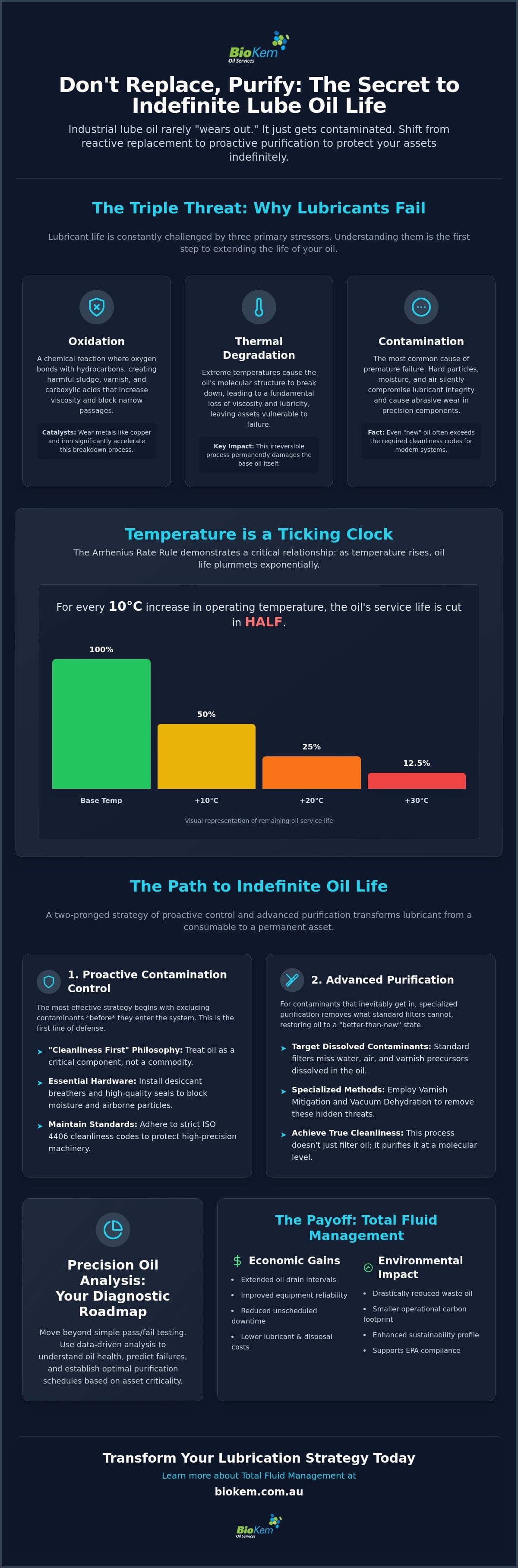
Lubricant life is the functional duration before the base oil or its additive package fails to provide necessary protection for the asset. In high-demand industrial sectors, this life cycle is constantly challenged by the “Triple Threat”: oxidation, thermal degradation, and contamination. Learning how to increase the life of your lube oil? requires a departure from simple schedule-based changes toward a deeper understanding of these chemical and physical stressors. This proactive approach treats the lubricant as a critical component rather than a disposable commodity.
Industrial environments create a perfect storm for lubricant failure. High pressures, extreme temperatures, and constant exposure to moisture catalyze the breakdown of the fluid’s molecular structure. While additive depletion involves the sacrificial consumption of protective chemicals like anti-wear agents, base oil breakdown is a more fundamental failure where the fluid loses its viscosity and lubricity. When these two factors converge, the asset is left vulnerable to catastrophic failure.
To better understand this concept, watch this helpful video:
The Chemistry of Oxidation and Thermal Stress
Oxidation is a chemical reaction where oxygen molecules bond with the lubricant’s hydrocarbons. This process generates carboxylic acids and heavy sludge that can block narrow passages and increase fluid viscosity. The speed of this reaction is largely governed by temperature. Following the Arrhenius Rate Rule, every 10°C increase in a system’s operating temperature effectively halves the oil’s service life. Wear metals like copper and iron act as catalysts, speeding up the rate of chemical breakdown significantly. Utilizing Oil analysis allows maintenance teams to track these chemical shifts and intervene before the fluid reaches its terminal state.
External Contamination: The Silent Killer
External contaminants, including hard particles, moisture, and air, represent the most common cause of premature lubricant failure. Many operators mistakenly believe that oil delivered in drums or tankers is ready for immediate use. However, “new” oil often contains particle counts that exceed the tolerances of modern, high-precision hydraulic systems. Moisture is especially damaging, as it leads to hydrogen embrittlement in bearings and promotes rapid oxidation. Maintaining strict ISO 4406 cleanliness codes is the only way to ensure these silent killers don’t compromise your machinery. By controlling the ingress of these elements, you can preserve the chemical integrity of the oil and extend its functional lifespan.
Proactive Contamination Control and Filtration
Adopting a “cleanliness first” philosophy is the most effective way to protect your industrial assets. If you’re investigating how to increase the life of your lube oil? you’ll find that the most effective strategy begins with excluding contaminants before they reach the reservoir. Most industrial systems fail not because the oil is old, but because it’s dirty. By the time a particle is visible to the naked eye, it’s already large enough to cause significant abrasive wear in high-precision components. Proactive control focuses on maintaining a closed system where air, moisture, and silica are strictly managed.
Desiccant breathers and high-quality seals act as the first line of defense. Standard filler caps often allow humid, particle-laden air to enter the tank as the oil level fluctuates. Replacing these with desiccant breathers ensures that only clean, dry air enters the system. Similarly, maintaining rod wipers and cylinder seals prevents environmental dust from being “pumped” into the hydraulic circuit during normal operation. These simple mechanical barriers significantly reduce the burden on your primary filtration system.
Selecting High-Performance Filtration Hardware
Effective filtration isn’t just about catching dirt; it’s about the efficiency of the media. Engineers use Beta ratios to measure this performance. While a standard filter might have a Beta 75 rating, the industrial gold standard is a Beta 1000 rating, which signifies 99.9% efficiency at a specific micron size. For critical systems where reliability is non-negotiable, utilizing Filters S.p.A. products provides the high-efficiency depth filtration required to capture sub-micron silt. When sizing these units, you must balance the flow rate against dirt-holding capacity. A filter that’s too small will frequently go into bypass, allowing unfiltered oil to circulate and defeating the purpose of the installation.
ISO 4406: Setting and Achieving Cleanliness Targets
The ISO 4406 standard provides a three-digit code representing the number of particles at 4, 6, and 14 microns. Setting a target cleanliness level depends on the sensitivity of your equipment. For instance, a gearbox might tolerate an ISO 18/16/13, but a high-pressure system with sensitive servo valves requires a much cleaner fluid. Achieving an ISO 16/14/11 target is essential for high-pressure hydraulics because even microscopic particles can cause catastrophic erosion in tight-tolerance orifices. Industry data suggests that reducing a single ISO code can often double the life of a component by significantly slowing the rate of mechanical wear. Implementing these standards requires a commitment to quality hardware, such as specialist oil filters designed for precision performance.
Advanced Purification: Varnish Mitigation and Dehydration
Standard mechanical filtration is an essential baseline for any maintenance program, but it has distinct physical limitations. While high-efficiency filters capture suspended solids, they cannot remove dissolved chemical contaminants. If your goal is to understand how to increase the life of your lube oil? you must look beyond simple particle counts. Varnish and moisture represent the most significant chemical threats to lubricant longevity and asset health. These contaminants require advanced purification methods that function like a “kidney loop,” continuously cleaning the oil while the system remains in operation.
Varnish is perhaps the most insidious threat to turbine and hydraulic reliability. It manifests as a sticky, resinous film that coats internal surfaces, leading to sticking valves and significant cooler inefficiency. Because varnish precursors are soluble in warm oil, they pass right through standard filters. They only precipitate into solid deposits when the oil cools or becomes saturated. This chemical degradation cycle can’t be stopped by mechanical means alone; it requires specialized molecular-level intervention to restore the oil’s chemistry.
Varnish Mitigation Strategies
Soluble oxidation products are the primary building blocks of varnish. When these products accumulate, they eventually drop out of solution to form hard, lacquer-like deposits on critical components. Implementing varnish removal systems is a proven strategy for maintaining turbine reliability and preventing costly unscheduled trips. To manage this effectively, maintenance teams utilize Membrane Patch Colorimetry (MPC) testing. This diagnostic tool measures the varnish potential of the oil, providing a numerical value that indicates when purification is necessary before physical deposits begin to form. It’s a proactive way to ensure your fluid remains chemically stable.
Vacuum Dehydration for Moisture Removal
Water is a relentless catalyst for oxidation and acid formation. It exists in oil in three distinct states: dissolved, emulsified, and free water. While free water may eventually settle in the tank, dissolved and emulsified moisture are much harder to extract. Standard coalescing filters often fail in high-viscosity or detergent-heavy oils because the additive chemistry prevents water droplets from merging effectively. Vacuum dehydration solves this by lowering the atmospheric pressure within a vacuum chamber, allowing water to boil off at temperatures as low as 50°C. This process removes all three states of water without compromising the oil’s chemical integrity. Maintaining moisture levels below 100 ppm is a critical benchmark for preventing hydrogen embrittlement and is a key step when you want to know how to increase the life of your lube oil? for the long term.
Precision Oil Analysis: The Roadmap for Extension
Effective maintenance programs rely on empirical data rather than arbitrary schedules. Oil analysis serves as the diagnostic roadmap for any facility manager asking how to increase the life of your lube oil? Instead of treating it as a simple pass or fail test, professionals use analysis to monitor the evolving health of both the fluid and the machine. This allows for a transition from reactive repairs to predictive maintenance, where interventions occur only when the data dictates a necessity.
Consistency in sampling is the foundation of this strategy. Developing a frequency based on asset criticality ensures that subtle shifts in fluid chemistry don’t go unnoticed. Key metrics to monitor include viscosity, which indicates the oil’s ability to maintain a protective film, and elemental analysis, which tracks both additive levels and wear metals. By observing these trends over time, you can predict potential failures and extend the service life of the lubricant far beyond manufacturer defaults.
Advanced Testing for Remaining Useful Life
Standard tests often overlook the specific health of the antioxidant package. The Remaining Useful Life Evaluation Routine (RULER) provides a targeted look at these additives, revealing how much protection remains before the base oil begins to degrade. For a more detailed investigation into mechanical health, a Filter Ferrogram identifies specific wear modes, such as fatigue or abrasion, by analyzing the morphology of captured particles. When immediate onsite confirmation is required, patch test kits allow technicians to visually assess contamination levels without waiting for laboratory results.
Interpreting the Report for Action
The goal of interpreting an analysis report is to differentiate between oil that is merely “dirty” and oil that is truly “dead.” Dirty oil requires specialized filtration or purification to restore its cleanliness, whereas dead oil has suffered irreversible chemical breakdown and must be replaced. Setting clear alarm limits for wear metals in parts per million (ppm) and moisture as a percentage provides the framework for these decisions. A rising Total Acid Number (TAN) indicates the onset of accelerated oxidation, signaling that the fluid is becoming corrosive and losing its protective properties. To ensure your assets remain protected by high-quality fluids, consider implementing a professional oil analysis program to guide your maintenance decisions.
Implementing a Total Fluid Management Strategy
The transition from reactive to proactive maintenance strategies is a strategic shift that redefines lubricants as permanent assets. Instead of waiting for a scheduled change or a component failure, a total fluid management strategy focuses on the continuous health of the oil through integrated technical interventions. This approach moves beyond simple filtration to encompass the entire lifecycle of the fluid, ensuring that every operational variable is managed to prevent degradation. It’s the most comprehensive answer to the question of how to increase the life of your lube oil? while simultaneously protecting the mechanical integrity of your most critical assets.
The economic case for this shift is compelling. The total cost of ownership for industrial lubricants includes not only the purchase price but also the logistical costs of transport, storage, and the high price of hazardous waste disposal. When you compare these cumulative expenses to the cost of onsite purification, the financial benefits are clear. Furthermore, a clean system is an efficient system. By maintaining fluid at peak chemical and physical performance, you reduce the internal friction and heat generation that lead to energy loss and accelerated component wear. Preparing a system for this extended service life often begins with hot oil flushing, which removes built-up debris and legacy contaminants from the pipework, creating a baseline of high cleanliness for the new or purified fluid.
The ROI of Oil Longevity
Extending lubricant service life delivers measurable returns on investment. For example, moving from a standard 2,000-hour drain interval to an 8,000-hour interval through precision maintenance effectively reduces your annual lubricant consumption by 75%. These savings extend beyond the balance sheet to your corporate sustainability goals. Reduced oil consumption directly correlates to a smaller carbon footprint and a significant decrease in the volume of waste oil generated by your facility. For operations that aren’t ready for a full capital investment in purification hardware, industrial oil filtration equipment hire provides a flexible solution for periodic system clean-ups, allowing you to achieve these results through operational expenditure.
Partnering with BioKem Oil Services
Executing a sophisticated oil life extension program requires technical expertise and specialized equipment. BioKem provides a partnership model that combines onsite purification with deep technical analysis to ensure your assets remain in peak condition. With national coverage across Australia, BioKem’s specialists manage complex industrial challenges, from varnish mitigation to EHC fluid maintenance. This localized expertise anchors global scientific standards in a dependable, practical context. To begin transforming your lubrication program from a recurring expense into a sustainable asset, Consult with BioKem today to design a tailored oil life extension program for your facility.
Optimizing Fluid Performance for Long-Term Reliability
As specialists in varnish mitigation and hot oil flushing, BioKem provides the technical expertise needed to manage your most critical assets. We’re the sole Australian distributor for Filters S.p.A. products and offer national onsite technical support to ensure your systems remain at peak performance. Contact BioKem for a professional oil analysis and longevity audit to secure the future of your facility. Implementing these advanced strategies today ensures your equipment remains reliable and your maintenance program delivers a clear, sustainable return on investment.
Frequently Asked Questions
How many times can you filter and reuse lube oil?
Industrial lube oil can be filtered and reused indefinitely as long as the base oil remains chemically stable and the additive package is sufficient. Because oil is a molecular asset rather than a consumable, removing contaminants allows it to function for years. You only need to replace the fluid when the chemical structure has suffered irreversible thermal or oxidative breakdown that standard purification cannot restore.
Does oil analysis really save money compared to regular oil changes?
Condition-based monitoring through oil analysis significantly reduces operational costs by preventing unnecessary oil changes. It identifies exactly how to increase the life of your lube oil? by confirming when purification has successfully restored the fluid’s properties. This proactive approach also detects machine wear at the microscopic level, preventing catastrophic failures that result in expensive unscheduled downtime and asset replacement.
What is the most common cause of industrial oil degradation?
Contamination from moisture and solid particulates is the leading cause of industrial lubricant degradation. While thermal stress plays a role, water and wear metals act as catalysts that speed up the oxidation process. These contaminants break down the molecular bonds in the base oil and rapidly deplete the sacrificial additive package, leading to the formation of sludge and harmful acids.
Can I extend the life of synthetic oil further than mineral oil?
Synthetic lubricants offer a much higher potential for life extension due to their superior thermal and oxidative resistance. Their engineered molecular structure is inherently more stable than mineral oil, allowing them to withstand the high-temperature environments that often trigger rapid degradation. When combined with advanced purification, synthetics provide a highly effective answer for how to increase the life of your lube oil? over multi-year cycles.
How do I know if my oil needs varnish mitigation or just a filter change?
If your system suffers from sticking valves or reduced cooler efficiency despite having clean filters, you likely require varnish mitigation. Standard mechanical filters cannot capture dissolved oxidation products that eventually precipitate as varnish on internal surfaces. A Membrane Patch Colorimetry (MPC) test is the definitive diagnostic tool to determine if your oil requires specialized chemical purification or just a standard filter replacement.
Is “new” oil clean enough to be put straight into a hydraulic system?
New oil delivered in drums or bulk tankers is rarely clean enough for direct use in sensitive hydraulic circuits. It often carries a high particulate load and moisture from the manufacturing and transport process that exceeds modern ISO 4406 cleanliness targets. Best practice dictates that all new oil should be passed through a high-efficiency filter or a kidney loop system before it enters the reservoir.
What is the difference between oil purification and oil filtration?
Filtration is the mechanical removal of solid, suspended particles through a physical medium. Purification is a broader technical intervention designed to remove dissolved contaminants, such as water, gases, and varnish precursors. While filtration handles the solid “dirt,” purification methods like vacuum dehydration and varnish mitigation address the chemical health of the lubricant to ensure long-term stability and performance.