

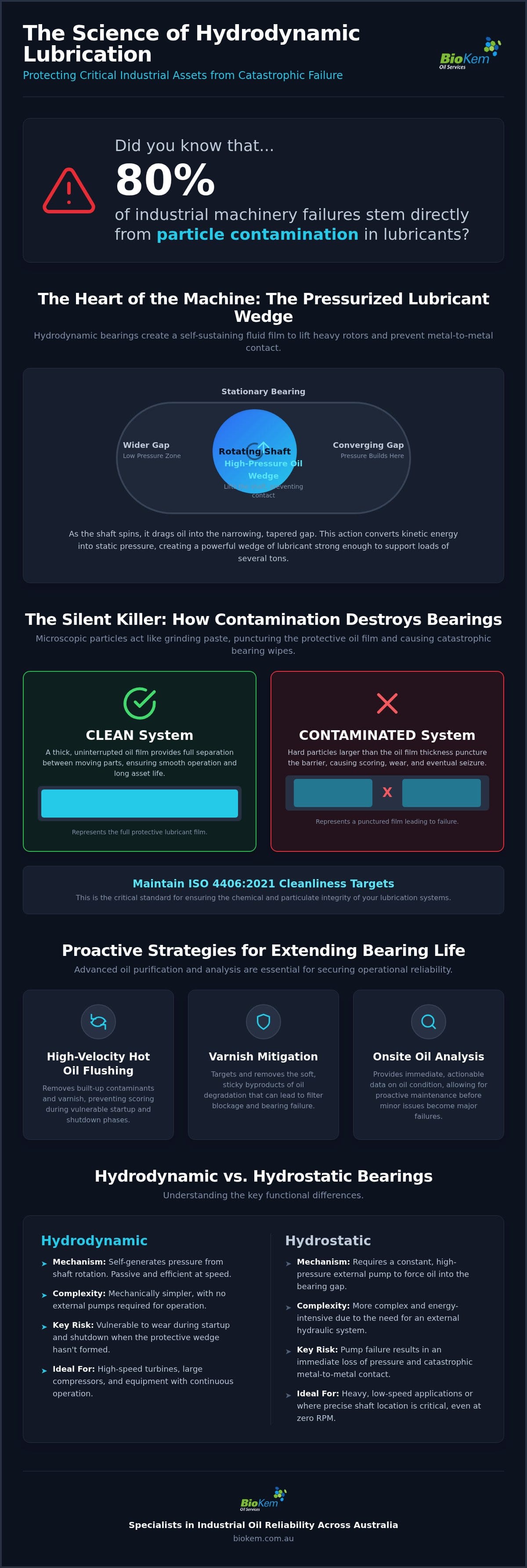
Did you know that 80% of industrial machinery failures stem directly from particle contamination? In high-speed turbines and compressors, this contamination targets the most vital component of your system: the hydrodynamic bearings – a pressurized wedge of lubricant. It’s frustrating when unscheduled downtime occurs because of a bearing wipe, especially when your oil analysis reports are clouded by confusing varnish indicators. You likely understand that maintaining these assets is a complex technical challenge, and justifying the investment in a high-velocity hot oil flush to management can feel like an uphill battle without the right data.
This guide from BioKem Oil Services helps you master the mechanics of the lubricant wedge and provides the technical justification you need to protect your critical infrastructure. We’ll explore the dynamic equilibrium of the wedge effect, practical strategies for extending bearing life, and how advanced oil purification methods like varnish mitigation secure your operational reliability. By aligning your maintenance with the latest ISO 4406:2021 standards, you can ensure your Australian operations remain both productive and environmentally responsible. Understanding these microscopic fluid dynamics is the first step toward achieving long-term asset health and avoiding the high costs of premature component failure.
Key Takeaways
- Discover how relative motion generates the necessary internal fluid pressure to lift heavy industrial rotors and prevent metal-to-metal contact.
- Learn why hydrodynamic bearings, a pressurized wedge of lubricant, are vulnerable to microscopic particles that can puncture the oil film and cause catastrophic bearing wipes.
- Identify the specific ISO 4406 cleanliness targets required to maintain the chemical and particulate integrity of your lubrication systems.
- Master the technical justification for high-velocity hot oil flushing and varnish mitigation as essential proactive strategies for extending bearing life.
- Explore how specialized onsite oil analysis and purification services across Australia can reduce unscheduled downtime and improve overall asset reliability.
Understanding Hydrodynamic Lubrication: The Science of Fluid Films
Hydrodynamic lubrication represents a pinnacle of mechanical efficiency. Unlike systems that rely on external pressure, these components generate their own protective lift through the simple physics of rotation. In critical high-speed industrial applications across various sectors globally, hydrodynamic bearings – a pressurized wedge of lubricant serve as the primary defense against catastrophic metal-to-metal contact. It’s a self-sustaining fluid film that relies on the precise interaction between surface geometry, rotational speed, and oil chemistry.
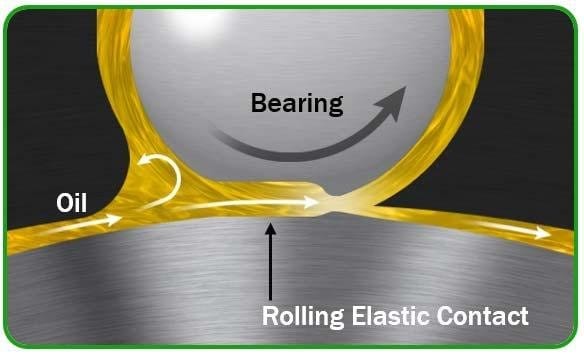
A Fluid bearing operates on the principle that a liquid can support a heavy load if it’s trapped and pressurized within a narrow space. While hydrostatic systems use external pumps to force oil into the gap, hydrodynamic systems are passive miracles. They use the journal’s rotation to drag oil into a converging clearance. This action creates a high-pressure zone that literally floats the shaft. This makes hydrodynamic bearings – a pressurized wedge of lubricant the gold standard for assets like turbines and large compressors where reliability is non-negotiable.
The Fundamental Principles of Fluid Film Separation
The process starts with adhesion and cohesion. Oil molecules cling to the moving shaft and the stationary bearing wall. As the shaft spins, it pulls layers of oil along with it. The clearance between the journal and the shell is critical. If the gap is too wide, pressure won’t build. If it’s too narrow, friction increases heat and risks a bearing wipe. Viscosity acts as the primary driver of this process. It provides the internal resistance necessary to maintain film thickness under heavy loads. In challenging industrial environments, where ambient temperatures fluctuate, maintaining the correct viscosity is essential for wedge stability.
Hydrodynamic vs. Hydrostatic: Key Functional Differences
Hydrostatic bearings require a constant external pump to maintain separation, making them complex and energy-intensive. Hydrodynamic systems are simpler but carry unique risks during startup and shutdown. When the shaft is stationary, the pressurized wedge doesn’t exist. The journal sits directly on the bearing material. As the machine accelerates, the wedge forms, lifting the load. This transition is when contamination is most dangerous. Ensuring a clean system through hot oil flushing is vital to prevent scoring during these vulnerable moments. Most high-speed turbines rely on hydrodynamic principles because they offer superior dampening and lower maintenance once operational speed is reached.
The Mechanics of the Pressurized Wedge: How It Forms and Functions
Visualizing this process often involves the Stribeck Curve. This graph illustrates the relationship between friction and the dimensionless Hersey number. It identifies the critical transition from boundary lubrication, where surfaces touch, to the full hydrodynamic regime. In this state, the lubricant film is thick enough to ensure total separation. Detailed technical resources, such as this guide on Understanding Hydrodynamic Bearings, explain how this equilibrium is maintained under varying operational stresses. Understanding this curve helps engineers predict when a bearing is at risk of entering a mixed lubrication state, where wear begins to accelerate.
The Converging Clearance and Pressure Build-up
The geometry of the converging gap is the primary driver of pressure. As the rotating journal pulls oil into the narrowing space, the fluid resists being squeezed. This resistance generates a hydrodynamic force that pushes the shaft away from the bearing wall. Calculating the minimum film thickness is a vital engineering step; it must remain larger than the combined surface roughness of the metal components to avoid contact. The pressure peak represents the point of maximum fluid compression and load support, occurring just upstream of the point where the shaft and bearing surface are closest. Professional oil analysis helps ensure that your lubricant’s chemical properties still support this pressure build-up effectively by monitoring for viscosity changes or chemical degradation.
The Role of Oil Velocity and Rotational Speed
Rotational speed is a double-edged sword for wedge stability. Increasing the RPM generally improves the lift by pumping more oil into the gap. However, once a certain threshold is reached, the flow can transition from laminar to turbulent. Turbulence disrupts the pressure gradient and increases heat generation, which can thin the oil film dangerously. Similarly, sudden load variations change the eccentricity of the shaft. A higher load forces the journal closer to the bearing shell, narrowing the gap and increasing the pressure, but also reducing the safety margin of the minimum film thickness. In Australian industrial settings, maintaining steady-state conditions is key to preventing the “sticky” bearing behavior often associated with varnish build-up and thermal instability.
Threats to the Wedge: How Contamination Destroys Bearing Integrity
Hard particles between 5 and 10 microns are particularly lethal. These particles are small enough to enter the clearance but large enough to bridge the gap between the journal and the bearing surface. This bridging causes abrasive wear. As documented in the Fundamentals of Fluid Film Lubrication, maintaining the integrity of this film is paramount for high-speed rotors. Even a small number of particles can initiate a failure sequence that bypasses standard monitoring systems until it’s too late.
Abrasive Wear and Surface Degradation
When hard particles score the soft Babbitt metal of the bearing, they create microscopic furrows. These ruts disrupt the smooth flow of oil, causing local turbulence and reducing the effective pressure of the wedge. This creates a dangerous feedback loop. Metal-to-metal contact generates heat. This heat thins the oil further, making it easier for more particles to penetrate. Standard industrial filters often miss these sub-10-micron silt particles. This is why high-velocity hot oil flushing is necessary during commissioning or after a major overhaul in Australian industrial facilities.
The Impact of Varnish on Thermal Transfer
Varnish is a silent killer of hydrodynamic equilibrium. It acts as a thermal insulator, trapping heat within the bearing rather than allowing the oil to carry it away. As temperatures rise, the lubricant’s viscosity drops. This thins the hydrodynamic bearings – a pressurized wedge of lubricant until it can no longer support the load. Varnish deposits also physically change the bearing’s internal geometry. This disruption alters the converging gap, preventing the pressure peak from forming correctly. Implementing a robust varnish mitigation strategy is the primary solution for preventing this “sticky” bearing behavior in turbines.
Water contamination represents a final, critical threat. Water lacks the load-bearing capacity of oil. In the high-pressure zone of the wedge, water can vaporize into steam or emulsify with the oil, causing the film to collapse. This loss of lubricity leads to boundary contact and rapid component failure. Regular oil analysis is required to detect these moisture ingress issues before they compromise the system’s structural integrity.
Optimizing Bearing Life: Advanced Maintenance Strategies
Shifting from reactive to proactive maintenance is the most effective way to protect capital-intensive assets. While a bearing wipe can cost an Australian operation hundreds of thousands in lost production and repair fees, the investment in precision oil purification is a fraction of that risk. Maintaining hydrodynamic bearings – a pressurized wedge of lubricant requires a commitment to chemical and particulate purity that exceeds standard industrial practices. A proactive strategy ensures the lubricant film remains robust enough to handle load variations without boundary contact, effectively shifting the operational focus from crisis management to long-term reliability.
Establishing Rigorous Oil Cleanliness Standards
For high-speed turbomachinery, achieving an ISO 4406 code of 16/14/11 is often the baseline requirement for operational safety. This specific target minimizes the presence of silt-sized particles that can bridge the clearance and initiate surface degradation. Using BioKem Oil Services Patch Test Kits allows for immediate onsite verification of fluid health, providing a visual and quantitative check against these stringent standards. To maintain this level of purity, integrating Filters S.p.A. technology is essential. These advanced filtration systems are designed for superior particulate removal, ensuring the fluid film remains an impenetrable barrier against wear even under extreme pressure.
Hot Oil Flushing: Restoring the System to “Base State”
New systems or those undergoing major overhauls contain built-in contaminants like welding slag, rust, and preservative coatings. Simple oil changes are insufficient because they only remove suspended debris rather than dislodging particles adhered to pipe walls. High-velocity BioKem Oil Services Hot Oil Flushing uses turbulent flow to dislodge sub-surface contaminants that laminar flow cannot reach. By achieving a high Reynolds Number, the fluid physically scrubs the internal piping. This process restores the system to a clean base state, ensuring that hydrodynamic bearings – a pressurized wedge of lubricant can form on a pristine surface. It’s the only way to guarantee a reliable start for critical turbine wedges in harsh Australian environments.
Precision oil analysis serves as a diagnostic window into the bearing’s operational environment. By monitoring viscosity and chemical health, you can detect early signs of the “viscosity wedge” weakening before physical damage occurs. If the oil thins or degrades, the pressure peak will drop, leading to premature failure and costly downtime. Regular chemical health monitoring anchors your global reliability goals in localized, dependable data. Contact BioKem Oil Services today to schedule a high-velocity hot oil flush and secure the future of your industrial assets.
BioKem Oil Services: Australia’s Specialists in Industrial Oil Reliability
Operational excellence in Australian heavy industry requires more than just high-quality lubricants. It demands a sophisticated approach to fluid management that accounts for regional environmental stressors and stringent regulatory requirements. BioKem Oil Services provides national coverage for onsite oil purification services, ensuring that critical assets in mining, power generation, and manufacturing remain protected. Our technicians understand that hydrodynamic bearings – a pressurized wedge of lubricant are the lifeblood of your machinery. We provide the technical expertise and specialized hardware necessary to maintain the delicate equilibrium required for these high-speed systems to function without failure.
Our commitment to sustainability is reflected in our methodology. By focusing on advanced purification rather than simple oil replacement, we help Australian businesses reduce their ecological footprint and waste disposal costs. BioKem Oil Services operates as an innovative expert, utilizing a sophisticated blend of laboratory analysis and onsite technical reporting to guide maintenance decisions. This logical sequence of identifying a challenge and applying a scientific solution ensures that your operations remain compliant with both local standards and global best practices.
Onsite Solutions for Immediate Reliability Gains
During scheduled outages, every hour of downtime carries a significant financial weight. BioKem Oil Services technicians deploy specialized machinery, including vacuum dehydration and varnish mitigation units, to restore fluid health without removing the asset from service. These onsite interventions are designed to minimize disruption while maximizing reliability gains. For facilities managing short-term purification projects or specific contamination events, our Equipment Hire service provides access to world-class filtration technology without the need for immediate capital expenditure. This flexibility allows maintenance teams to respond quickly to emerging threats before they compromise the hydrodynamic bearings – a pressurized wedge of lubricant.
Strategic Partnership for Long-Term Asset Health
Reliability is a continuous process, not a one-off event. BioKem Oil Services establishes long-term partnerships with clients through customized maintenance programs built on oil analysis trends and chemical health monitoring. As the authorized Australian distributor for Filters S.p.A. Products, we provide local access to global filtration innovations. This synergy between localized expertise and international technology ensures that your fluid film integrity is never left to chance. Our onsite laboratory testing provides the data needed to justify advanced purification strategies to management, anchoring your operational goals in verifiable scientific results. Contact BioKem Oil Services today for a comprehensive system audit and learn how our specialized services can extend the life of your critical industrial assets.
Protecting Your Critical Fluid Films
Maintaining the integrity of your high-speed assets requires a deep understanding of fluid dynamics and a commitment to rigorous maintenance. You’ve seen how microscopic contaminants and varnish can puncture the fluid film, leading to catastrophic bearing wipes. By adopting proactive strategies like high-velocity hot oil flushing and varnish mitigation, you ensure that your hydrodynamic bearings – a pressurized wedge of lubricant remain stable under varying loads. These technical interventions are the only way to safeguard the dynamic equilibrium required for turbine and compressor reliability.
BioKem Oil Services stands ready as your reliable partner across Australia. As the authorized Australian distributor for Filters S.p.A. and specialists in high-velocity hot oil flushing, we offer a national service footprint to support your reliability goals. Ensure your critical bearings are protected with BioKem Oil Services’ specialist oil services. Our team provides the technical expertise and onsite analysis needed to justify advanced purification to management and secure long-term operational health. You can achieve zero unscheduled downtime by prioritising the chemical and particulate health of your lubricants today.
Frequently Asked Questions
What is the minimum film thickness in a hydrodynamic bearing?
The minimum film thickness in a hydrodynamic bearing generally ranges between 5 and 50 microns depending on the machine’s operational speed and load. This microscopic gap ensures that the rotating journal remains fully separated from the bearing shell. If the film drops below this threshold, metal-to-metal contact occurs, leading to rapid wear and potential seizure. Maintaining this gap requires high-quality lubricants and stringent contamination control.
Can a hydrodynamic bearing operate at zero speed?
A hydrodynamic bearing cannot maintain a protective film at zero speed because the wedge effect relies entirely on the relative motion of the shaft. Without rotation, the journal rests directly on the bearing material; this is why startup and shutdown are the most critical phases for wear. Some systems use hydrostatic lift pumps to provide separation during these low-speed intervals before the rotation takes over.
How does temperature affect the pressurized lubricant wedge?
Temperature directly impacts the viscosity of the oil, which is the primary driver of film thickness. As temperatures rise, the oil thins, reducing the load-carrying capacity of the hydrodynamic bearings – a pressurized wedge of lubricant. Excessive heat can cause the film to become dangerously thin; this increases the risk of a bearing wipe if the cooling system or oil quality fails to maintain thermal equilibrium.
What are the first signs of hydrodynamic bearing failure?
The earliest indicators of bearing failure are typically subtle increases in operating temperature and changes in vibration signatures. These symptoms often suggest that the lubricant film is thinning or that contamination is causing abrasive wear. Monitoring these trends through digital sensors allows for predictive maintenance before a catastrophic collapse of the pressurized wedge occurs, saving your operation from the high cost of unscheduled downtime.
Is hot oil flushing necessary for new industrial systems?
Hot oil flushing is essential for new industrial systems to remove built-in contaminants like welding slag, rust, and preservative coatings. These particles are often larger than the bearing’s minimum film thickness and can cause immediate scoring during the initial startup. Performing a high-velocity flush ensures that the hydrodynamic bearings – a pressurized wedge of lubricant form on a clean, debris-free surface from the very first rotation.
How often should oil analysis be performed on high-speed turbines?
Oil analysis for high-speed turbines should typically be conducted on a monthly or quarterly basis depending on the asset’s criticality and operational environment. Regular testing monitors for viscosity changes, oxidation, and the presence of sub-micron particles. This frequency allows Australian maintenance teams to identify chemical degradation or varnish precursors before they impact the stability of the lubricant wedge and lead to equipment failure.
What is the difference between varnish and sludge in bearings?
Varnish is a hard, thin, and often shiny coating formed by oil degradation products that plate out on hot metal surfaces. Sludge is a soft, thick, and heavy deposit that tends to settle in low-flow areas like tanks or sumps. While both are harmful, varnish is particularly dangerous for bearings because it acts as an insulator and disrupts the precise geometry required for the wedge to form.
Can I use any oil for a hydrodynamic bearing system?
You cannot use generic lubricants because hydrodynamic systems require oils with specific viscosity grades and thermal stability to maintain film integrity. The oil must be formulated to resist oxidation and prevent varnish formation under high-shear conditions. Selecting a lubricant that doesn’t meet the OEM’s technical specifications can lead to a premature collapse of the pressurized wedge and costly equipment damage in critical Australian infrastructure.