

Could a gearbox warning sign be hiding in the oil before it becomes an unplanned shutdown? Knowing how to prevent gearbox failure means looking beyond whether lubricant is present. Its condition, cleanliness and suitability for the operating load all matter, alongside operating conditions and early signs of wear.
When a critical gearbox stops, operations can be disrupted, and the cause isn’t always obvious. Contamination, degraded oil, excessive loading or mechanical wear may all need consideration. A consistent, condition-led maintenance routine helps teams investigate these factors early, while keeping equipment manufacturer (OEM) requirements at the centre of every decision.
This guide explains practical ways to reduce preventable failure through correct lubrication, cleaner oil, routine inspections and timely assessment. You’ll learn what to monitor, how oil analysis can inform maintenance decisions and when specialist oil-service support may be appropriate. BioKem supports industrial gearbox reliability in Australia through services including Hot Oil Flushing, Vacuum Dehydration, Fuel & Oil Filtration and coalescing, and Condition Monitoring. These oil-management capabilities can form part of a broader reliability strategy, alongside mechanical assessment where equipment condition calls for it.
Key Takeaways
- To understand how to prevent gearbox failure, investigate lubrication, contamination, operating conditions and mechanical damage rather than assuming one cause.
- Don’t rely on oil appearance or a single warning sign to determine gearbox health. Use appropriate checks to guide the next step.
- Build a routine around OEM requirements, baseline observations, planned inspections and trending findings over time.
- Separate operator observations from technical inspections, and escalate concerns for suitable diagnostic assessment.
- Oil analysis, Vacuum Dehydration, filtration and Hot Oil Flushing may support gearbox reliability when the equipment condition and agreed scope make them suitable.
How to prevent gearbox failure starts with understanding its main causes
Gearbox failure means the unit can no longer perform its required function to specification. It may involve a loss of power transmission, unreliable operation or damage that makes continued use unsuitable. A symptom is evidence that something may need attention, not proof of what has failed or why. For teams considering how to prevent gearbox failure, separating observation from diagnosis is a practical starting point.
Investigate potential contributors rather than settling on the first apparent explanation. Common pathways include:
- Lubrication breakdown: The lubricant may be unsuitable, degraded or unable to provide the protection required by the gears and bearings.
- Contamination: Particles or moisture in oil can affect its condition and warrant investigation, but don’t establish a particular failure cause on their own.
- Operating conditions: Excessive load, elevated temperature or misalignment may place additional demands on the gearbox.
- Mechanical damage: Wear, pitting and fatigue are among the main causes of gear failure. Identifying the specific damage requires assessment.
These are investigation pathways, not a universal diagnosis checklist. Gearbox design, duty and operating limits differ, so use the applicable OEM documentation to guide lubricant selection, operating requirements and maintenance decisions. Check the gearbox specification before changing lubricant or setting inspection limits. A recommendation suitable for one gearbox may not apply to another.
Which operating and lubrication conditions can contribute to gearbox failure?
Lubricant choice and condition both matter. Oil with an unsuitable specification, or oil whose condition has deteriorated, may not provide the protection the gearbox requires. Confirm the correct lubricant type and change or monitoring requirements against the OEM instructions rather than assuming that oils with similar appearances are interchangeable.
Contamination and moisture are reasons to investigate oil condition, not conclusive evidence of a specific defect. Likewise, a change in load, temperature or alignment may justify inspection by a qualified specialist. Consider these factors together with the gearbox’s design and recorded operating history.
When reviewing a concern, compare current conditions with normal operation and note any recent changes to the process, duty or maintenance history. This gives the maintenance team relevant context and helps identify whether an oil-related check, equipment inspection or both may be appropriate.
Why a failure symptom does not always reveal the root cause
Unusual noise, heat, leakage and vibration are observations, not diagnoses. A change may have several possible explanations, and a symptom alone can’t confirm whether the source is lubrication, contamination, operating conditions or mechanical damage. Avoid treating one indicator as a complete assessment.
Record what changed, when it occurred and whether the operating load or conditions were different. Compare findings with the equipment’s normal baseline and OEM guidance. Don’t apply universal alarm limits: use limits specified for the equipment and seek qualified assessment when a concern persists or worsens.
Preventive gearbox maintenance is a condition-led process of checking equipment requirements, monitoring relevant changes and acting on concerns before they develop into loss of required function. It reduces avoidable risk, but cannot guarantee that failure will be eliminated.
How lubrication, contamination and operating conditions affect gearbox reliability
Lubricant condition can’t be assessed in isolation. The oil must be suitable for the gearbox, applied according to its requirements and considered alongside contamination and actual operating conditions. A lubricant that looks normal may still warrant testing, while a visible change doesn’t, by itself, confirm internal damage.
Oil appearance is only one observation. Cloudiness, darkening or debris may prompt further checks, but appearance alone can’t identify the contaminant, establish lubricant performance or confirm a mechanical fault. Oil analysis provides additional information about condition and potential contamination. Interpret results against equipment requirements and operating history rather than treating a single result as a diagnosis.
Oil condition becomes more meaningful when interpreted alongside operating history and the equipment’s specified requirements. Record changes in temperature, load, duty cycle or operating environment alongside oil observations. A change that coincides with a demanding operating period may help guide investigation, but a qualified assessment is needed to establish its significance.
What to check in gearbox lubricant and oil condition
Confirm the lubricant type and operating requirements in the OEM documentation before selecting or changing oil. Follow site maintenance requirements for inspection and analysis, and avoid applying generic oil-change intervals or target values where the equipment documentation specifies otherwise. Oil analysis can help assess lubricant condition and potential contamination. BioKem’s stated capabilities include onsite and lab-based patch analysis.
Keep results in context: note the sampling date, operating state and any recent changes in load or temperature. This makes it easier to compare findings over time and decide whether further investigation is appropriate. For lubrication concerns, industrial oil filtration is one service to consider where filtration suits the system and identified need.
Before acting on a result, check whether it is consistent with previous findings and whether operating conditions have changed. If a result raises a concern, review the equipment requirements and consult the maintenance team about the appropriate next assessment. A result is useful evidence, but it should not be treated as a stand-alone diagnosis of gearbox condition.
How contamination control supports gearbox maintenance
Suitable filtration may help manage particles in oil, but the right approach depends on the system design, lubricant and contamination concern. Filtration isn’t a substitute for investigating the source of contamination or assessing suspected wear, misalignment or component damage. BioKem offers ISO 16889-certified filtration; suitability should be considered against equipment requirements and condition assessment.
If oil results or operating changes raise questions, review them with the relevant equipment documentation and site maintenance team. For oil-related service enquiries, contact BioKem to discuss the concern and determine whether an oil-service scope may be relevant. Mechanical faults require appropriate mechanical assessment.
Also consider how contamination could have entered or circulated through the system. Filtration may address oil cleanliness, but investigating the source helps determine whether the issue could recur. Site procedures and equipment requirements should guide any sampling, filtration or maintenance work.
How to distinguish gearbox warning signs from confirmed failure
A change in how a gearbox sounds, feels or operates is a reason to investigate, not a confirmed diagnosis. Similar symptoms can have different causes, and some faults may not be obvious from an external observation. Treat early warning signs as useful evidence: record them, compare them with equipment history and OEM guidance, then decide what assessment is appropriate.
The table offers starting points for investigation, not a fault-finding verdict. NASA research on gearbox warning signs describes vibration analysis as one approach to detecting faults; any finding still needs to be interpreted in context.
| Symptom | Possible area to investigate | Appropriate next check |
|---|---|---|
| Unusual or changing noise | Changes in operation, lubrication or mechanical condition | Record when the sound occurs and arrange assessment if it persists or worsens. |
| Temperature change | Load, operating conditions, lubricant condition or cooling arrangements | Compare readings with equipment history and OEM guidance. |
| Leakage | Seal area, connections or lubricant level | Document where and when it appears, then follow site procedures for inspection. |
| New or increasing vibration | Operating changes or a potential mechanical concern | Record operating state and seek qualified assessment; don’t infer a specific fault from vibration alone. |
| Oil-condition change | Potential contamination, lubricant degradation or another change requiring investigation | Use appropriate oil analysis and compare results with prior findings and equipment requirements. |
Which gearbox warning signs should prompt investigation?
Persistent or worsening noise, vibration, heat or leakage warrants attention, especially if it differs from the asset’s normal behaviour. Operators can help by noting the time, load, duty and any recent maintenance or process changes. This record gives maintenance teams useful context without asking operators to diagnose the cause.
Use the equipment’s history and OEM documentation to judge what is abnormal. Don’t apply a universal alarm threshold or assume one symptom proves a particular fault. If a symptom suggests possible mechanical damage, arrange qualified mechanical inspection. Oil-service work can help assess lubricant condition, but it doesn’t replace inspection or repair of gearbox components.
Make sure a reported symptom is clear enough for someone else to follow up. For example, record whether a noise is present during a particular operating state, rather than writing only “gearbox noisy.” A useful record describes what was observed and when, without guessing at the cause.
When do oil analysis and condition monitoring help?
Oil analysis and condition monitoring add information about lubricant or operating condition; neither confirms every mechanical fault. BioKem’s stated capabilities include Condition Monitoring and onsite and lab-based patch analysis. Use findings alongside equipment history and, where symptoms point to a mechanical issue, qualified mechanical assessment. This evidence-led approach supports decisions about how to prevent gearbox failure without treating oil-service results as a substitute for diagnosis.
Before comparing results, check that the readings relate to comparable operating conditions and that the equipment requirements are understood. Changes over time can help prompt a closer review, but a single reading or trend should be interpreted in context by the relevant technical team.
How to build a practical gearbox failure-prevention routine
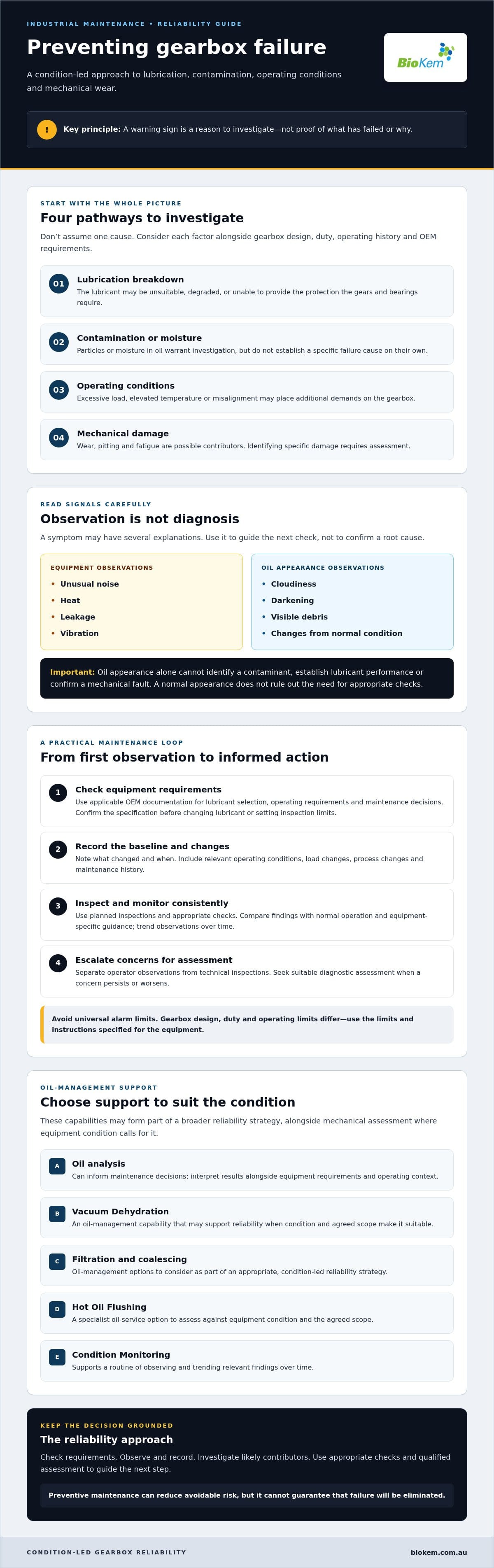
A useful routine turns observations into consistent, traceable decisions. It should define what operators watch for, what planned technical inspections cover and when specialist diagnostic work is needed. Use the equipment manufacturer’s (OEM) instructions and site maintenance programme to set inspection frequencies, limits and escalation steps. Don’t apply generic intervals or alarm thresholds to every gearbox.
Build the routine in sequence:
- Check equipment requirements. Confirm the gearbox specifications, approved lubricant and operating requirements in the relevant OEM documentation.
- Establish a baseline. Capture normal operating observations and available oil-condition results so later changes can be compared with a known reference.
- Inspect and record. Operators can note visible changes and unusual sounds during their assigned checks. Planned technical inspections should follow site procedures and equipment requirements.
- Trend findings. Review observations, oil results and maintenance history together. A developing pattern may be more informative than an isolated reading.
- Escalate concerns. Follow site-defined limits and seek appropriate technical assessment when symptoms persist, worsen or suggest a mechanical issue.
This structured approach supports how to prevent gearbox failure by helping teams act on evidence without confusing routine observation with a confirmed diagnosis. Keep the routine practical: each check should have a clear purpose, a place to record the result and a defined route for raising concerns. For wider planning context, explore BioKem’s maintenance planning articles.
What information should a gearbox inspection record capture?
Make each entry useful to the next person reviewing the asset. Record the gearbox identification, lubricant type, date, operating context and observations such as noise, heat, leakage or vibration. Include relevant oil-analysis findings, recent maintenance actions and changes to process or load from site records.
Compare new entries with previous records and applicable OEM requirements. Keep operator observations distinct from technical inspection results, so a reported symptom isn’t mistaken for a confirmed fault. Record the source of each finding, such as an operator check, planned inspection or specialist assessment.
Where a measurement is taken, record the operating state and the method used according to site procedures. This helps the team interpret the result properly and avoid comparing information gathered under different conditions as though it were directly equivalent.
When should maintenance teams escalate an emerging concern?
Escalate persistent abnormal symptoms and any change that exceeds site-defined limits. If evidence suggests physical damage or an operating problem, arrange qualified mechanical assessment; oil-service work doesn’t replace gearbox inspection or repair. Where lubricant condition or contamination is a relevant concern, oil analysis or suitable filtration support may help inform the next step.
Don’t wait for an oil-related explanation if the evidence points to a mechanical fault. Follow site escalation procedures and equipment guidance, and make sure the concern is reviewed by the appropriate technical personnel. To discuss oil-related support for an industrial gearbox, contact BioKem about your maintenance requirements.
How BioKem’s oil services can support industrial gearbox reliability
Oil management can support gearbox reliability by helping maintenance teams assess lubricant condition and respond to relevant cleanliness concerns. BioKem’s listed capabilities include Fuel & Oil Filtration and coalescing, Condition Monitoring, Hot Oil Flushing and Vacuum Dehydration (VDOPS). The company also lists onsite and lab-based patch analysis. These capabilities address oil-related needs within a broader maintenance strategy. They don’t replace OEM requirements or mechanical inspection.
Service suitability depends on the gearbox’s design and requirements, its assessed condition and the agreed scope. A symptom such as noise or vibration shouldn’t automatically lead to an oil treatment. Where a mechanical defect is suspected, arrange assessment by a suitably qualified specialist—for instance, marine operators managing vessel propulsion systems can explore Mechanical Ship Repairs when extensive component overhauls are required.
BioKem’s key applications include gearboxes, gear trains and pinion drivers of all configurations, as well as lubrication systems where oil must meet a client or OEM specification. The relevant service depends on the actual system and its requirements, so start with the equipment details and the concern maintenance teams are investigating.
When may filtration, oil analysis or flushing be relevant?
Filtration may be appropriate when oil cleanliness needs attention and the system can support the selected approach. Oil analysis can provide information to help assess lubricant condition and potential contamination. BioKem lists onsite and lab-based patch analysis among its capabilities. These findings can inform maintenance decisions, but they don’t establish that a gearbox component is mechanically sound.
Hot Oil Flushing may be considered where an oil-system cleaning need has been identified and the equipment requirements support the work. It isn’t a default response to every gearbox symptom or a remedy for physical damage, misalignment or other mechanical defects. Review BioKem’s hot oil flushing service overview when assessing whether this oil service may be relevant to the identified need.
Vacuum Dehydration (VDOPS) is also among BioKem’s listed services. Whether it is relevant depends on the oil concern and the system requirements. Discuss the condition, available findings and intended scope with the service provider rather than choosing a treatment based on a symptom alone.
What to prepare before discussing a gearbox oil concern
A clear summary helps frame the discussion. Gather the gearbox identification and available OEM requirements, lubricant details, the observed concern and the conditions in which it occurs. Include relevant maintenance history and any existing oil-analysis or condition-monitoring findings. This context helps distinguish an oil-related question from one that needs mechanical assessment.
BioKem provides Australia-wide service coverage for its relevant oil-management capabilities. The next step is to discuss the asset, oil concern and maintenance context, then determine whether a service is suitable for the equipment and agreed scope. This measured approach supports decisions about how to prevent gearbox failure without promising that any single service can prevent every failure.
To discuss an industrial gearbox oil concern, contact BioKem about industrial oil services.
Turn gearbox observations into a reliable maintenance plan
Reducing preventable gearbox problems takes a consistent approach: follow OEM requirements, monitor lubricant condition and operating changes, and treat unusual symptoms as prompts to investigate rather than diagnoses. A useful maintenance record helps teams spot trends and decide when oil analysis, filtration support or qualified mechanical assessment may be appropriate.
For teams considering how to prevent gearbox failure, the key is to match each action to the equipment and evidence. Oil services can support reliability, but they don’t replace mechanical assessment when physical damage is suspected.
BioKem lists gearboxes, gear trains and pinion drivers of all configurations among its key applications, and provides onsite and lab-based patch analysis. Its Capability Statement also lists Australia-wide service coverage. Discuss your asset, oil concern and maintenance context to explore whether an oil service may suit your requirements.
Discuss your gearbox oil concern with BioKem to take the next step towards a more informed maintenance routine.
Frequently Asked Questions
How can I prevent gearbox failure?
To reduce the risk, follow the equipment manufacturer’s (OEM) requirements and use a consistent, condition-led maintenance routine. Check that the lubricant is suitable, record operating conditions, inspect for changes and review oil-analysis findings alongside equipment history. Set inspection frequencies and limits through OEM instructions and your site maintenance programme. For how to prevent gearbox failure, treat warning signs as prompts to investigate, not as proof of a specific fault.
What is the most common cause of gearbox failure?
There isn’t one cause that applies to every gearbox. Lubrication problems, contamination, unsuitable operating conditions and mechanical damage are all relevant investigation pathways, and the underlying cause depends on the equipment and its duty. A bearing or gear fault describes a damaged component or failure mode, not necessarily the root cause. Review operating history, oil condition and OEM requirements before deciding what needs further assessment.
Can contaminated oil cause gearbox failure?
Contaminated oil can compromise lubricant condition and may contribute to wear or damage, so it’s a risk worth investigating. However, finding contamination doesn’t prove it caused a particular gearbox problem. Consider the type of contamination, equipment requirements, oil-analysis results and operating history together. Suitable filtration may help manage particles where the system supports it, but it won’t correct mechanical damage or address the source of contamination by itself.
How often should gearbox oil be changed?
Use the oil-change interval specified by the gearbox manufacturer and your site maintenance programme. There’s no universal interval that suits every gearbox, because equipment design, operating conditions and lubricant requirements differ. Don’t extend or shorten an interval based only on oil appearance. Where oil condition is monitored, use analysis as an additional input alongside OEM guidance and site procedures, and investigate results that suggest a change may be needed.
What are the early warning signs of gearbox failure?
Changes in noise, vibration, temperature, leakage or oil condition can warrant investigation. None confirms a specific fault on its own. Record when the change occurs, the operating load and any recent maintenance or process changes, then compare observations with equipment history and OEM guidance. Persistent or worsening symptoms may require qualified mechanical inspection, particularly if physical damage or an operating problem is suspected.
Can oil filtration fix a failing gearbox?
No. Filtration may help manage oil contamination when it suits the system and the identified need, but it can’t repair damaged gears or bearings, correct misalignment or resolve every cause of abnormal operation. Assess symptoms and oil condition separately, and follow OEM requirements. If the evidence suggests mechanical damage, arrange a qualified mechanical assessment. Filtration can be one part of an oil-management response, not a substitute for gearbox repair; when replacement power transmission components or assemblies are required, check out Jealco International, Inc..
Does gearbox oil analysis predict failure?
Oil analysis can provide information about lubricant condition and potential contamination, helping teams identify changes that may need attention. It doesn’t predict every failure or replace mechanical inspection. Interpret findings alongside operating conditions, prior results and OEM requirements rather than treating a single result as a diagnosis. BioKem lists onsite and lab-based patch analysis among its capabilities for assessing oil-related information within a broader maintenance process.

Article by
James McAllister
James McAllister is an industry professional with BioKem Oil Services, specialising in lubrication reliability, oil filtration, contamination control and asset performance. Drawing on BioKem's extensive field experience across turbines, compressors, hydraulic systems and critical rotating equipment, James writes practical, insight-driven articles that help maintenance and reliability teams improve equipment performance, extend asset life and reduce operational risk.