

Is the aggressive chemical “pickling” of your lubrication pipework a necessary safeguard or a high-risk liability for your asset’s longevity? You’re likely balancing the pressure to meet strict OEM cleanliness specifications against the reality of a tight shutdown window. “Do we need to chemical clean our lubrication pipework during the upcoming shut?” is a question that often triggers concerns about hazardous waste disposal and potential metal loss from acid exposure. At BioKem, we draw on over 70 years of combined industry experience and a safety record of zero Lost Time Injuries since 2012 to help you navigate these complex reliability decisions with professional confidence.
This technical assessment provides the clarity you need to determine if your system requires invasive chemical intervention or if high-velocity hot oil flushing is the more effective strategy for your facility. We’ll explore the specific conditions where chemical cleaning is essential, compare it to modern flushing efficiencies, and outline a strategy that protects your equipment while ensuring environmental compliance. By the end, you’ll have a clear path toward a successful restart with minimal operational risk and a solid technical justification for your maintenance approach.
Key Takeaways
- Contrast the technical mechanisms of chemical pickling versus high-velocity hot oil flushing to select the most efficient reliability strategy for your asset.
- Establish a logic-based decision framework to answer the critical question: Do we need to chemical clean our lubrication pipework during the upcoming shut?
- Identify specific metallurgical conditions, such as mill scale on carbon steel pipework, where chemical intervention remains a technical necessity.
- Evaluate how choosing non-invasive flushing over aggressive chemical agents can reduce environmental risks and shorten the critical path of your maintenance shutdown.
- Utilize over 70 years of specialist experience to ensure your lubrication systems meet stringent OEM cleanliness specifications with zero operational delays.
The Chemical vs. Oil Flush Dilemma in Shutdown Planning
Shutdown turnarounds represent the most critical phase of an industrial asset’s lifecycle. During these high-pressure windows, maintenance managers face a recurring question: “Do we need to chemical clean our lubrication pipework during the upcoming shut?” The answer dictates the reliability of your system for the next operating cycle. Choosing between a traditional chemical cleaning process and high-velocity Hot Oil Flushing isn’t merely a matter of preference. It’s a technical decision that impacts metallurgy, environmental compliance, and the risk of catastrophic bearing failure. Inadequate cleaning during a shut can leave systems vulnerable to immediate failure upon restart.
To better understand this concept, watch this helpful video:
Chemical cleaning, often referred to as pickling and passivation, utilizes acidic solutions to strip away mill scale and heavy oxidation from internal pipe surfaces. In contrast, hot oil flushing uses turbulent flow to lift and transport particulate matter to specialized filtration units. With over 70 years of specialist experience, BioKem views these methods as distinct tactical tools. Selecting the wrong approach can lead to delayed commissioning or, worse, leaving aggressive residues that compromise oil chemistry. When you ask, “Do we need to chemical clean our lubrication pipework during the upcoming shut?” you’re really asking how to balance thoroughness with asset safety.
The Cost of Incorrect Cleaning Scopes
Missing the mark on your cleaning scope often results in residual contaminants that accelerate varnish formation. When these microscopic soft contaminants precipitate out of the oil, they cause “varnish-induced” valve sticking during the critical restart phase. This leads to costly troubleshooting and unexpected downtime that erodes the efficiency of the entire shutdown. Ensuring your system reaches the necessary cleanliness levels is vital for long-term health. BioKem’s turnkey commissioning and shutdown support provides the technical oversight needed to avoid these financial pitfalls and ensure a smooth return to service.
Understanding Your OEM Cleanliness Specifications
Original Equipment Manufacturer (OEM) specifications, typically expressed through ISO 4406 particle counts, are the baseline for shutdown success. High-speed rotational assets like turbines require significantly tighter cleanliness targets than heavy-duty gearboxes. You must align your cleaning method with these specific requirements to ensure warranty compliance and operational safety. A turbine system might demand an ISO 16/14/11 target, which requires a rigorous flushing regime to achieve. Without a clear target, your cleaning efforts lack a measurable definition of success, risking the integrity of your most valuable assets across Australia.
When Chemical Cleaning is Non-Negotiable
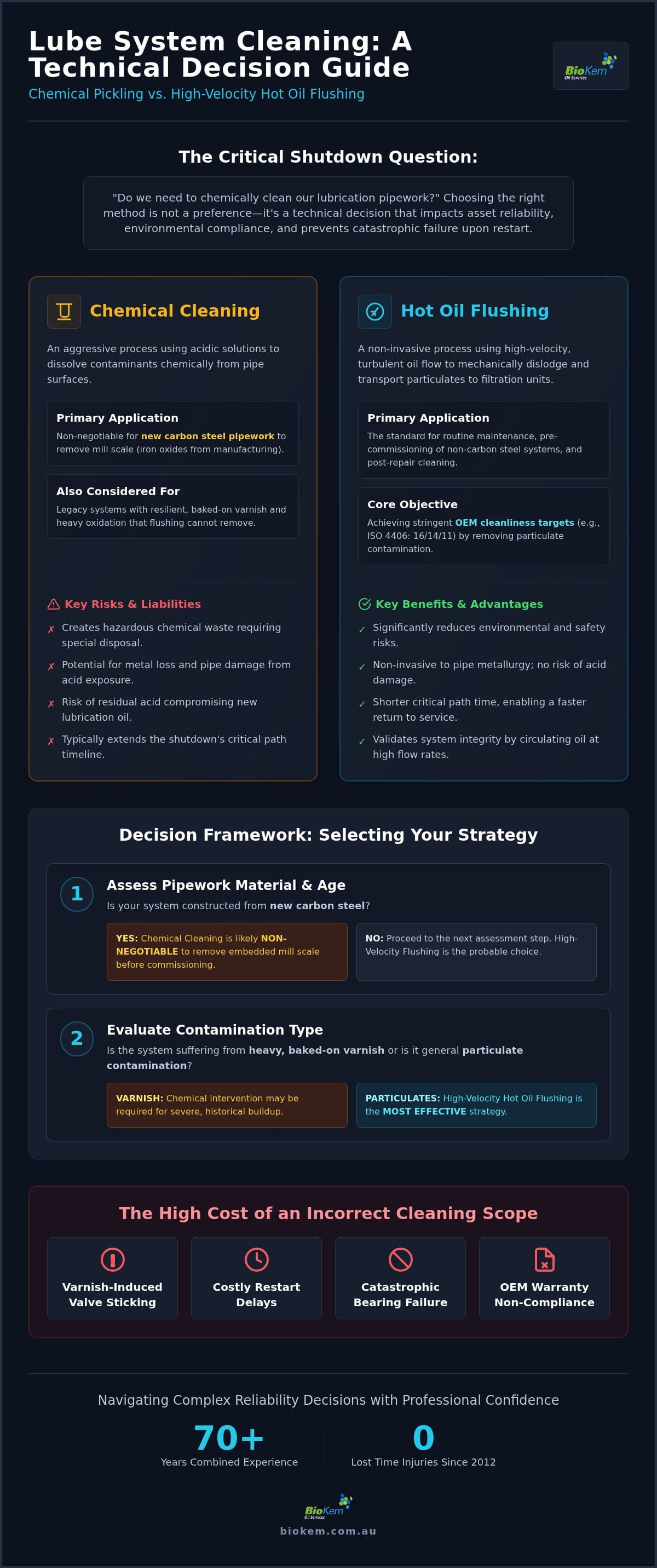
Determining the necessity of chemical intervention requires a deep dive into your system’s metallurgy and operational history. While high-velocity oil flushing is highly effective for routine maintenance, it cannot resolve fundamental manufacturing defects or deep-seated metallurgical contamination. When asset managers ask, “Do we need to chemical clean our lubrication pipework during the upcoming shut?” the answer often depends on whether the system is constructed from carbon steel or if it’s recently suffered a catastrophic mechanical failure. Mill scale is a flaky, dark-gray surface layer of iron oxides formed during the hot rolling of steel that requires acid pickling for total removal.
For legacy assets, the decision hinges on the level of fouling. If your system has operated for years without proper varnish mitigation, the internal pipework surfaces may be coated in a resilient, baked-on layer of oxidation. In these instances, standard oil flushing might only clean the surface, leaving deeper contaminants to slough off once the system returns to full operating temperature. If you’re unsure about your system’s current metallurgical state, consulting with a technical specialist can clarify the safest and most cost-effective path forward for your facility.
New Carbon Steel Installations and Mill Scale
New carbon steel pipework arrives with a magnetite layer that is physically bonded to the metal. If this mill scale isn’t removed via a specialized chemical cleaning process, the thermal expansion and vibration of normal operation will cause it to delaminate. This results in “particle showers” that can destroy bearings and sensitive hydraulic components within hours of commissioning. Following a rigorous chemical cleaning procedure ensures these inorganic contaminants are dissolved and neutralized before they ever reach your rotating elements. This step is a technical requirement for any new carbon steel build to ensure long-term reliability.
Post-Breakdown Decontamination
Catastrophic component failures often leave more than just visible metal shavings in the oil; they embed microscopic debris into the varnish layers coating the pipework. In these scenarios, the varnish acts as a binder, holding abrasive particles in place where a standard flush cannot reach them. A system flush is often insufficient for these “baked-on” contaminants that have survived multiple heat cycles. Effective decontamination must include thorough tank cleaning alongside pipework treatment to prevent the immediate re-contamination of your new oil charge. Addressing the root cause through chemical stripping ensures the system is truly returned to a baseline state of cleanliness.
Hot Oil Flushing vs. Chemical Cleaning: Technical Comparison
Choosing between chemical cleaning and hot oil flushing requires an understanding of how each method interacts with your system’s internal surfaces. Chemical cleaning is an invasive process that utilizes aggressive acids to achieve a specific metallurgical reaction. While effective for removing mill scale, it introduces foreign substances into your asset that must be meticulously neutralized. Hot oil flushing is a non-invasive mechanical process. It utilizes the system’s intended lubricant to lift and transport contaminants to external filtration units. When you ask, “Do we need to chemical clean our lubrication pipework during the upcoming shut?” you must consider if the risk of introducing chemicals outweighs the mechanical efficiency of a high-flow flush.
The timeframe for these operations differs significantly. Chemical cleaning involves multiple stages, including degreasing, acid washing, rinsing, and passivation. Each step adds hours to your shutdown’s critical path. Hot oil flushing is often more streamlined. It allows for a faster transition from cleaning to operational readiness. BioKem manages these complexities with a steadfast commitment to safety. Our record of zero Lost Time Injuries (LTI) since establishment in 2012 ensures that whether we’re handling aggressive pickling agents or high-pressure oil, your project is executed with professional discipline and zero operational delays.
The Risk of Chemical Carryover
Incomplete neutralization is the primary danger associated with chemical cleaning. If residual acids remain in the pipework crevices, they will immediately react with your new oil charge. This leads to rapid oil oxidation and can cause premature Heat Transfer Fluid Degradation. These chemical residues act as catalysts for varnish formation, potentially causing more damage than the contaminants you sought to remove. For this reason, hot oil flushing is often employed as a final displacement step. It ensures that any trace chemicals are safely removed before the system returns to service.
Efficiency and High-Velocity Turbulence
The effectiveness of oil flushing depends on the physics of fluid dynamics, specifically the Reynolds Number. To move heavy particulate matter, the flow must be turbulent rather than laminar. BioKem utilizes High Flow Flushing Skids to achieve the high velocities required for this turbulence. By reaching a Reynolds Number greater than 4,000, we ensure that the oil scours the pipe walls effectively. You can learn more about the technical requirements in our guide on How Hot Oil Flushing Works. This mechanical approach often reaches OEM cleanliness targets faster than chemical soaking for most maintenance scenarios.
Decision Framework: Determining Your Pipework Cleaning Scope
Selecting the appropriate methodology requires a structured evaluation of your system’s current state. When maintenance managers ask, “Do we need to chemical clean our lubrication pipework during the upcoming shut?” they are looking for a technical justification that balances operational risk with turnaround efficiency. BioKem utilizes over 70 years of specialist experience to help you navigate this decision through a logic based framework. This process begins with an audit of your system’s metallurgy, age, and operational history to identify if inorganic scale or organic varnish is the primary threat to your reliability targets.
Onsite diagnostics provide the empirical data needed to finalize your shut scope before mobilization. Conducting a professional Filter Debris Analysis allows us to identify the specific nature of contaminants currently trapped in your system. If the debris consists primarily of wear metals and soft organic particulates, high velocity flushing is typically the superior, less invasive choice. If the analysis reveals heavy mill scale or deep seated corrosion products from long periods of standby, chemical pickling may be a technical necessity to prevent downstream component damage.
Material-Based Selection Criteria
The metallurgy of your pipework dictates its tolerance for aggressive cleaning agents. Stainless steel lines generally only require passivation to restore their protective oxide layer; aggressive pickling is usually unnecessary and potentially damaging to the surface finish. Carbon steel presents a higher risk, especially in legacy systems where internal corrosion has developed over years of service. Specialized assets containing copper or brass components require extreme caution. These materials are highly sensitive to the acids used in traditional chemical cleaning, making mechanical flushing a safer alternative for preserving component integrity.
Shutdown Timeline vs. Cleanliness Requirements
Your shutdown’s critical path often determines the feasible scope of work. A full chemical cleaning cycle, including degreasing, pickling, and neutralization, can consume 4 to 6 days of your schedule. In contrast, hot oil flushing bearing circuits can often achieve OEM cleanliness specifications within a 48 hour window. This efficiency provides a significantly higher ROI for tight maintenance schedules. However, cost saving should never come at the expense of baseline cleanliness. Understanding Why Skipping Oil Flushing Before Startup Costs You More is essential for justifying the necessary technical intervention to project stakeholders. Before mobilization, it is equally important to understand what battery limits should be established for your hot oil flushing contractor to prevent scope creep and protect sensitive components from high-velocity scouring.
To ensure your upcoming shutdown is supported by a technically sound cleaning strategy, contact BioKem for a comprehensive scope assessment today.
Turnkey Shutdown Support and Reliability Solutions
BioKem operates as a specialized partner within your shutdown structure, providing the technical oversight and mobilization capacity required for complex asset turnarounds. We understand that the decision-making process for pipework maintenance is often compressed. If you’re still asking, “Do we need to chemical clean our lubrication pipework during the upcoming shut?” our team provides a rapid technical assessment to define the most efficient scope. With national mobilization capabilities, we deploy across Australia to support facilities in the mining, power generation, and oil and gas sectors. Our approach is anchored by 70 years of specialist experience, ensuring that every procedure aligns with both OEM standards and regional regulatory requirements.
Executing these scopes requires more than just personnel; it requires high-performance hardware. Our Equipment Hire division offers access to high-flow flushing skids and specialized filtration rigs that are often unavailable through general rental providers. This allows your team to scale up capacity during the shut without the capital expenditure of permanent installations. Every project is managed with a meticulous focus on safety, maintaining our record of zero Lost Time Injuries (LTI) since establishment in 2012. This commitment to responsibility ensures that your shutdown stays on schedule while meeting the highest ecological and operational standards.
Specialist Equipment for Critical Shuts
Achieving deep-system cleanliness often involves managing multiple contamination streams simultaneously. We deploy Vacuum Dehydration Oil Purification Systems (VDOPS) to eliminate dissolved water and particulate matter that standard filters cannot capture. To address the chemical challenges of aged oil, we utilize Varnish Removal Systems (VRS) to strip soft contaminants from internal surfaces, preventing valve sticking during the high-stakes restart phase. As an Australian distributor for Filters S.p.A. Products, we ensure that every filtration element used during the shut meets or exceeds original equipment specifications for particle retention and flow rate.
Final Certification and Asset Handover
The conclusion of a cleaning scope isn’t just about finishing the flush; it’s about providing the technical proof of success. We provide comprehensive oil analysis reports and ISO 4406 cleanliness certifications that document the system’s condition at handover. Our onsite lab-based patch analysis provides immediate verification, allowing your commissioning team to proceed with confidence. This transparency ensures that your asset is returned to service in peak condition, with every reliability risk mitigated through scientific validation. For a tailored shutdown consultation or to review your specific pipework requirements, contact the BioKem technical team. Our mission remains the delivery of superior asset health through innovative, environmentally responsible lubrication management.
Optimising Asset Reliability for Your Next Shutdown
Determining the correct cleaning scope is a technical decision that impacts your facility’s long term operational health. You’ve seen that while chemical pickling remains essential for removing mill scale from new carbon steel installations, high-velocity hot oil flushing often provides a more efficient, non-invasive path for routine maintenance. Aligning your strategy with OEM specifications and current system conditions prevents the risks of chemical carryover and varnish-induced failures during the critical restart phase.
When you ask, “Do we need to chemical clean our lubrication pipework during the upcoming shut?” you’re seeking a balance between technical thoroughness and asset safety. BioKem provides the expert justification you need, backed by 70 years of specialist experience. With national Australian mobilisation and a safety record of Zero Lost Time Injuries (LTI) since establishment in 2012, we ensure your project is executed with professional discipline. Our ISO-certified filtration services guarantee that your assets meet the highest reliability standards for the next operating cycle.
Contact BioKem for a Technical Shutdown Consultation to secure your equipment’s future. We’re ready to help you achieve a seamless and reliable return to service.
Frequently Asked Questions
Is chemical cleaning better than hot oil flushing for new pipework?
Chemical cleaning is technically superior for new carbon steel installations because it removes mill scale through acid pickling. Hot oil flushing cannot dissolve the magnetite layer formed during manufacturing. However, for stainless steel systems, high-velocity flushing is often sufficient once welding slag is removed. BioKem utilizes over 70 years of combined specialist experience to determine which method ensures your asset reaches its required baseline cleanliness without unnecessary chemical exposure.
How long does a typical chemical cleaning process take during a shut?
A comprehensive chemical cleaning cycle typically requires 4 to 6 days within a shutdown schedule. This duration accounts for degreasing, acid pickling, rinsing, and the critical passivation phase. In contrast, hot oil flushing can often achieve results in 48 hours. When asking, “Do we need to chemical clean our lubrication pipework during the upcoming shut?” you must evaluate if the critical path of your turnaround can accommodate this longer, more invasive timeframe.
What are the environmental risks of chemical pipework cleaning in Australia?
The primary environmental risks involve the management and neutralization of aggressive acidic and alkaline effluents. Australia maintains strict regulatory standards regarding the disposal of industrial wastewater to protect local ecosystems. Mishandling these chemicals can lead to soil contamination or groundwater issues. BioKem prioritizes sustainability by recommending non-invasive mechanical flushing whenever technically viable, reducing the volume of hazardous waste generated during your maintenance window across the country.
Can hot oil flushing remove mill scale from carbon steel?
Hot oil flushing cannot remove mill scale from carbon steel because the oxide layer is metallurgically bonded to the pipe surface. Flushing relies on mechanical turbulence to lift loose particulates, while mill scale requires the chemical reaction of acid pickling to dissolve. If you’re commissioning new carbon steel lines, skipping the chemical phase risks delaminated scale causing catastrophic damage to high-speed rotational bearings shortly after the system returns to service.
What happens if we skip cleaning before restarting our turbine?
Skipping the cleaning process often leads to immediate bearing damage or varnish-induced valve sticking upon restart. Contaminants that settled during the shutdown become mobile once the system reaches operating temperature and flow. This can trigger unscheduled downtime and expensive repairs. BioKem’s shutdown support ensures your system meets OEM specifications, utilizing our record of zero Lost Time Injuries since 2012 to execute safe and effective decontamination before your asset returns to operation.
Do we need to clean stainless steel pipework if it has been capped?
Even if stainless steel pipework has been capped, it still requires cleaning to remove atmospheric moisture, condensation, and any debris introduced during the installation or modification phase. While stainless steel doesn’t suffer from mill scale like carbon steel, internal surfaces can still harbor welding tint or fine particulates. A high-velocity hot oil flush is generally the most effective way to certify these lines as clean and ready for operation without the need for aggressive chemicals.
How do we dispose of the waste generated from chemical cleaning?
Waste generated from chemical cleaning must be neutralized onsite to a safe pH level before being transported by licensed waste contractors. This process involves significant logistics and cost, as the spent acids and degreasers cannot be disposed of via standard industrial drains. Because BioKem focuses on asset health and sustainability, we often suggest hot oil flushing as a cleaner alternative that produces recyclable oil waste rather than complex and hazardous chemical effluents.
What ISO cleanliness code should we aim for post-shutdown?
Most high-speed rotational assets, such as turbines and compressors, require a post-shutdown cleanliness target of ISO 16/14/11 or better. You should always consult your OEM specifications, as different assets have varying tolerances for particulate contamination. BioKem uses ISO 16889-certified filtration equipment to reach these stringent targets. We provide detailed oil analysis reports and onsite patch verification to certify that your lubrication system is compliant and ready for a reliable restart across Australia.

Article by
James McAllister
James McAllister is an industry professional with BioKem Oil Services, specialising in lubrication reliability, oil filtration, contamination control and asset performance. Drawing on BioKem's extensive field experience across turbines, compressors, hydraulic systems and critical rotating equipment, James writes practical, insight-driven articles that help maintenance and reliability teams improve equipment performance, extend asset life and reduce operational risk.
Disclaimer
The information contained in this article is provided by BioKem Oil Services for general informational and educational purposes only. While every effort has been made to ensure the accuracy and relevance of the information at the time of publication, BioKem Oil Services makes no representations or warranties, express or implied, regarding its completeness, accuracy, reliability, suitability or availability.
Readers should seek professional advice before making maintenance, operational, engineering or investment decisions based on the content of this article. BioKem Oil Services accepts no liability for any loss, damage or consequential loss arising from the use of, or reliance upon, the information presented.
Unless otherwise stated, all content, including text, graphics, images and technical information, is the property of BioKem Oil Services and is protected by applicable copyright and intellectual property laws. No part of this publication may be reproduced, copied, distributed, republished, stored, transmitted, modified or used in any form without the prior written permission of BioKem Oil Services.
© BioKem Oil Services. All rights reserved.