

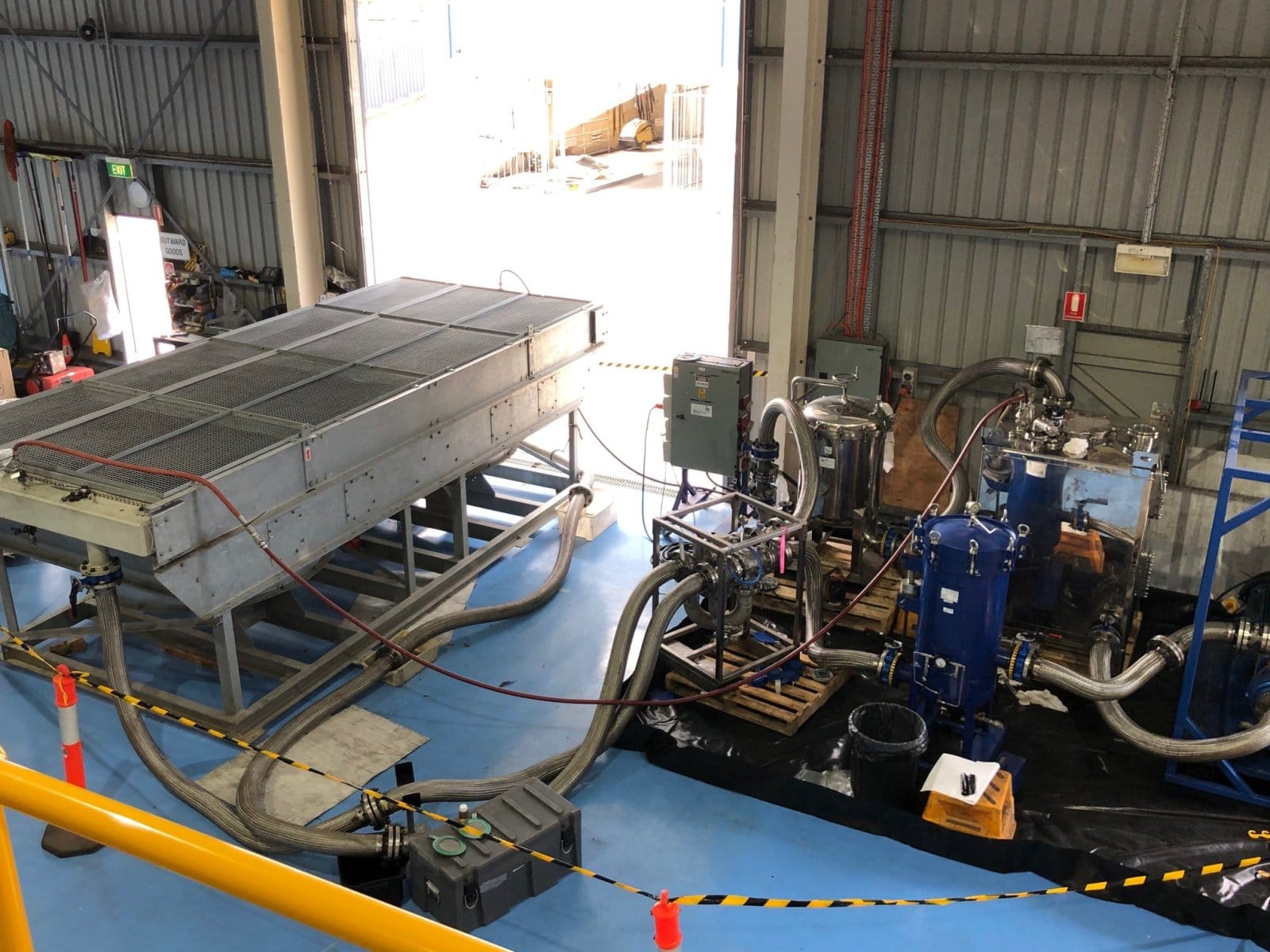
What if the “clean” stainless steel pipework you just installed is actually a ticking time bomb for your lubrication system? It’s a common dilemma for Australian project managers facing tight commissioning deadlines: Should we chemical clean our new stainless steel pipework? You’ve likely invested significantly in high-grade materials specifically to avoid corrosion, so it’s natural to feel that a standard hot oil flush should be sufficient to clear out any remaining debris.
However, surface-level cleanliness doesn’t equate to chemical stability. We understand the pressure to meet strict OEM specifications while protecting expensive new assets from internal degradation. This guide explores why new stainless steel requires more than just a physical rinse to ensure long-term reliability. You’ll discover the essential criteria for deciding when chemical intervention is necessary and learn the technical distinctions between degreasing, pickling, and passivation. We also outline how to align your processes with the updated ASTM A967-25 standards to ensure your lubrication system achieves the ISO cleanliness levels required for peak operational performance.
Key Takeaways
- Understand why “factory-new” stainless steel often harbours invisible contaminants like shop dirt and iron inclusions that compromise the protective passive layer.
- Identify how the three-stage process of degreasing, pickling, and passivation creates a chemically stable surface to prevent premature corrosion and system failure.
- Assess the criticality of high-value assets, such as LNG compressors and steam turbines, to determine: Should we chemical clean our new stainless steel pipework?
- Learn how chemical cleaning and mechanical hot oil flushing work together to achieve the strict ISO cleanliness levels required by global OEMs.
- Explore the safety and operational benefits of engaging Australian commissioning specialists with a proven record of zero Lost Time Injuries for your next shutdown.
The Myth of the ‘Clean’ Factory Finish: Why New Pipework Needs Attention
Many project managers and engineers in the Australian energy and mining sectors often ask: Should we chemical clean our new stainless steel pipework? On the surface, new stainless steel appears pristine, reflecting a mirror-like finish that suggests it’s ready for immediate service. However, this visual cleanliness is a dangerous misconception. Chemical cleaning in this context is the systematic removal of organic and inorganic surface contaminants to restore the material’s inherent corrosion resistance through passivation. Without this process, “invisible” threats remain embedded in the metal’s surface, waiting to compromise the entire lubrication system.
Relying on a visual inspection for critical lubrication systems is insufficient because the most damaging contaminants are microscopic. Shop dirt, grease films, and iron inclusions don’t always change the light-reflective properties of the pipe, but they pose a severe threat to high-speed rotational assets. For equipment like LNG compressors or steam turbines, even minute particles can lead to catastrophic bearing failure or servo-valve sticking during the critical commissioning and shutdown support phase.
Common Contaminants Found in New Stainless Steel
Contamination occurs at every stage of the supply chain, from the mill to the installation site. Even “clean” pipework usually carries a variety of residues that a standard water flush won’t touch:
- Protective oils and lacquers: These are often applied during transport and storage to prevent surface marring, but they act as a sticky trap for particulate matter.
- Iron contamination: This is a frequent issue in Australian fabrication shops where carbon steel and stainless steel are handled in proximity. Free iron from carbon steel tools or grinding dust embeds in the stainless surface, creating focal points for pitting corrosion.
- Atmospheric pollutants: Dust and salt spray common in coastal Australian industrial sites can settle inside open pipework during construction.
The Downstream Risks of Neglecting Pre-Commissioning Cleaning
Ignoring these contaminants leads to operational headaches that far outweigh the cost of initial cleaning. When considering “Should we chemical clean our new stainless steel pipework?”, managers must weigh the risk of premature filter plugging. As the system warms up, protective lacquers soften and migrate, quickly blinding high-efficiency filters. Residual contaminants compromise lubricant chemistry by acting as catalysts for oxidation and depletion of additive packages from day one. This chemical degradation shortens oil life and risks damage to close-tolerance components that rely on ultra-clean fluid for reliable operation.
Understanding the Chemistry: Degreasing, Pickling, and Passivation
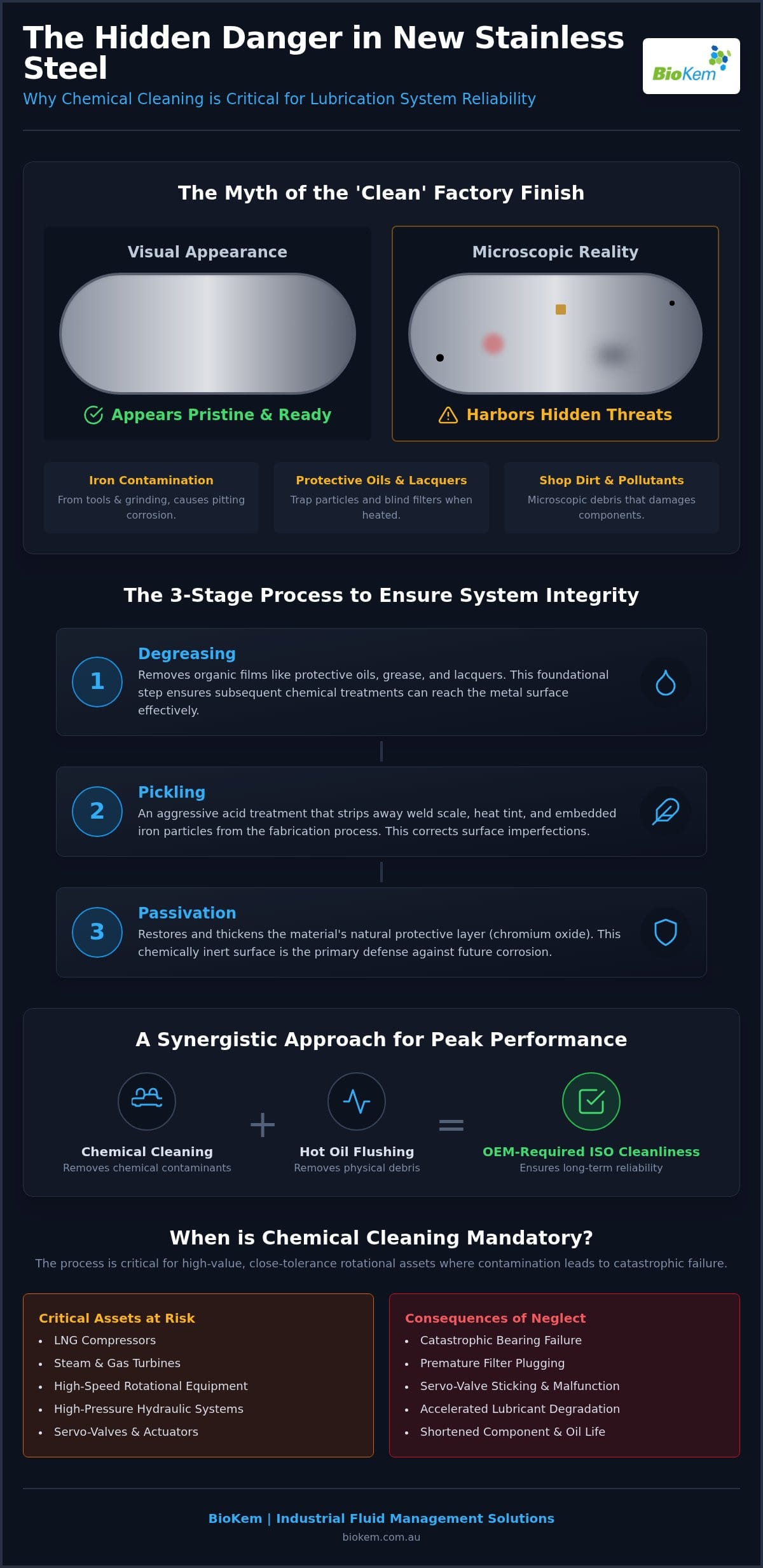
Achieving an industrial-grade finish requires a precise chemical sequence rather than a single wash. When project teams ask, “Should we chemical clean our new stainless steel pipework?”, they’re seeking a solution that ensures the metal’s surface is chemically inert and ready for high-velocity fluid service. This process typically follows a three-stage approach: degreasing, pickling, and passivation. Degreasing is the foundational phase. It removes organic films, such as hydrocarbons or protective oils, that would otherwise act as a barrier to subsequent treatments. Without this step, acids cannot penetrate the surface evenly, leading to patchy results and potential failure points.
Pickling follows as a more aggressive remedial process. It uses acid solutions to strip away weld scale, heat tint, and embedded iron particles that accumulated during fabrication. Finally, passivation restores the surface by encouraging the growth of a thin, transparent chromium oxide layer. This layer is the primary defence against corrosion in harsh Australian industrial environments. If you’re managing a high-stakes commissioning project, you can speak with our technical team to determine the best chemical approach for your specific alloy grades.
Pickling vs. Passivation: Knowing the Difference
While often used interchangeably, these processes serve distinct roles. Pickling is a corrective measure that removes a thin layer of metal to eliminate surface defects and contamination. Passivation is a preventative treatment that doesn’t remove metal but instead enriches the chromium-to-iron ratio at the surface. Industry standards, such as ASTM A967-25, outline specific Cleaning methods for stainless steel using nitric or citric acid solutions. Nitric acid remains a powerful, traditional oxidiser, while citric acid offers a more environmentally conscious alternative for certain applications without sacrificing the quality of the protective layer.
The Science of the Passive Layer
Stainless steel’s corrosion resistance isn’t a bulk property; it depends entirely on the chemistry of the top few atomic layers. A high chromium-to-iron ratio is essential for a stable surface. Mechanical cleaning, such as wire brushing or grinding, often fails because it can smear iron particles deeper into the metal or create micro-crevices where moisture can settle. Chemical passivation ensures a uniform finish that allows oxygen to interact with the chromium. This interaction creates the “self-healing” property where the chromium oxide layer reforms if scratched. This chemical stability is vital for maintaining the integrity of the lubricant and the long-term health of the asset.
Chemical Cleaning vs. Hot Oil Flushing: A Synergistic Approach
Understanding the hierarchy of cleaning is essential for project success in the Australian heavy industry sector. While chemical cleaning addresses the molecular state of the surface, hot oil flushing focuses on the physical removal of particulates. One is a chemical treatment; the other is a mechanical process. Many site managers ask: Should we chemical clean our new stainless steel pipework? The answer lies in the limitations of oil. Hot oil flushing alone cannot remove embedded iron or weld scale. These contaminants are chemically bonded to the surface. High-velocity oil might dislodge a loose bead, but it won’t strip the heat tint that compromises the material’s corrosion resistance.
The most effective turnkey workflow follows a logical sequence: degrease, pickle, and passivate the pipework first. Once the surface is chemically stable, the system is neutralised and dried. Only then should the hot oil flush begin. This sequence ensures that any microscopic debris created during the acid treatment is physically swept away by the oil. Integrating these steps into a formal Commissioning Lubrication Systems checklist ensures no stage is overlooked. Following rigorous industrial cleaning specifications guarantees that the asset meets OEM requirements before the first start-up.
Why Hot Oil Flushing is the Second Step
Hot oil flushing serves as the final validation of system cleanliness. After the chemical stages, the system must be thoroughly neutralised to prevent acid carryover into the service oil. The flushing process uses high-velocity turbulent flow to dislodge post-chemical debris and construction silt. This step is critical for meeting strict ISO 4406 particulate cleanliness codes. Without it, the microscopic particles left behind by the pickling process could circulate through the system, causing abrasive wear on precision bearings and sensitive valves.
Coordinating Shutdowns and Turnarounds
In the Australian industrial landscape, time is the most expensive commodity. Coordinating these activities requires precise scheduling to prevent cleaning from becoming a bottleneck on the critical path. Engaging a single contractor for both chemical and oil-based services streamlines the process. It eliminates the friction of managing multiple vendors and ensures a seamless transition between stages. For more on managing these complex timelines, see our specialised Commissioning And Shutdowns Turnaround services. This unified approach reduces mobilisation costs and ensures a safety-first focus on-site, backed by a record of zero Lost Time Injuries since 2012.
When is Chemical Cleaning Mandatory? Decision Criteria for Managers
Deciding whether to invest in chemical cleaning requires a balanced assessment of operational risk versus upfront cost. When asking, “Should we chemical clean our new stainless steel pipework?”, managers must prioritise the long-term reliability of the asset over immediate schedule gains. This decision is rarely subjective; it’s driven by the technical requirements of the equipment and the environment where it operates. For high-value assets, chemical cleaning isn’t merely an option. It’s a foundational step in risk mitigation that prevents catastrophic failure during the first few hundred hours of operation.
High-speed rotational assets, such as LNG compressors and large-scale steam turbines, operate with extremely tight bearing clearances. In these systems, even microscopic surface contaminants act as abrasive agents. Beyond mechanical wear, most global OEMs mandate specific surface cleanliness and passivation levels as a condition of warranty. Failing to provide a certificate of passivation can void multi-million dollar warranties before the first megawatt is generated. The intended fluid also dictates the cleaning requirement. Electro-hydraulic control (EHC) fluids and high-pressure fuel systems are notoriously sensitive to chemical impurities, requiring a level of surface purity that only a three-stage chemical treatment can provide.
Asset Criticality and Risk Assessment
Managers should focus on systems where Varnish In Lube Oil is a primary concern. Varnish often begins with surface-level chemical reactions where residual fabrication oils or iron inclusions act as catalysts for oil oxidation. High-speed assets with close-tolerance bearings are particularly vulnerable. If the pipework was field-installed rather than shop-built, the risk of internal contamination increases significantly, making chemical cleaning a mandatory step to ensure the system meets ISO 4406 standards.
Environmental and Regulatory Factors
The industrial landscape presents unique challenges. Many major projects are located in coastal or saline environments, or other challenging industrial locations. Exposure to salt-laden air during the construction phase can lead to flash rusting or pitting on stainless steel surfaces if the passive layer is compromised. Compliance with industrial safety and environmental standards is also paramount when handling pickling acids. BioKem operates with a proven safety record of zero Lost Time Injuries (LTI) since our establishment in 2012, ensuring that high-risk chemical handling on-site is managed with absolute precision. To ensure your commissioning process meets these rigorous standards, contact our specialist team for a technical consultation.
Ensuring System Reliability with BioKem’s Turnkey Solutions
BioKem Oil Services leverages 70 years of specialist experience to provide a level of expertise that’s unmatched in the Australian industrial sector. When project managers ask, “Should we chemical clean our new stainless steel pipework?”, they’re looking for a partner that understands the high stakes of commissioning. We utilise “best of breed” international equipment, specifically designed for varnish and contamination mitigation, which allows for rapid national mobilisation to remote sites from the Pilbara to the Surat Basin. This logistical capability ensures that the Energy, Oil & Gas, and Mining sectors have access to specialist cleaning services regardless of their geographic location or the complexity of their infrastructure.
Verification is the cornerstone of our turnkey approach. We provide comprehensive onsite analysis, including patch test kits and detailed laboratory-based reporting. This data-driven strategy confirms that the degreasing, pickling, and passivation stages have achieved the required metallurgical finish. By providing transparent, evidence-based results, we ensure that your lubrication system meets the highest international standards before the first drop of oil is introduced. Our process doesn’t just meet specifications; it provides the documented proof required for warranty compliance and operational peace of mind.
The BioKem Oil Services Advantage: Expertise and Safety
Safety and technical precision are inseparable in our operations. Since our establishment in 2012, we’ve maintained a record of zero Lost Time Injuries (LTI), a testament to our safety-focused culture. This record is particularly relevant during chemical cleaning, where the handling of acidic solutions requires strict adherence to environmental and safety protocols. Our technicians are highly trained in managing complex procedures and utilise ISO 16889-certified filtration equipment. This high-specification gear provides superior contamination control, ensuring that the transition from chemical treatment to oil-based flushing is seamless and effective.
Next Steps for Your Commissioning Project
Securing the future of your critical assets begins with a comprehensive scoping phase. Requesting a tailored turnkey solution allows you to consolidate your commissioning and shutdown support under a single, expert contractor. This reduces the administrative burden and ensures that the chemical cleaning and hot oil flushing stages are perfectly synchronised. Mike Smith and our customer service team provide detailed project scoping to align our services with your OEM requirements and operational timelines. Contact BioKem Oil Services today to discuss your pipework cleaning requirements and experience the reliability of a professionally managed industrial cleaning program designed for the Australian market.
Securing Long-Term Asset Reliability through Professional Commissioning
Ensuring the longevity of high-value industrial assets requires a move beyond visual inspections toward verified chemical stability. When project teams ask, “Should we chemical clean our new stainless steel pipework?”, the decision rests on the need to restore the material’s passive layer and remove microscopic contaminants that standard flushing cannot touch. By integrating degreasing, pickling, and passivation with mechanical hot oil flushing, you create a robust defence against premature corrosion and component wear.
BioKem brings 70 years of specialist experience to every project, delivering turnkey solutions that prioritise technical precision and operational safety. Our commitment to excellence is reflected in our record of zero Lost Time Injuries (LTI) since 2012 and our use of ISO 16889-certified filtration technology for superior contamination control. We’re ready to help you meet strict OEM specifications and ensure your system is prepared for peak performance from the moment of start-up. Request a technical consultation for your pipework cleaning project today to safeguard your infrastructure. We look forward to supporting your next successful commissioning phase.
Frequently Asked Questions
Is chemical cleaning always necessary for new stainless steel pipework?
Chemical cleaning is mandatory for critical assets like LNG compressors or steam turbines where surface purity is vital. While less critical systems might rely on physical flushing, the question of “Should we chemical clean our new stainless steel pipework?” usually arises when OEM warranties and long-term reliability are at stake. This process removes invisible contaminants, such as shop dirt and free iron, that a standard hot oil flush cannot address.
What is the difference between pickling and passivation for industrial pipes?
Pickling is a remedial chemical process that uses aggressive acids to remove surface defects, weld scale, and heat tint by stripping a thin layer of metal. In contrast, passivation is a preventative treatment that doesn’t remove metal but enriches the chromium-to-iron ratio on the surface to restore the protective oxide layer. While pickling cleans the metal, passivation ensures it stays resistant to corrosion in harsh Australian industrial environments.
Can hot oil flushing replace chemical cleaning in a new system?
Hot oil flushing cannot replace chemical cleaning because they target different types of contamination. Flushing is a mechanical process designed to remove particulate matter through high-velocity turbulent flow. Chemical cleaning is a molecular process that removes organic films and restores the passive layer. For new systems, these processes are synergistic; chemical cleaning prepares the surface, while the subsequent hot oil flush removes any remaining microscopic debris.
How long does the chemical cleaning and passivation process typically take?
The duration of the chemical cleaning and passivation sequence depends on the total surface area of the pipework and the complexity of the system’s internal geometry. A standard turnkey project involves distinct phases for degreasing, pickling, and final passivation, each requiring specific contact times to be effective. BioKem focuses on coordinating these activities within your shutdown schedule to minimise critical path delays while ensuring technical specifications are met.
What chemicals are used during the passivation of stainless steel?
Passivation typically utilises nitric acid or citric acid solutions, as outlined in international standards like ASTM A967. Nitric acid is a traditional, high-strength oxidiser used for many industrial grades. Citric acid is increasingly common as an environmentally conscious alternative that effectively removes free iron without the safety risks associated with harsher acids. The choice of chemical depends on the specific stainless steel alloy and the intended fluid service.
Does chemical cleaning affect the warranty of my industrial equipment?
Chemical cleaning generally supports and maintains your equipment warranty rather than voiding it. Many global OEMs for turbines and compressors specifically mandate chemical cleaning and passivation as a pre-commissioning requirement. Providing a certificate of passivation from an experienced specialist is often necessary to prove the system was prepared according to industrial standards. This documentation protects your multi-million dollar asset from claims related to premature corrosion or contamination.
How do we verify that the passivation process was successful?
Verification is achieved through specific testing methods that confirm the removal of free iron and the integrity of the passive layer. Common techniques include water immersion tests, high humidity tests, or copper sulfate testing. BioKem provides onsite and lab-based patch analysis to verify that the surface chemistry meets the required standards. These detailed technical reports provide the empirical evidence needed to proceed with the next phase of commissioning.
What safety precautions are required for on-site chemical cleaning in Australia?
On-site chemical cleaning in Australia requires strict adherence to safety protocols, including the use of specialised PPE, spill containment systems, and acid neutralisation procedures. Technicians must follow documented safe work method statements to protect personnel and the environment. BioKem maintains a safety-focused culture with a record of zero Lost Time Injuries (LTI) since our establishment in 2012, ensuring high-risk chemical treatments are performed with absolute precision and care.

Article by
James McAllister
James McAllister is an industry professional with BioKem Oil Services, specialising in lubrication reliability, oil filtration, contamination control and asset performance. Drawing on BioKem's extensive field experience across turbines, compressors, hydraulic systems and critical rotating equipment, James writes practical, insight-driven articles that help maintenance and reliability teams improve equipment performance, extend asset life and reduce operational risk.
Disclaimer
The information contained in this article is provided by BioKem Oil Services for general informational and educational purposes only. While every effort has been made to ensure the accuracy and relevance of the information at the time of publication, BioKem Oil Services makes no representations or warranties, express or implied, regarding its completeness, accuracy, reliability, suitability or availability.
Readers should seek professional advice before making maintenance, operational, engineering or investment decisions based on the content of this article. BioKem Oil Services accepts no liability for any loss, damage or consequential loss arising from the use of, or reliance upon, the information presented.
Unless otherwise stated, all content, including text, graphics, images and technical information, is the property of BioKem Oil Services and is protected by applicable copyright and intellectual property laws. No part of this publication may be reproduced, copied, distributed, republished, stored, transmitted, modified or used in any form without the prior written permission of BioKem Oil Services.
© BioKem Oil Services. All rights reserved.