

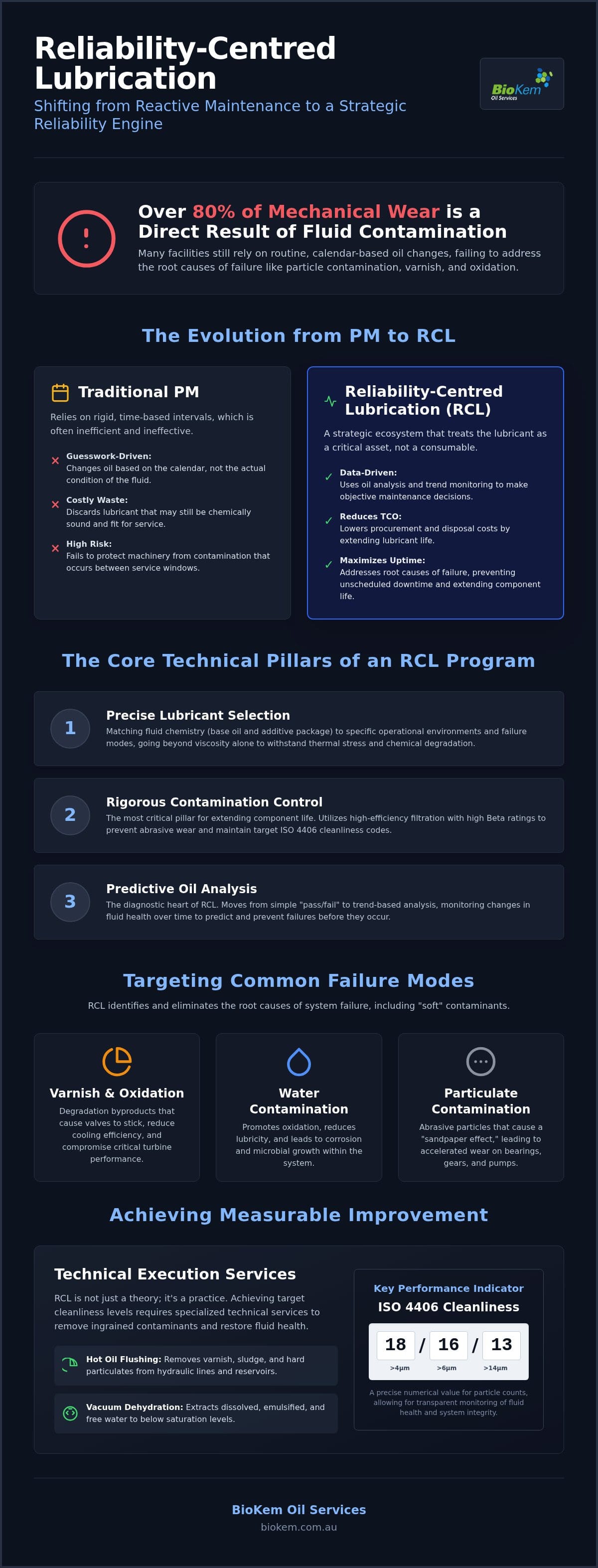
Over 80% of mechanical wear is the direct result of fluid contamination, yet many facilities still treat lubrication as a routine task. In this guide to Reliability-Centred Lubrication Programs Explained, we examine how to shift from reactive maintenance to a strategic reliability engine. If you’ve faced unscheduled downtime from bearing failures or turbine valves sticking due to varnish buildup, you know that frequent oil changes often fail to address root causes. It’s time to move beyond the calendar and focus on precision fluid management.
By designing lubrication tasks around component attributes and environmental conditions, you can achieve a measurable improvement in ISO cleanliness codes and lower your total cost of ownership. We’ll outline a clear framework for implementing RCL, covering everything from advanced oil analysis to the technical execution of hot oil flushing and vacuum dehydration. This approach provides a logical sequence for eliminating contamination, ensuring your critical assets operate with the efficiency and longevity required in demanding industrial environments. Through these strategic interventions, you can transform maintenance into a profit centre while meeting rigorous regulatory and operational standards.
Key Takeaways
- Transition from calendar-based maintenance to a failure-mode-driven strategy that prioritizes asset uptime and long-term mechanical reliability.
- Discover the technical pillars of Reliability-Centred Lubrication Programs Explained, focusing on matching lubricant chemistry to specific operational environments.
- Identify and eliminate the root causes of system failure, including “soft” contaminants like varnish and oxidation that compromise critical turbine performance.
- Learn how to conduct a comprehensive gap analysis to establish precise ISO cleanliness targets tailored to your site’s unique asset requirements.
- Understand the role of technical execution services, such as hot oil flushing and vacuum dehydration, in achieving measurable improvements in fluid health.
What is Reliability-Centred Lubrication (RCL)?
Reliability-Centred Lubrication (RCL) is a technical ecosystem. It moves maintenance teams beyond rigid, calendar-based schedules by designing tasks around component attributes, environmental conditions, and specific failure modes. When considering Reliability-Centred Lubrication Programs Explained, the focus shifts from the lubricant as a consumable to the lubricant as a critical asset. This strategy prioritizes asset uptime by addressing the technical mechanisms that cause mechanical wear, specifically fluid contamination.
Traditional Preventative Maintenance (PM) relies on time-based intervals. This often results in changing oil that remains chemically sound or, worse, leaving contaminated oil in a system because the service date hasn’t arrived. RCL replaces this guesswork with objective data. The primary KPI for this success is the ISO 4406 cleanliness standard. This standard provides a precise numerical value for particle counts, allowing for transparent monitoring of fluid health and system integrity. It’s a logical, scientific approach to ensuring machinery operates at peak efficiency.
The Evolution from PM to RCL
Interval-based oil changes are a blunt instrument. They fail to protect machinery from ingress or internal wear that occurs between service windows. When Reliability-Centred Lubrication Programs Explained are integrated into broader Reliability-Centred Maintenance (RCM) frameworks, operators move toward managing oil health. This transition requires a deep understanding of fluid dynamics and regular oil analysis to detect early signs of degradation. Instead of simply changing oil, the team focuses on maintaining the fluid’s physical and chemical properties. This shift ensures that lubricants remain in service as long as they meet specific performance criteria, reducing waste and improving operational consistency.
The Financial Impact of Lubrication Excellence
The financial benefits of this technical shift are direct. Extending the life of the lubricant reduces the Total Cost of Ownership (TCO) by lowering procurement and disposal expenses. It’s a sustainable approach that aligns operational efficiency with environmental responsibility. More importantly, it mitigates the extreme costs of unscheduled downtime. In heavy industry, a single bearing failure can stall production for days. Maintaining high cleanliness levels through professional hot oil flushing ensures that components reach their full design life. This maximizes the return on capital investment while ensuring regulatory compliance and long-term asset health.
The Four Technical Pillars of an RCL Program
The execution of Reliability-Centred Lubrication Programs Explained requires a foundation built on four technical pillars. These elements work in concert to ensure every asset operates within its designed parameters. While many programs focus on the theory of maintenance, RCL demands a rigorous technical approach to fluid management. It’s not just about applying oil; it’s about engineering the environment in which that oil performs.
Lubricant selection is the first pillar. This process involves matching fluid chemistry to the specific failure modes of the operational environment. It’s not enough to select a lubricant based on viscosity alone. The base oil and additive package must withstand thermal stress, chemical degradation, and the specific load requirements of the machinery. Choosing the wrong chemistry often leads to premature oxidation or varnish formation, regardless of how often you change the oil.
Contamination Control and Filtration Standards
Contamination control is the most critical pillar for extending component life. High-efficiency filtration acts as the primary defense against abrasive wear. Utilizing Filters S.p.A. products ensures systems maintain the required ISO cleanliness codes. In industrial contexts, understanding Beta ratings is essential. A filter with a high Beta ratio captures a larger percentage of contaminants, preventing the "sandpaper effect" that leads to accelerated bearing failure. This proactive approach reduces the environmental footprint by extending the interval between oil disposals.
Oil Analysis as a Predictive Engine
Oil analysis serves as the diagnostic heart of RCL. This moves maintenance teams away from simple "pass/fail" metrics toward trend-based analysis. By monitoring changes in fluid health over time, technicians can identify emerging issues before they lead to catastrophic failure. Specialized tests, such as Filter Ferrogram analysis, provide deep insights into wear debris. This allows for the identification of specific metal types, pinpointing exactly which component is wearing within the system. It’s a precise, scientific method for auditing the internal health of a machine.
Fluid purification is the final pillar. This involves the active removal of contaminants that standard filters might miss, such as dissolved water or sub-micron varnish precursors. Technologies like vacuum dehydration and varnish mitigation systems are vital for maintaining high-value assets like turbines or large hydraulic presses. If your current program lacks these technical foundations, exploring professional hot oil flushing can provide the necessary baseline for RCL excellence.
Targeting Failure Modes: Varnish, Water, and Oxidation
Effective Reliability-Centred Lubrication Programs Explained focus on the elimination of specific failure modes before they manifest as mechanical breakdown. While particulate contamination is a primary concern, "soft" contaminants and chemical degradation often cause more insidious damage to critical systems. By targeting the root causes of fluid failure, maintenance teams can prevent the chain reactions that lead to component wear and unscheduled outages.
Soft contaminants, primarily varnish and sludge, represent a significant risk to high-precision machinery. These byproducts of lubricant degradation are non-particulate in their early stages, meaning they pass through conventional high-efficiency filters. As they precipitate out of the oil, they form sticky deposits on internal surfaces. This leads to restricted flow and increased friction. Similarly, oxidation acts as a permanent chemical transformation of the base stock. Once the additive package is depleted, the oil’s molecular structure breaks down, resulting in increased viscosity and acidic byproduct formation.
Water contamination is equally destructive. Whether dissolved, emulsified, or free, moisture significantly reduces the load-carrying capacity of the lubricant film. This leads to hydrogen embrittlement and accelerated corrosion. In high-pressure hydraulic systems, even trace amounts of water can cause catastrophic component failure by compromising the protective boundary layer between moving parts.
Varnish Mitigation in Turbines and Hydraulics
Standard filtration systems often fail to address sub-micron varnish precursors. These precursors exist in a dissolved state at operating temperatures, only to settle as solid deposits when the system cools or experiences pressure drops. In critical turbine applications, this results in valve sticking and erratic governor response. Implementing specialized Varnish Removal Systems is essential for maintaining operational stability. These units actively strip the oil of polar degradation products, ensuring that servo valves remain responsive and heat exchangers stay clear of insulating sludge.
Vacuum Dehydration for Moisture Control
While simple coalescing filters can manage free water, they are ineffective against dissolved or emulsified moisture. Vacuum dehydration is the process of boiling water out of oil at low temperatures to protect fluid integrity. This mechanism allows for the removal of 100% of free and emulsified water, as well as up to 90% of dissolved moisture. You should deploy vacuum dehydration units when oil analysis shows moisture levels exceeding the saturation point of the fluid. This intervention is far more effective than traditional methods, as it addresses the water at a molecular level without subjecting the lubricant to damaging thermal stress. Maintaining dry oil is a fundamental requirement for achieving the longevity promised by RCL strategies.
Implementing RCL: A Practical Roadmap for Industrial Sites
Implementation transforms technical theory into operational reality. For Australian industrial sites, particularly those in remote locations, Reliability-Centred Lubrication Programs Explained must account for logistics and specific environmental stressors like extreme dust and humidity. The roadmap begins with a comprehensive gap analysis. This audit assesses current maintenance practices against industry benchmarks to identify where lubrication failures are most likely to occur. Once vulnerabilities are mapped, the next step involves establishing specific ISO 4406 cleanliness targets for every critical asset. These targets aren’t arbitrary; they’re based on the sensitivity of internal components and the total cost of failure.
System Remediation via Hot Oil Flushing
Achieving these cleanliness targets often requires a technical system reset. Standard oil changes leave behind significant volumes of residual contaminants and wear debris trapped in dead legs or large reservoirs. In contrast, Hot Oil Flushing Services utilize high-velocity fluid movement to create turbulent flow. This turbulence dislodges particulate matter that stagnant oil cannot move. New systems or those undergoing major repairs require this process before startup to prevent "infant mortality" failures caused by construction debris or welding slag. It’s a technical necessity for ensuring the system begins its lifecycle at an as-new cleanliness level.
Hardware Upgrades for Cleanliness Maintenance
Maintaining these standards over the long term requires physical upgrades to the machinery. Precision monitoring is impossible without high-quality sampling ports and desiccant breathers. These upgrades prevent atmospheric moisture and dust from entering the system while allowing for consistent, representative oil samples. Integrating Advanced Fluid Management strategies ensures that filtration is not just a temporary fix but a permanent part of the asset’s operational profile. Whether using permanent high-performance filters or temporary equipment hire for project-based purification, the hardware must match the strategy’s technical requirements.
Continuous improvement relies on the technical literacy of the onsite team. Training ensures that personnel understand why a specific ISO code is targeted and how to handle lubricants without introducing new contaminants. This cultural shift from "changing oil" to "managing fluid health" is the final step in the roadmap. If you’re ready to bridge the gap between maintenance theory and technical execution, view our specialist filtration products to begin your system remediation journey.
Executing RCL Excellence with BioKem Oil Services
BioKem acts as the technical bridge between a strategic reliability plan and measurable onsite results. While Reliability-Centred Lubrication Programs Explained provide the necessary framework, BioKem delivers the specialized machinery and technical expertise required to execute it. We don’t just consult on maintenance; we provide the physical interventions—such as vacuum dehydration and hot oil flushing—that eliminate the root causes of mechanical wear. This focus on technical execution ensures that your reliability strategy isn’t just a document, but a functioning ecosystem that protects your most valuable assets.
High-performance filtration is non-negotiable for maintaining RCL standards. As the authorized distributor for Filters S.p.A. products, BioKem provides the world-class consumables necessary to sustain low ISO particle counts. We pair this hardware with onsite laboratory testing and expert interpretation of oil health data. By transforming raw numbers into technical insights, we help maintenance managers make informed decisions regarding fluid purification and component replacement, ensuring the lubricant continues to function as a strategic asset.
Onsite Technical Services and Project Support
Complex projects like hot oil flushing or varnish mitigation require more than just equipment; they require specialized technicians who understand fluid dynamics and system architecture. BioKem deploys experts to manage these technical interventions, ensuring every project meets stringent regulatory standards and environmental requirements. For sites that don’t require permanent installations, our Industrial Oil Filtration Equipment Hire provides a flexible, project-based solution for system remediation. This approach ensures that even temporary maintenance windows result in permanent reliability gains without the need for significant capital expenditure.
The BioKem Advantage: Australian Expertise
Industrial operations in Australia face unique challenges, from extreme ambient dust to the logistical hurdles of remote site access. BioKem provides national support, bringing customized reliability solutions to turbines, compressors, and hydraulic systems across the country. BioKem has a 15-year history of maintaining critical Australian infrastructure. This local expertise ensures that global scientific standards are applied within a dependable, regional context. Partnering with an execution specialist allows facilities to achieve true operational excellence through precision fluid management and a commitment to long-term asset health.
Optimising Asset Longevity Through Precision Lubrication
Moving from reactive maintenance to a technical reliability ecosystem ensures that your critical assets operate at peak efficiency. As Reliability-Centred Lubrication Programs Explained demonstrate, the transition requires more than just a change in strategy; it demands the right technical execution to eliminate varnish, moisture, and particulate contamination. By prioritizing fluid health, you reduce environmental waste and lower the total cost of ownership for your machinery.
BioKem Oil Services provides the machinery and expertise needed to fulfil these strategic goals. As the sole Australian distributor for Filters S.p.A., we offer high-performance filtration consumables alongside specialists in high-velocity hot oil flushing. Our team provides expert varnish mitigation and vacuum dehydration services to reset your systems to as-new cleanliness levels. Don’t let contamination dictate your production schedule. Contact BioKem Oil Services to design your RCL execution strategy today. With the right technical partner, you can transform your lubrication practices into a sustainable engine for industrial reliability.
Frequently Asked Questions
How do I start a Reliability-Centred Lubrication program?
Starting a program begins with a comprehensive gap analysis of your current maintenance practices against industry benchmarks. This audit identifies specific vulnerabilities in your fluid management and helps establish ISO cleanliness targets for every critical asset. Once these goals are defined, you can move toward system remediation. Utilizing technical services like hot oil flushing allows you to reset your machinery to a clean baseline before implementing long term monitoring strategies.
What are the main benefits of RCL over traditional maintenance?
The primary benefit is a shift from reactive, time based tasks to a failure mode driven strategy that prioritizes asset uptime. By addressing root causes like particulate and moisture contamination, you extend the functional life of both the lubricant and the component. This technical approach lowers the total cost of ownership and reduces environmental waste by minimizing unnecessary oil disposal and procurement cycles across your facility.
What is the difference between RCL and RCM?
Reliability-Centred Maintenance (RCM) is a broad framework used to determine the maintenance requirements of any physical asset. Reliability-Centred Lubrication Programs Explained are a specialized subset of this framework. While RCM addresses all potential failure modes, RCL focuses exclusively on those related to lubrication and fluid health. It ensures the lubricant acts as a strategic engine for reliability rather than just a consumable part of the machine.
How often should oil analysis be performed in an RCL program?
Analysis frequency depends on asset criticality and environmental stressors rather than a fixed calendar. Critical systems like power generation turbines or high pressure hydraulics require frequent monitoring to detect early signs of oxidation or varnish. Trend based analysis is essential in this context. It allows technicians to identify emerging issues and chemical degradation before they manifest as mechanical failure, ensuring operational stability in demanding industrial environments.
Can RCL help with varnish problems in gas turbines?
RCL specifically targets varnish by implementing proactive mitigation strategies that standard maintenance often ignores. Varnish precursors are sub micron in size and pass through regular filters to deposit on sensitive valves. An RCL program incorporates specialized varnish mitigation systems to strip these polar degradation products from the oil. This prevents valve sticking and ensures consistent governor response, which is vital for avoiding unscheduled outages in gas turbine operations.
What ISO cleanliness code should I aim for in my hydraulic system?
ISO cleanliness targets depend on system pressure and the sensitivity of internal components. High pressure hydraulic systems utilizing servo valves often require a stringent target such as ISO 15/13/10. Achieving these levels requires high performance filtration consumables, such as Filters S.p.A. products, alongside regular auditing. Maintaining these precise codes ensures the system remains within its designed technical parameters and prevents the abrasive wear that leads to component failure.
Is equipment hire a viable option for implementing RCL?
Equipment hire is an effective solution for project based reliability improvements and system remediation. It allows industrial facilities to access specialized machinery like vacuum dehydration units or high velocity flushing rigs without significant capital expenditure. This flexibility is particularly valuable for remote Australian sites that need to perform intensive fluid purification during scheduled shutdowns. It ensures that global reliability standards are met within a dependable, localized context.
Does RCL require changing the type of oil I currently use?
RCL doesn’t always require a change in oil type, but it does involve a rigorous review of your lubricant selection. The process ensures that fluid chemistry matches the specific failure modes of your operational environment. If your current lubricant is prone to rapid oxidation or varnish formation in its specific context, a change to a more stable base stock or a different additive package may be recommended to ensure long term asset health.