

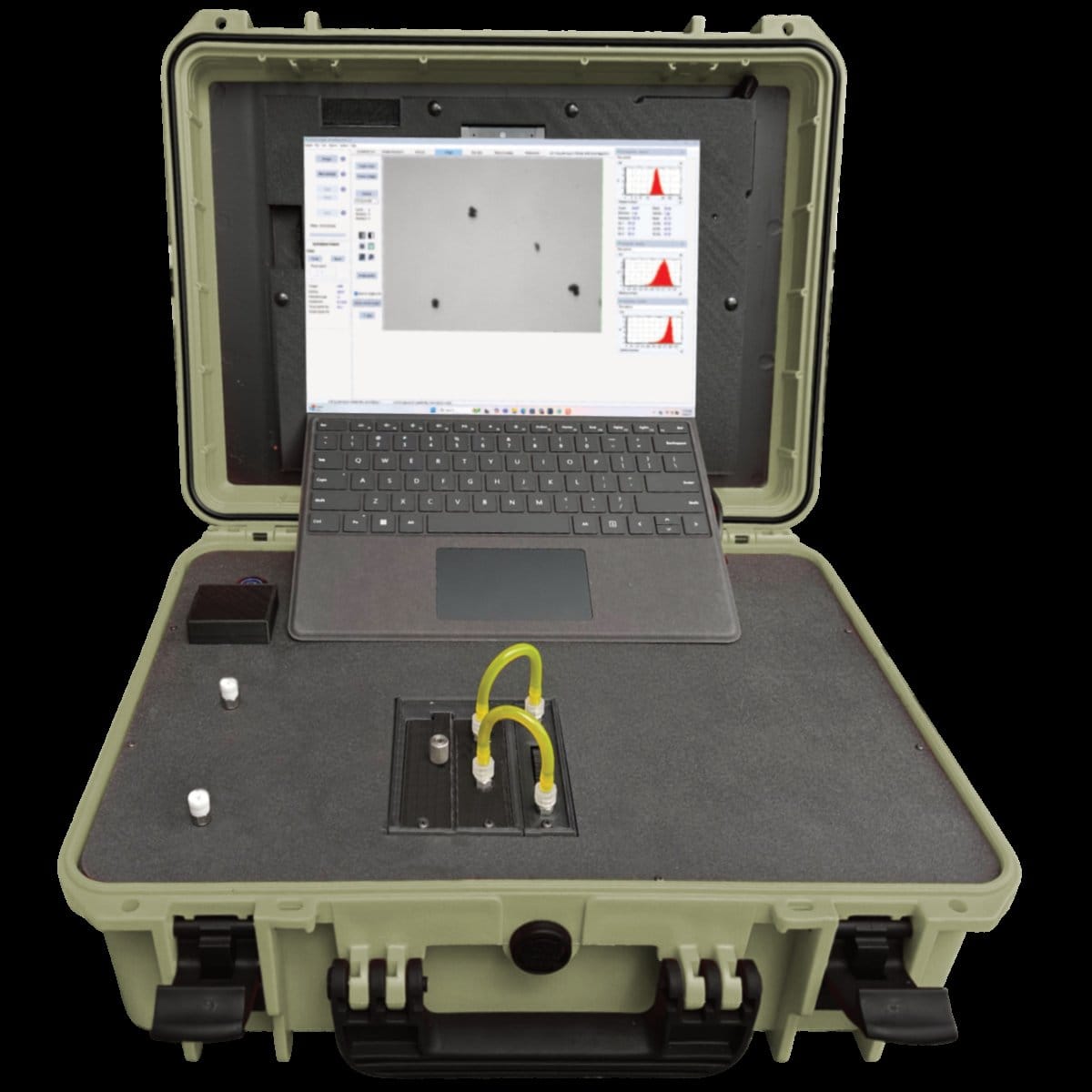
Traditional laser particle counters are often blind to the most critical threats hiding in your hydraulic systems. If your current monitoring tool cannot distinguish a harmless air bubble from a jagged piece of cutting wear, you’re making decisions based on incomplete data. Understanding the features and benefits of the Particle Pal Raptor – why you need this instrument starts with a shift from simple counting to visual diagnostic clarity. You likely already know that waiting days for lab results often leads to unscheduled downtime that can cost Australian industrial operations tens of thousands in lost productivity.
In this guide, we’ll demonstrate how the Particle Pal Raptor uses Dynamic Image Analysis (DIA) to provide real-time, lab-grade results directly on-site. By categorizing particles down to 1µm into over 30 custom categories, this instrument ensures you never mistake water droplets or additives for metal debris again. We will examine how BioKem Oil Services’ distribution of this technology helps you identify specific wear types like sliding or fatigue. This approach allows for proactive contamination control that extends asset life and maintains strict compliance with ISO 21018-1 standards.
Key Takeaways
- Transition from reactive repairs to a proactive maintenance strategy that identifies the root causes of equipment wear before failure occurs.
- Discover the features and benefits of the Particle Pal Raptor – why you need this instrument to accurately distinguish between air bubbles, water droplets, and actual metallic debris.
- Learn how the system’s 30+ custom categories pinpoint specific wear types, such as cutting or fatigue, to provide a clear diagnostic picture of internal component health.
- Understand how the five-hour battery life and ruggedised design support reliable oil condition monitoring across remote Australian industrial sites.
- Leverage BioKem’s local technical expertise and calibration services to integrate real-time, lab-grade analysis into your existing varnish mitigation and filtration workflows.
The Evolution of Oil Condition Monitoring: Introducing the Particle Pal Raptor
The Particle Pal Raptor represents a significant leap in high-resolution oil condition monitoring. Unlike standard sensors that offer basic data, this system provides a comprehensive visual analysis of fluid health. As the official Australian distributor for the Particle Pal range, BioKem Oil Services provides local industries with a tool capable of detecting particles as small as 1 micron (µm). This precision is vital for maintaining high-pressure hydraulic systems where even microscopic debris can trigger a chain reaction of component wear. The technology is powered by Vision Analytical, bringing over 25 years of specialized expertise in particle shape analysis directly to the Australian market.
Australian heavy industry is currently undergoing a decisive shift from reactive repairs to proactive maintenance strategies. Relying on failure to dictate your service schedule is no longer viable in a high-cost environment. Understanding the features and benefits of the Particle Pal Raptor – why you need this instrument is the first step toward achieving lab-grade data in the field. This capability allows site engineers to make immediate, informed decisions without the risk of operating contaminated machinery.
To better understand how this technology functions in real-world applications, watch this helpful video:
The Limitations of Traditional Oil Analysis
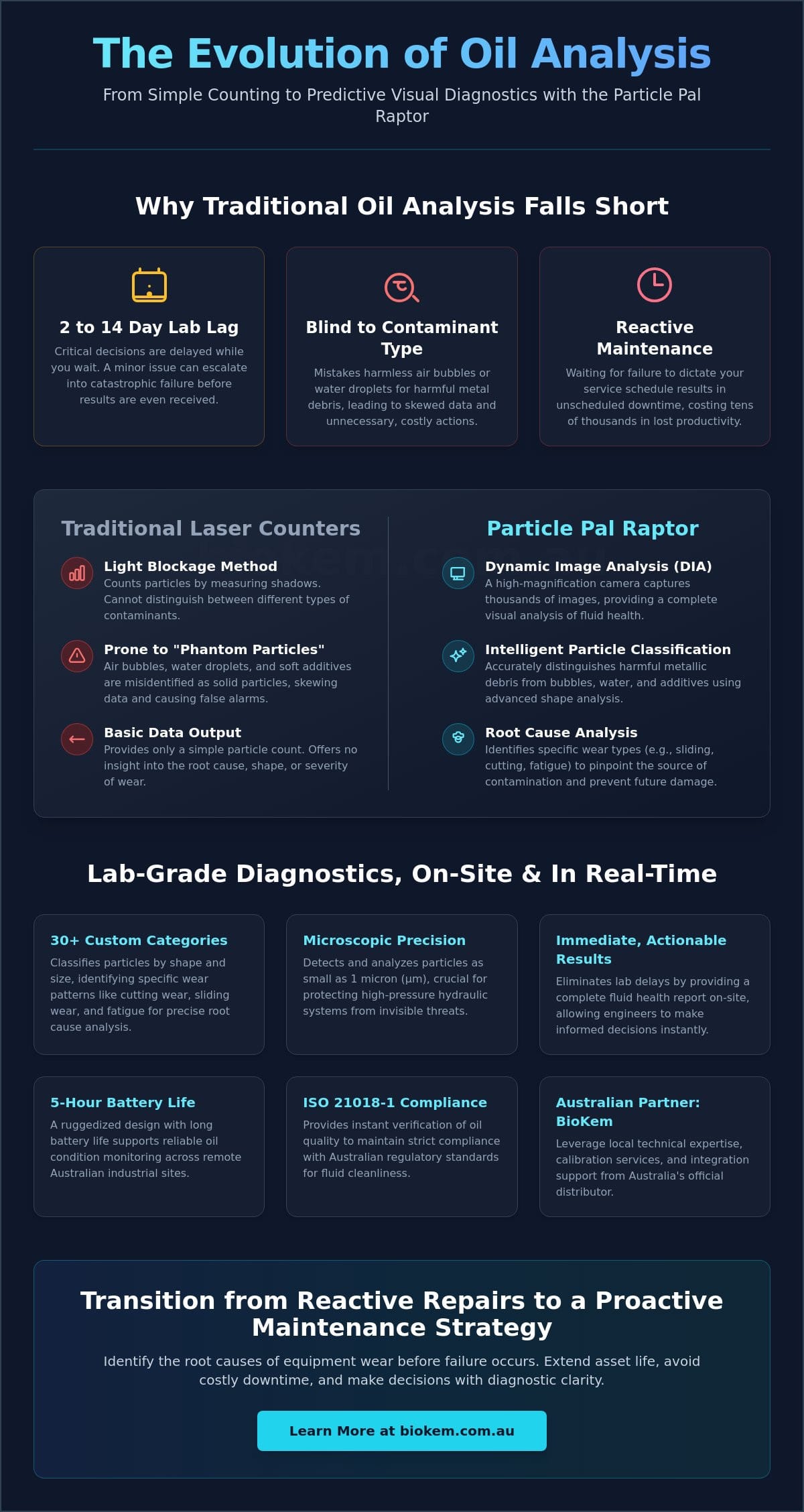
Standard fluid testing often involves a 2 to 14 day lag time while samples are sent to external laboratories. During this window, a minor wear issue can escalate into a catastrophic failure. Traditional light blockage counters also face significant technical hurdles; they’re frequently blinded by entrained air and water droplets. These “phantom particles” skew results and lead to unnecessary oil changes. The Raptor solves this by moving beyond simple counting. It uses Dynamic Image Analysis to visualise the debris, allowing you to perform an accurate root cause analysis by seeing the shape and nature of the contaminants in real time. This evolution is a core component of modern Condition monitoring practices.
Why Real-Time Monitoring is Non-Negotiable in 2026
In 2026, the cost of industrial downtime in sectors like power generation and mining has reached record levels. A single day of unscheduled stoppage can impact a company’s bottom line by hundreds of thousands of dollars. The Particle Pal Raptor ensures compliance with Australian regulatory standards for fluid cleanliness, such as ISO 21018-1, by providing instant verification of oil quality. It’s no longer enough to guess the health of your lubricants. By identifying features and benefits of the Particle Pal Raptor – why you need this instrument, you gain the ability to spot early-stage fatigue or sliding wear. This immediate insight is the difference between a routine filter change and a multi-million dollar turbine overhaul. With its 5-hour internal battery, the Raptor is perfectly suited for remote Australian sites where immediate data is non-negotiable.
Beyond Particle Counting: The Power of Dynamic Image Analysis (DIA)
Dynamic Image Analysis (DIA) transforms oil monitoring by replacing simple light-obstruction sensors with high-speed digital imaging. The Particle Pal Raptor uses a high-magnification camera to capture thousands of frames per minute as oil flows through the sensor. Sophisticated software then processes these images to identify the specific shape and size of every object in the sample. This digital processing is the reason why features and benefits of the Particle Pal Raptor – why you need this instrument are so highly regarded in heavy industry. It effectively filters out “pseudo-particles” like air bubbles or water droplets that typically cause false alarms in lesser devices.
By visualising the fluid in a high-flow environment, the Raptor provides a level of clarity that traditional counters cannot match. It doesn’t just provide a count; it categorises debris based on actual physical characteristics. This allows maintenance teams to distinguish between harmless contaminants and critical wear indicators. For teams managing critical assets, integrating this level of detail into your varnish mitigation strategy ensures that precursors are caught before they coat internal surfaces. You can view our full range of monitoring equipment to see how this fits into your broader reliability framework.
DIA vs. Traditional Laser Particle Counting
Traditional laser counters rely on light blockage methods, which essentially measure the “shadow” cast by a particle. This method is fundamentally limited because it cannot determine what is casting the shadow. If your oil is aerated or contains water, a laser counter will report those bubbles as solid particles, leading to inaccurate ISO codes. DIA technology overcomes this by taking a direct image. Air bubbles are perfectly spherical, while metal particles are irregular and jagged. The Raptor’s software recognises these geometric differences and excludes the non-harmful bubbles from the final count. This capability makes it the superior choice for high-viscosity fluids and dark oils that frequently “blind” traditional laser systems.
Accuracy and Compliance Standards
The Particle Pal Raptor is designed to meet and exceed the most rigorous international benchmarks. It is fully compliant with ISO 21018-1 for fluid contamination monitoring, providing reliable data for ISO 4406, NAS 1638, and NAVAIR reporting codes. The instrument’s sophisticated shape recognition technology exceeds the requirements of the ASTM D7596-23 standard for the classification of particles in oil.
Every analysis generates an auditable report featuring high-resolution thumbnail images of the detected debris. This visual evidence is invaluable for reporting and long-term trend analysis. As the Australian distributor for the Particle Pal range, BioKem Oil Services provides the local technical support necessary to integrate these high-compliance tools into your existing maintenance workflows. Having a visual record of wear particles allows you to prove the necessity of maintenance actions to stakeholders with absolute certainty.
Advanced Wear Debris Classification: Identifying Root Causes
The Particle Pal Raptor distinguishes itself by moving beyond binary “clean or dirty” results. It classifies debris into over 30 custom categories, providing a granular look at the specific contaminants within a system. This level of detail is a core component of the features and benefits of the Particle Pal Raptor – why you need this instrument in complex industrial settings. By identifying whether a particle is metallic or non-metallic, operators can quickly determine if they’re dealing with external dust ingress or internal component degradation. This immediate clarity prevents the common mistake of over-servicing systems that only contain harmless non-metallic fibres.
The “thumbnail” feature provides a high-resolution image of individual particles, allowing for immediate visual verification. This visual evidence bridges the gap between field testing and laboratory results. While the Raptor provides instant onsite data, some cases require even deeper investigation. For those instances, BioKem offers oil analysis services that include detailed ferrogram insights to confirm the metallurgical composition of the wear debris. Combining onsite classification with professional lab analysis creates a comprehensive maintenance record that stands up to regulatory scrutiny.
Understanding Wear Types: Cutting, Sliding, and Fatigue
Wear particles aren’t just random shapes; their morphology tells a story of the mechanical stress occurring inside your equipment. Cutting wear, often appearing as long, spiral ribbons, usually signals that a hard edge is gouging a softer surface. This is a common indicator of seal failure or high-pressure bypass issues. Sliding wear consists of flat, smooth particles that appear when the lubrication film breaks down, allowing metal-to-metal contact. Finally, fatigue wear presents as chunky, pitted particles. These are critical precursors to catastrophic bearing or gear failure. Spotting these early prevents the multi-million dollar repair bills often seen in Australian mining and power sectors.
The Role of Artificial Intelligence in Classification
The Raptor uses internal AI-driven software to automate the classification process. You don’t need to be a trained tribologist to interpret the results. The system instantly categorises each particle, significantly reducing human error during onsite inspections. This automation is particularly useful for manufacturing and quality control. A “Pass/Fail” capability allows for rapid verification of fluid cleanliness before equipment is commissioned or after a hot oil flushing procedure. In remote Australian sites where expert staff may be limited, this automated diagnostic power ensures that maintenance decisions remain accurate and consistent across the entire fleet. It’s a reliable way to maintain high standards without waiting for off-site laboratory confirmation.
Operational Advantages: Why Your Maintenance Strategy Needs the Raptor
The Particle Pal Raptor is engineered specifically for the rigours of the Australian field. Its five-hour internal battery life ensures that technicians can complete a full day of testing at remote sites without needing a constant power source. Housed in a ruggedised, waterproof case, the instrument survives the harsh conditions found in diverse industrial environments. These physical features and benefits of the Particle Pal Raptor – why you need this instrument make it an essential tool for mobile service teams. Because the device requires a sample volume as low as 1ml for ad-hoc testing, you can perform frequent checks without significantly depleting your oil reservoirs.
Integrating this technology with BioKem’s varnish mitigation services provides a double-layered defence for your machinery. The Raptor’s high-resolution camera identifies the sub-micron precursors that lead to varnish build-up long before they settle on internal components. By catching these contaminants early, you maintain the efficiency of heat transfer systems and prevent the sticking of sensitive servo valves. This proactive approach ensures your equipment remains operational while reducing the need for aggressive chemical cleaning later in the asset’s lifecycle.
Extending Asset Life and Reducing TCO
Avoiding a single catastrophic failure in a large-scale hydraulic system can save an operation upwards of A$100,000 in repair costs and lost production time. The Raptor is a cornerstone of a proactive maintenance strategy, allowing you to monitor trends and intervene at the first sign of abnormal wear. This data-driven oversight directly reduces the Total Cost of Ownership (TCO) by extending the interval between major overhauls. Instead of replacing components based on a fixed schedule, you move to condition-based maintenance, ensuring that every part reaches its maximum service life. You can view our full range of monitoring equipment to see how the Raptor fits into a broader asset management plan.
Environmental Responsibility and Sustainability
BioKem prioritises “green” industrial solutions that balance operational efficiency with ecological health. Precise monitoring via the Raptor prevents unnecessary oil changes, which are often performed out of caution rather than necessity. By extending the life of your lubricants, you significantly reduce the volume of hydrocarbon waste your site generates. This reduction in waste oil and disposal requirements helps your organisation meet ISO 14001 environmental management goals. Using the features and benefits of the Particle Pal Raptor – why you need this instrument allows you to prove your commitment to sustainability through measurable data. It’s a practical way to lower your environmental footprint while simultaneously improving the reliability of your industrial assets.
BioKem: Your Australian Partner for Particle Pal Raptor Integration
BioKem serves as the specialist Australian distributor for the Particle Pal range. Our role extends far beyond equipment sales. We provide the essential local technical support and calibration services that ensure your monitoring tools remain accurate in high-stakes environments. By integrating real-time Raptor data into our hot oil flushing and purification projects, we offer a closed-loop solution for fluid health. This local presence means you aren’t waiting for international time zones to resolve a technical query or a calibration issue. Understanding the features and benefits of the Particle Pal Raptor – why you need this instrument is much simpler when you have a dedicated partner to guide the implementation on-site.
We invite industrial operators to request a technical consultation or a live demonstration. Seeing the Dynamic Image Analysis (DIA) technology in action on your own fluid samples provides immediate proof of its diagnostic power. Our engineers work with you to ensure the Raptor isn’t just a standalone tool but a functional part of your broader reliability framework. This collaborative approach ensures that the data captured leads to actionable maintenance outcomes rather than just filling up a spreadsheet.
Training and Onsite Support
BioKem provides comprehensive training for maintenance teams to ensure they master DIA interpretation. While the internal software automates much of the classification, knowing how to correlate specific particle shapes with component wear adds a layer of expert oversight to your operations. We also offer equipment hire for short-term projects or emergency monitoring. If a critical asset shows signs of failure, our hire fleet can be deployed to your site within 24 to 48 hours. For high-stakes decisions, BioKem’s Brisbane-based laboratory can validate Raptor field results, providing a secondary layer of certainty before you commit to expensive repairs.
Customised Monitoring Solutions
Industrial fluids vary significantly across sectors, and a one-size-fits-all approach rarely works. The Raptor is available in specialized editions, including Oil and Gas, Fuel and Lubrication, and Water Quality versions. BioKem helps you select the correct magnification range for your specific application. Whether you need high-magnification for 0.5µm particles in sensitive hydraulics or low-magnification for larger debris in heavy gearboxes, we ensure the hardware matches your fluid type. This precision ensures you get the most relevant features and benefits of the Particle Pal Raptor – why you need this instrument for your unique site conditions. Contact BioKem today to secure your Particle Pal Raptor and transition your facility to a truly proactive maintenance model.
Securing the Future of Your Industrial Assets
The shift toward Dynamic Image Analysis marks a turning point for Australian maintenance teams. By transitioning from simple particle counting to high-resolution visual diagnostics, you eliminate the ambiguity that often leads to catastrophic equipment failure. The Particle Pal Raptor provides the clarity needed to distinguish between harmless air bubbles and jagged metallic wear, ensuring every maintenance decision is backed by empirical, lab-grade data. This advanced precision has been shown to reduce unplanned downtime by up to 40% in heavy industrial applications.
Understanding the features and benefits of the Particle Pal Raptor – why you need this instrument is key to maintaining strict ISO 4406 and ASTM D7596 compliance while protecting your bottom line. As the authorised Australian distributor, BioKem ensures you have access to the local expertise and calibration services required to keep your systems running at peak efficiency. Implementing this technology is a practical commitment to both operational excellence and environmental sustainability through extended lubricant life.
Optimise your reliability, get the Particle Pal Raptor from BioKem today. Taking control of your fluid health is the most effective way to guarantee the long-term performance of your critical machinery.
Frequently Asked Questions
How does the Particle Pal Raptor differ from a standard laser particle counter?
The Raptor utilizes Dynamic Image Analysis (DIA) instead of traditional light blockage technology. While standard laser counters only measure the shadow cast by a particle, the Raptor takes high-resolution digital images. This allows the system to identify the actual shape and type of debris. You get a much clearer diagnostic picture than a simple count can provide, which is essential for accurate root cause analysis.
Can the Raptor distinguish between air bubbles and metal fragments in hydraulic oil?
Yes, the internal software is designed to recognize the geometric differences between contaminants. Air bubbles and water droplets appear as perfect spheres, whereas metallic wear debris is typically jagged and irregular. The Raptor automatically identifies and excludes these “pseudo-particles” from the final count. This prevents the false positives that often lead to unnecessary and expensive oil changes in aerated systems.
What is the minimum particle size the Particle Pal Raptor can detect?
The standard magnification model detects particles as small as 1 micron (µm). Depending on the specific model magnification you choose, the device can capture debris ranging from 0.5µm up to 2500µm. This sensitivity ensures that even the smallest precursors to component fatigue are identified before they cause significant damage to your high-pressure hydraulic circuits or sensitive bearings.
Is the Particle Pal Raptor suitable for high-viscosity industrial oils?
The Raptor handles a broad range of fluid viscosities up to 2,400 cSt. Traditional laser counters often struggle with thick or dark oils because the light cannot penetrate the sample effectively. Because DIA technology relies on high-speed digital imaging, it remains accurate even in heavy gear oils and specialized lubricants. This makes it a versatile tool for diverse Australian industrial applications.
What reporting codes does the Raptor provide for ISO compliance?
The instrument provides instant reporting for ISO 4406, NAS 1638, and NAVAIR standards. It’s built to comply with ISO 21018-1 and exceeds the classification requirements of ASTM D7596. These features and benefits of the Particle Pal Raptor – why you need this instrument ensure that every onsite test meets the rigorous documentation standards required for Australian regulatory audits and insurance compliance.
How long does the battery last for remote field work in Australia?
The internal battery provides up to 5 hours of continuous use on a single charge. This capacity is specifically designed for technicians working at remote sites where power access is limited. You can easily conduct multiple tests across a large facility or mine site throughout the day. The ruggedized case further protects the electronics from the dust and heat typical of Australian field conditions.
Does the Raptor require a laboratory specialist to interpret the results?
No, the system uses AI-driven software to automatically categorize debris into over 30 custom categories. While understanding the features and benefits of the Particle Pal Raptor – why you need this instrument involves recognizing its visual power, the automated “Pass/Fail” results make it accessible for any maintenance technician. The device translates complex visual data into actionable maintenance reports without needing an off-site scientist.
Can the Raptor be integrated into an existing online monitoring system?
The Raptor is designed for both portable use and permanent integration into existing fluid systems. It can provide continuous data streams to SCADA or other remote monitoring platforms. This allows Australian plant managers to maintain constant oversight of oil condition across their most critical assets. Integrating the device into your digital workflow enables a truly predictive maintenance strategy based on real-time data.