

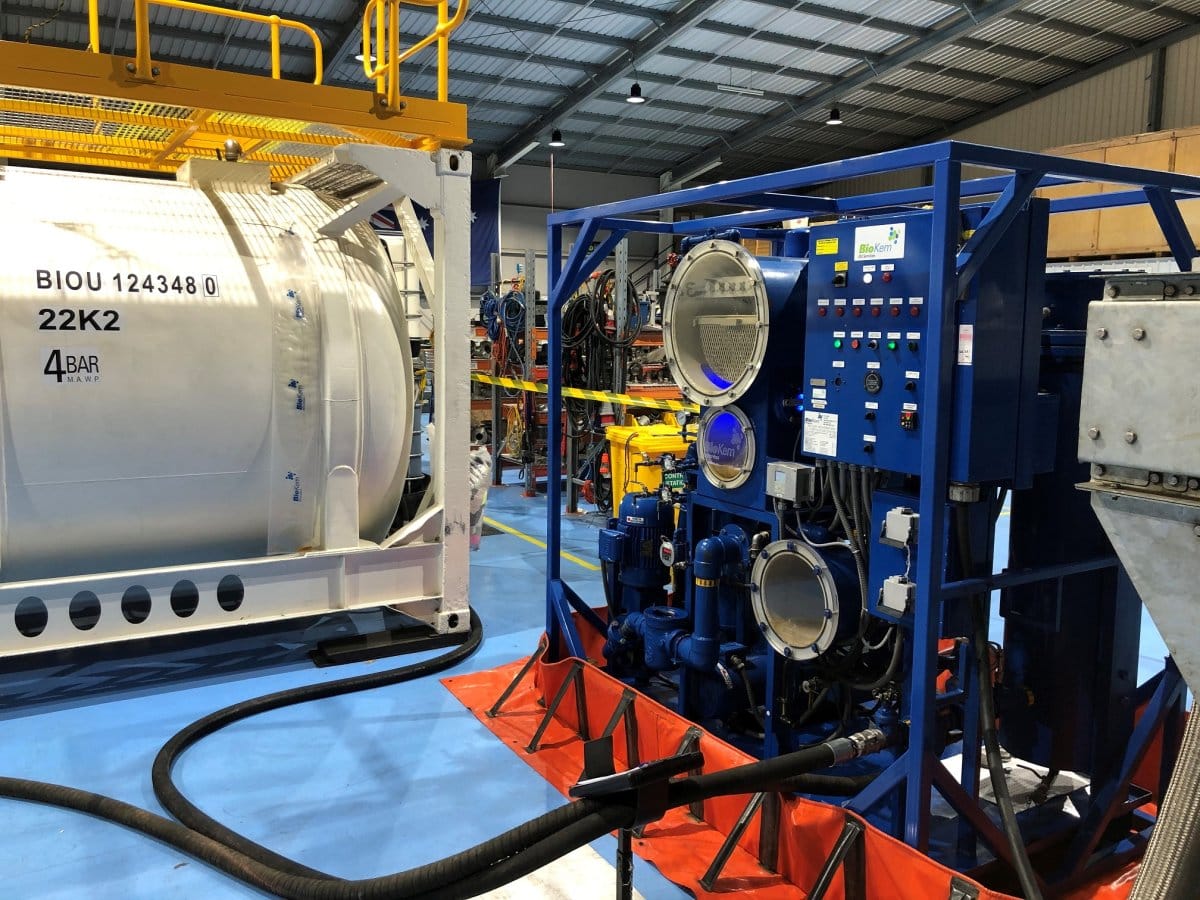
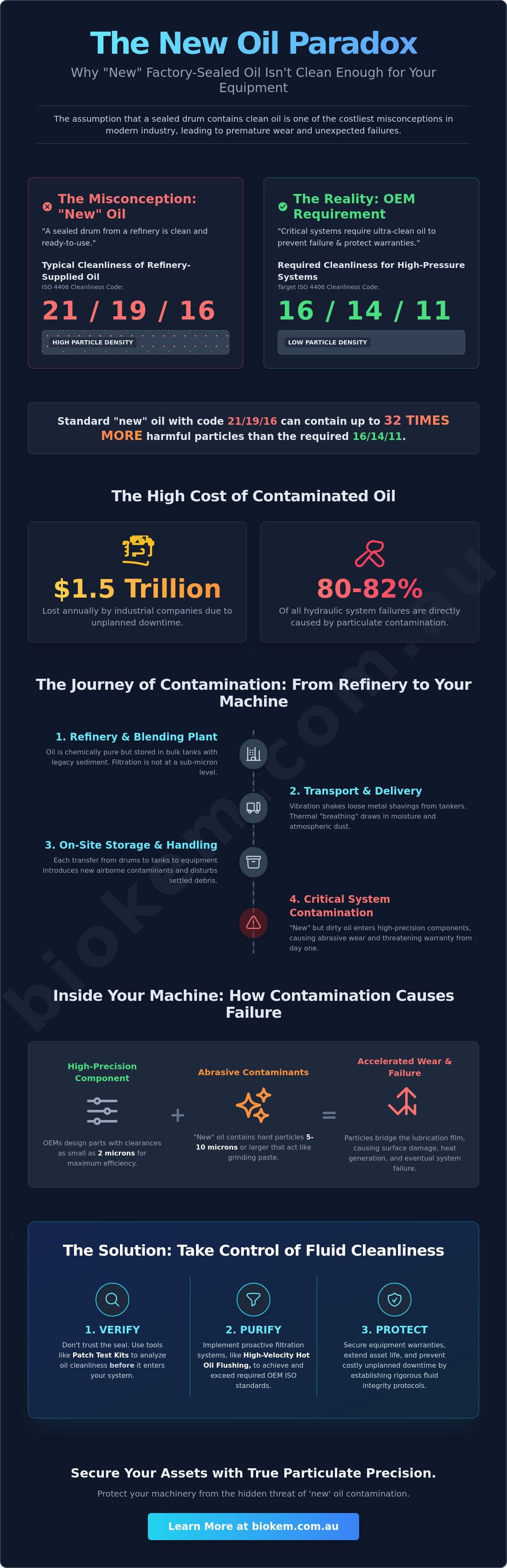
The assumption that a factory-sealed drum contains “clean” oil is one of the most costly misconceptions in modern industry. In reality, oil packaged and supplied by a refinery most often does not meet the cleanliness specification set by the OEM for the equipment it is used on. While refineries prioritize chemical purity and viscosity, the journey from the blending plant to your facility involves multiple transfers that introduce microscopic particulates. This “New Oil Paradox” explains why a fresh delivery typically measures at an ISO 4406 code of 21/19/16, while your high-pressure hydraulic systems likely require a far more stringent 16/14/11 to function reliably.
It’s understandable to feel confident in a supplier’s seal, yet relying on that seal alone contributes to the $1.5 trillion lost annually by industrial companies due to unplanned downtime. This guide clarifies how you can bridge the gap between refinery standards and OEM requirements to secure your equipment warranty and extend asset life. We will examine the latest ISO 4406:2021 protocols, the impact of the new ISO 18464:2025 system design standards, and the technical mechanisms required to achieve true particulate precision for your critical machinery.
Key Takeaways
- Understand the critical distinction between a lubricant’s chemical purity and its particulate cleanliness to prevent premature wear on high-tolerance machinery components.
- Recognise that oil packaged and supplied by a refinery most often does not meet the cleanliness specification set by the OEM for the equipment it is used on, necessitating secondary filtration.
- Identify the specific contamination risks during the supply chain journey, including bulk storage sediment and debris introduced during transport and thermal cycling.
- Protect your equipment warranties by establishing rigorous oil analysis and sampling protocols that verify fluid integrity before it enters your critical systems.
- Implement proactive solutions like high-velocity hot oil flushing and specialized filtration hardware to achieve the precise ISO 4406 standards required for asset longevity.
The New Oil Paradox: Chemical Purity vs. Particulate Cleanliness
Chemical purity describes the molecular integrity of the lubricant. Refineries excel at this stage. They ensure the base oil is stable, the viscosity is precise, and the additive package is perfectly balanced for the intended application. However, there’s a fundamental disconnect in the industrial supply chain. Oil packaged and supplied by a refinery most often does not meet the cleanliness specification set by the OEM for the equipment it is used on. While the fluid is chemically “new,” it’s physically “dirty” by the standards of modern high-precision machinery.
To better understand the environmental and industrial context of oil management, watch this helpful video:
The impact of this disconnect is staggering for maintenance budgets. Industry data indicates that 80% to 82% of all hydraulic system failures and mechanical wear are directly attributed to particulate contamination. This means the vast majority of equipment damage originates from microscopic debris that isn’t even visible to the naked eye. To combat this, technicians should utilise patch test kits to verify the actual state of the fluid before it ever enters a critical system.
Refinery Standards: What You Are Actually Buying
Refineries operate primarily under ASTM standards, which focus on the chemical and physical properties of the oil. These standards rarely mandate specific ISO 4406 particulate counts for standard delivery. Bulk handling infrastructure, including storage tanks and transfer lines, often contains legacy sediment that migrates into the final product. Because standard refineries don’t filter to sub-micron levels, the oil leaves the facility with a significant particulate load. It’s a hard reality that oil packaged and supplied by a refinery most often does not meet the cleanliness specification set by the OEM for the equipment it is used on. Understanding various oil purification methods is essential for operators who need to rectify this before usage.
The OEM Perspective: Why Clearances Matter
Original Equipment Manufacturers (OEMs) design components with incredibly tight tolerances to maximise efficiency and power density. In high-pressure hydraulic systems, clearances can be as small as 2 microns. When “new” oil contains 5-micron or 10-micron particles, those contaminants act as abrasive grinding paste. This debris bridges the gap between moving parts, causing accelerated wear, heat generation, and eventual component failure. Adhering to OEM cleanliness specifications is the only true benchmark for operational readiness.
This engineering precision is equally vital for high-performance European vehicles, where engine and transmission tolerances are similarly demanding. For owners in Brisbane seeking specialized technical support, you can check out Eurotech Automotive for expert vehicle care.
The Journey of Contamination: Why Refinery Supply Falls Short
The journey from the refinery to the machine sump is fraught with contamination opportunities. While the chemical composition is set at the point of blending, the particulate load increases with every transfer. It’s a logistical reality that oil packaged and supplied by a refinery most often does not meet the cleanliness specification set by the OEM for the equipment it is used on. This is largely due to the infrastructure involved; bulk storage tanks and miles of transfer piping often harbour legacy scale, rust, and atmospheric debris that haven’t been purged for years.
Transport adds another layer of risk. During long-haul transit across Australia, constant vibration acts as a mechanical agitator, shaking loose microscopic metal shavings from the internal surfaces of tankers and drums. Thermal cycling also plays a role. As temperatures rise during the day and drop at night, the air space inside a container expands and contracts. This “breathing” effect pulls in ambient moisture and fine silica dust, which is particularly prevalent in Australian mining and industrial regions.
Packaging itself isn’t always the safeguard users expect. Standard intermediate bulk containers (IBCs) and steel drums are rarely cleaned to high-precision standards before being filled. Even a “new” drum can contain manufacturing residues or moisture from storage. To mitigate these risks before commissioning new systems, many operators rely on hot oil flushing to ensure the entire fluid circuit is purged of these transit-acquired contaminants.
Bulk Handling and the “Last Mile” Problem
The final transfer to the site often involves multi-user delivery tankers. If the previous load was a different grade or contained higher levels of moisture, shared pumping equipment and hoses can easily cross-contaminate the fresh supply. Human error during the offloading process, such as leaving a hatch open or using a dirty funnel, further compromises the fluid’s integrity. It’s vital to recognize that oil packaged and supplied by a refinery most often does not meet the cleanliness specification set by the OEM for the equipment it is used on, especially after these multiple handling points.
Storage Degradation on Industrial Sites
Once on-site, drums are frequently stored in environments that accelerate degradation. A sealed drum isn’t a hermetic seal against microscopic threats. Temperature fluctuations cause the drum to “inhale” humid air through the bungs. This moisture then condenses inside, leading to water contamination and potential additive dropout. Identifying these touch points is crucial; without implementing specialised filtration hardware at the point of dispense, you’re essentially introducing a failure mechanism directly into your machinery.
The OEM vs. Refinery Conflict: Why Your Warranty is at Risk
Every critical piece of industrial machinery comes with an operator’s manual that dictates Target Cleanliness Levels (TCL). These aren’t suggestions; they’re rigid operational requirements. The conflict arises because oil packaged and supplied by a refinery most often does not meet the cleanliness specification set by the OEM for the equipment it is used on. When a high-value component like a hydraulic pump or a turbine bearing fails prematurely, the first action an OEM takes is to request an oil analysis report. If that report shows a particulate count exceeding the TCL at the time of commissioning, the warranty claim is almost certainly rejected.
This legal reality places the burden of proof on the asset manager. Proving fluid integrity requires a documented history of oil analysis from the moment the lubricant arrives on site. In many cases, industrial companies lose thousands in rejected claims because they assumed the “new” oil in the drum was ready for service. Onsite filtration acts as a technical insurance policy, ensuring that the fluid matches the mechanical requirements of the system before it ever touches a moving part.
Decoding ISO 4406 for Asset Managers
The ISO 4406:2021 standard uses a three-part code to quantify particles at sizes of ≥4 µm, ≥6 µm, and ≥14 µm. Each increase in the code number represents a doubling of the contaminant level. For example, a typical refinery supply might arrive at 21/19/16, while a modern high-pressure system requires 16/14/11. This means the refinery oil contains roughly 32 times more particles than the OEM allows. For a deeper dive into these metrics, read our guide on Understanding Oil Cleanliness ISO 4406 Codes to see how these numbers impact your maintenance strategy.
The Cost of Assuming Readiness
The financial impact of assuming oil is “clean” can be devastating. A single hour of downtime at an oil and gas facility can cost nearly $500,000. Beyond immediate failure, “new” oil debris acts as a catalyst for varnish formation. Small particulates increase friction and localized heat, which causes the oil to oxidize and leave sticky deposits on valves and actuators. Preventing a single major component failure through a proactive purification program can save over $300,000. It’s helpful to remember that new oil is merely a raw material until it is purified for service.
Achieving Fluid Integrity: Purification and Transfer Protocols
Maintaining the integrity of industrial lubricants requires a shift from reactive top-ups to proactive purification protocols. The foundational rule for any reliability program is simple: never introduce oil into a machine that hasn’t first passed through a high-efficiency filter. Since oil packaged and supplied by a refinery most often does not meet the cleanliness specification set by the OEM for the equipment it is used on, the responsibility for purification shifts to the end-user. This process begins with a rigorous sampling protocol for every incoming delivery, ensuring that the particulate load is quantified before the fluid enters your storage infrastructure.
The “Transfer Trap” is where many facilities fail. Contamination is frequently introduced during the movement of oil from a drum or IBC to the machine’s reservoir. Implementing a closed-loop transfer method is essential to eliminate atmospheric exposure. This involves using dedicated pump sets with sealed couplings and high-efficiency desiccant breathers. By ensuring the oil is never exposed to the ambient environment, you prevent the ingress of silica dust and moisture. For bulk storage tanks, kidney-loop filtration provides a continuous cleaning cycle, effectively managing the sediment that naturally accumulates over time.
Onsite purification techniques must also address dissolved contaminants that standard filters can’t capture. While mechanical filtration removes solid particles, vacuum dehydration is necessary to extract entrained water and gases. This is particularly critical for EHC fluid maintenance and high-pressure hydraulic systems where moisture accelerates oil oxidation and component corrosion. Combining these mechanical and chemical purification methods creates a robust barrier against the inherent particulate load of refinery-supplied lubricants.
Pre-Service Filtration Strategies
Choosing between portable filter carts and permanent filtration stations depends on your facility’s layout and the criticality of the assets. Portable units offer flexibility for multiple machines, while permanent stations are ideal for large-volume reservoirs. Selecting the correct micron rating is vital; a filter must be capable of reaching the target ISO code in a single pass or through a dedicated kidney-loop cycle. For those managing temporary projects or commissioning new systems, Industrial Oil Filtration Equipment Hire provides access to high-spec hardware without the capital expenditure of a permanent installation.
Onsite Oil Analysis and Verification
Verification is the final step in achieving fluid integrity. Patch test kits provide an immediate visual confirmation of the particulate load, allowing technicians to see the debris that refinery processes missed. Since oil packaged and supplied by a refinery most often does not meet the cleanliness specification set by the OEM for the equipment it is used on, digital particle counters are required to confirm precise ISO 4406 compliance. Utilising professional BioKem Lube Oil Analysis Services ensures that your data is scientifically validated, providing the documentation needed to protect your equipment warranties and prove operational readiness.
To ensure your machinery receives only the highest quality fluid, explore our range of specialist oil filters designed for critical industrial applications.
BioKem Solutions: Securing Asset Longevity through Expertise
BioKem bridges the technical gap between bulk refinery output and the precise operational requirements of modern industrial machinery. As established in previous sections, oil packaged and supplied by a refinery most often does not meet the cleanliness specification set by the OEM for the equipment it is used on, making onsite intervention a requirement rather than an option. Our approach focuses on bringing refinery-level precision directly to the machine sump through sophisticated technical interventions and customized lubrication management programs. By integrating scientific oil analysis with high-performance filtration, we ensure that every litre of fluid entering your system supports, rather than degrades, asset longevity.
Our onsite technical interventions are designed to address the specific environmental challenges of Australian industry, from high-dust mining environments to humid coastal power plants. We don’t just provide hardware; we implement a logical sequence of contamination control that identifies the particulate load, explains the mechanical risk, and executes a purification strategy. This structured flow allows business decision-makers to move away from reactive maintenance and toward a proactive model that values long-term ecological health and operational efficiency.
Hot Oil Flushing and System Commissioning
New systems require specialized attention before they’re ever powered on. Even when using “clean” oil from a drum, internal surfaces often contain construction debris, welding slag, and preservative coatings that can’t be removed by standard system filters alone. BioKem utilizes high-velocity Hot Oil Flushing & Filtering Services to achieve turbulent flow within the pipework. This process dislodges and captures microscopic contaminants that would otherwise lead to immediate component wear. Since oil packaged and supplied by a refinery most often does not meet the cleanliness specification set by the OEM for the equipment it is used on, this flushing process is the only way to guarantee a system is truly ready for service.
Specialist Equipment and Hire Solutions
Accessing world-class filtration technology shouldn’t require massive capital expenditure. BioKem serves as the Australian distributor for Filters S.p.A. Products, providing our clients with access to high-performance elements specifically engineered for critical assets. For facilities that prefer to manage their own purification cycles, our equipment hire solutions provide the same high-spec hardware used by our field technicians. This includes vacuum dehydration units and specialized oil filters that can handle the rigorous demands of EHC fluid maintenance and varnish mitigation. To secure your machinery’s future, Contact BioKem for a fluid integrity audit today and ensure your lubricants meet the stringent standards your equipment deserves.
Securing Operational Reliability through Fluid Precision
Relying on factory seals for fluid cleanliness is a risk your machinery can’t afford. As we have examined, oil packaged and supplied by a refinery most often does not meet the cleanliness specification set by the OEM for the equipment it is used on. Bridging this gap requires a move from passive acceptance to active purification. By implementing rigorous onsite analysis and closed-loop transfer protocols, you protect your critical components from the high percentage of failures caused by particulate contamination.
BioKem provides the technical expertise needed to ensure your lubricants are truly fit for service. As the sole Australian distributor for Filters S.p.A. and specialists in high-velocity hot oil flushing since 2011, we deliver comprehensive onsite oil analysis and technical reporting that secures your equipment warranties. Don’t leave your asset longevity to chance. Ensure your oil meets OEM specs with BioKem’s professional filtration services. We are ready to help you achieve the highest standards of industrial reliability and environmental responsibility.
Frequently Asked Questions
Is it true that new oil from a refinery is dirty?
Yes, in terms of particulate contamination, “new” oil is rarely clean enough for immediate use in high-precision machinery. While refineries ensure chemical integrity and viscosity, the infrastructure used for blending and bulk storage often introduces microscopic debris. It is a technical reality that oil packaged and supplied by a refinery most often does not meet the cleanliness specification set by the OEM for the equipment it is used on.
How does ISO 4406 measure oil cleanliness in new lubricants?
ISO 4406:2021 quantifies solid particle contamination using a three-part numerical code. These numbers represent the quantity of particles per millilitre at sizes of ≥4 µm, ≥6 µm, and ≥14 µm. For new lubricants, this code provides a standardised baseline to compare the actual state of the delivered fluid against the target cleanliness level required by your equipment manufacturer for optimal performance.
Can I use a standard filter to clean new oil before use?
Standard onboard filters are designed to maintain cleanliness, not to perform the heavy lifting of initial purification. Using them to clean contaminated new oil often leads to premature filter plugging and may inadvertently bypass contaminants into the system. High-efficiency off-line filtration or kidney-loop systems should be used to bring the oil to the required ISO specification before it enters the machine reservoir.
Why do OEMs have stricter cleanliness standards than refineries?
OEMs prioritise the mechanical longevity of components with clearances as small as 2 to 5 microns. Even microscopic particles can bridge these gaps, causing abrasive wear and system failure. Refineries focus on the chemical health of the base oil and additives, which does not account for the physical debris introduced during the complex supply chain and multiple transfer points common in industrial logistics.
What are the most common contaminants found in refinery-supplied oil?
The most frequent contaminants include silica dust, metal shavings from storage tanks, and manufacturing residues from drums. Additionally, water is a common contaminant introduced through atmospheric breathing during transport. These solid and liquid impurities act as catalysts for oxidation, which is why oil packaged and supplied by a refinery most often does not meet the cleanliness specification set by the OEM for the equipment it is used on.
What happens if I use oil that doesn’t meet OEM specifications?
Using oil that exceeds OEM particulate limits leads to accelerated component wear and a significantly higher risk of unplanned downtime. From a legal perspective, it also compromises your ability to file successful warranty claims. If a component fails and the oil analysis shows the fluid was out of specification at the time of commissioning, the manufacturer is likely to deny coverage for the repair costs.
How much does pre-filtering new oil typically cost?
The cost of pre-filtering varies depending on the volume of oil, the target ISO code, and the specific filtration hardware required. While there is an investment in filtration equipment or service, it is substantially lower than the cost of a single major component failure or an hour of lost production. Asset managers should evaluate this as a proactive maintenance investment that yields a high return through extended equipment life.
Can moisture contamination occur in new, sealed oil drums?
Yes, moisture contamination frequently occurs in factory-sealed drums due to thermal cycling. As temperatures fluctuate, the air space inside the drum expands and contracts, pulling in humid ambient air through the bungs. This moisture then condenses inside the drum, leading to water levels that exceed OEM limits. Using desiccant breathers and vacuum dehydration is often necessary to rectify this before the oil is commissioned.