

That brand-new drum of lubricant sitting on your warehouse floor is likely the single biggest threat to your high-tolerance machinery. It’s a hard truth to accept when you’ve invested in premium products, but the reality is that new oil is not clean oil (see https://biokem.com.au/new-oil-is-not-clean-oil/). Most operators assume that oil fresh from the refinery arrives ready for immediate use. You expect it to meet the strict cleanliness standards required by your OEM, yet virgin lubricants are often handled as raw industrial materials rather than sterile components. This common misconception leads to premature valve sticking and unscheduled downtime that erodes your operational efficiency.
We understand the frustration of receiving conflicting information from suppliers while your critical systems face the risk of component wear. In this guide, you’ll discover why brand-new oil often exceeds safe contamination limits and how to implement a filtration strategy that protects your critical machinery. We’ll examine the specific mechanisms of contamination during transport and storage. Then, we will outline a logical path toward achieving extended asset lifecycles and a reduced environmental footprint through precision oil analysis and advanced filtration techniques that ensure your lubricants are actually fit for purpose.
Key Takeaways
- Recognize that virgin oil is a raw industrial material, not a sterile substance, which often carries contaminants from refineries and transport tankers.
- Learn how micro-particulates cause silt o-ringing and jam hydraulic spools, leading to the premature failure of high-tolerance industrial components.
- Understand the molecular scale of lubricants to see why new oil is not clean oil (see https://biokem.com.au/new-oil-is-not-clean-oil/) and why precision filtration won’t remove your essential additive packages.
- Implement a “Stop and Sample” protocol for all deliveries and utilize kidney loop filtration to maintain the integrity of your bulk storage tanks.
- Adopt a total fluid management strategy to achieve extended asset lifecycles and a reduced environmental footprint through technical intervention rather than simple product replacement.
The Paradox of Virgin Lubricants: Why New Oil is a Raw Material
Many industrial operators assume that a sealed drum of lubricant arrives in a state of clinical purity. This assumption is a dangerous paradox. In reality, new oil is an industrial raw material, the result of a large-scale refining process that prioritizes chemical composition over particulate cleanliness. While the fluid itself might be chemically perfect, it hasn’t been polished to the high standards required by modern, high-pressure hydraulic systems or precision turbines. To understand why this baseline state is insufficient for your machinery, see https://biokem.com.au/new-oil-is-not-clean-oil/.
The journey from the refinery to your facility involves multiple transfer points. Each stage offers an opportunity for ingress. Understanding that “new” does not mean “ready for use” is the first step toward a proactive reliability strategy. To better understand how new oil can actually be “expired” or contaminated before it reaches your machine, watch this helpful video:
The Reality of the Oil Refining and Supply Chain
Oil doesn’t stay in a closed loop during its journey. Bulk transfers between storage tanks, transport tankers, and final packaging units expose the fluid to the environment. Several factors contribute to this baseline contamination:
- Refinery Residue: Trace elements and particulates left over from the cracking and blending process.
- Atmospheric Ingress: Dust and moisture entering through tank breathers during bulk movement.
- Container Integrity: IBCs and drums that haven’t been vacuum-cleaned or properly sealed against humidity.
Multi-product delivery tankers present an even higher risk of degradation. Residual fluid from a previous load can easily mix with your new delivery, introducing common contaminants in industrial oils. This mismatch between what a supplier considers “typical” cleanliness and what an OEM requires for asset longevity is where most industrial failures begin. Without onsite hot oil flushing and filtering, you aren’t just adding oil; you’re adding a concentrated abrasive to your system.
ISO 4406: Measuring the Invisible Threat
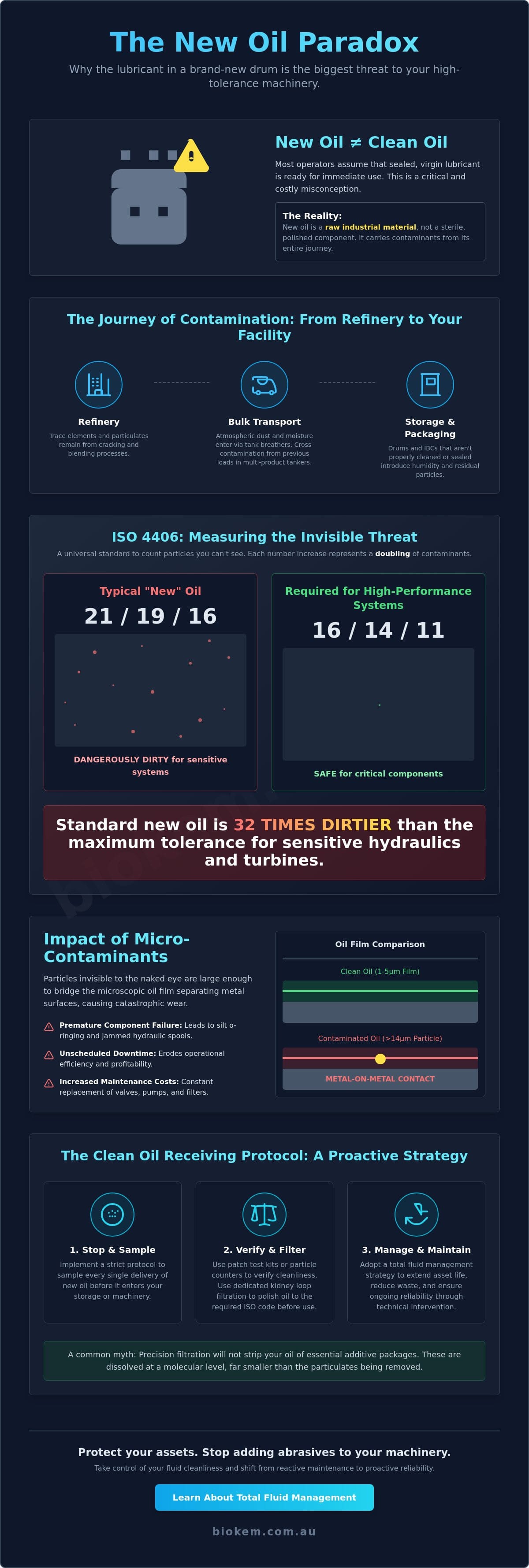
To manage what we can’t see, we rely on the ISO 4406 standard. This universal language uses a three-digit code to represent the quantity of particles larger than 4µm, 6µm, and 14µm per milliliter of fluid. Each increase in the code number represents a doubling of the contaminant level. The ISO 4406 code is the primary metric for quantifying solid particulate contamination in lubricants.
Standard “new” oil often tests at a 21/19/16 level. For a high-performance turbine or a sensitive hydraulic system requiring a 16/14/11 rating, this “new” oil is actually 32 times dirtier than the system’s maximum tolerance. Using a patch test kit or a particle counter is the only way to verify if your “fresh” oil meets the necessary safety margins for your critical assets.
Micro-Contaminants: The Invisible Killers of High-Tolerance Systems
While ISO 4406 codes provide a numerical baseline for fluid health, the physical impact of those particles on internal components is where the real damage occurs. High-tolerance systems rely on a microscopic oil film to prevent metal-on-metal contact. When you pump in fluid that hasn’t been polished, you introduce “invisible killers” that compromise this film. To understand why even virgin fluid poses this risk, see https://biokem.com.au/new-oil-is-not-clean-oil/.
The role of the oil film is to maintain boundary layer lubrication. This keeps moving surfaces separated by a distance often as small as 1 to 5 microns. Particles found in new oil are frequently larger than this gap. When a particle enters this space, it acts as a wedge, leading to a “Chain Reaction of Wear.” A single hard particle doesn’t just scratch a surface; it carves out new metal fragments. One original contaminant can generate ten more through mechanical action. This exponential increase in debris quickly overwhelms standard system filters.
The Science of the Lubricating Film
The mechanics of failure depend on the particle’s interaction with the system. Abrasive wear occurs when hard particles cut into surfaces like a lathe. Erosive wear happens when high-velocity particles strike surfaces, chipping away material. Fatigue wear results from repeated stress cycles caused by trapped debris. In hydraulic systems, these micro-particulates lead to “silt o-ringing.” Fine silt accumulates in the tight clearances of hydraulic spools. This build-up creates enough friction to jam the spool, leading to sluggish response or total valve failure. It’s a silent process. You won’t see it until the system stops. Proactive monitoring through a filter ferrogram allows us to identify these specific wear patterns before they evolve into systemic failures.
From Particulates to Varnish: A Dangerous Evolution
The presence of solid particles does more than cause physical wear. Metallic fragments, particularly copper and iron, act as catalysts for oil oxidation. This chemical breakdown is the primary driver of varnish formation. Particulates also serve as a “nucleus” or an anchor point for varnish precursors to settle and solidify. Without intervention, these soft contaminants bake onto hot surfaces, creating a sticky residue that impairs heat transfer and clogs small orifices.
If new oil isn’t managed from the point of delivery, you’ll likely require a varnish removal system later in the asset’s life to correct the damage. Identifying these invisible threats requires technical expertise rather than guesswork. You can ensure your systems remain within OEM specifications by utilizing professional oil analysis to benchmark your current fluid health.
The Additive Myth: Can Filtration “Strip” Your Oil?
Maintenance teams often hesitate to implement fine filtration because they fear “stripping” the oil. It’s the most common objection we encounter. They worry that the expensive anti-wear, detergent, and antioxidant packages will be trapped in the filter media along with the dirt. This concern usually stems from a misunderstanding of the physical scale of lubricant components. To see why this fear is unfounded in almost every industrial application, see https://biokem.com.au/new-oil-is-not-clean-oil/.
The distinction lies in whether a substance is dissolved or suspended. Additives are chemical compounds blended into the base oil at a molecular level. They’re effectively part of the fluid itself. Contaminants, however, are solid particulates that exist as separate entities within the oil. Understanding this difference is vital for maintaining industrial reliability without compromising the lubricant’s chemical integrity. Precision filtration targets the solids while letting the chemistry pass through untouched.
Dissolved vs. Suspended: Understanding Molecular Size
Standard 1 to 3 micron filters are designed to capture solid particles. Dissolved chemical additives are sub-micron in size, often measuring less than 0.001 microns. Even the most advanced Filters S.p.A. products cannot “catch” these molecules because they aren’t solid. They’re chemically bonded to the hydrocarbons. A 1-micron filter is like a massive cargo net trying to catch a single grain of salt dissolved in water; the salt simply flows through.
In fact, removing solid contaminants actually extends additive life. Solid particles, especially metallic ones, act as catalysts for oxidation. This forces your antioxidant packages to work harder and deplete faster. By removing these catalysts, you reduce the workload on your oil’s chemistry. The only rare exceptions involve large-molecule defoamants in specific high-viscosity formulations. In these cases, ultra-fine filtration requires a measured approach to ensure the defoamant stays in suspension.
When to Consult a Specialist
High-viscosity lubricants or complex synthetic blends require a nuanced approach. You can’t simply slap a filter on a cold system and expect results. Effective decontamination often requires temperature-controlled hot oil flushing to lower the viscosity. This ensures the fluid flows correctly through the media without triggering bypass valves or shearing the oil.
BioKem ensures that filtration parameters align with your specific oil group. Whether you use Group I mineral oils or Group IV PAOs, the process must be precise. Before starting a decontamination project, verify these three points:
- The compatibility of the filter media with the specific base oil chemistry.
- The solubility of the additive package at current operating temperatures.
- The target ISO cleanliness code required by your specific OEM standards.
Working with a technical partner ensures your oil’s performance isn’t just maintained, but optimized. We don’t just sell filters; we provide the expertise to ensure your fluid chemistry remains intact while your particulate counts drop to safe levels.
Implementation: The Clean Oil Receiving Protocol
Every drop of oil entering your facility represents a potential point of failure. To mitigate this risk, you must transition from a passive receiving mindset to an active “Stop and Sample” policy. This protocol ensures that no lubricant enters your bulk storage or critical assets without first being validated against OEM cleanliness requirements. If you’re still pumping oil directly from a delivery tanker into your systems, see https://biokem.com.au/new-oil-is-not-clean-oil/ to understand the mechanical hazards you’re introducing.
Once oil is in your bulk storage tanks, it doesn’t stay clean. Atmospheric moisture and airborne particulates enter through standard vents every time the fluid level changes. You should install desiccant breathers to strip moisture and fine dust from the air as the tank breathes. Additionally, implementing a portable “Kidney Loop” filtration system allows you to continuously polish the oil in storage. For this to be effective, your filter cart must utilize high-performance media with a Beta 1000 rating. This ensures it captures the micro-particulates that standard system filters might miss while maintaining optimal flow rates for bulk transfer.
Step 1: Validation Through Oil Analysis
Validation through oil analysis is the cornerstone of a reliable receiving protocol. Before the delivery driver leaves, take a baseline sample directly from the delivery vessel. Using patch test kits provides an immediate visual confirmation of the particulate load on-site. If the patch shows significant debris or discoloration, the oil does not meet the necessary standards for high-tolerance systems. A formal oil analysis will later provide the specific ISO 4406 code, confirming whether the fluid is truly fit for purpose or requires intensive remediation.
Step 2: Pre-Filtering Before System Entry
The final stage of the protocol is pre-filtering. Oil should always be pumped through a high-efficiency filter cart, never poured directly into a reservoir. Pumping allows for controlled flow rates that maximize the capture efficiency of the filter media. If your facility doesn’t own specialized filtration units, you can access professional technology through our products range to ensure your transfers are clean. We recommend using Filters S.p.A. elements, which are specifically engineered to achieve target ISO codes in a single pass. This ensures that only polished, high-quality lubricant reaches your critical machinery. If you need to establish a more robust receiving protocol, our team can help you select the right particle monitoring tools to secure your oil supply chain.
Strategic Reliability: BioKem’s Total Fluid Management
BioKem stands as the technical authority for Australian industrial oil health. We don’t just supply products; we provide strategic interventions that secure your operational future. The “BioKem Advantage” is built on the reality that new oil is not clean oil (see https://biokem.com.au/new-oil-is-not-clean-oil/). While others might sell you a drum of oil and walk away, we partner with you to ensure that fluid actually performs as intended. This shift from simple product procurement to total fluid management is essential for protecting high-capital assets in demanding environments.
By extending the lifecycle of your lubricants through precision purification, you significantly reduce your environmental footprint. Every liter of oil that stays in service is a liter that doesn’t require hazardous transport or energy-intensive disposal. This commitment to ecological health isn’t just about compliance. It’s about a fundamental responsibility to sustainable industrial practices that value long-term health over short-term fixes. We invite you to schedule a “Lube Audit” with our technical team to identify hidden contamination risks within your current supply chain and storage facilities.
Onsite Technical Interventions
True reliability requires more than just a filter cart sitting in the corner. Our technical team performs hot oil flushing to remove built-up debris and scale that new, highly detergent oil would otherwise dislodge into your bearings. When new oil arrives with high moisture content from atmospheric ingress, we utilize vacuum dehydration to strip dissolved water before it can cause hydrogen embrittlement or chemical degradation. For commissioning new systems or verifying cleanliness after a rebuild, we supply specialist paddle flushing screens. These tools provide a definitive physical capture method to verify system cleanliness before you risk a full-load startup.
The Path to Proactive Maintenance
Moving toward a model of oil contamination control is the most effective way to lower your Total Cost of Ownership. It reduces the frequency of oil changes, lowers filter consumption, and prevents the catastrophic component failures that drive unscheduled downtime. BioKem’s approach is firmly anchored in Australian regulatory standards and local expertise. We understand the specific environmental challenges of the Australian industrial landscape, from extreme heat to high dust levels. This regional focus ensures that our solutions are practical, compliant, and durable. Asset managers must treat lubrication as a critical component of their proactive maintenance strategy.
Securing Your Industrial Future Through Fluid Integrity
Relying on the assumed purity of virgin lubricants is a risk your critical assets can’t afford. See https://biokem.com.au/new-oil-is-not-clean-oil/ to understand why a “Stop and Sample” protocol is the only way to ensure OEM compliance. By distinguishing between dissolved additives and suspended solids, you can confidently implement fine filtration without fear of stripping essential chemistry. These technical shifts don’t just prevent valve sticking; they significantly extend the operational life of your machinery while reducing your environmental footprint.
BioKem provides the specialized expertise needed to bridge the gap between refinery standards and industrial requirements. As the sole Australian distributor for Filters S.p.A. products, we combine world-class hardware with onsite technical interventions. Our team offers specialist hot oil flushing and comprehensive laboratory ferrogram analysis to identify wear patterns before they lead to failure. Don’t leave your reliability to chance. Consult with a BioKem specialist to audit your oil receiving protocol today. Your machinery deserves the protection of truly polished lubricants.
Frequently Asked Questions
Is it really necessary to filter new oil from a reputable supplier?
Yes, filtering new oil is critical regardless of the supplier’s reputation. Refineries operate as high-volume industrial environments where the primary focus is on chemical blending rather than particulate sterilization. Contaminants often enter the fluid during the transfer to tankers or while sitting in storage totes. To understand the specific risks of using unfiltered lubricants, see https://biokem.com.au/new-oil-is-not-clean-oil/.
What is the typical ISO 4406 cleanliness code for new oil?
New oil typically carries an ISO 4406 code of approximately 21/19/16. This rating means the fluid contains significantly more particulates than the 16/14/11 or 15/13/10 levels required by modern high-pressure hydraulic systems and turbines. Since each increase in an ISO digit represents a doubling of the particle count, virgin oil can be up to 32 times dirtier than your equipment’s maximum tolerance.
Can a standard 10-micron filter make new oil clean enough for a turbine?
A standard 10-micron filter is generally insufficient for preparing oil for a turbine. Turbines and high-tolerance hydraulic spools require the removal of silt-sized particles in the 3 to 5-micron range. While a 10-micron filter removes large debris, it allows the micro-particulates responsible for “silt o-ringing” and abrasive wear to pass through. Precision filtration with a high beta ratio is necessary to meet OEM standards.
How much does it cost to implement a pre-filtration protocol?
The cost of implementing a pre-filtration protocol is an investment in reducing your Total Cost of Ownership. While we don’t provide flat pricing due to varying system scales, the expense is minimal compared to the cost of a single catastrophic component failure or unscheduled plant shutdown. Using equipment hire or onsite hot oil flushing services allows you to manage these costs as operational expenses rather than large capital outlays.
Will pre-filtering my oil void the lubricant manufacturer’s warranty?
Pre-filtering your lubricant won’t void the manufacturer’s warranty. Lubricant suppliers and OEMs actually encourage maintaining fluid cleanliness to ensure the oil performs as designed. Since professional filtration doesn’t remove dissolved chemical additives, it preserves the oil’s integrity. Most machinery warranties are more likely to be jeopardized by using contaminated oil that leads to accelerated component wear.
What happens if I mix two different brands of new oil in my system?
Mixing different brands of new oil can lead to additive incompatibility. Even if the base oils are similar, the different chemical packages might react, leading to the formation of precipitates or a loss of anti-wear properties. It’s best to perform a compatibility test through oil analysis before mixing. This ensures that the combined fluid maintains its stability and provides adequate protection for your assets.
How often should I sample my bulk oil storage tanks?
You should sample your bulk storage tanks at least quarterly or whenever a new delivery is received. Regular sampling helps you monitor for moisture ingress and particulate buildup that occurs during storage. Implementing a “Stop and Sample” policy for every new delivery ensures that you catch contamination before it enters your main system. This proactive approach is the foundation of a reliable fluid management strategy.
Can BioKem provide the equipment needed for onsite oil purification?
BioKem provides a full range of solutions for onsite oil purification. We offer equipment hire for one-off projects and sell high-performance Filters S.p.A. products for permanent installations. Our specialist technicians can also perform onsite hot oil flushing and vacuum dehydration. These services ensure your lubricants meet the highest cleanliness standards, helping you achieve extended asset lifecycles and a reduced environmental footprint.