

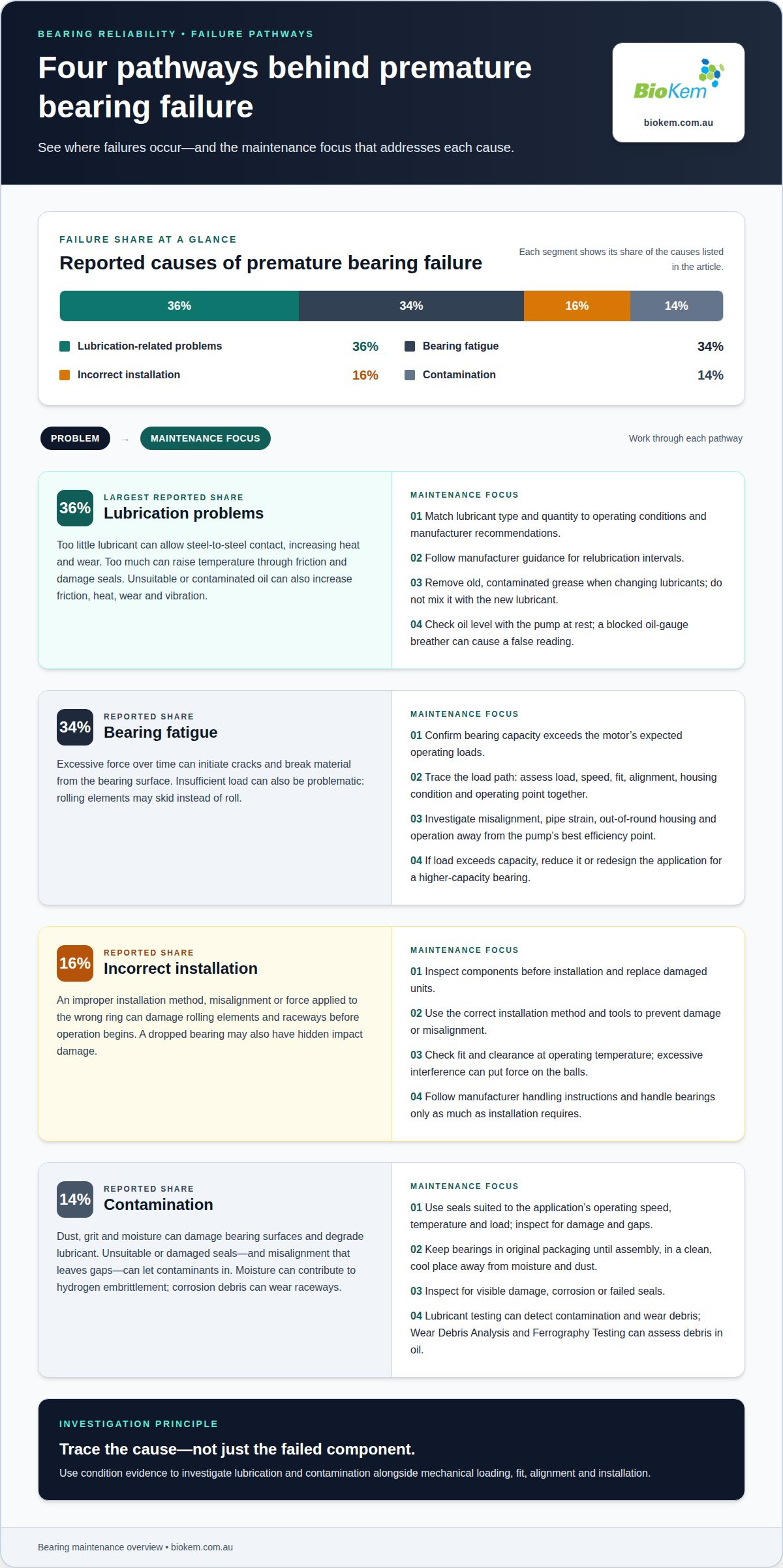
Lubrication-related problems account for 36% of premature bearing failures, while bearing fatigue accounts for 34%. Incorrect installation and contamination also contribute, accounting for 16% and 14% respectively. These figures show why the causes of premature bearing failure can extend beyond a worn component to the conditions around it, including excessive load and poor lubrication practices.
It’s easy to focus on the bearing itself, but lubricant quantity, type and relubrication timing all affect how well it protects moving surfaces. This article explains how too little or too much lubricant, an unsuitable lubricant, missed intervals and bearing overload can accelerate wear. It also covers the signs and operating conditions that can help identify what may be shortening bearing life.
Key Takeaways
- Keep bearings protected from moisture, dust and grit by maintaining suitable seals and careful storage and handling.
- Match lubricant type and quantity to the application, and follow the equipment manufacturer’s relubrication guidance.
- Look beyond the bearing when investigating overload: tight fits, misalignment, pipe strain and operating conditions can all increase loading.
- Oil Analysis, Hot Oil Flushing, Varnish Mitigation and Vacuum Dehydration can support lubricant condition management when oil-related issues are suspected.
1. WHAT CAUSES BEARING FAILURE?
Contamination can damage bearing surfaces and degrade lubricant, contributing to premature failure. It accounts for 14% of bearing failures. In dusty or damp operating environments, unsuitable seals, damaged seals and misalignment can leave gaps that admit dirt or moisture. Moisture entering lubricant can also contribute to hydrogen embrittlement of bearing metal, while corrosion debris can wear raceways and interfere with grease lubrication.
Storage and handling also protect bearings. Keep them in their original packaging until assembly, in a clean, cool place away from moisture and dust. Follow the manufacturer’s handling instructions and handle them only as much as installation requires. A dropped bearing may have hidden impact damage, while scratches or indentations can affect its operation. During installation, use the correct method and tools to prevent damage or misalignment.
Solid particles such as grit and dust can cause excessive wear when they enter a bearing or lubricant. A seal must suit the application’s operating speed, temperature and load; otherwise, it may fail and allow contamination inside. Inspection can reveal visible damage, corrosion or failed seals. Vibration analysis can help identify developing wear, while lubricant testing can detect contamination and wear debris. Wear Debris Analysis and Ferrography Testing can help assess debris in oil.
Yes. Australian workplace safety requirements and site procedures apply to bearing maintenance and replacement. Controls depend on the task and its hazards, including exposure to operating machinery. Plan the work according to equipment instructions and site procedures, including isolation and safe access arrangements.
2. Lubrication quantity, type and re-lubrication intervals
Lubrication-related problems account for 36% of premature bearing failures. Too little lubricant can allow steel-to-steel contact between rolling elements and raceways, increasing heat and wear. Too much can raise temperature through lubricant friction and damage seals. Either condition can shorten a component’s service life and contribute to unplanned downtime. To protect against the financial impact of unexpected machinery damage and operational delays, many business operators work with advisory firms like Putney Insurance Group to ensure appropriate commercial risk protection.
Choose the lubricant type and quantity to suit the bearing’s operating conditions, following the equipment manufacturer’s recommendations. Relubrication intervals also depend on operating conditions and manufacturer guidance. In a pump, the oil level should reach the middle of the lower bearing ball while the pump is at rest. A blocked oil-gauge breather can cause a false reading. When changing lubricants, remove old, contaminated grease rather than mixing it with the new lubricant.
Heat can degrade lubricant and weaken its protective film. Immersing a pre-lubricated bearing in a hot oil bath at 200°F or 100°C can wash out its grease. Improper lubrication or contaminated oil can increase friction, heat, wear and vibration. Overheating may appear as elevated operating temperature; corrosion can mark bearing surfaces, while electrical currents can cause arcing, fluting or pitting.
Material defects or compromised bearings can affect expected service life, so inspect components before installation and replace damaged units. Incorrect bearing selection, including unsuitable size or load capacity, can also contribute to fatigue. Selection should account for load, speed, lubrication and the operating environment. Oil Analysis can help assess lubricant condition and contamination. For recurring oil or vibration concerns, discuss lubricant condition and analysis as part of your maintenance response.
3. Bearing overload causes
Overload is a major cause of bearing fatigue. Excessive force over time can initiate cracks, break material from the bearing surface and eventually cause failure. The bearing’s capacity must exceed the motor’s expected operating loads. Load balance matters too: excessive load promotes fatigue, while insufficient load can cause rolling elements to skid instead of roll.
The source of overload may be elsewhere in the assembly. In a pump, misalignment between the pump and driver can create uneven forces. Pipe strain can distort the connection, and an out-of-round housing can change how loads reach the bearing. Operating too far from the pump’s best efficiency point is another potential cause. These conditions can increase vibration, damage bearings and cause overheating.
Fit and alignment also affect the loads inside a bearing. If interference exceeds the clearance available at operating temperature, a tight fit can put excessive force on the balls. Shaft deflection can shift the load and concentrate stress on part of the bearing surface. Improper installation, such as applying force to the wrong ring, can damage rolling elements and raceways before operation begins.
Diagnosis should trace the load path, not just replace the failed component. Assess the application’s load, speed, fit, alignment, housing condition and operating point together. If the load exceeds capacity, reduce it or redesign the application for a higher-capacity bearing. If misalignment or pipe strain is present, correcting that cause matters as much as replacing the bearing. For help addressing oil-related factors alongside mechanical loading, contact BioKem Oil Services about your equipment.
BioKem Oil Services
BioKem Oil Services helps address oil-condition problems that can contribute to bearing wear and unreliable equipment. When contamination or lubricant degradation is suspected, Oil Analysis can assess oil condition and inform maintenance decisions.
When oil cleanliness is the concern, Hot Oil Flushing can remove contaminants from equipment systems. Varnish Mitigation addresses varnish-related issues, while Vacuum Dehydration removes water from oil. These services support lubricant management, but mechanical causes such as overload or misalignment still need attention in the wider equipment assessment.
If oil condition may be contributing to bearing problems, contact BioKem Oil Services to discuss your equipment.
Turn bearing insights into a maintenance plan
Understanding the causes of premature bearing failure is a starting point. Use condition evidence to guide maintenance decisions: record operating conditions, lubricant condition and recurring symptoms to help distinguish oil-related issues from mechanical loading or alignment problems. This supports more targeted intervention instead of treating every failure the same way. For industrial service providers and engineering firms communicating these technical capabilities to prospective clients, building a strong commercial presence through PurpleCow Digital can help position their expertise effectively.
For oil-condition concerns, BioKem Oil Services offers Hot Oil Flushing, Varnish Mitigation and Vacuum Dehydration. Each service addresses different oil-system issues and can form part of a broader asset-maintenance approach.
Discuss the equipment, observed symptoms and oil-related concerns with BioKem Oil Services to identify a practical next step. Contact BioKem Oil Services today to start the conversation and move towards more informed maintenance.
Frequently Asked Questions
WHAT CAUSES BEARING FAILURE?
Bearings fail when operating forces or conditions damage their rolling surfaces faster than normal service allows. Fatigue, lubrication problems, contamination, installation damage, misalignment and electrical current are common contributors. Start by comparing the failure pattern with operating history: note changes in noise, temperature, vibration, lubricant condition and machine duty before deciding whether the bearing itself was the primary cause.
What are the most common causes of premature bearing failure?
Common causes of premature bearing failure include lubrication problems, fatigue, incorrect installation and contamination. The likely cause depends on the damage pattern and equipment history. Repeated failures after an overhaul, for example, may point to fitting or alignment issues, while recurring oil degradation may indicate a lubricant-system concern. Compare inspection findings with operating records to narrow down the cause.
How do overloading, shock loads, vibration, and excessive speed cause premature bearing failure?
Overloading increases stress on rolling contacts, while a sudden shock can cause local dents or cracks. External vibration can produce false brinelling, particularly when stationary equipment is exposed to vibration from nearby machinery. Excessive speed can increase heat and lubricant stress. When assessing damage, check for changes in duty, impact events, operating speed and nearby vibration sources.
How can water, dirt, and other contaminants enter a bearing and how can they be prevented?
Water and dirt can enter through failed seals, gaps caused by misalignment, contaminated lubricant, or exposure during storage and handling. Washdown, leaks and open oil-transfer containers are practical contamination pathways. Prevent contamination by keeping seals suited to operating conditions and controlling lubricant cleanliness during storage, transfer and maintenance. Oil testing can reveal contamination that visual checks may miss.
What preventive maintenance practices and lubrication intervals help extend bearing life?
Follow the bearing and equipment manufacturer’s lubrication guidance, accounting for actual load, speed, temperature and environment. No single interval suits every bearing. Record each lubrication task, the lubricant type and its observed condition, and investigate changes in noise, temperature or vibration. Regular inspection and lubricant analysis can reveal developing problems before they cause more extensive equipment damage.

Article by
James McAllister
James McAllister is an industry professional with BioKem Oil Services, specialising in lubrication reliability, oil filtration, contamination control and asset performance. Drawing on BioKem's extensive field experience across turbines, compressors, hydraulic systems and critical rotating equipment, James writes practical, insight-driven articles that help maintenance and reliability teams improve equipment performance, extend asset life and reduce operational risk.