

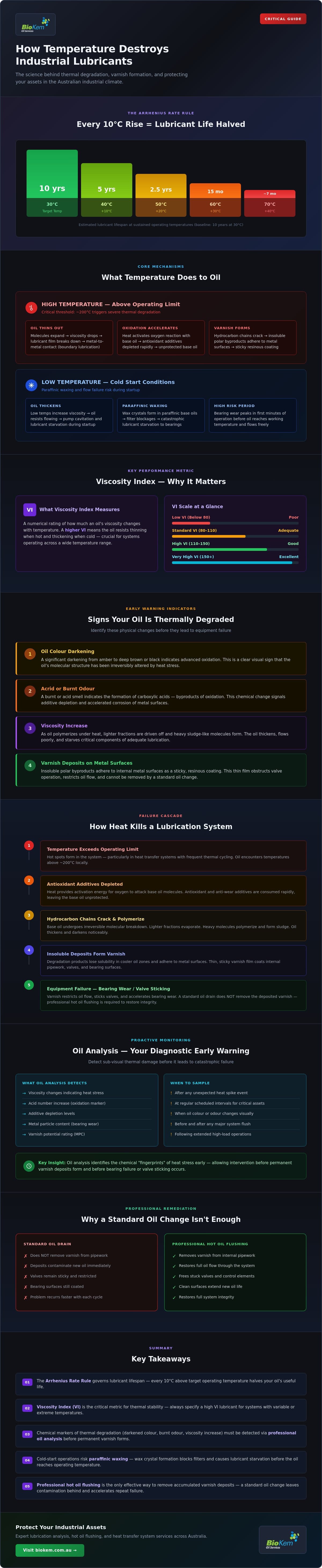
Did you know that for every 10°C increase in operating temperature above its target, the life of your industrial lubricant is effectively cut in half? This principle, known as the Arrhenius Rate Rule, means an oil that should last ten years at 30°C might fail in just fifteen months if it’s pushed to 60°C. In the demanding Australian climate, managing the effects of temperature on oils isn’t just a routine maintenance task; it’s a critical strategy for asset survival. You’ve likely experienced the frustration of unscheduled downtime or the uncertainty of when to pull a sample after a sudden heat spike. It’s a common industrial challenge where heat transforms a vital protector into a destructive contaminant.
This article explores how thermal fluctuations accelerate chemical degradation and trigger the formation of harmful varnish and sludge. You’ll discover how to protect your industrial assets from temperature-induced failure while extending the functional life of your lubricants. We’ll examine the technical mechanisms behind additive depletion, the risks of microdieseling, and the specialized mitigation strategies that keep your systems running at peak efficiency despite extreme thermal stress.
Key Takeaways
- Understand how the Arrhenius Rate Rule dictates lubricant lifespan and why the Viscosity Index is a critical metric for maintaining operational stability.
- Identify the chemical markers of thermal degradation and the specific effects of temperature on oils that lead to the formation of restrictive varnish and sludge.
- Discover the risks associated with cold-start operations, including how paraffinic waxing can cause filter blockages and catastrophic lubricant starvation.
- Learn how proactive oil analysis serves as a diagnostic tool to detect sub-visual thermal damage before it results in bearing failure or valve sticking.
- Explore why professional hot oil flushing is necessary to restore system integrity when traditional oil changes fail to remove accumulated deposits from internal pipework.
Table of Contents
-
Understanding the Relationship Between Temperature and Oil Condition
-
Professional Remediation: Restoring System Integrity with BioKem
Understanding the Relationship Between Temperature and Oil Condition
Temperature acts as the primary catalyst for chemical instability in industrial lubricants. While contamination and moisture are significant operational threats, the effects of temperature on oils represent the most dominant driver of oxidation and premature molecular breakdown. When a system operates beyond its thermal design limits, the base oil undergoes irreversible changes that compromise its ability to protect critical metal surfaces. This thermal stress doesn’t just reduce efficiency; it fundamentally alters the fluid’s chemistry, turning a vital asset into a potential liability for your machinery.
To better understand how these thermal shifts influence performance, watch this helpful video:
Viscosity and the Lubricant Film
As temperature rises, the molecules within the lubricant expand. This expansion reduces internal friction and thins the fluid, a process that can lead to a dangerous state known as boundary lubrication. In this condition, the oil film becomes so thin that it no longer prevents metal-to-metal contact between moving components. Conversely, low temperatures cause the oil to thicken, which can lead to pump cavitation or lubricant starvation during a cold startup. The Viscosity index is a critical measure of an oil’s ability to maintain its flow resistance across a range of temperatures. A higher index indicates superior thermal stability, ensuring the lubricant remains effective in both peak heat and cold-start scenarios.
The Arrhenius Rate Rule and Oxidation
The relationship between heat and oil longevity is governed by the Arrhenius Rate Rule. This chemical principle suggests that the life of a lubricant is halved for every 10°C increase in temperature above its target operating range. Heat provides the necessary activation energy for oxygen to react with the base oil molecules, leading to rapid oxidation. This process is particularly aggressive in heat transfer systems where thermal cycling is frequent. Operators can often identify advanced oxidation through physical changes in the fluid, such as:
-
A significant darkening of the oil’s colour, shifting from amber to a deep brown or black.
-
The presence of an acrid or burnt odour, indicating the formation of carboxylic acids.
-
An increase in viscosity as the oil begins to polymerize and form heavier, sludge-like molecules.
Detecting these changes early through professional oil analysis is vital. Identifying the chemical fingerprints of heat stress allows for proactive intervention before the degradation leads to the formation of permanent varnish deposits.
Thermal Degradation: How Heat Triggers Varnish and Sludge
Thermal degradation represents a more severe chemical breakdown than standard oxidation. While oxidation occurs gradually as oxygen reacts with the lubricant, thermal degradation is triggered when the oil encounters temperatures beyond its stable operating limit. In many industrial systems, this threshold is approximately 200°C. When these "hot spots" occur, the effects of temperature on oils result in localized cracking and carbonization. This process doesn’t just age the oil; it physically alters the hydrocarbon chains, depleting essential antioxidants and anti-wear agents at an accelerated rate. As these additives are consumed, the base oil is left unprotected, leading to a rapid cascade of equipment wear and fluid failure.
Beyond industrial lubricants, maintaining oil integrity at high temperatures is a universal challenge; for those managing high-heat food production, learn more about High-stability MUFA oils and commercial frying equipment to see how specialized solutions prevent similar thermal degradation issues.
The Chemistry of Oil Varnish
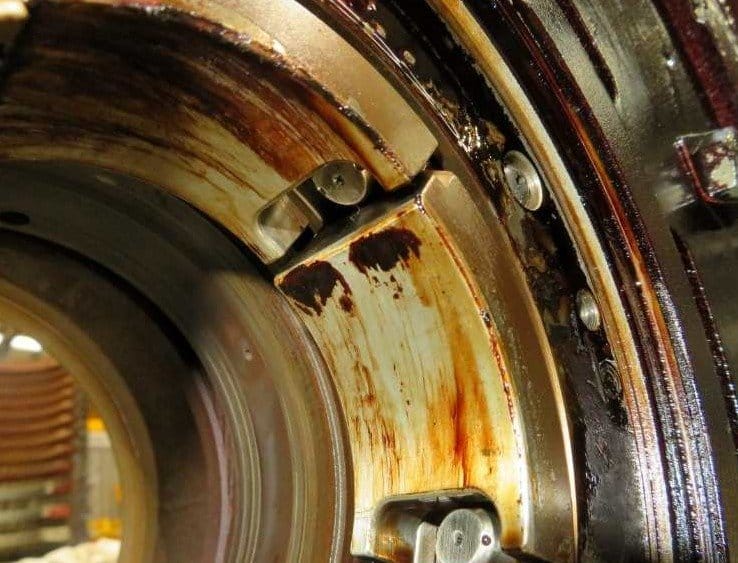
Oil varnish is a thin, insoluble film that forms when oil degradation products precipitate out of the fluid. These degradation products are initially soluble in hot oil, but as the lubricant circulates through cooler reservoirs or low-flow zones, they lose their solubility. These polar byproducts then adhere to internal metal surfaces, forming a sticky, resinous coating. This is particularly hazardous for turbine and hydraulic control valves, where even a microscopic layer of varnish can cause sticking, erratic operation, or complete seizure. Because these deposits are resistant to standard mechanical filtration, professional varnish mitigation is a critical reliability service. If your system is showing signs of valve lag or increased bearing temperatures, implementing a dedicated varnish removal system can prevent catastrophic failure and restore operational precision.
Micro-Dieseling and Thermal Cracking
Extreme localized heat can also be generated through a phenomenon known as micro-dieseling. This occurs when entrained air bubbles are rapidly compressed in high-pressure zones, such as hydraulic pumps or loaded bearings. This adiabatic compression generates localized temperatures exceeding 1,000°C, causing the surrounding oil molecules to undergo immediate thermal cracking. During this process, the long-chain hydrocarbon molecules that provide lubricity are broken into smaller, volatile fragments.
These chemical shifts lead to a permanent loss of the oil’s load-carrying capacity. Additionally, electrostatic spark discharge (ESD) within the lubrication system can create localized temperatures as high as 10,000°C, which severely degrades the oil and creates hard carbon soot particles. Unlike oxidation, which can often be monitored through acid number trends, thermal cracking and micro-dieseling represent a permanent loss of fluid integrity. These processes create a cycle of degradation that standard oil changes cannot fully resolve, as the remaining sludge and carbon continue to contaminate new fluid.
Cold Temperature Effects: Waxing and Flow Issues
While the destructive nature of excessive heat is a primary concern for maintenance teams, the effects of temperature on oils at the lower end of the thermal spectrum are equally critical to manage. In Australian industrial environments, particularly in cooler southern regions or high-altitude mining sites, seasonal temperature drops can transform a functional lubricant into a semi-solid obstacle. Cold temperatures don’t just increase viscosity; they can trigger the precipitation of paraffinic wax crystals. This physical change leads to restricted flow through narrow galleries and can completely block specialist oil filters, leaving downstream components without protection.
The financial consequences of ignoring low-temperature flow are significant. Industry data highlights a case where a mining company incurred costs exceeding £300,000 for repairs and downtime after multiple pump failures were caused by oil freezing. When a lubricant reaches these low-temperature thresholds, its ability to move through the system is compromised, leading to pump cavitation. The mechanical stress of attempting to move high-viscosity fluid can cause immediate damage to pump impellers and seals before the machinery even reaches its intended operating temperature.
Cloud Point vs. Pour Point
Understanding the distinction between cloud point and pour point is essential for cold-weather reliability. The cloud point is the temperature where wax crystals first become visible. While the oil remains fluid at this stage, these crystals can begin to coat filter elements and restrict fine tolerances. The pour point, measured via the ASTM D97 standard, is the lowest temperature at which the lubricant remains fluid. Operating a system near its pour point is a recipe for catastrophic failure. In these conditions, the oil behaves more like a gel than a liquid, making it impossible for the lubrication system to maintain necessary pressure and flow rates.
Cold Starts and Boundary Lubrication
The first few seconds of a machine’s startup sequence are the most wear-intensive. If the lubricant is too viscous to circulate immediately, the system enters a state of boundary lubrication where metal surfaces rub against each other without a protective film. To mitigate this, sites often utilize immersion heaters or external circulation pumps to maintain oil readiness during downtime. Synthetic lubricants generally offer superior cold-flow properties because they are engineered without the paraffinic waxes found in mineral-based fluids. This molecular advantage ensures that the oil maintains a stable viscosity even in extreme cold, providing immediate protection to bearings and gears the moment the system is engaged.
Monitoring and Managing Temperature-Induced Damage
Monitoring is the only reliable way to catch thermal degradation before it triggers a complete system shutdown. While earlier sections detailed the chemical shifts that occur under stress, managing the effects of temperature on oils requires a combination of real-time sensory data and periodic laboratory testing. Effective temperature management begins with correct sensor placement. Sensors shouldn’t just be installed at the reservoir; they must also be placed at critical component outlets. This dual-point monitoring allows operators to calculate the "delta T", or temperature rise, across specific components. A sudden increase in this temperature differential is often a more accurate indicator of mechanical friction or cooling failure than bulk oil temperature alone.
Filtration systems must also be engineered to handle the physical changes that temperature induces. Cold oil is significantly more viscous and can cause high pressure drops across filters, while hot oil carries a higher load of soft contaminants like sludge. Monitoring the effects of temperature on oils through differential pressure gauges helps ensure that filtration remains effective across the entire operational thermal range.
The Role of Oil Analysis in Thermal Monitoring
Regular laboratory testing identifies the chemical fingerprints of heat stress long before they’re visible to the naked eye. Tracking the Acid Number (AN) is a standard practice to monitor the progression of oxidation. As the oil oxidizes, its acidity increases, which can eventually lead to component corrosion. To see the physical impact of these chemical changes, a Filter Ferrogram is used to identify specific wear particles generated when the lubricant film breaks down. For high-stakes assets, the Rotating Pressure Vessel Oxidation Test (RPVOT) provides a predictive look at the lubricant’s remaining useful life. This test measures the oil’s resistance to oxidation under high pressure, giving maintenance teams a clear window for scheduled replacement before the fluid becomes unstable.
Implementing Effective Cooling and Filtration
Maintaining the hardware that regulates temperature is as vital as monitoring the fluid itself. Cooling towers and heat exchangers must be regularly inspected for fouling or scale buildup, which can significantly reduce their efficiency and lead to bulk oil overheating. Utilizing high-quality Filters S.p.A. products ensures that the system can handle varying viscosities while effectively removing the micro-particles generated during thermal stress. Bypass filtration is another effective strategy, allowing for continuous cleaning of a portion of the oil volume without interrupting the main system flow. This constant polishing removes the precursors to varnish before they have the chance to precipitate onto metal surfaces.
To ensure your lubricants are performing within their design specifications and to prevent premature asset wear, contact BioKem to schedule a comprehensive oil analysis today.
Professional Remediation: Restoring System Integrity with BioKem
Once the destructive effects of temperature on oils have manifested as varnish or sludge, a standard oil change is rarely sufficient to restore system reliability. New oil introduced into a contaminated system will quickly become compromised as the residual deposits on pipe walls and reservoir floors act as a catalyst for further oxidation. To truly recover asset health, a more rigorous decontamination process is required. BioKem provides the specialized equipment and technical expertise necessary to remove these stubborn contaminants, restoring your lubricants and internal surfaces to an "as-new" condition while ensuring long-term operational stability.
Hot Oil Flushing for System Decontamination
Standard circulation cannot dislodge the resinous films created by thermal stress. Hot oil flushing addresses this by utilizing high-velocity, turbulent flow to physically scrub the internal surfaces of the lubrication system. By heating the flushing fluid to specific temperatures, we increase the solubility of the varnish, allowing it to be dissolved and carried away by the flow. We employ paddle flushing screens during the process to verify cleanliness levels against stringent ISO standards. This method ensures that every corner of the system, from the reservoir to the most distant bearing, is free of the debris that causes valve sticking and premature wear.
Varnish Mitigation and Vacuum Dehydration
While flushing removes larger deposits, sub-micron oxidation products require a different approach. BioKem’s varnish removal system specifically targets these microscopic precursors before they can precipitate. This proactive mitigation is essential for high-precision hydraulic and turbine controls where even minute films lead to operational lag. Additionally, we utilize vacuum dehydration to remove dissolved water, a common contaminant that significantly accelerates thermal oxidation. By stripping moisture from the fluid under vacuum, we eliminate the primary catalyst that allows heat to degrade the oil’s molecular structure.
Our comprehensive onsite services are designed to support national industrial reliability by tackling the most complex lubrication challenges. Whether you’re managing a power generation facility or a remote mining operation, our team ensures your systems remain resilient against the harsh effects of temperature on oils. We don’t just treat the symptoms of thermal stress; we restore the chemical and physical integrity of your entire lubrication circuit. This approach protects your capital investments and significantly reduces the risk of unplanned downtime in even the most demanding Australian climates.
Securing Long-Term Asset Reliability through Thermal Control
Maintaining industrial machinery in Australia requires a sophisticated understanding of how thermal fluctuations dictate lubricant health. We’ve explored how extreme heat accelerates oxidation and varnish formation, while cold temperatures threaten flow through paraffinic waxing. Mastering the effects of temperature on oils allows maintenance teams to move beyond crisis management toward a strategy of operational resilience. By prioritizing accurate monitoring and timely intervention, you can effectively extend the service life of your fluids and prevent the catastrophic failure of critical bearings and valves.
As specialists in hot oil flushing and varnish mitigation, BioKem provides the technical expertise and equipment necessary to restore contaminated systems. We are the sole Australian distributor for Filters S.p.A. products and offer comprehensive onsite laboratory analysis to pinpoint degradation before it causes downtime. Protect your assets with BioKem’s expert oil analysis and remediation services to ensure your infrastructure remains efficient in any climate. Taking control of your system’s thermal health today is the most effective way to secure your operational future. We look forward to partnering with you to achieve a cleaner, more reliable industrial environment.
Frequently Asked Questions
How does high temperature affect oil viscosity?
High temperatures cause lubricant molecules to expand, which significantly reduces the fluid’s internal friction and kinematic viscosity. This thinning effect compromises the protective oil film between moving metal components, often leading to a state of boundary lubrication. Without sufficient film thickness, machinery experiences increased friction and accelerated wear across critical contact surfaces.
What is the maximum safe operating temperature for most industrial oils?
Most industrial lubricants are designed to operate optimally within a range of 40°C to 70°C. While many systems can tolerate brief spikes, the chemical stability of the base oil begins to decline rapidly above 60°C. Following the Arrhenius Rate Rule, operating consistently above these levels will drastically shorten the fluid’s service life and increase the risk of component failure.
Can oil recover its properties after being overheated?
Lubricants cannot recover their original chemical properties once they’ve undergone significant thermal degradation. Heat induces permanent changes such as oxidation and the breaking of hydrocarbon chains, known as thermal cracking. While professional remediation can remove contaminants like varnish, the original additive package and base oil integrity are irreversibly altered during the overheating event.
How do I know if my oil has been damaged by heat?
Physical indicators include a distinct darkening of the fluid’s colour and a burnt, acrid odour. However, the most reliable way to identify the effects of temperature on oils is through laboratory analysis. Testing for an elevated Acid Number (AN) or a decrease in oxidation resistance via RPVOT confirms whether the fluid’s chemical structure has been compromised by excessive thermal stress.
Does cold weather affect the filtration of industrial oil?
Cold temperatures significantly impact filtration efficiency by increasing the oil’s viscosity and flow resistance. High viscosity creates a greater pressure differential across filter elements, which may trigger bypass valves and allow unfiltered oil to circulate. Additionally, paraffinic mineral oils can develop wax crystals that physically blind the filter media, leading to lubricant starvation in downstream components.
What is the difference between thermal cracking and oxidation?
Oxidation is a chemical reaction between the oil and oxygen that’s accelerated by heat, whereas thermal cracking is the physical breaking of long-chain molecules due to extreme localized temperatures. While oxidation happens gradually throughout the system, thermal cracking often occurs at hot spots exceeding 200°C, leading to the formation of volatile light ends and hard carbon deposits.
How often should I perform oil analysis on high-temperature systems?
High-temperature systems should undergo oil analysis at least once a month to monitor the accelerated rate of chemical breakdown. Because heat halves the oil’s life for every 10°C increase, more frequent sampling is necessary to detect additive depletion and oxidation. This proactive approach allows maintenance teams to schedule remediation before varnish begins to precipitate on internal surfaces.
Why does heat cause varnish to form in hydraulic systems?
Heat generates degradation byproducts that are initially soluble in hot oil. As the lubricant moves to cooler sections of a hydraulic system, such as the reservoir or low-flow valve galleries, these byproducts lose their solubility and precipitate. They then adhere to internal metal surfaces, forming the sticky, resinous film known as varnish that causes valve sticking and erratic operational response.