

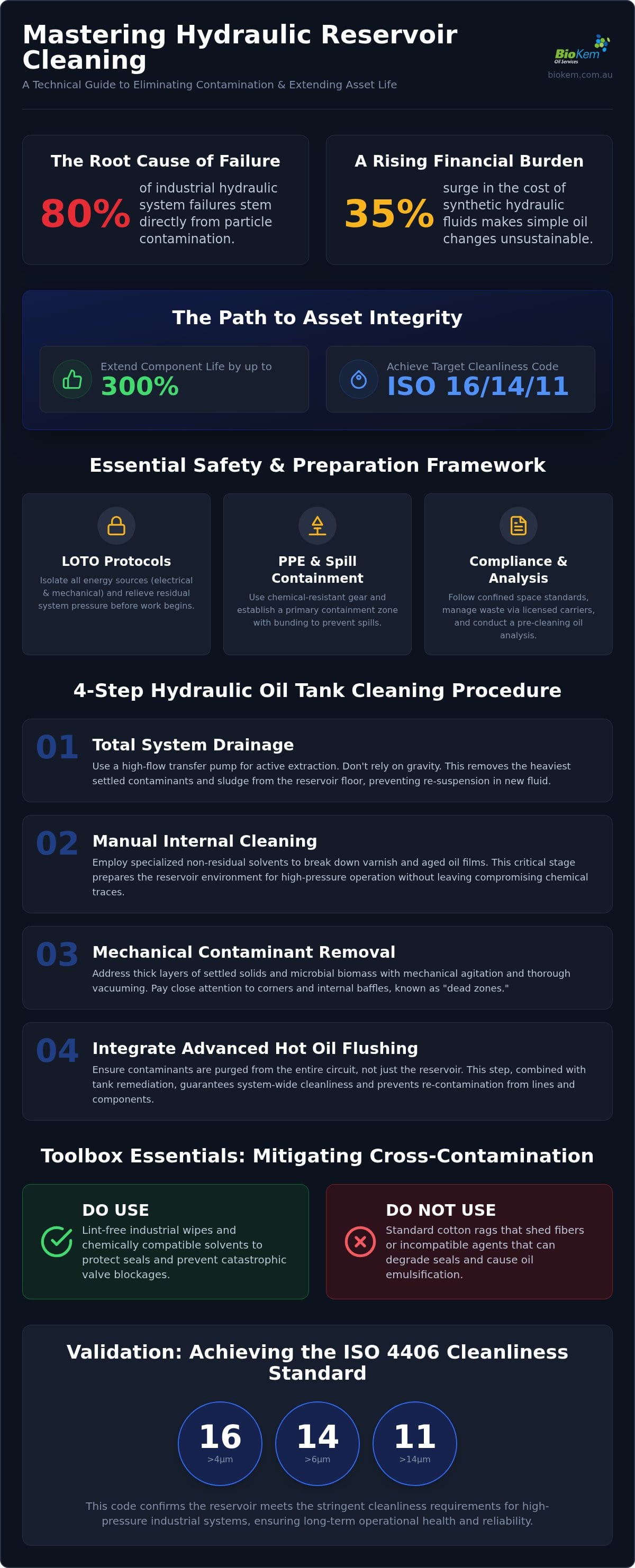
Approximately 80% of industrial hydraulic system failures stem directly from particle contamination, yet many operators overlook the reservoir as the primary source of these particulates. You’ve likely experienced the frustration of recurring valve sticking or high particulate counts on oil analysis reports even after a fresh fluid change. It’s a common challenge in Australian heavy industry, especially as the cost of synthetic hydraulic fluids has surged by up to 35% in early 2026. Simply replacing the oil is no longer a sustainable or cost-effective strategy for maintaining asset integrity.
By mastering a professional hydraulic oil tank cleaning procedure, you can eliminate internal sludge and restore your system to a target ISO 4406 cleanliness code of 16/14/11. This guide provides a repeatable, compliant protocol designed to lower your maintenance costs and extend component life by up to 300%. We’ll examine the technical mechanisms of effective tank remediation, the role of specialized filtration, and how to implement these standards within current Australian safety and environmental regulations to ensure long-term operational health.
Key Takeaways
- Establish a compliant safety framework by integrating LOTO protocols and current Australian confined space entry standards into your maintenance schedule.
- Execute a rigorous hydraulic oil tank cleaning procedure that utilizes specialized non-residual solvents and total sludge removal to eliminate the root causes of valve sticking.
- Implement ISO 4406 validation techniques to confirm your reservoir meets the stringent cleanliness requirements of high-pressure industrial systems.
- Integrate tank remediation with advanced hot oil flushing to ensure contaminants are purged from the entire circuit, not just the reservoir floor.
- Access professional equipment hire or national onsite expertise to restore asset integrity and reduce unscheduled maintenance costs across heavy industry.
Preparation and Safety Protocols for Hydraulic Reservoir Cleaning
Establishing a rigorous hydraulic oil tank cleaning procedure begins long before the first access hatch is opened. Safety remains the primary priority in industrial environments where high pressure and chemical exposure are constant risks. Before commencing, technicians must implement a strict Lock Out Tag Out (LOTO) protocol to isolate all energy sources. This includes electrical isolation of pumps and mechanical isolation of accumulators. Relieving residual system pressure is critical; even a small amount of trapped hydraulic fluid under pressure can cause severe injection injuries.
PPE requirements for handling industrial fluids include chemical-resistant gloves, face shields, and splash-proof coveralls. For sites in the Australian mining or marine sectors, these protocols must align with local site-specific safety management plans. Managing hazardous waste is also a legal obligation. In Australia, used oil must be transported by licensed carriers to authorized facilities. Proper documentation of this chain of custody is essential for regulatory compliance and corporate sustainability reporting.
BioKem emphasizes that environmental stewardship is inseparable from technical excellence. You must establish a primary containment zone using bunding to prevent accidental spills. Before draining the system, conduct a pre-cleaning oil analysis. This baseline contamination profile, often performed via patch test kits or laboratory sampling, identifies the specific nature of the particulates or varnish present. It ensures the cleaning strategy is tailored to the actual chemical state of the reservoir.
Risk Assessment and Site Readiness
Australian safety standards for confined space entry in 2026 require stringent atmospheric monitoring. If the reservoir size necessitates entry, technicians must verify oxygen levels and the absence of volatile gases. Ensure all lighting is intrinsically safe to prevent ignition of oil mists. You also need high-capacity, sealed storage vessels ready for the drained fluid. This prevents environmental contamination and ensures the site remains compliant with regional environmental protection standards.
Tool and Material Checklist
Precision is vital when selecting materials for a professional hydraulic oil tank cleaning procedure. Never use standard cotton rags. They shed fibres that cause catastrophic valve blockages. Only lint-free industrial wipes are acceptable. Choose cleaning agents that are chemically compatible with your system’s elastomers. Incompatible solvents can degrade seals or cause the new oil to emulsify. We define cross-contamination as the unintended transfer of residues, moisture, or particulate matter between the old fluid and the new charge. Using professional paddle flushing screens during the later stages of the process helps mitigate this risk and protects your asset integrity.
The Step-by-Step Hydraulic Oil Tank Cleaning Procedure
A systematic hydraulic oil tank cleaning procedure is essential to prevent the 80% of system failures caused by contamination. Once the system is isolated, the first step is total drainage. You must use a high-flow transfer pump to strip the fluid into prepared storage. Don’t rely on gravity alone; the heaviest contaminants and sludge settle at the lowest points of the reservoir floor and require active extraction. Removing this settled material prevents it from being stirred back into suspension when the system is refilled with new fluid.
After drainage, technicians perform a manual internal cleaning. This stage utilizes specialized non-residual solvents designed to break down varnish and aged oil films without leaving chemical traces that could compromise the new fluid. It’s vital to aim for specific ISO 4406 cleanliness standards during this process to ensure the reservoir environment is prepared for high-pressure operation. If you lack the specialized gear for this phase, BioKem offers industrial equipment hire to support in-house maintenance teams with professional-grade tools.
Mechanical Removal of Contaminants
Settled solids often form a thick layer that manual wiping cannot easily reach. In systems exposed to moisture, you might encounter “diesel bug” or microbial biomass. These organic contaminants require mechanical agitation and thorough vacuuming to ensure complete eradication. Pay close attention to “dead zones” behind internal baffles. These areas act as sediment traps where particulates accumulate over years of operation. During this phase, inspect the internal tank coatings. Any signs of peeling or corrosion indicate a risk of future particulate generation that could bypass even the best filtration.
Component Inspection and Replacement
Cleaning the tank walls is only part of the protocol. You must evaluate the condition of suction strainers and return line filters. If strainers show signs of mesh deformation or permanent bypass, replace them with high-quality components for superior protection. Magnetic plugs should be pulled and inspected; the type of metallic debris found provides a diagnostic window into component wear elsewhere in the circuit. If you find large flakes or excessive “fuzz,” it may indicate an impending pump or motor failure.
Final validation involves a rinse and dry cycle. Use a small volume of clean, filtered oil to flush away any solvent traces. Finally, verify the removal of all internal debris using paddle flushing screens. This step ensures that no loose material remains to be swept into the pump upon restart. Servicing the reservoir breathers at this stage prevents immediate re-contamination from airborne dust, which is a constant challenge in harsh Australian industrial environments.
Validation: Achieving ISO 4406 Cleanliness Standards
Visual inspection is the most deceptive metric in industrial maintenance. While a manual wipe-down might remove visible sludge, the microscopic particles responsible for the majority of component wear remain invisible to the human eye. Validating a professional hydraulic oil tank cleaning procedure requires objective, quantitative data. Industrial reliability depends on meeting specific ISO targets, typically 16/14/11 for high-pressure systems. Without this quantitative proof, you’re merely guessing at the integrity of your asset. Achieving these standards ensures that the reservoir environment doesn’t immediately compromise the expensive new fluid charge.
Professional oil analysis serves as the final arbiter of success. It transforms a subjective maintenance task into a verified engineering process. To ensure accuracy, technicians must employ precise sampling techniques. This involves taking samples from a turbulent zone or using a dedicated sampling port rather than a stagnant drain valve. This ensures the data reflects the true state of the fluid that will eventually circulate through your pumps and valves. Samples taken from “dead zones” or bottom drains often provide skewed results that don’t accurately represent the system’s operational health.
Particle Counting and Analysis
Particles at the 4μm, 6μm, and 14μm levels are the primary drivers of abrasive wear in hydraulic pumps and motors. A comprehensive lab report provides a clear roadmap of whether the tank is “system-ready” or requires further remediation. Implementing ISO 4406 provides a quantifiable metric for fluid health, allowing maintenance managers to make data-driven decisions. If the particle count exceeds the specified target, the cleaning protocol must continue until the threshold is met. This rigour is what separates professional remediation from a standard oil change.
Varnish Detection and Mitigation
Varnish often manifests as a thin, resilient “golden” or “black” film on internal surfaces. It’s a byproduct of oil oxidation and thermal degradation. Standard physical cleaning often fails to remove these deposits because they’re chemically bonded to the metal surfaces. Left untreated, varnish will quickly migrate into and contaminate new oil, leading to “stiction” in sensitive servo valves. Integrating varnish removal systems provides long-term protection by chemically stripping these polar contaminants. This proactive approach ensures that the clean reservoir doesn’t become a source of immediate re-contamination for the fresh fluid charge, preserving the longevity of the entire circuit.
Advanced Methods: Hot Oil Flushing and Dehydration
Even the most rigorous hydraulic oil tank cleaning procedure only addresses the reservoir itself. The remaining 50% of the contamination risk resides within the internal pipework and circuit components. Restarting a system with clean oil in a clean tank while the lines are full of debris leads to an immediate “slug” of contamination. This bypasses the new filters and risks catastrophic failure of sensitive valves. For a complete restoration of asset integrity, you must look beyond the tank walls to the entire fluid circuit.
To mitigate this risk, we employ high-velocity hot oil flushing. This process circulates fluid at temperatures high enough to reduce viscosity, allowing for high-flow rates that achieve turbulent flow. We target a Reynolds Number greater than 4000. This turbulence physically scours the internal walls of the pipework, dislodging particulates that stagnant or laminar flow cannot move. We utilize specialized hardware from Filters S.p.A. during this phase to ensure that even the finest microscopic debris is captured before it can settle in critical components.
Total System Remediation
Synergy is key to successful remediation. A clean reservoir provides the foundation, but the flushed loop ensures the entire circuit is remediated. Using external pumps instead of the system’s own pump protects your capital assets from damage during the cleaning phase. It ensures that the first drop of oil through your servo valves is as clean as the fluid in the tank. We also utilize vacuum dehydration to address dissolved water. While manual cleaning removes free water from the tank floor, it cannot address moisture trapped in the lines, which vacuum dehydration boils off at lower temperatures to preserve the oil’s chemical integrity.
Equipment Hire for Onsite Cleaning
For remote Australian sites or projects requiring in-house execution, accessing professional equipment hire is a strategic alternative to capital expenditure. This allows maintenance teams to utilize professional-grade dehydration units and centrifuges that are calibrated for critical industrial outages. Ensuring your hardware is ready for the rigours of a 2026 maintenance schedule is vital for reducing unscheduled downtime. If your site requires a complete circuit purge to restore ISO cleanliness, request a consultation for professional hot oil flushing to secure your system’s longevity.
BioKem Oil Services: National Specialists in Hydraulic Integrity
BioKem stands as Australia’s dedicated partner for industrial fluid management. We deliver national onsite services tailored to the unique demands of the mining, marine, and manufacturing sectors. Our technical depth covers everything from standard reservoirs to complex heat transfer systems. By utilizing a professional hydraulic oil tank cleaning procedure, we help businesses transition from reactive repairs to proactive maintenance strategies. This approach is reinforced by our role as an authorized distributor for Filters S.p.A. Products, ensuring your assets are protected by world-class filtration hardware.
Every project we undertake is validated by laboratory-backed results. We don’t just clean; we provide documented proof that your system has reached the required ISO 4406 cleanliness codes. Our technicians are specifically trained to operate in high-risk industrial environments, maintaining rigorous safety standards for confined space entry and hazardous material handling. We prioritize ecological health by focusing on fluid life extension. By restoring the chemical and physical integrity of your oil, we reduce the need for premature disposal and the associated environmental impact. This significantly lowers long-term operational costs for our clients across the country.
The BioKem Advantage
The BioKem advantage lies in our commitment to precision and sustainability. We utilize onsite laboratory testing to provide immediate feedback during the cleaning process. This ensures that the hydraulic oil tank cleaning procedure is not concluded until the fluid meets the exact specifications required by the equipment manufacturer. By extending the service life of your hydraulic fluids, we help you avoid the rising costs of synthetic oil replacements, which saw increases of up to 35% in early 2026. Our focus remains on maximizing asset uptime through scientific rigour rather than immediate, synthetic interventions.
Partnering for Reliability
Reliability begins with a clear understanding of your current fluid health. BioKem offers comprehensive oil health assessments and site audits to identify hidden risks before they lead to system failure. We develop customized remediation plans for bulk hydraulic storage assets, ensuring that your specific operational challenges are addressed with a tailored protocol. Whether you require a one-off tank remediation or a nationwide maintenance contract, our team provides the technical support and project consulting necessary to secure your industrial infrastructure. Contact the BioKem team today to discuss your next shutdown or to audit your site’s fluid management protocols.
Securing Industrial Longevity Through Precision Maintenance
Implementing a rigorous hydraulic oil tank cleaning procedure is a fundamental requirement for maintaining asset integrity in high-pressure environments. By transitioning from basic oil changes to validated remediation, you eliminate the root causes of component wear and unscheduled downtime. This process requires more than just physical cleaning; it demands strict adherence to ISO 4406 cleanliness standards and the integration of high-velocity flushing to purge the entire circuit. You don’t have to manage these complex technical requirements alone.
BioKem provides the technical expertise and specialized hardware needed to achieve these results. As an authorized Filters S.p.A. distributor and ISO 4406 cleanliness specialist, our national onsite service team is equipped to handle complex remediation projects across Australia. Whether you’re managing mining equipment or marine systems, we ensure your assets remain operational and efficient. Request a Technical Consultation for Your Hydraulic Assets to restore your system’s health and secure its long-term performance. Taking proactive steps today prevents catastrophic failures tomorrow.
Frequently Asked Questions
How often should a hydraulic oil tank be professionally cleaned?
Professional cleaning should occur every 2,000 to 4,000 operating hours or during major component overhauls. We recommend a full remediation if your oil analysis reports show a persistent upward trend in ISO codes despite regular filtration. Regular cleaning prevents the accumulation of heavy sludge that standard filters cannot capture, ensuring the reservoir doesn’t become a source of ongoing contamination.
Can I use diesel or kerosene to flush my hydraulic reservoir?
You should never use diesel or kerosene to flush a hydraulic system. These fluids possess low flash points and chemical properties that can degrade internal seals and elastomers. Additionally, residual diesel will lower the viscosity of the new fluid, potentially leading to pump cavitation. Use only dedicated non-residual cleaning agents or filtered base oil to maintain chemical compatibility.
What is the most common contaminant found in industrial hydraulic tanks?
Particulate matter, specifically silica dust and metallic wear debris, is the most prevalent contaminant in industrial systems. Water is also a significant concern, often entering through reservoir breathers or seal leaks. These contaminants combine to form an abrasive slurry that accelerates component wear and promotes fluid oxidation, leading to the formation of sludge and varnish on internal surfaces.
Do I need to clean the tank if I am only doing a routine oil change?
Cleaning the tank is a critical step in a professional hydraulic oil tank cleaning procedure to prevent immediate re-contamination of the new fluid. A standard drain and fill often leaves behind up to 10% of the old, degraded oil and settled particulates. This residual contamination can significantly reduce the service life of your fresh hydraulic oil and lead to premature filter plugging.
How do I know if my hydraulic tank has varnish buildup?
Varnish is typically identified by a thin, tacky, golden or brown film on internal tank walls or valve spools. While visual inspection provides a baseline, we use Membrane Patch Colorimetry (MPC) testing to quantify the varnish potential. This scientific approach ensures that we address chemical degradation before it causes valve stiction or cooler inefficiency in your high-pressure circuits.
Is it safe to clean a hydraulic tank while the machine is idling?
It is never safe to perform internal tank cleaning while a machine is operational or idling. You must follow strict Lock Out Tag Out (LOTO) procedures to isolate all electrical and hydraulic energy before commencing work. Cleaning an active system risks severe injury from moving parts or high-pressure fluid injection and prevents the thorough removal of settled sludge from the tank floor.
What is the best way to remove water from a hydraulic system after cleaning?
Vacuum dehydration is the most effective method for removing free, emulsified, and dissolved water from hydraulic circuits. While manual cleaning removes bulk water from the reservoir, vacuum dehydration boils off moisture at low temperatures under a vacuum. This process preserves the oil’s additive package while ensuring the system reaches optimal dryness levels for long-term reliability.
How does BioKem validate that a tank meets ISO 4406 standards?
BioKem utilizes onsite laboratory testing and calibrated particle counters to validate every hydraulic oil tank cleaning procedure. We take fluid samples after the cleaning and flushing phases to verify that the particulate counts at 4, 6, and 14 microns meet your specific target codes. This data-driven validation provides documented proof of asset integrity and ensures the system is ready for immediate restart.