

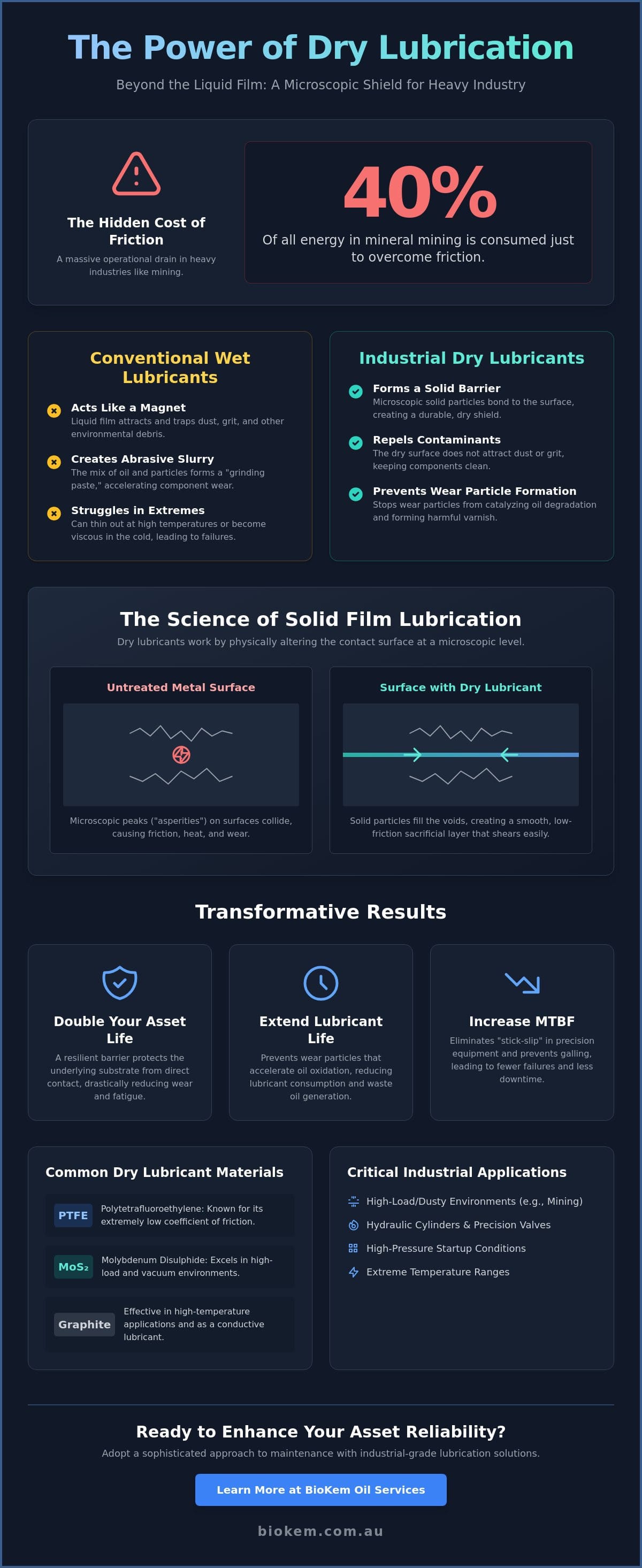
In the mineral mining industry, 40% of all energy consumed is used solely to overcome friction. This hidden operational cost proves that traditional liquid films often struggle to protect assets in high-load or dusty environments. It’s a technical reality that Dry Lube Oil extends the life of machinery and the lubricant by creating a resilient, microscopic barrier against abrasive particles. Instead of acting as a simple additive, dry lubrication serves as a critical shield that prevents wear particles from catalyzing oil degradation and forming harmful varnish.
You’re likely familiar with the frustration of frequent oil changes and the unscheduled downtime caused by friction-related failures. We understand that maintaining equipment reliability while navigating evolving standards, such as the 2026 ECHA opinions on PFAS chemicals, requires a sophisticated approach to maintenance. This article explores how industrial-grade dry lubricants work synergistically with oil purification methods like varnish mitigation and vacuum dehydration to double your asset life. You’ll learn how to extend your mean time between failures (MTBF), reduce lubricant consumption, and lower your total maintenance costs through proactive contamination control and oil analysis.
Key Takeaways
- Identify how solid lubricants like PTFE and MoS2 bond to surface asperities to eliminate stick-slip in precision valves and hydraulic cylinders.
- Understand how Dry Lube Oil extends the life of machinery and the lubricant by preventing the formation of abrasive particles that accelerate oil oxidation.
- Master the critical implementation factors, including specialized surface preparation and selection criteria for high-load industrial environments.
- Learn to combine dry film technology with holistic maintenance practices like hot oil flushing to maximize asset reliability and reduce overall lubricant consumption.
Understanding Dry Lube Oil in Industrial Environments
Industrial reliability depends on managing the microscopic interactions between moving parts. While conventional oils provide a fluid film, certain environments demand a more resilient approach. A Dry Lubricant consists of solid materials like polytetrafluoroethylene (PTFE), molybdenum disulphide (MoS2), or graphite suspended in a carrier solvent. Unlike standard lubricants, these solids remain on the surface after the carrier evaporates. This provides a low-friction interface that doesn’t attract environmental debris.
Standard wet oils often act as a magnet for particulates in high-dust industrial zones. When dust mixes with oil, it creates an abrasive slurry that accelerates component wear. Using Dry Lube Oil extends the life of machinery and the lubricant by ensuring that the primary lubricating film remains free from these external contaminants. This is particularly vital for preventing “laps and folds,” which are microscopic surface defects caused by metal-to-metal contact under high pressure. Transitioning from consumer-grade sprays to high-performance industrial dry lubricants is necessary for heavy machinery, as industrial variants offer superior molecular bonding to handle extreme mechanical loads.
To better understand this concept, watch this helpful video:
The Science of Solid Film Lubrication
Materials like PTFE and MoS2 possess unique molecular structures that allow their layers to slide over one another with minimal resistance. This significantly reduces the coefficient of friction compared to untreated metal surfaces. The carrier solvent is essential here; it ensures the solid particles achieve uniform surface coverage and penetrate tight tolerances before evaporating. Boundary lubrication in this context is the state where the load is entirely supported by the solid film rather than a pressurized liquid layer.
Wet vs. Dry: When to Make the Switch
The decision to transition from wet to dry lubrication usually occurs when the environment turns hostile. In mining or heavy manufacturing, wet oil can quickly turn into a “grinding paste” as it captures ambient grit. High-performance industrial dry lubricants bond more aggressively to the substrate than consumer-grade sprays. This makes them suitable for extreme temperature ranges where oils might thin or oxidize. It’s a strategic choice for engineers who realize that Dry Lube Oil extends the life of machinery and the lubricant by minimizing the generation of internal wear particles. This proactive approach supports long-term ecological health by reducing the volume of waste oil generated through frequent changes.
How Dry Lube Protects Machinery and Prevents Wear
Microscopic analysis reveals that even the most highly polished metal surfaces are comprised of jagged peaks and valleys known as asperities. When two surfaces move against each other, these asperities collide, causing friction, heat, and material fatigue. Dry lubricants function by filling these microscopic voids to create a significantly smoother contact zone. Understanding How Solid Lubricants Work involves recognizing their ability to form a sacrificial layer that shears easily, protecting the underlying substrate from direct contact. This mechanism ensures that Dry Lube Oil extends the life of machinery and the lubricant by maintaining surface integrity even under extreme mechanical stress.
In hydraulic cylinders and precision industrial valves, this protective layer is essential for mitigating “stick-slip” phenomena. Stick-slip occurs when static friction exceeds dynamic friction, leading to jerky, inconsistent movement that compromises operational accuracy. By providing a consistent low-friction interface, dry films allow for smooth, linear motion. Additionally, these lubricants prevent cold welding and galling during high-pressure startup conditions. Since liquid films often take a moment to establish full pressure, the dry film acts as a critical fail-safe that prevents metal-to-metal bonding and subsequent tearing of the surface material.
Reducing Mechanical Stress and Fatigue
Minimizing friction doesn’t just protect surfaces; it directly lowers energy consumption. When machinery operates with less resistance, the load on motors and drive systems decreases. This reduction in mechanical stress extends the longevity of gear teeth and protects bearing races from premature pitting. Lower friction levels also correlate with reduced vibration. Excess vibration is a leading indicator of misalignment or wear that eventually leads to catastrophic failure. By stabilizing the contact interface, dry lubricants help maintain the structural health of the entire asset. If you’re seeing signs of increased wear in your systems, a professional filter ferrogram analysis can help identify the specific metallic particulates currently circulating in your oil.
Varnish Prevention and Surface Integrity
A significant gap in traditional maintenance is the failure to address how friction-induced heat contributes to oil degradation. High temperatures at the contact point cause wet lubricants to oxidize, forming a sticky residue known as varnish. This substance coats internal components, restricts flow, and causes valves to stick. Dry films provide a thermal barrier that reduces localized heat generation, thereby preventing the chemical breakdown of the primary oil. This is especially important in “dead zones” within hydraulic systems where oil flow is minimal and heat can build up rapidly. By keeping surfaces clean and reducing thermal stress, Dry Lube Oil extends the life of machinery and the lubricant simultaneously, ensuring turbine operations and critical systems remain responsive and efficient.
Extending Lubricant Life Through Contamination Control
Metallic wear particles are more than just physical contaminants; they are potent chemical catalysts. In industrial systems, small fragments of iron or copper circulating in the oil accelerate the oxidation process, leading to premature fluid breakdown and sludge formation. This chemical cycle forces frequent oil changes and increases the environmental footprint of the operation. Applying Dry Lube Oil extends the life of machinery and the lubricant by preventing the initial generation of these metallic “seeds.” By shielding the metal surfaces, the dry film ensures that the primary wet lubricant remains chemically stable for longer durations.
This proactive approach creates a significant synergy with broader oil contamination control efforts. When the system produces fewer internal contaminants, the total particle load decreases. This allows the primary lubricant to maintain its viscosity and lubricating properties far beyond standard drain intervals. It directly reduces the volume of waste oil and lowers maintenance costs; a logical step for facilities aiming for long-term ecological health and operational efficiency.
Dry Lube as a Pre-Filtration Strategy
Filtration systems are often overwhelmed by the volume of wear debris generated during high-load operations. Integrating dry lubrication into a proactive maintenance strategy significantly lowers the demand on primary filters. This makes it easier to achieve and maintain strict ISO 4406 cleanliness targets, as the filters can focus on removing external ingress rather than constant internal wear. The result is a cleaner system that requires fewer filter replacements and less frequent intervention.
Protecting the Chemical Additive Package
Every industrial oil contains a complex package of anti-wear (AW) and extreme pressure (EP) additives designed to protect surfaces under stress. These additives are sacrificial and deplete over time. Dry lubricants take the “first hit” of mechanical shear, allowing the chemical additives in the wet oil to remain in reserve. This preservation extends the functional life of the additive package, reducing the need for frequent top-ups to restore fluid health. It’s a technical safeguard that ensures Dry Lube Oil extends the life of machinery and the lubricant by maintaining the chemical integrity of the entire lubrication system.
Implementation Strategies for Heavy Industry
Successful integration of dry lubrication requires more than a simple spray-and-forget approach. It’s a technical process that starts with choosing the right solid lubricant for the specific operational load and speed of the asset. Correctly applied Dry Lube Oil extends the life of machinery and the lubricant by providing a predictable friction barrier, but this only works if the film adheres correctly to the substrate. Surface preparation is the most critical step; any residual grease, moisture, or oxidation will prevent the dry film from bonding at a molecular level. For large-scale industrial assets, bulk application via dipping or specialized brushing often provides more uniform coverage than aerosol sprays typically used on smaller components.
Monitoring the effectiveness of these strategies is essential for maintaining long-term reliability. By utilizing regular oil analysis, maintenance teams can track the reduction in wear metals over time. A measurable decrease in iron or copper particulates in the oil sample serves as empirical evidence that the dry film is performing its protective function. This data-driven approach allows for the optimization of application intervals and provides a clear picture of internal component health.
Selection Criteria for Industrial Dry Lubes
Temperature thresholds are a primary deciding factor in selection. PTFE is excellent for moderate temperatures and offers superior chemical resistance, whereas graphite or molybdenum disulphide (MoS2) are preferred for extreme heat environments where synthetic binders might fail. Compatibility checks are also vital; the carrier solvents must not degrade existing seals or gaskets within the system. As the industry moves toward stricter environmental standards, such as the 2026 ECHA opinions on PFAS chemicals, choosing compliant or biodegradable alternatives becomes a regulatory necessity for forward-thinking facilities.
Best Practices for Application and Maintenance
High-cycle industrial environments require a defined re-application frequency to maintain the integrity of the solid film. Integrating this application into existing preventive maintenance (PM) schedules ensures the protective barrier is never fully depleted. Staff training should focus on the technical difference between ‘wetting’ a surface and truly ‘lubricating’ it. Over-application can lead to material flake-off, which may interfere with precision tolerances in hydraulic valves. If you’re ready to optimize your system’s reliability, you can book a hot oil flushing service to ensure your internal surfaces are perfectly prepared for new lubricant implementation.
The BioKem Oil Services Approach: Advanced Lubrication Management
BioKem Oil Services views industrial reliability as a comprehensive lifecycle strategy rather than a series of isolated product applications. While the technical evidence proves that Dry Lube Oil extends the life of machinery and the lubricant, achieving these results requires a clean and stable operating environment. Our holistic approach begins by ensuring the internal surfaces of your equipment are free from legacy contaminants. By integrating dry lubrication with professional hot oil flushing, we remove the debris and oxidation products that would otherwise compromise the adhesion of solid film lubricants. This ensures the asset starts its service life with a pristine contact interface.
Technical excellence in lubrication also requires high-performance hardware. As the Australian distributor for Filters S.p.A., BioKem Oil Services provides the specialized filtration technology necessary to maintain the ISO cleanliness standards discussed in previous sections. These precision-engineered products work alongside dry films to capture external ingress before it can cause mechanical stress. Our technical interventions are designed to maximize both machinery and lubricant life, ensuring every component operates at peak efficiency.
Onsite Technical Services for Asset Longevity
Maintaining asset health in demanding environments requires a multi-faceted toolkit. BioKem Oil Services combines dry lubrication strategies with advanced onsite services like vacuum dehydration and varnish mitigation. These processes address the root causes of fluid degradation, such as moisture and thermal breakdown. To verify the success of these interventions, we utilize professional laboratory testing. A detailed filter ferrogram provides the empirical data needed to prove ROI, showing a clear reduction in wear particles and confirming the protective dry film is functioning as intended.
Partnering for Reliability
We support national clients across the mining, power generation, and manufacturing sectors by focusing on sustainable maintenance practices. The BioKem Oil Services “Purify, Don’t Replace” philosophy aligns technical performance with environmental responsibility. By extending the functional life of existing fluids and reducing the frequency of component replacements, we help facilities meet their sustainability targets while lowering operational costs. This commitment to long-term ecological health ensures our solutions remain compliant with evolving regional standards. If you’re ready to optimize your maintenance program, contact BioKem Oil Services for a comprehensive lubrication audit today.
Securing Future Operational Reliability
Adopting a sophisticated lubrication strategy is a technical necessity for modern industry. We’ve explored how solid film technology creates a resilient shield against the abrasive contaminants that traditionally degrade liquid lubricants. It’s clear that Dry Lube Oil extends the life of machinery and the lubricant by preventing the catalytic wear that leads to varnish formation and premature component failure. This proactive approach doesn’t just lower maintenance costs; it supports a sustainable operational model by reducing the demand for new fluids and minimizing energy waste.
As an authorized Filters S.p.A. distributor and specialists in varnish mitigation, BioKem Oil Services provides the technical expertise needed to implement these advanced strategies. Our national Australian technical support team is ready to help you transition from reactive repairs to a data-driven reliability program. Optimize your asset reliability with BioKem Oil Services’ specialized filtration services. Taking control of your system’s internal environment today ensures peak performance and long-term asset health for years to come.
Frequently Asked Questions
What is dry lube oil and how does it differ from traditional oil?
Dry lube oil consists of solid lubricating particles suspended in a carrier solvent that evaporates to leave a non-tacky film. Traditional oils maintain a liquid state to provide a hydrodynamic barrier between surfaces. Unlike liquid films, dry lubricants don’t attract ambient dust or grit. This technical distinction makes dry films superior in contaminated industrial zones where traditional oils often transform into abrasive pastes that accelerate component degradation.
Can dry lube oil really extend the life of heavy industrial machinery?
Technical data confirms that Dry Lube Oil extends the life of machinery and the lubricant by minimizing the production of internal wear debris. By bonding to metal surfaces at a molecular level, these films prevent direct metal-to-metal contact during high-pressure startups. This reduction in physical friction prevents the micro-tears and surface fatigue that lead to catastrophic failure. It creates a more resilient system that maintains operational integrity over longer service intervals.
Is dry lube compatible with existing wet lubrication systems?
Dry lubricants are generally compatible with wet systems and are often used as a primary layer before the introduction of liquid oil. The dry film provides boundary lubrication during periods of low flow or high load, while the wet oil handles heat dissipation and secondary flushing. It’s essential to verify that the carrier solvent is compatible with existing seals and gaskets to prevent chemical degradation within the hydraulic or gear system.
How often does dry lube need to be reapplied in a mining environment?
Re-application frequency depends on the mechanical load, cycle speed, and the severity of environmental ingress. In mining operations, engineers typically schedule re-application during standard preventive maintenance windows to ensure the protective barrier remains intact. High-friction points like conveyor pins or open gears may require more frequent attention than enclosed systems. Regular monitoring through oil analysis helps determine the optimal interval by tracking wear metal trends over time.
Does using dry lube reduce the need for frequent oil changes?
Using Dry Lube Oil extends the life of machinery and the lubricant by lowering the total particle load within the system. Fewer metallic particulates mean there are fewer catalysts available to trigger oil oxidation and chemical breakdown. This stability allows facilities to extend their drain intervals safely. Combining dry lubrication with professional varnish mitigation further ensures that the primary fluid remains chemically viable for significantly longer periods than untreated systems.
What are the best dry lubricants for high-temperature applications?
Graphite and molybdenum disulphide (MoS2) are the preferred choices for high-temperature industrial environments. While PTFE is effective up to approximately 260°C, graphite remains stable at much higher thermal thresholds. These solids maintain their structural integrity when liquid oils would otherwise thin or carbonize. Choosing the correct solid lubricant ensures a consistent low-friction interface even when the asset operates under extreme thermal stress or in vacuum conditions.
Can dry lube prevent varnish buildup in turbine systems?
Dry lubricants effectively reduce the localized frictional heat that serves as a primary driver for varnish formation. When oil is exposed to high temperatures at the contact point, it undergoes thermal degradation and leaves behind a sticky residue. A dry film acts as a thermal barrier, keeping the bulk oil temperature lower and preserving the chemical additive package. This prevention is a critical component of a comprehensive turbine maintenance strategy.
Is dry lubricant environmentally friendly compared to synthetic oils?
Dry lubricants support sustainability by reducing the volume of waste oil generated through frequent changes. Their ability to minimize friction also leads to lower energy consumption across the facility. As global regulations like the 2026 ECHA opinions on PFAS chemicals evolve, the industry is shifting toward more ecologically responsible formulations. Partnering with technical experts ensures your lubrication choices remain compliant with regional environmental standards while maximizing the service life of your assets.