


How much of a lubricant additive package can an oil filtration system remove? There’s no single percentage that applies to every system, which is why “Lubricant Additives – What Degree Are They Removed by Filtration Systems” is a question of chemistry and conditions, not just filter ratings. It’s understandable to worry that fine filtration could strip useful additives. In a healthy oil, many additives are dissolved and pass through filter media, while filtration is designed to capture contaminants. The risk can change if additives become suspended, degrade, or attach to particles, including when oil is contaminated with water.
This article explains how additive form, filter media and operating conditions influence that risk. You’ll learn why particle removal and chemical change are different, which situations warrant closer attention, and how suitable oil-condition analysis can support a sound maintenance decision. For Australian industrial operators, BioKem’s oil analysis and onsite and laboratory patch analysis help assess oil condition and cleanliness. The key is to consider the application and evidence together, rather than assume every filtration system affects lubricant chemistry in the same way.
Key Takeaways
- There’s no universal percentage for “Lubricant Additives – What Degree Are They Removed by Filtration Systems”; the answer depends on the lubricant, filter media and operating conditions.
- Distinguish direct particle capture from possible interactions such as adsorption, and assess the specific additive and media combination.
- Compare particle filtration, adsorptive media and vacuum dehydration by their purpose and potential interaction pathways, not by a single risk score.
- Build a meaningful before-and-after picture by documenting the filtration setup and using consistent sampling points, procedures and laboratory methods.
- Use oil-condition analysis alongside cleanliness requirements to guide filtration decisions; onsite and laboratory patch analysis can help assess particulate contamination.
Do filtration systems remove lubricant additives, or mainly contaminants?
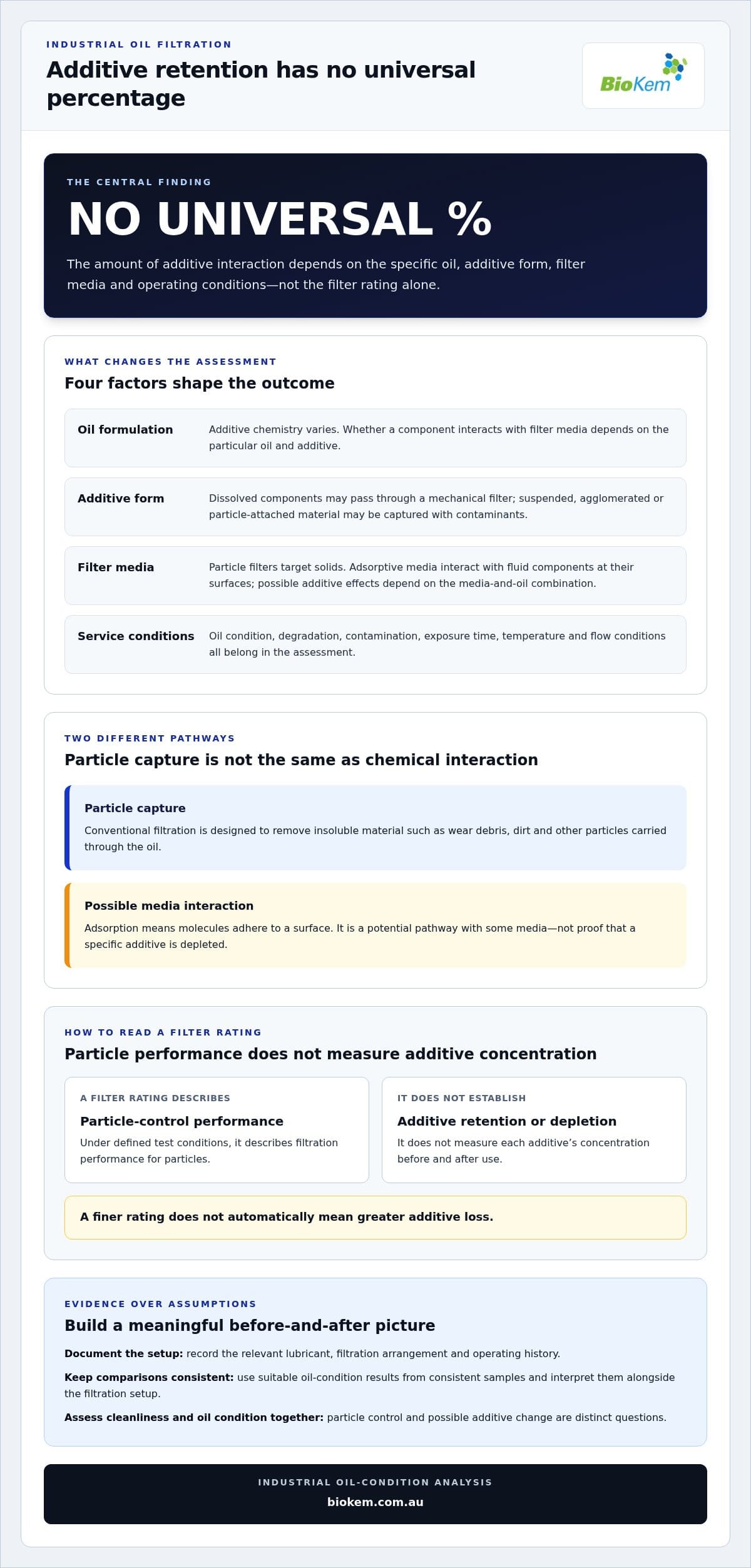
There’s no single removal percentage that applies to every filtration system. Filters are generally selected to remove unwanted contamination, but whether a particular additive interacts with the filter depends on the oil, the additive’s physical state, the media and the operating conditions. The question “Lubricant Additives – What Degree Are They Removed by Filtration Systems” can’t be answered with a universal figure.
Lubricant additives are formulated components that help an oil deliver specified performance, such as controlling wear, oxidation or deposits. Some are dissolved in the base oil; others may be present as suspended material or associated with contaminants. For an overview of these chemical compounds that improve lubricant performance, it’s useful to consider both their function and their form in the finished lubricant.
What does an oil filter normally capture?
In a circulating hydraulic system, for example, a filter may capture debris moving through the return line while oil-soluble components travel with the fluid. Not every additive is fully dissolved, however, and material that is suspended, agglomerated or attached to a contaminant may behave differently. Particle control should therefore be matched to the equipment’s cleanliness requirements and considered as part of a managed lubrication oil filtration process.
Filtration captures contaminants by design; any change to additive chemistry is a separate possibility that must be assessed for the specific oil and filter media.
Why is there no universal additive-removal percentage?
Additive chemistry varies, as do filter-media properties, oil condition and operating conditions. A dissolved component may pass through a mechanical filter, while an additive that has become suspended or attached to material being captured may be removed along with it. These are different pathways, and neither should be assumed without evidence.
A filter rating alone doesn’t establish whether additives are retained or depleted. It describes filtration performance for particles under specified test conditions, rather than measuring the concentration of each additive before and after use. For the same reason, a finer rating doesn’t automatically mean greater additive loss.
Numerical removal estimates aren’t reliable unless they come from application-specific test data using the relevant lubricant and filtration setup. To investigate a suspected change, compare suitable oil-condition results from consistent samples and interpret them alongside the filtration arrangement and operating history. That gives maintenance teams a stronger basis for protecting both cleanliness and lubricant performance than assuming every filter behaves alike.
How can filtration interact with lubricant additive chemistry?
Beyond trapping particles, some filtration media can interact with oil components at their surfaces. Adsorption is the term for molecules adhering to a surface rather than simply passing through it. Whether that happens to a useful additive depends on the particular additive chemistry and media, so it shouldn’t be assumed from the filter type alone.
When might filter media adsorb additive components?
Media designed to adsorb contaminants, including some resin-based or other high-surface-area media, work through interactions at the media surface. Depending on the application, a surface that attracts certain polar compounds could also interact with some polar lubricant components. That’s a potential pathway, not proof that a specific additive will be depleted.
Ordinary particle filters and adsorptive media shouldn’t be treated as equivalent. A particle filter is primarily designed to capture solids; an adsorptive medium is selected for particular fluid-cleanup objectives. To assess possible additive effects, consider the oil formulation and media together, and look for evidence from the relevant combination. The phrase Lubricant Additives – What Degree Are They Removed by Filtration Systems therefore points to an application-specific question, not a fixed property of all filters.
Which operating and fluid conditions can change the assessment?
The same media may encounter different fluids and service conditions. The formulation, the oil’s degradation state, exposure time, temperature and flow conditions all belong in the assessment. These variables can affect what is present in the oil and how it contacts the media, but they don’t establish a predictable direction or amount of additive change on their own.
New and aged oil also shouldn’t be assumed to behave identically. As oil ages, oxidation and contamination can change its chemistry independently of filtration. Water or other contaminants may alter additive condition or cause components to associate with material that is later captured. A change detected after filtration doesn’t, by itself, show that the filter caused it.
Additive impact depends on the fluid-media-system combination, not filter labels alone. Before changing a filtration arrangement, review the lubricant and equipment specifications, the purpose and construction of the media, and the system’s cleanliness requirements. BioKem’s lubrication oil filtration and oil-condition analysis can support a documented assessment; for guidance on an application, discuss your filtration requirements.
How do filtration methods compare for additive-retention risk?
Filtration methods address different contamination problems, so their additive-retention risk can’t be ranked by equipment category alone. Particle filters capture solids, adsorptive media interact with selected fluid constituents, and vacuum dehydration targets water removal. Whether any method changes an additive package depends on the specific oil, media and system. The question Lubricant Additives – What Degree Are They Removed by Filtration Systems is best answered with evidence for the actual application, not a universal risk score.
| Method | Primary purpose | Possible interaction pathway | Evidence to assess |
|---|---|---|---|
| Particle filtration | Capture solid contaminants as oil passes through filter media. | Additives may be affected if they are suspended, associated with captured particles, or otherwise interact with the specific media. | Filter specification and construction, lubricant formulation, and comparable oil-condition results. |
| Adsorptive media | Interact with selected fluid constituents to address a defined cleanup need. | Surface interactions may affect some oil components, but the effect depends on the media and lubricant chemistry. | Media documentation and application-specific evidence for the oil being treated. |
| Vacuum dehydration | Remove water from oil under vacuum. | The process purpose alone doesn’t establish whether additives change; assess any suspected change with suitable oil analysis. | Process setup, lubricant specifications, and consistent before-and-after samples. |
Particle filtration and depth media
Particle capture isn’t, by itself, proof of additive depletion. Filter performance relates to removing particles under defined test conditions; BioKem supplies and uses ISO 16889-certified filtration. That certification is relevant to filtration performance, but it doesn’t establish additive retention for every oil and operating condition.
Media structure and depth can vary, so avoid assuming that all particle filters behave alike. Interpret the filter specification alongside the oil formulation and the equipment’s cleanliness requirements. BioKem’s lubrication oil filtration service and batch filtration service provide relevant context for treating filtration as a managed cleanliness process.
Adsorptive media and vacuum dehydration
Adsorptive media are intended to interact with selected fluid constituents, so their effects should be assessed for the specific lubricant rather than generalised to all oils. Vacuum dehydration is selected to address water contamination; that purpose alone doesn’t demonstrate additive removal. In either case, the method should match the contamination problem and lubricant requirements, with oil analysis used to investigate suspected changes.
Choose by contamination objective, then verify performance against the oil and equipment requirements. A filter label or method name cannot, on its own, show whether an additive package changed.
How can you check whether filtration changed lubricant condition?
A reliable before-and-after assessment starts with a baseline and a repeatable process. Without comparable samples and records, a difference in test results may reflect sampling variation, normal oil ageing or contamination rather than the filtration itself. To answer “Lubricant Additives – What Degree Are They Removed by Filtration Systems,” treat testing as an investigation of the whole system, not a search for one decisive number.
What should be recorded before filtration?
Before treatment, record the lubricant identity and service condition, the equipment and operating context, and the filtration arrangement. Include the method, filter or media details, and relevant operating conditions. Use the equipment or lubricant cleanliness specification as the reference for the intended outcome. Where practical, retain a representative baseline sample and note exactly where, when and how it was collected.
After filtration, sample from a comparable point using the same procedure. Keep the laboratory methods consistent where possible, and record changes in operating conditions between samples. These controls make a comparison more meaningful, though they can’t eliminate every source of variation.
Which tests can help assess oil condition?
Choose tests to answer specific questions. Onsite or laboratory patch analysis can help assess particulate cleanliness and the nature of visible debris; it isn’t a complete test of additive chemistry. Laboratory methods such as elemental analysis or infrared analysis may help track selected oil properties or additive-related indicators, but each method has limits. For example, elemental results don’t identify every additive or establish the full condition of an additive package. A qualified laboratory or lubrication specialist can help select and interpret appropriate methods.
Consider the results alongside operating history, oil condition and the filtration setup. A single result, even if it differs from the baseline, doesn’t establish what caused the change. Oxidation, contamination, oil make-up, sampling differences and filtration may all warrant consideration.
A measured change is evidence of a difference, not proof of its cause. BioKem provides oil analysis and onsite and laboratory patch analysis to support oil-condition and cleanliness investigations. Its oil filter debris analysis can also provide relevant evidence when assessing captured material. For help planning a documented oil-condition investigation, contact BioKem about oil analysis.
How should industrial sites manage filtration without guessing about additives?
A sound filtration plan starts with the operating problem, not an assumption about additive loss. The question “Lubricant Additives – What Degree Are They Removed by Filtration Systems” is best addressed by bringing together the contamination concern, lubricant requirements, filtration setup and comparable oil-condition evidence. This lets a site pursue its cleanliness objectives while making decisions on evidence rather than a general claim about all filters.
Build a filtration plan around the lubricant and asset
Start with the application and equipment requirements. Identify the contamination to be managed, the lubricant in use and the cleanliness target specified for the asset. Then match the filtration method and media to that purpose, taking account of the lubricant’s specifications and the system design. Don’t assume that one media type suits every oil or that the finest filtration is automatically the right choice.
Set up a record that connects the treatment to measurable condition information:
- Document the lubricant identity, its service condition and the contamination concern.
- Record the filtration method, media details and relevant system operating context.
- Establish a baseline and plan follow-up sampling using comparable points and procedures.
This creates a practical basis for checking cleanliness and investigating suspected oil changes over time. Results are more useful when interpreted alongside the equipment’s requirements and the treatment history.
When can specialist filtration support help?
BioKem provides industrial lubrication oil filtration, batch filtration and oil analysis. Its onsite and laboratory patch analysis can help assess particulate cleanliness, but it isn’t a direct assay of additive concentration. Where additive chemistry is the concern, testing should be selected for the specific question and interpreted with the oil’s service history and other relevant results.
BioKem’s filtration and analysis capabilities can support a documented approach that considers the system, lubricant, contamination issue and available test information together. With 70 years of specialist experience, BioKem can bring relevant technical context to a discussion about filtration and oil condition.
Make the next decision from the application and the evidence. To discuss an oil-filtration requirement, contact BioKem about your project.
Make filtration decisions with evidence
There’s no universal percentage for “Lubricant Additives – What Degree Are They Removed by Filtration Systems.” Additive retention depends on the lubricant, filtration media and operating conditions. Particle capture is not, by itself, proof of chemical depletion, and a change in an oil test result doesn’t automatically identify filtration as its cause.
A sound decision starts with the equipment’s cleanliness requirements, a clear record of the filtration setup and comparable oil-condition checks. BioKem’s industrial oil filtration and analysis capabilities support this managed approach, including onsite and laboratory-based patch analysis for assessing particulate cleanliness. BioKem also supplies and uses ISO 16889-certified filtration, backed by 70 years of specialist experience.
Protecting oil condition while managing contamination calls for a plan grounded in the application and reliable evidence. Discuss your industrial oil-filtration requirements with BioKem and take a considered next step for your system.
Frequently Asked Questions
Does oil filtration remove lubricant additives?
Usually, oil filtration is designed to remove particulate contamination, not dissolved lubricant additives. Some additives may be suspended or attached to contaminants, and certain media may interact with fluid components. The outcome depends on the lubricant formulation, media, oil condition and operating conditions. A filter rating alone doesn’t show whether additives are retained. If a change is suspected, compare consistent oil samples using suitable analysis before drawing a conclusion.
Can a filter strip additives from hydraulic or turbine oil?
It’s possible in specific circumstances, but it shouldn’t be assumed for hydraulic or turbine oil as a category. A conventional particle filter primarily captures solids; potential additive interaction depends on the oil formulation and filter media. Contamination or degradation may also change what is present in the oil. Review the lubricant and equipment specifications, and use comparable oil-condition results to investigate a suspected change.
How much of an additive package is removed by filtration?
There’s no universal percentage. “Lubricant Additives – What Degree Are They Removed by Filtration Systems” depends on the additive chemistry, its state in the oil, the media and the application. A filter’s particle-performance rating doesn’t quantify additive retention or depletion. Avoid applying a general estimate to a specific system; a numerical claim requires application-specific testing with the relevant lubricant and filtration setup.
What happens if a filtration system removes additives?
If essential additive components decline, the lubricant may no longer deliver all the performance intended by its formulation. The practical effect depends on which components changed, the oil’s condition and the equipment’s requirements. Don’t assume filtration caused a chemistry change based on one result. Compare suitable oil analyses and consider other causes, such as oxidation, contamination, oil make-up or differences in sampling.
Does vacuum dehydration remove oil additives?
Vacuum dehydration is used to remove water from oil; that purpose alone doesn’t prove that additives are removed. Any suspected effect needs to be assessed for the particular oil, process and operating conditions. Water contamination may itself affect oil condition, so distinguish changes associated with moisture or degradation from a direct effect of treatment. Use comparable samples and suitable oil analysis to investigate.
How can you tell whether filtration has changed oil chemistry?
Establish a representative baseline, document the lubricant and filtration setup, then collect follow-up samples from comparable points using consistent procedures. Select laboratory chemistry tests that address the specific concern; patch analysis can assess particulate cleanliness but isn’t a direct additive assay. Interpret results with operating history and qualified technical review. A measured difference indicates a change, but doesn’t by itself prove filtration caused it.

Article by
James McAllister
James McAllister is an industry professional with BioKem Oil Services, specialising in lubrication reliability, oil filtration, contamination control and asset performance. Drawing on BioKem's extensive field experience across turbines, compressors, hydraulic systems and critical rotating equipment, James writes practical, insight-driven articles that help maintenance and reliability teams improve equipment performance, extend asset life and reduce operational risk.