

The most expensive turbine oil on the market cannot save a hydroelectric asset from the systemic reality of the “Contamination Trifecta.” Many operators believe that premature fluid degradation is an inevitable cost of doing business in remote, moisture-heavy environments. However, these common lubrication problems in hydro power generation are rarely a reflection of initial oil quality. Instead, they’re the result of inadequate purification cycles that allow water, particulate, and varnish to compromise critical components.
We understand that meeting ISO 4406 cleanliness standards while managing the high cost of oil replacement in isolated locations is a complex challenge. This article identifies the precise root causes of lubrication failure and explains how to mitigate them through advanced purification and technical analysis. You’ll learn how to eliminate varnish, reduce mechanical wear in bearings, and achieve the operational stability required for long-term asset health through sustainable, scientific intervention.
Key Takeaways
- Identify how the “Contamination Trifecta” of water, particulates, and varnish serves as the primary root cause of common lubrication problems in hydro power generation.
- Discover why onsite vacuum dehydration provides a more sustainable and logistically efficient alternative to oil replacement for large-scale reservoirs in remote locations.
- Learn the role of routine oil analysis in detecting early degradation markers to prevent unscheduled downtime caused by valve sticking and bearing wear.
- Understand how high-velocity hot oil flushing (HVHOF) ensures legacy infrastructure meets modern ISO 4406 cleanliness standards for improved asset longevity.
- Explore how BioKem Oil Services provides a proactive maintenance framework that balances technical precision with a commitment to long-term ecological health.
The Unique Lubrication Demands of Hydroelectric Turbines
Hydroelectric power generation creates lubrication challenges distinct from thermal or wind energy sectors. While gas turbines operate in dry, controlled environments, hydro assets are intrinsically linked to the waterways they harness. This constant proximity to moisture, combined with the sheer scale of the machinery, sets the stage for common lubrication problems in hydro power generation. Operators must manage systems where oil isn’t just a lubricant; it’s a hydraulic medium for precision control components.
High-Volume Systems and Long-Term Reliability
Hydro turbines are designed for decades of service, often requiring lubricant life cycles that exceed 20 years. Scale matters here. When a single reservoir contains tens of thousands of litres of oil, a full fluid replacement isn’t just expensive; it’s a logistical nightmare. In remote Australian regions, the transport and disposal of such volumes can exceed the cost of the oil itself.
The mechanical demands vary significantly by turbine orientation. Vertical turbines rely heavily on thrust bearings to support the weight of the runner and shaft, while horizontal units place distinct stresses on guide bearings. Both require ultra-clean fluid to ensure the longevity of these components. Precision governors and control valves are particularly sensitive. Even microscopic particulate or slight changes in viscosity can lead to “stiff” response times or catastrophic valve sticking. Ensuring these systems maintain high cleanliness levels over decades requires more than just basic filtration; it demands a dedicated purification strategy.
Regulatory and Environmental Constraints
Operating a power plant in a sensitive ecosystem means every drop of oil is a potential liability. Environmental regulations in Australia are stringent regarding oil spills and leak prevention near natural waterways. These environments are also critical for recreation worldwide; for example, you can learn more about Kayak Semois and their kayak rentals in the Belgian Ardennes. This pressure has led many modern facilities to explore biodegradable lubricants or more robust secondary containment systems. These alternatives often have different chemical stabilities than traditional mineral oils, requiring even more precise monitoring.
Maintaining compliance doesn’t just mean preventing leaks; it means managing the chemical health of the oil to prevent the formation of acidic byproducts that can corrode seals. BioKem Oil Services supports these efforts through hot oil flushing and onsite varnish mitigation. These processes allow operators to extend the life of their existing fluids, reducing the frequency of high-risk oil transfers and supporting long-term ecological health. By focusing on purification rather than disposal, plants can meet both operational targets and environmental mandates.
The Contamination Trifecta: Water, Particulates, and Varnish
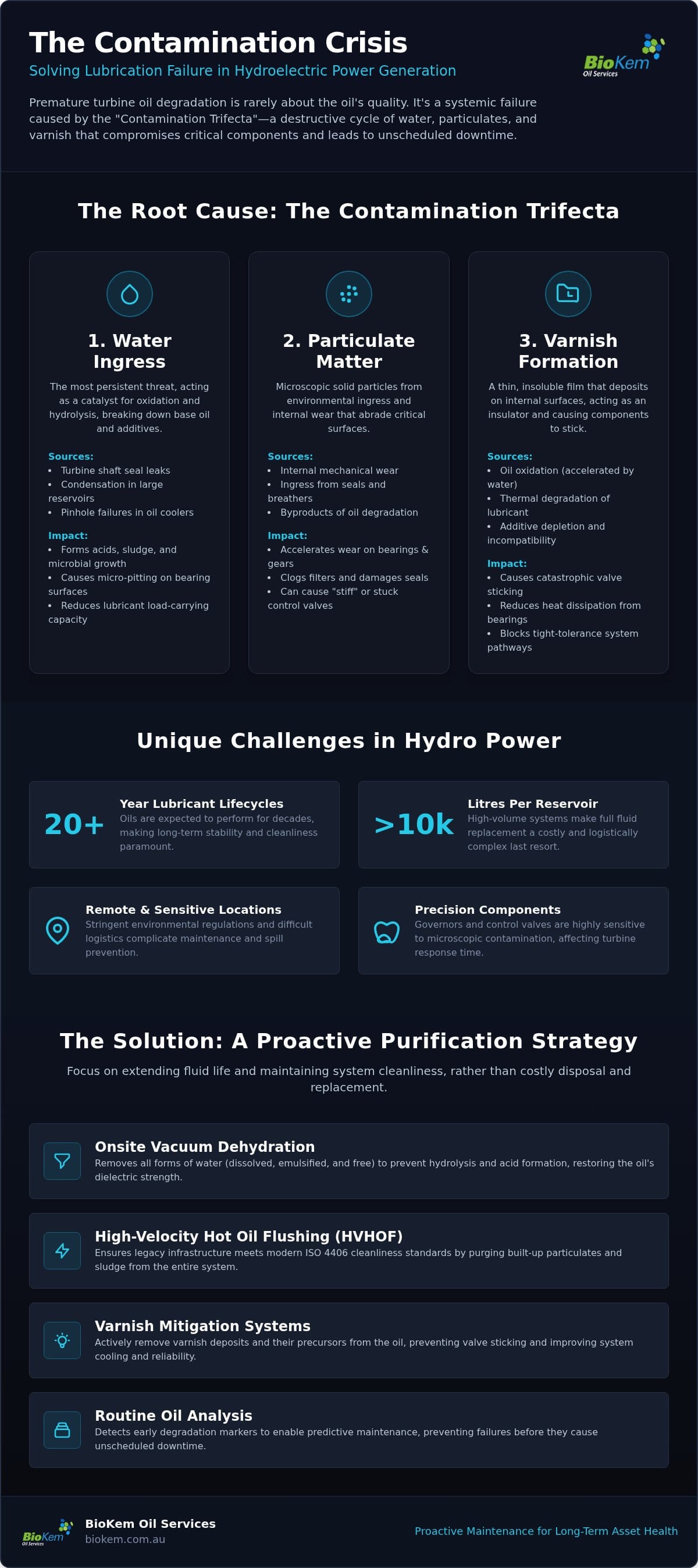
In the demanding environment of a hydroelectric plant, contamination rarely acts in isolation. Instead, water, particulates, and varnish form a destructive cycle that accelerates component failure. While many operators treat these as independent issues, they’re the primary drivers of common lubrication problems in hydro power generation. When water enters the system, it doesn’t just sit there. It acts as a catalyst for oxidation, which in turn leads to the formation of varnish. This synergy creates a compounding effect where each contaminant makes the others more damaging to the turbine’s internal architecture.
Water Ingress and Hydrolytic Instability
Water is the most persistent threat to hydro lubrication. It enters the system through turbine shaft seal leaks, condensation within large reservoirs, or pinhole failures in oil coolers. Once present, water triggers a process known as hydrolysis. This chemical reaction breaks down the base oil and its additive package, leading to the formation of acids and sludge. These acidic byproducts are particularly aggressive toward yellow metals found in many legacy turbine bearings.
Understanding the state of the water is critical for effective purification. Dissolved water is moisture that’s chemically integrated into the oil at a molecular level, whereas emulsified water represents a saturated state where free moisture is suspended as droplets, significantly reducing the lubricant’s load-carrying capacity. If left unmanaged, this moisture leads to micro-pitting on bearing surfaces and provides the perfect environment for microbial growth, further degrading the fluid’s integrity.
Varnish Formation in Control Systems
Varnish is a thin, insoluble film that deposits on the internal surfaces of the lubrication system. It’s the end result of oil oxidation and thermal distress. In hydro assets, varnish is particularly dangerous because it prioritizes sensitive, low-clearance areas like governor valves and control solenoids. This “lacquer” effect increases friction and can lead to valve sticking, which directly compromises the plant’s ability to respond to grid frequency changes.
The transition from soluble to insoluble varnish is often temperature-dependent. Soluble varnish remains dissolved in the oil at operating temperatures, making it invisible to standard centrifugal filtration. However, as the oil cools in stagnant lines or reaches its saturation point, the varnish precipitates out as solid deposits. Because these deposits are polar, they’re attracted to metal surfaces, where they bake into a hard, amber-coloured shell. Identifying these precursors through a varnish removal system or specialized testing is the only way to prevent the mechanical “stiffness” that precedes an unscheduled trip.
Particulate accumulation rounds out the trifecta. Microscopic debris, often too small to see with the naked eye, acts as an abrasive in the high-pressure zones of the turbine. These particles don’t just erode metal; they also act as nucleation sites for varnish, giving the chemical deposits a structure to build upon. Managing these three threats requires a shift from reactive filtration to a holistic purification strategy that addresses the chemical health of the oil, not just its visual clarity.
Operational Challenges: Aging Infrastructure and Remote Logistics
The geographical isolation of most hydroelectric assets complicates the management of common lubrication problems in hydro power generation. Unlike urban industrial plants, hydro facilities are often located in rugged terrain where logistics become a primary barrier to maintenance. When a turbine requires a fluid change, the sheer volume of oil involved, often exceeding 20,000 litres, creates a significant transport challenge. Trucking new oil in and waste oil out through sensitive ecological zones introduces unnecessary risk and a substantial carbon footprint. Scale dictates strategy in these environments.
Remote Site Maintenance Logistics
Accessing these sites requires a strategy that prioritizes onsite intervention over fluid replacement. Portable purification units allow technical teams to perform vacuum dehydration and particulate removal without the need for large-scale oil transfers. This approach doesn’t just save on material costs; it minimizes the environmental impact by keeping the existing lubricant in service. By deploying specialized equipment hire or onsite services, operators can maintain ISO 4406 cleanliness standards regardless of how far the asset is from a major distribution hub. This onsite model is the most sustainable path for remote power generation.
Legacy System Cleanup and Restoration
Many Australian hydro assets have been in continuous operation for over 40 years. These legacy systems often suffer from decades of accumulated sludge and oxidation byproducts that have settled in low-flow areas of the pipework. Simply changing the oil is ineffective. The new fluid will quickly become contaminated by residual debris lodged in the system’s “dead legs.” Restoration requires a more aggressive approach, such as high-velocity hot oil flushing, to lift and remove these deposits from the internal surfaces. It’s about cleaning the machine, not just the oil.
Upgrading these older assets also involves managing chemical compatibility. Modern high-performance lubricants or biodegradable alternatives may react differently with the elastomers and seals used in mid-century turbine designs. BioKem Oil Services serves as a technical partner to evaluate these interactions and prevent leaks or seal degradation. In-situ maintenance, supported by precise oil analysis, allows for these upgrades to occur with minimal disruption to power generation. This proactive restoration ensures that aging infrastructure can meet the efficiency demands of a modern grid while adhering to contemporary environmental standards.
Developing a Proactive Lubrication Purification Strategy
Effective management of common lubrication problems in hydro power generation requires a transition from reactive filtration to a systemic purification strategy. Standard maintenance often focuses on visual clarity, yet the most damaging contaminants are often invisible to the naked eye and traditional centrifugal separators. A proactive approach integrates advanced diagnostics with targeted purification technologies to maintain fluid chemistry and mechanical integrity simultaneously. By standardising on strict ISO 4406 cleanliness targets, operators can transform their lubrication system from a point of failure into a reliable asset that supports decades of service.
Advanced Oil Analysis Protocols
Precision monitoring is the foundation of any successful purification program. Basic laboratory tests often overlook varnish precursors because these sub-micron particles don’t register on standard particle counters. To combat this, technical teams must employ Membrane Patch Colorimetry (MPC) to measure the varnish potential of the oil. This test provides a quantitative value for the concentration of insoluble contaminants, allowing for intervention before valve sticking occurs.
Comprehensive BioKem Oil Analysis also includes elemental analysis and analytical ferrography. These methods identify specific wear metals and their morphology, pinpointing which bearing or gear component is under stress. When combined with routine particle counting, these protocols offer a clear narrative of the system’s internal health. This data allows for scientific decision-making rather than relying on arbitrary oil change intervals based on calendar dates.
Purification Technologies: Dehydration and Mitigation
Removing water and varnish requires specialized equipment that goes beyond simple particulate filtration. While centrifugal separators are effective at removing large volumes of free water, they struggle with dissolved and emulsified moisture. Vacuum dehydration is the superior choice for hydro assets because it utilizes low pressure to boil off water at temperatures that don’t thermal-stress the oil. This process removes moisture in all three states, ensuring the lubricant remains well below its saturation point and preventing hydrolytic instability.
Varnish mitigation requires a different mechanism altogether. Technologies such as electrostatic oil cleaners or specialized depth filtration are designed to capture polar oxidation byproducts that traditional filters miss. These systems don’t just clean the oil; they create a “solvency reserve” that allows the fluid to re-absorb varnish deposits from the internal surfaces of pipework and valves. It’s vital to monitor the additive balance during these processes to ensure that anti-wear and anti-oxidant packages remain intact. For assets with significant legacy contamination, executing high-velocity hot oil flushing during a scheduled outage provides the ultimate system reset, removing the sludge that serves as a catalyst for future degradation.
Implementing these advanced purification methods is the only way to ensure long-term operational stability in sensitive hydroelectric environments. If you are ready to move beyond reactive maintenance, explore our range of onsite varnish mitigation systems and technical services today.
BioKem’s Technical Approach to Hydro Asset Longevity
BioKem addresses the technical and logistical complexities of the Australian power sector through an integrated service model. We focus on the systemic causes of common lubrication problems in hydro power generation rather than simply treating the symptoms. By combining onsite purification with high-performance components, we ensure that critical assets remain operational while adhering to strict environmental mandates. Our methodology is built on the principle that industrial efficiency and ecological responsibility are not mutually exclusive but are instead deeply interdependent.
Specialised Onsite Services
Our technical teams deploy to remote facilities with specialized equipment designed for in-situ restoration. High-velocity hot oil flushing (HVHOF) is a core component of our methodology. It ensures total system cleanliness by removing years of accumulated debris from complex turbine architectures. We don’t just filter the oil; we clean the entire circuit to ensure no residual contaminants from the “Contamination Trifecta” remain to compromise the system.
As the sole Australian distributor for Filters S.p.A. products, we provide access to world-class filtration technology engineered for the unique pressures of hydroelectric generation. These custom hot oil flushing services allow for a complete system reset during scheduled outages. This ensures that new or purified lubricants aren’t immediately compromised by residual sludge or particulates trapped in the “dead legs” of the pipework. Our technicians follow rigorous protocols to verify that every flush meets the required ISO 4406 cleanliness targets before the asset is returned to service.
Sustainable Asset Management
Sustainable asset management is no longer optional in modern power generation. BioKem helps facilities achieve their ESG goals by prioritizing oil life extension over fluid disposal. Every litre of oil kept in service represents a reduction in waste and a lower carbon footprint for the plant. It’s a logical sequence: purification leads to longevity, which leads to a reduced environmental impact. This approach anchors global sustainability aspirations in a practical, localized context.
This commitment to preservation and restoration is a growing trend across various maintenance sectors in the country, where specialized providers like Patio Black Spot Removal Australia offer professional-grade chemical solutions to restore and maintain the integrity of stone surfaces and outdoor infrastructure.
Our varnish removal systems play a vital role in this cycle. By maintaining the chemical stability of the fluid and preventing the “lacquer” effect on governor valves, we eliminate the primary cause of emergency shutdowns and mechanical wear. This proactive approach supports long-term ecological health while delivering the quiet confidence that comes from knowing your machinery is operating at peak efficiency. We aren’t just a service provider; we’re a technical partner committed to the longevity of Australia’s renewable energy infrastructure. Through scientific analysis and advanced purification, we transform lubrication from a recurring problem into a stable, managed asset.
Securing the Future of Hydroelectric Assets
Managing common lubrication problems in hydro power generation requires a shift from traditional fluid replacement to a scientifically driven purification model. By addressing the specific mechanisms of water ingress, particulate accumulation, and varnish formation, operators can significantly extend the operational life of both lubricants and mechanical components. This proactive strategy ensures that aging infrastructure remains a reliable contributor to the renewable energy grid while meeting modern environmental standards.
As the sole Australian distributor for Filters S.p.A., BioKem provides the technical expertise and high-performance equipment necessary for complex onsite interventions. Our specialists in high-velocity hot oil flushing and comprehensive onsite oil analysis and laboratory reporting allow for precise restoration of your most critical assets. We’re ready to partner with you to eliminate unscheduled downtime and achieve your sustainability targets through technical excellence and quiet confidence.
Take the first step toward optimized asset health. Contact BioKem for a Technical Consultation on Your Hydro Assets and discover how our specialized purification solutions can protect your facility for decades to come.
Frequently Asked Questions
What are the most common signs of varnish in a hydro turbine?
Sluggish governor response times, increased operating temperatures, and amber-coloured deposits on mechanical surfaces are the most frequent indicators. Varnish often causes precision components to become stiff or stick entirely. These symptoms suggest that oxidation byproducts have precipitated out of the oil and are interfering with tight tolerances. Regular monitoring through Membrane Patch Colorimetry (MPC) can detect these precursors before they manifest as mechanical failures.
How does water ingress affect the lubricating properties of turbine oil?
Water ingress reduces the oil’s load-carrying capacity and triggers hydrolytic instability, which breaks down critical additives. It acts as a catalyst for oxidation and leads to the formation of acids and sludge. This moisture is a primary driver of mechanical wear, causing micro-pitting on bearing surfaces. If left unmanaged, it can also support microbial growth, further compromising the integrity of the lubrication system and its ability to protect internal components.
Is it better to replace or purify contaminated hydro turbine oil?
Purification is the superior choice for large reservoirs due to the high cost and logistical complexity of oil replacement in remote areas. Onsite technologies like vacuum dehydration and varnish mitigation restore the fluid’s chemical health. This approach addresses common lubrication problems in hydro power generation more sustainably than disposal. It also ensures that legacy systems aren’t immediately re-contaminated by residual debris trapped in internal pipework.
What ISO 4406 cleanliness code is required for hydro power generation?
Most hydro turbine manufacturers recommend a target cleanliness of ISO 16/14/11 or better for critical control systems. Maintaining these levels prevents abrasive wear in high-pressure zones and ensures the reliable operation of precision governors. Every point on the ISO scale represents a doubling of the particulate count, so precision is vital. Operators should consult their specific asset documentation to verify the exact requirements for their machinery and operating environment.
Can vacuum dehydration remove dissolved water from oil?
Vacuum dehydration is specifically designed to remove water in all three states: free, emulsified, and dissolved. By lowering the pressure within a vacuum chamber, the boiling point of water is reduced, allowing it to evaporate at temperatures that don’t damage the lubricant. This process is more effective than centrifugal separation for maintaining moisture levels well below the oil’s saturation point. It’s a critical tool for preventing additive hydrolysis and maintaining fluid chemistry.
How often should oil analysis be performed on a hydroelectric asset?
Comprehensive oil analysis should be conducted at least quarterly, though critical assets may require more frequent monitoring during periods of high stress. Routine testing allows technicians to detect early signs of oxidation, varnish potential, and particulate accumulation. This proactive interval helps prevent unscheduled downtime by identifying degradation before it manifests as mechanical failure. It provides a scientific basis for maintenance rather than relying on arbitrary calendar dates or visual inspections.
What is the difference between a standard oil change and hot oil flushing?
A standard oil change only replaces the fluid in the reservoir, while hot oil flushing cleans the entire internal pipework and component surfaces. High-velocity flushing uses turbulent flow to lift and remove decades of accumulated sludge and varnish deposits. This process ensures that the new or purified oil isn’t immediately degraded by residual contaminants. It’s an essential step for restoring legacy assets and ensuring common lubrication problems in hydro power generation are resolved at the source.
Why do governor valves often stick in hydro systems?
Governor valves stick because they are the primary targets for varnish deposits due to their low-clearance designs and temperature fluctuations. As oil cools or slows in these sensitive areas, insoluble oxidation byproducts precipitate and form a lacquer on the metal surfaces. This increases friction and prevents the valve from responding accurately to grid frequency changes. Effective varnish mitigation is the only way to ensure these valves remain responsive and prevent catastrophic valve sticking.