


Did you know that 80% of hydraulic system failures stem directly from particle contamination? It’s a staggering figure that underscores why Managing Oil Cleanliness: Best Practices isn’t just a maintenance chore; it’s a critical pillar of industrial sustainability and operational reliability. As the global economy loses $2.5 trillion annually to corrosion, the pressure to meet stringent ISO 4406:2021 standards has never been higher. You’re likely feeling the strain of rising downtime costs and the looming threat of premature component failure in your turbines or hydraulic systems.
We understand that achieving specific ISO codes while navigating new 2026 EPA regulations on PFAS and air emissions feels like a moving target. This article provides a strategic framework to help you move from reactive repairs to a proactive contamination control model. You’ll learn how to justify the ROI of advanced filtration services and implement technical mechanisms like varnish mitigation and vacuum dehydration to protect your assets. We’ll explore the essential trio of contaminant exclusion, removal, and rigorous oil analysis to ensure your facility remains both compliant and efficient.
Key Takeaways
- Decode the ISO 4406:2021 standard to establish precise technical benchmarks for solid particle contamination in your turbines and hydraulics.
- Adopt an exclusion-first philosophy by upgrading to high-efficiency desiccant breathers, preventing ingress before it requires expensive removal.
- Integrate Managing Oil Cleanliness: Best Practices by deploying targeted purification technologies, such as vacuum dehydration and hot oil flushing, for critical assets.
- Establish a rigorous sampling and oil analysis schedule to differentiate between normal wear and catastrophic component failure.
- Quantify the ROI of proactive maintenance by comparing the cost of specialized filtration services against the financial impact of a single unscheduled turbine trip.
The Foundation of Oil Cleanliness: Understanding ISO 4406
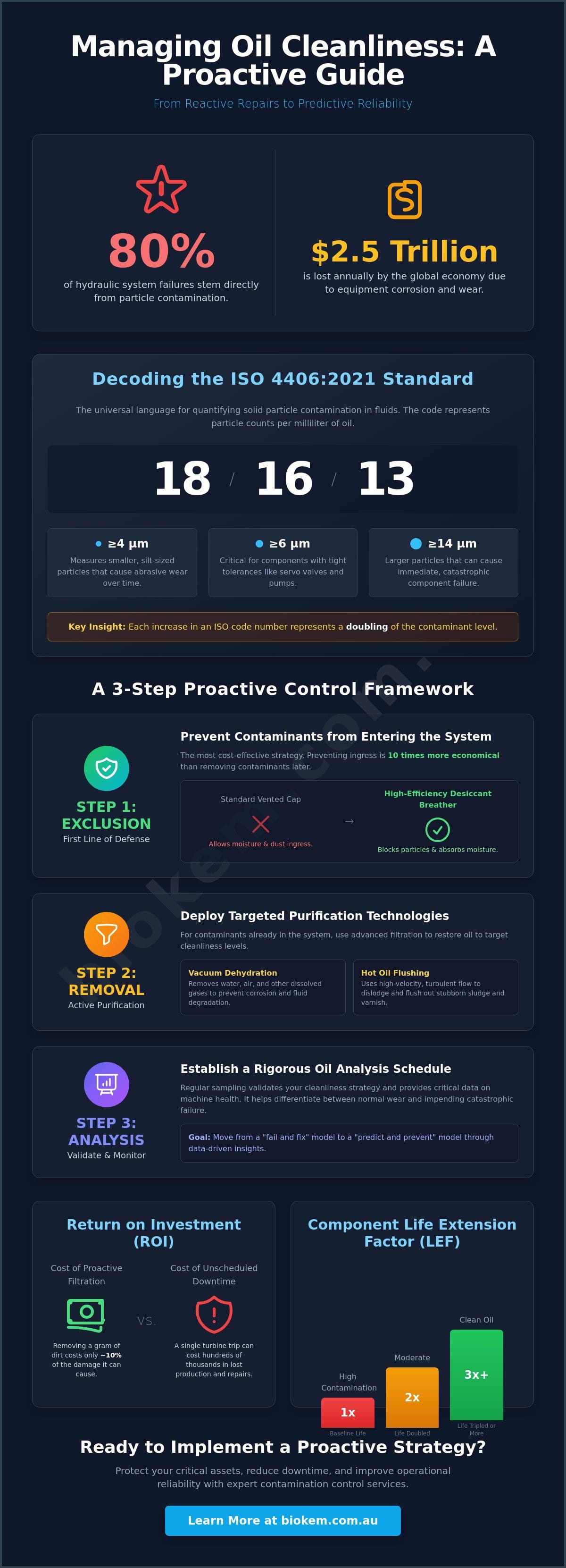
Oil cleanliness is a technical measurement of solid, liquid, and gaseous contaminants within a lubricant. While moisture and air are detrimental, solid particulate matter remains the primary driver of mechanical degradation. Research indicates that 80% of hydraulic system failures result directly from particle contamination. Managing Oil Cleanliness: Best Practices begins with a deep understanding of the ISO 4406:2021 standard, which provides the universal language for quantifying these microscopic threats.
The ISO 4406:2021 standard uses a three-number code to represent the quantity of particles per milliliter of fluid at three specific size thresholds: ≥4 µm, ≥6 µm, and ≥14 µm. For example, a code of 18/16/13 indicates a specific range of particles at each level, with each increase in the code number representing a doubling of the contaminant level. Adhering to Contamination Control Principles ensures that these levels remain within safe operational limits, preventing the abrasive wear that leads to catastrophic failure.
To better understand this concept, watch this helpful video:
Particle counting is the most vital metric for hydraulic and turbine reliability because it identifies the “silent killers” of machinery before they cause audible or thermal symptoms. There is a direct correlation between achieving lower ISO codes and the Life Extension Factor (LEF) of industrial components. By reducing contamination levels, you can effectively double or even triple the service life of bearings and pumps. The economic justification is clear: the cost to remove a gram of dirt from a system is often as little as 10% of the potential damage that same gram could cause if left circulating.
Setting Realistic Cleanliness Targets
Determining your target ISO code depends on the sensitivity of your most critical components. High-pressure systems utilizing servo valves require significantly cleaner fluid (often 16/14/11 or better) compared to heavy-duty gearboxes, which may tolerate 20/18/15. For critical power generation and mining equipment, it’s a strategic advantage to aim for one ISO code below the manufacturer’s minimum requirement. This conservative approach provides a safety buffer against sudden ingress events and justifies the use of advanced oil analysis and ferrography to monitor health trends.
The ‘New Oil’ Myth: Why Purity Starts at Delivery
A common misconception is that oil arriving in a drum or tanker is “clean.” In reality, new oil typically exceeds the ISO cleanliness targets required for sensitive industrial systems, often arriving with a code of 18/16/13 or higher. Lubricants can pick up contaminants during the refining, blending, and transportation stages. Establishing a clean delivery protocol is essential. You should never transfer oil directly from a delivery vessel into a machine without first passing it through a high-efficiency filtration system to ensure it meets your specific purity standards from day one.
Contamination Exclusion: Best Practices for Keeping Oil Clean
Exclusion is the most cost-effective strategy in the lifecycle of a lubricant. Industry data confirms that preventing the ingress of contaminants is 10 times more economical than removing them once they’ve entered the system. This proactive approach is the cornerstone of Managing Oil Cleanliness: Best Practices, shifting the focus from remediation to prevention. By treating the reservoir as a clean room, you protect sensitive components from the very start of their service life.
Standard vented caps are often the weakest link in an industrial reservoir. These components allow moisture and particulate matter to be drawn directly into the oil during thermal cycles. Managing Oil Cleanliness: Best Practices demands a rigorous focus on sealing the system against the environment. Upgrading to high-efficiency desiccant breathers provides a physical barrier against dust and chemically strips moisture from incoming air. For highly sensitive systems, moving to closed-loop expansion chambers or bladders eliminates the air exchange entirely, creating a hermetically sealed environment that prevents atmospheric interaction.
Effective exclusion also requires disciplined storage protocols. Drums should be stored horizontally in a temperature-controlled environment. This orientation prevents water from pooling on the drum head, which can be sucked through the bungs during temperature-induced pressure changes. Maintaining a stable environment reduces the risk of condensation forming inside the storage vessel, which is a common but avoidable source of water contamination.
Precision Lubricant Handling and Transfer
Human intervention is a frequent source of contamination. Implementing color-coded, dedicated transfer containers ensures that cross-contamination between different oil types is physically impossible. Utilizing quick-connect couplings during top-ups further protects the system by preventing airborne ingress. Your Standard Operating Procedures (SOPs) must mandate the cleaning of all ports and fittings with lint-free cloths before any access point is opened. Integrating specialized filtration products into your transfer process ensures that even the smallest particles are captured before they reach the reservoir.
Advanced Seal and Gasket Management
Internal contamination often originates from the degradation of seals and gaskets. As these components wear, they shed microscopic material into the fluid stream. Selecting seal materials that are chemically compatible with modern synthetics or EHC fluids is vital for long-term integrity. Routine inspection protocols should focus on identifying micro-leaks. While these leaks might not cause a significant drop in fluid levels, they act as entry points for external contaminants, particularly in high-dust environments like mining or cement production.
Contaminant Removal: Advanced Purification Technologies
Standard onboard filtration systems are designed to maintain steady-state conditions, but they often lack the capacity to handle heavy contamination loads or chemical degradation. Managing Oil Cleanliness: Best Practices requires moving beyond simple filter changes toward a comprehensive purification strategy. When a system is compromised by high-velocity debris, moisture, or sub-micron soft contaminants, specialized intervention becomes a technical necessity rather than an optional service.
For new system commissions or following major component overhauls, hot oil flushing is the industry benchmark for ensuring long-term reliability. This process utilizes high-velocity turbulent flow combined with elevated temperatures to dislodge and capture particles that standard laminar flow would leave behind. It’s a critical step in eliminating “built-in” contamination that can cause immediate damage to sensitive bearings and valves. Similarly, when water enters the system through seal failure or condensation, vacuum dehydration provides the most effective remedy. Unlike centrifugal methods that only address free or emulsified water, vacuum dehydration removes dissolved water and entrained gases at the molecular level, preventing the oil from reaching its saturation point and triggering oxidation.
Varnish Mitigation and EHC Fluid Health
Varnish is a sophisticated threat that traditional mechanical filters cannot capture. It’s the result of chemical degradation, specifically oxidation and thermal distress, which creates sub-micron polar molecules. These molecules eventually plate out on cool, low-flow surfaces like servo valves and heat exchangers. Implementing varnish removal systems is essential for high-pressure turbine applications where valve sticking can lead to unscheduled trips. This is particularly vital for Electro-Hydraulic Control (EHC) systems using Phosphate Ester fluids. These specialized lubricants require precise acid number control and moisture management to prevent the autocataltic breakdown of the fluid’s molecular structure.
The Role of High-Performance Filtration Hardware
The efficiency of your removal strategy is largely defined by the Beta ratio of your hardware. A Beta ratio of 1000 (βx(c) = 1000) signifies that a filter is 99.9% efficient at a specific micron size, which is the standard benchmark for critical asset protection. Utilizing specialist oil filters allows for the capture of sub-micron particles that contribute to the “silt” load of the system. In high-contamination environments, depth filtration media offers a significant advantage over surface filtration. By utilizing the full thickness of the media to trap contaminants, depth filters provide a higher dirt-holding capacity and more consistent results in achieving strict ISO 4406:2021 targets.
Monitoring and Analysis: Validating Your Cleanliness Strategy
Validation is the technical bridge between implementing a strategy and achieving long-term reliability. Without rigorous monitoring, even the most advanced filtration hardware cannot guarantee asset health. Managing Oil Cleanliness: Best Practices requires a data-driven approach that transitions from schedule-based tasks to predictive condition monitoring. By establishing a sampling frequency based on asset criticality, you ensure that high-stakes systems like steam turbines receive more frequent scrutiny than auxiliary gearboxes. This structured oversight allows you to catch “soft failures” before they manifest as catastrophic mechanical breakdowns.
Onsite particle counting provides immediate feedback on current ISO 4406:2021 levels. It’s an excellent tool for day-to-day validation of your filtration efforts. However, laboratory analysis remains essential for identifying the root cause of contamination. While a particle counter tells you how many particles are present, a filter ferrogram reveals exactly what those particles are. Distinguishing between silica from external ingress and steel from internal wear is the difference between a simple filter change and a necessary component overhaul. For immediate, field-level confirmation, patch test kits allow technicians to visually inspect debris density and color, providing a qualitative check between formal lab reports.
Effective Oil Sampling Techniques
The accuracy of your data depends entirely on the quality of your sample. Sampling from a drain port is a common mistake that leads to “bottom-heavy” data. These ports often contain stagnant sludge and sediment that don’t represent the oil currently circulating through your bearings or valves. The industrial gold standard is sampling from a live, turbulent zone, such as a bend in the return line. This ensures the fluid is well-mixed and the particle count is representative of the system’s actual state. You must also maintain strict sample bottle cleanliness. Even a microscopic amount of dust in a “clean” bottle can trigger a false positive report, leading to unnecessary and expensive maintenance interventions.
Interpreting Reports for Actionable Insights
Reading an oil analysis report requires looking beyond a single snapshot in time. You should trend ISO 4406 data over several months to identify “wear-out” phases. A sudden jump in the 4µm or 6µm count often signals the beginning of an abrasive wear cycle. Setting specific alarm limits is vital. These limits should trigger corrective interventions, such as bringing in equipment hire for vacuum dehydration if moisture levels spike, or performing hot oil flushing if particle counts exceed your target ISO code. If you’re seeing persistent high particle counts, schedule a detailed oil analysis and ferrogram to pinpoint the exact source of the debris before your next scheduled outage.
Implementing a Proactive Lubrication Reliability Program
Transitioning from a reactive “fix-it” mentality to a proactive maintenance strategy is the final step in securing asset longevity. Reactive maintenance is inherently inefficient; it relies on component failure to trigger action, leading to high costs and environmental waste. Managing Oil Cleanliness: Best Practices involves a shift in organizational culture where every team member understands the “cleanliness imperative.” This approach treats the lubricant as a vital machine component rather than a consumable, ensuring that purity is maintained through disciplined exclusion and removal techniques discussed in previous sections.
The ROI of a cleanliness program is easily quantified when compared to the financial impact of a single unscheduled turbine trip. Lost production, emergency labor, and the replacement of sensitive servo valves can cost hundreds of thousands of dollars. In contrast, a consistent purification and analysis program costs a fraction of a potential catastrophic failure. By maintaining specific ISO 4406:2021 targets, you don’t just prevent downtime; you extend the life of your equipment and reduce your facility’s overall ecological footprint by minimizing oil disposal and consumption.
For project-based needs, such as post-overhaul commissioning or decontaminating a system after a seal breach, utilizing industrial oil filtration equipment hire is a strategic choice. It allows you to access high-performance hardware without the capital expenditure of purchasing specialized rigs. This flexibility ensures that even temporary contamination challenges are met with technical precision and authoritative results.
Outsourcing vs. In-House Cleanliness Management
Evaluating the technical complexity of your systems is essential when deciding between in-house management and outsourcing. Processes like varnish mitigation and hot oil flushing require specialized knowledge and high-velocity equipment that most internal maintenance teams don’t possess. Third-party interventions during major shutdowns provide a level of expertise that anchors a national reliability framework. BioKem’s onsite services offer a transparent and efficient solution, allowing your team to focus on core operations while experts handle the scientific intricacies of fluid purification.
Summary of Best Practices for 2026
Managing Oil Cleanliness: Best Practices in 2026 requires a structured commitment to three core pillars: exclusion, removal, and validation. Use this checklist for immediate implementation:
- Replace standard vented caps with high-efficiency desiccant breathers to block moisture.
- Establish a live-zone sampling port for representative oil analysis.
- Pre-filter all new oil deliveries to meet or exceed system ISO targets.
- Partner with authorized filter suppliers to ensure the use of high Beta-ratio media.
Review your current ISO cleanliness codes against industry benchmarks today. If your systems are operating above target levels, it’s time to implement a proactive purification program to protect your critical assets and ensure long-term operational health.
Securing Operational Reliability Through Precision Purification
Achieving long-term mechanical integrity requires a shift from reactive repairs to a sophisticated, data-driven framework. We’ve explored how identifying precise ISO 4406 targets and implementing rigorous contamination exclusion can protect your most sensitive turbine and hydraulic components. While preventing ingress is your primary defense, advanced technical interventions like vacuum dehydration and varnish mitigation remain essential for restoring system health after a compromise. Managing Oil Cleanliness: Best Practices is an ongoing commitment to technical excellence and environmental responsibility.
As the sole Australian distributor for Filters S.p.A. with over a decade of experience in national industrial reliability, BioKem provides the specialized expertise needed to solve complex lubrication challenges. We specialize in high-velocity hot oil flushing and targeted fluid maintenance to ensure your assets meet the strictest purity standards. Contact BioKem Oil Services for a comprehensive oil cleanliness audit and technical intervention plan. Your journey toward eliminated downtime and extended component life starts with a proactive commitment to fluid health.
Frequently Asked Questions
What is the most common cause of oil contamination in industrial systems?
Solid particulate ingress from the external environment is the most frequent source of contamination. Dust and moisture enter through standard vented caps during thermal breathing cycles. Preventing this is a core part of Managing Oil Cleanliness: Best Practices, as it’s far more efficient to block contaminants using desiccant breathers than to remove them after they’ve entered the fluid stream.
Is new oil clean enough to put directly into a hydraulic system?
New oil is rarely clean enough for direct use in high-performance hydraulic systems. It often arrives with an ISO code of 18/16/13 or higher, which exceeds the sensitivity limits of modern servo valves. You must pre-filter all lubricants during the transfer from drums or tankers to the reservoir to ensure the fluid meets your specific cleanliness benchmarks from the moment of startup.
How often should oil analysis be performed for critical assets?
For critical assets like power generation turbines, monthly oil analysis is the industrial standard. This frequency allows for the identification of subtle trend changes in wear metals and particle counts. Semi-critical systems may only require quarterly testing. Adjusting your sampling schedule based on asset criticality ensures that high-risk components receive the necessary technical oversight to prevent unscheduled downtime.
What is the difference between oil filtration and oil purification?
Filtration typically refers to the mechanical removal of solid particles using porous media. Purification is a broader term that includes the removal of dissolved water, entrained gases, and chemical degradation products like varnish. While filtration maintains particle counts, purification technologies like vacuum dehydration address the molecular health of the lubricant to prevent oxidation and acid formation.
Can varnish be removed by standard mechanical filters?
Standard mechanical filters cannot effectively remove varnish because the particles are sub-micron and polar. Varnish often exists in a dissolved state at operating temperatures and only precipitates as a solid when the oil cools or reaches saturation. Effective varnish mitigation requires specialized systems that utilize chemical adsorption or temperature-controlled precipitation to capture these soft contaminants before they plate out on valves.
What ISO 4406 code should I aim for in a high-pressure hydraulic system?
High-pressure hydraulic systems utilizing sensitive servo valves should typically aim for an ISO 4406 code of 16/14/11. This level of purity minimizes the risk of silt lock and abrasive wear on precision-machined surfaces. Establishing these specific targets is a foundational step in Managing Oil Cleanliness: Best Practices, providing a clear benchmark for your filtration and purification efforts.
How does water contamination affect oil cleanliness and lubricity?
Water contamination significantly reduces the lubricant’s load-carrying capacity by thinning the oil film between moving parts. This leads to increased friction, heat, and surface fatigue. Chemically, water promotes the formation of acids and sludge through oxidation. It also facilitates microbiologically influenced corrosion, which can cause significant infrastructure damage if the fluid is not processed through vacuum dehydration.
When is hot oil flushing necessary compared to standard kidney-loop filtration?
Hot oil flushing is necessary during system commissioning or after a major component failure where high-velocity debris is present. It uses turbulent flow to dislodge particles trapped in pipework that standard kidney-loop filtration cannot reach. While kidney-loop systems are ideal for maintaining steady-state cleanliness, they lack the flow velocity required to scrub the internal surfaces of a complex piping network effectively.