

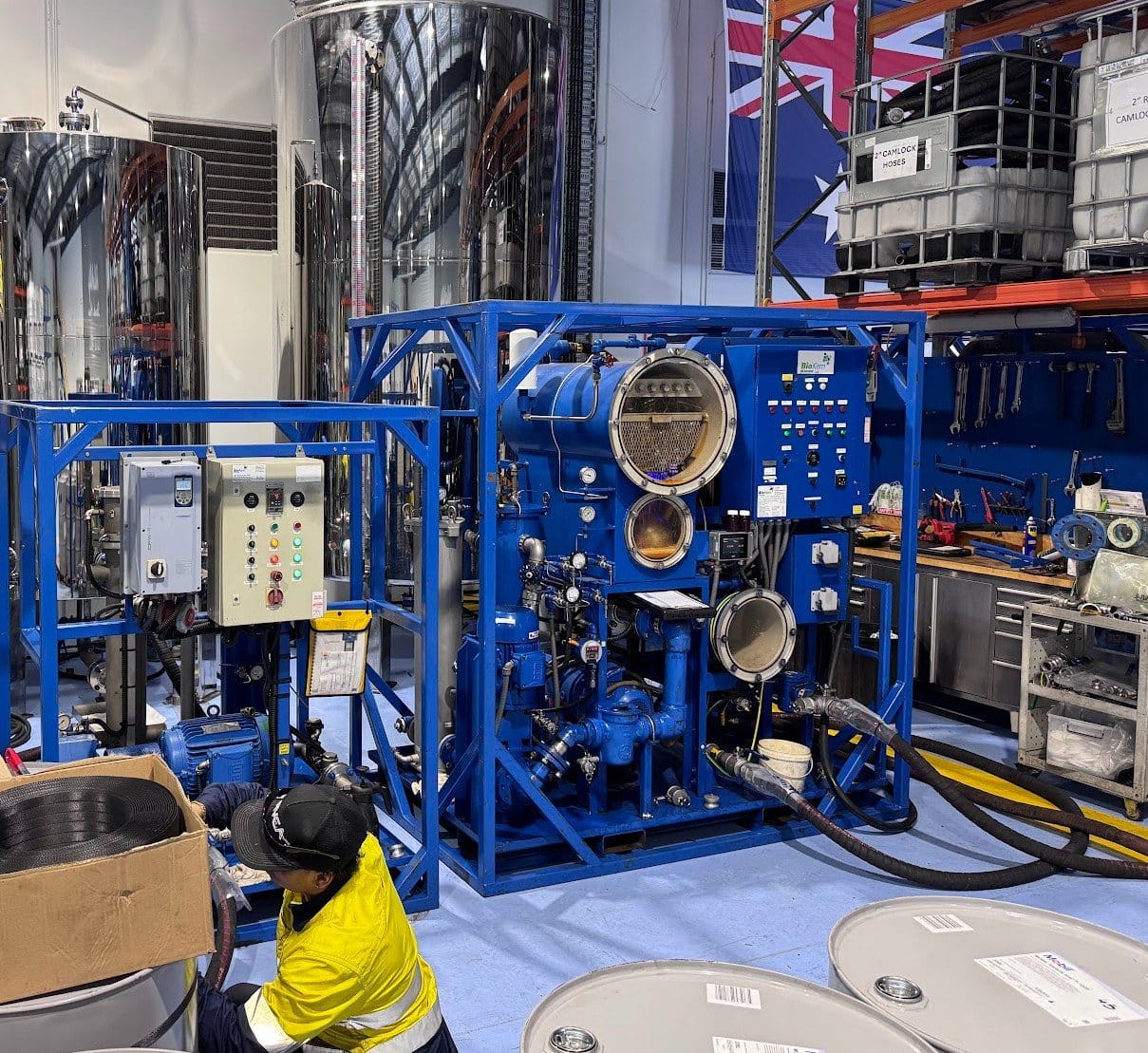
What if extending an asset’s useful life depends less on treating its fluid routinely and more on knowing when and how to intervene? Asset lifecycle extension through fluid maintenance starts with understanding what fluid condition can reveal about equipment reliability, then matching action to evidence rather than applying a blanket treatment.
Fluid problems can be difficult to identify before they affect performance. Maintenance teams also need to weigh different responses, from continued monitoring and filtration to vacuum dehydration, hot oil flushing or varnish removal. The appropriate option depends on the condition of the fluid and asset, operating requirements, applicable specifications and available maintenance windows.
This guide explains how fluid condition relates to asset reliability and how analysis can inform proportionate intervention choices. It also sets out a practical way to build monitoring and fluid maintenance into a lifecycle plan, helping teams make considered decisions about equipment care and resource use.
Key Takeaways
- Learn how contamination, moisture, fluid degradation and varnish can affect fluid-system condition and asset reliability.
- Use oil analysis and condition monitoring as evidence to guide decisions, interpreted alongside fluid requirements, equipment context and applicable specifications.
- Distinguish when filtration, vacuum dehydration, flushing or varnish removal may be appropriate, and when engineering review is needed.
- Build asset lifecycle extension through fluid maintenance into a practical plan that accounts for baseline condition, fluid history and maintenance windows.
- Explore how BioKem’s Australia-wide fluid-maintenance capabilities may fit assets in energy, gas, mining, manufacturing and heavy industry.
How Fluid Maintenance Supports Industrial Asset Lifecycle Extension
Fluid maintenance is the monitoring and management of lubricants and other operating fluids to help keep them suitable for their role in equipment. It goes beyond replacing fluid: depending on its condition and equipment requirements, management may involve analysis, filtration, moisture removal, flushing or varnish removal. The aim is to make informed decisions about fluid and system condition, not to apply the same treatment to every asset.
Contamination, moisture, fluid degradation and varnish can affect a fluid system in different ways. Particles may contribute to wear or interfere with sensitive components, while water can compromise fluid performance. Oxidation and other degradation processes may alter fluid properties, and deposits or varnish can affect surfaces and components. The impact depends on the fluid, equipment design and operating conditions, so symptoms and test results need to be interpreted in context.
What does asset lifecycle extension mean in fluid maintenance?
In practice, asset lifecycle extension through fluid maintenance means supporting reliable operation and making better-informed maintenance decisions throughout an asset’s service life. It doesn’t promise a fixed number of extra operating years. An improvement in fluid condition, for example, is evidence about the fluid, not proof that the asset’s overall lifespan has increased. Outcomes depend on the equipment, operating conditions, fluid requirements and maintenance history.
This approach aligns with condition-based maintenance, where evidence about an asset’s condition informs when maintenance is considered. For fluid systems, analysis can help determine whether to continue monitoring or assess a suitable intervention. Check findings against equipment requirements and applicable client or OEM specifications.
Which industrial assets depend on controlled fluid condition?
Fluid condition matters across a range of industrial equipment, including turbines, gas compression facilities, gearboxes and hydraulic systems. Each has operating demands that influence the fluid’s role. Close-tolerance components and high-speed rotating assets can have particular lubrication requirements, making fluid selection, cleanliness and condition relevant to maintenance planning.
For example, a result from a turbine oil sample needs to be considered in relation to that system’s operating conditions and fluid requirements. The same finding may not call for the same response in a gearbox or hydraulic system. For a broader framework, read about proactive maintenance strategies and how planned decisions can support asset care.
How Fluid Condition Monitoring Guides Maintenance Decisions
Monitoring makes fluid condition one part of the asset-health picture. Oil analysis, condition monitoring and inspection findings can help identify changes that warrant attention, but no single test should be treated as a complete diagnosis. In the wider practice of asset lifecycle management, evidence is most useful when considered alongside the asset’s operating history and maintenance requirements.
Which fluid indicators can inform an asset-health review?
Review the indicators relevant to the equipment and fluid, including solid contamination, moisture, signs of varnish and changes in fluid condition. BioKem’s onsite and lab-based patch analysis can contribute condition evidence for technical review as part of a broader assessment.
Sampling quality matters. A sample that doesn’t represent the fluid being assessed can lead to misleading comparisons. Use consistent sampling and interpretation practices, following applicable procedures and guidance for the equipment and analysis. Trends across comparable samples may add context, but results still need to be considered alongside other asset information.
How should analysis results lead to a maintenance action?
Start with the operating context: identify the asset, fluid in use, service conditions, recent maintenance and relevant client or OEM specifications. Then assess the available evidence against those requirements. A result that differs from expectations may call for further investigation, repeat sampling or a review of operating conditions before treatment is selected.
Consider an action only after reviewing the evidence. Filtration may be suitable where particulate contamination is a concern; vacuum dehydration may be assessed where moisture is relevant. Flushing or varnish removal may suit different system conditions and should not be treated as interchangeable options. The decision should account for equipment compatibility, operating needs and the available maintenance window.
- Establish context: record asset requirements, fluid history and operating conditions.
- Assess condition: interpret analysis and monitoring evidence in that context.
- Select an action: choose monitoring, further investigation or a suitable intervention.
- Reassess: review subsequent evidence to understand the fluid’s response and inform next steps.
Fluid evidence should guide maintenance decisions, not replace engineering judgement. This evidence-led process supports asset lifecycle extension through fluid maintenance without assuming that a particular treatment will deliver the same outcome for every system. If you’re reviewing fluid findings and intervention options, you can contact BioKem about fluid maintenance.
Which Fluid Maintenance Intervention Fits the Asset Condition?
Choose an intervention to address the condition identified, not simply because a fluid has been in service for a set period. A flush or complete fluid replacement isn’t automatically the right response to every concern. The appropriate option depends on the evidence, system design, fluid requirements, applicable client or OEM specifications and operational constraints.
Machine fluid analysis can help assess lubricant condition, contamination and wear status. Use those findings alongside asset history and operating context to identify what needs attention. The options below address different needs, so they shouldn’t be treated as interchangeable.
| Observed need | Potential intervention | Factors for engineering review |
|---|---|---|
| Particulate contamination is a concern | Filtration | Fluid and system requirements, contamination source, filter suitability and target cleanliness requirements |
| Moisture mitigation is required | Vacuum dehydration | Evidence of moisture, fluid compatibility, equipment requirements and operating conditions |
| System cleanliness concerns warrant a defined cleaning approach | Hot oil flushing | System design, flush scope, component requirements, fluid compatibility and maintenance window |
| Varnish is suspected or identified | Assess varnish removal options | Evidence, affected components, system condition, specifications and operational constraints |
When might filtration, dehydration or flushing be considered?
Filtration can be considered to control particulate contamination, but it doesn’t necessarily correct fluid degradation or other issues. Vacuum dehydration may be assessed where moisture mitigation is needed. Hot oil flushing is a scoped intervention for system-cleaning requirements, not a default response to every fluid concern. Review BioKem’s hot oil flushing service as an example of this option.
When should varnish removal be assessed separately?
Varnish concerns merit their own assessment because the evidence and system context may call for a different response from filtration, dehydration or flushing. BioKem offers Varnish Removal (VRS); suitability should be assessed against the asset condition and applicable requirements. This is an option to assess, not a guarantee of a particular result.
Keeping the intervention proportionate supports asset lifecycle extension through fluid maintenance by linking action to condition evidence rather than routine treatment alone. Confirm the intended outcome, system compatibility and operating constraints before proceeding, then assess the fluid and system condition again after the work. For operations and facility managers overseeing broader commercial site infrastructure alongside machinery, discover Synergy Trades Group to assist with specialized blocked drain and trade maintenance solutions.
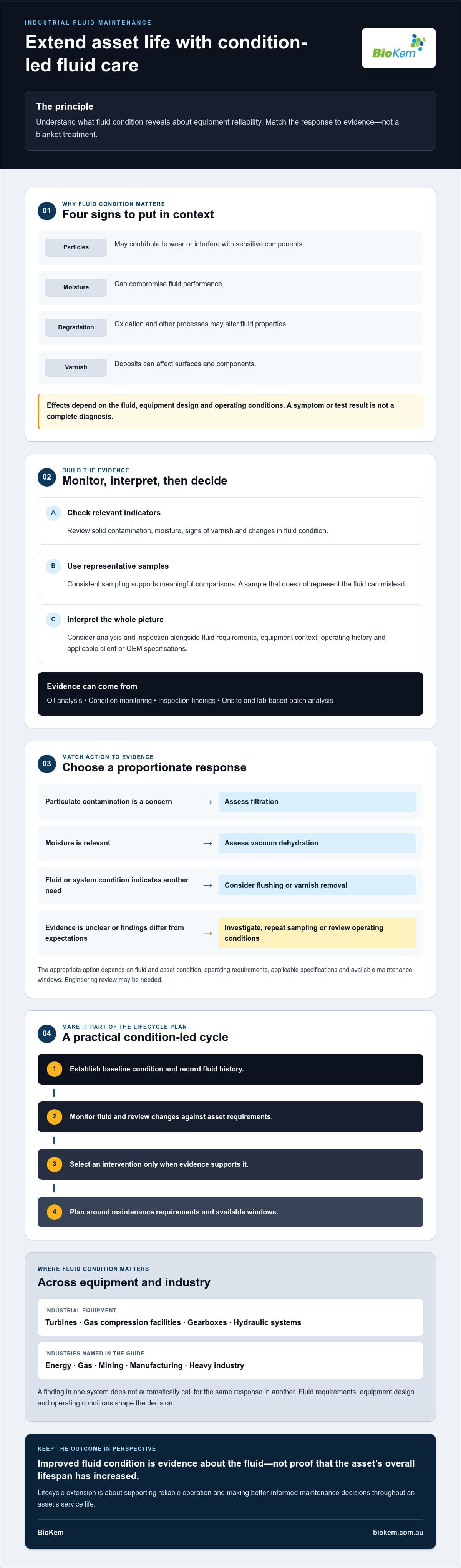
How to Build a Condition-Led Fluid Maintenance Plan
A useful plan turns asset and fluid information into a documented sequence of decisions. It should fit the equipment’s operational role and requirements, rather than impose one treatment or schedule across different systems. Use this workflow to structure planning and keep the reasoning behind each action clear.
- 1. Establish asset criticality and requirements. Identify the asset, its role in operations, the fluid it uses and the relevant system requirements. Review applicable client or OEM specifications before deciding what condition evidence matters.
- 2. Set a baseline. Record the current fluid and system condition using available analysis and maintenance findings. Note how and when the information was collected so future results can be compared meaningfully.
- 3. Review history and operating context. Gather fluid history, previous maintenance records, known condition concerns and current operating conditions. Consider whether a recent change in use or maintenance may affect how findings should be interpreted.
- 4. Identify evidence gaps. Compare what’s known with what’s needed to make a sound decision. If information is incomplete or conflicting, seek technical review rather than filling gaps with assumed thresholds or values.
- 5. Select and document the response. Decide whether to monitor, investigate further or proceed with a suitable intervention. Record the rationale, proposed scope, relevant requirements and maintenance-window constraints.
- 6. Reassess condition. After the planned work, review the system and fluid against the same suitable requirements and agreed indicators. Use findings to inform the next decision, not to assume a universal maintenance interval.
What information should be established before selecting an intervention?
Start with the specific asset and fluid, then establish system requirements, operating conditions and known concerns. Bring together available analysis, fluid and maintenance history, and applicable client or OEM specifications. A baseline gives the team a useful point of comparison, but it shouldn’t be treated as a target unless the relevant requirements support that interpretation.
How can teams evaluate whether the plan is working?
Track agreed condition indicators and maintenance findings over time using consistent methods. Compare results with relevant equipment or fluid requirements; acceptance limits should come from applicable specifications, not an assumed industry-wide value. For operations teams that also require continuous oversight of critical plant equipment like pumps and HVAC units, inTouch R&B provides remote monitoring and alert systems to track real-time operational status. Record what changed after an intervention, while distinguishing a measured change in fluid or system condition from claims of longer asset life or reduced downtime.
This disciplined approach makes asset lifecycle extension through fluid maintenance a practical planning objective, not a promised outcome. To discuss a condition-led fluid maintenance plan for your equipment, contact BioKem about your fluid maintenance requirements.
How BioKem Can Support Fluid Maintenance Across the Asset Lifecycle
BioKem’s fluid-maintenance capabilities can be considered as options within a condition-led plan, rather than as standard treatments for every asset. The appropriate scope depends on fluid and equipment condition, operating context, project requirements and applicable client or OEM specifications. BioKem provides Australia-wide services for the energy, gas, mining, manufacturing and heavy industry sectors.
Which BioKem capabilities may fit a fluid-maintenance plan?
Different findings can point to different service options. Hot Oil Flushing may be assessed where a system requires a defined flushing scope. Vacuum Dehydration (VDOPS) may be relevant when moisture mitigation is needed, while Fuel & Oil Filtration and coalescing may be considered for filtration needs. BioKem also offers Varnish Removal (VRS) and Condition Monitoring. Onsite and lab-based patch analysis can contribute condition evidence for technical review.
These options aren’t interchangeable. For example, filtration may address a particulate concern, but it shouldn’t be assumed to correct every fluid issue. A suitable intervention depends on the evidence, system design and requirements. For service-specific details, see BioKem’s lubrication oil filtration service.
BioKem’s stated capabilities include over 70 years of combined industry experience among staff, Zero Lost Time Injuries (LTI) since establishment in 2012, and ISO 16889-certified filtration. These provide relevant context when assessing capability, while the suitability and expected outcome of any work still depend on the asset and project scope.
What should an initial technical discussion cover?
To help frame the discussion, prepare the asset type, fluid requirements, known condition concerns, available analysis and maintenance history. It’s also useful to outline operating conditions, applicable specifications, the proposed scope and any maintenance-window constraints. This information can help identify potential next steps, but an initial discussion doesn’t replace a site-specific technical assessment where one is needed.
For asset lifecycle extension through fluid maintenance, the focus should remain on matching analysis and service options to the equipment’s actual needs. BioKem can discuss relevant fluid-maintenance capabilities in the context of your system and project. Contact BioKem to discuss fluid maintenance and the information that may help inform a suitable next step.
Make Fluid Condition Part of Your Asset Plan
Reliable fluid maintenance starts with evidence. Monitoring and analysis can help teams understand fluid condition, while equipment requirements, operating context and maintenance history guide whether to keep monitoring, investigate further or consider an intervention. Filtration, dehydration, flushing and varnish removal address different needs, so selecting the right response matters more than applying a routine treatment.
A practical plan records baseline condition, fluid history, the reasons for action and the results of reassessment. This supports asset lifecycle extension through fluid maintenance as a condition-led approach, without promising a fixed increase in service life. Outcomes depend on the asset and its operating requirements.
BioKem brings over 70 years of combined industry experience among staff, Zero Lost Time Injuries (LTI) since establishment in 2012, and ISO 16889-certified filtration. These capabilities provide context as you consider suitable fluid-maintenance options for your equipment.
Share your asset type, fluid requirements, condition concerns and project constraints to begin a focused discussion. Discuss your asset and fluid-maintenance requirements with BioKem to take a considered next step towards a plan that fits your operation.
Frequently Asked Questions
Can fluid maintenance extend the service life of industrial assets?
Fluid maintenance can support asset reliability and may contribute to longer useful service, but it can’t guarantee a fixed extension. Monitoring fluid condition and responding appropriately can help manage contamination, moisture, degradation or varnish where relevant. For asset lifecycle extension through fluid maintenance, assess findings alongside equipment design, operating conditions, fluid requirements, maintenance history and applicable OEM specifications. An improvement in fluid condition alone doesn’t prove that an asset’s lifespan has increased.
What fluid maintenance methods can support asset reliability?
Suitable methods depend on the condition evidence and equipment requirements. Filtration may help control particulate contamination, while vacuum dehydration may be considered where moisture mitigation is needed. Hot oil flushing can be assessed for defined system-cleaning requirements, and varnish removal may be relevant when varnish is identified as a concern. Oil analysis and condition monitoring help inform these choices. These methods address different needs, so they aren’t interchangeable or appropriate for every system.
How does oil analysis help guide fluid maintenance?
Oil analysis provides evidence about fluid condition that can help a team decide whether to continue monitoring, investigate further or assess an intervention. Interpret results alongside the asset’s fluid requirements, operating history, previous results and applicable client or OEM specifications. No single result should be treated as a complete diagnosis. Sampling and interpretation should follow applicable guidance, with comparable methods used where results will be assessed over time.
Is filtration enough to address every fluid-related asset concern?
No. Filtration can be an option for controlling certain contaminants, such as particles, but it may not address moisture, fluid degradation, viscosity concerns or varnish. The right response depends on what the evidence indicates and what the system requires. Review analysis findings, asset condition and applicable specifications before selecting treatment. Where a result is unclear, further investigation may be more suitable than assuming filtration will resolve the concern.
When should a team consider hot oil flushing?
Consider hot oil flushing when system condition and project scope indicate a defined flushing intervention may be suitable, including relevant commissioning, shutdown or breakdown work. First review the system design, fluid requirements, available evidence, OEM specifications and maintenance constraints. Flushing isn’t a default response to every fluid issue, and its suitability should be assessed for the specific asset. BioKem provides Hot Oil Flushing as one option within its fluid-maintenance capabilities.
How can a business measure whether its fluid maintenance plan is effective?
Set a baseline, then track agreed fluid-condition indicators and maintenance findings over time using consistent methods. Compare results with relevant equipment or fluid requirements, rather than applying assumed universal limits. Record the intervention scope and subsequent observations, including whether the condition evidence changed as expected. Keep measured fluid or system changes distinct from claims of longer asset life or reduced downtime, which require broader evidence than a single analysis result.

Article by
James McAllister
James McAllister is an industry professional with BioKem Oil Services, specialising in lubrication reliability, oil filtration, contamination control and asset performance. Drawing on BioKem's extensive field experience across turbines, compressors, hydraulic systems and critical rotating equipment, James writes practical, insight-driven articles that help maintenance and reliability teams improve equipment performance, extend asset life and reduce operational risk.