

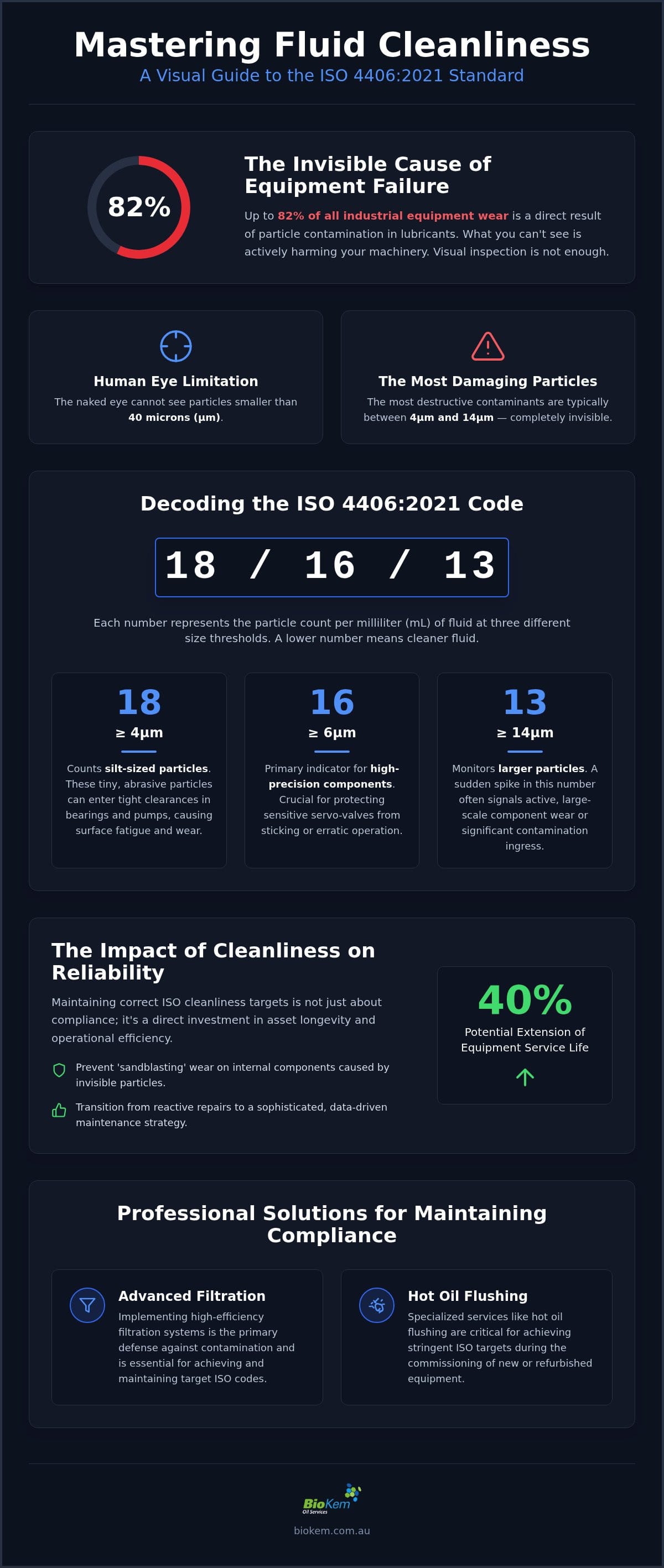
Up to 82% of industrial equipment wear is the direct result of particle contamination within the lubricant. It’s a staggering statistic that proves why a visual inspection of oil is never sufficient for modern reliability standards. Understanding ISO Cleanliness Codes is the essential first step in transitioning from reactive repairs to a sophisticated, data driven maintenance strategy. We understand that interpreting these abstract numbers can be frustrating, particularly when components fail despite the oil appearing clear to the naked eye.
This article will empower you to master the complexities of the ISO 4406:2021 standard to accurately monitor contamination and extend the service life of your critical assets. By the end of this guide, you’ll be able to read an oil analysis report with confidence, set realistic cleanliness targets for various hydraulic systems, and justify the investment in advanced filtration services. We’ll examine the technical mechanisms of particle monitoring and show how achieving specific ISO targets directly correlates with long term ecological health and operational efficiency.
Key Takeaways
- Understanding ISO Cleanliness Codes provides a universal technical language that allows maintenance professionals to accurately interpret laboratory reports and ensure regulatory compliance.
- Learn how the three-digit ISO 4406:2021 code quantifies particles at 4µm, 6µm, and 14µm to protect sensitive valves and high-precision hydraulic components.
- Discover the financial impact of fluid hygiene, where maintaining correct cleanliness targets can extend the service life of critical assets by as much as 40%.
- Establish sector-specific benchmarks for mining, power generation, and manufacturing to justify the operational costs of advanced filtration and oil analysis.
- Recognize when standard filtration is inadequate and how specialized solutions like hot oil flushing are essential for achieving the ISO targets required during system commissioning.
Decoding the ISO 4406 Standard for Oil Cleanliness
ISO 4406 stands as the definitive international reporting standard for fluid cleanliness levels, providing a universal technical language for laboratories, equipment manufacturers, and operators. This standard converts intricate laboratory findings into a concise three-digit code that quantifies the concentration of solid contaminants within a system. In the context of Australian industrial lubrication management, this system is essential for maintaining operational transparency. It enables site managers to establish rigorous performance benchmarks and ensure that filtration protocols meet regulatory and warranty requirements. Understanding ISO Cleanliness Codes is the first step toward a sophisticated maintenance culture that values data over intuition.
The generation of these metrics relies on Automatic Particle Counting (APC). Particle counters utilize advanced light obscuration or laser technology to detect and size debris within a lubricant sample. As fluid passes through the sensor, the device records the number of particles at specific thresholds. This objective process removes the risk of human error, ensuring that the resulting ISO code is a reliable reflection of the fluid’s physical state.
To better understand this concept, watch this helpful video:
The Relationship Between ISO 4406 and ISO 11171
The accuracy of any oil analysis report is contingent upon the calibration of the testing equipment. While ISO 4406 dictates how we report cleanliness, ISO 11171 governs the calibration of the particle counters used in the process. ISO 4406 is the quantitative measure of particulate matter per millilitre of fluid. Although the three-digit summary is the primary KPI, the raw data provided by labs often reveals deeper insights into asset health. By examining the distribution of particles across different sizes, technicians can determine if contamination stems from external ingress or internal component degradation. It’s a level of detail that simple visual checks can’t provide.
Why ‘Clean’ Oil is Often Heavily Contaminated
The limitations of human biology present a significant challenge in maintenance; the naked eye cannot see particles smaller than 40 microns. However, the most destructive contaminants in hydraulic and lubrication systems are typically between 4 and 14 microns. These silt-sized particles are small enough to infiltrate the critical clearances of high-pressure components, leading to a phenomenon known as ‘sandblasting.’ This process causes rapid, internal wear that remains invisible until a catastrophic failure occurs. To prevent this, many facilities implement hot oil flushing during the commissioning of new or refurbished equipment to achieve the stringent ISO targets necessary for long-term reliability. Understanding ISO Cleanliness Codes ensures you don’t mistake clear-looking oil for truly clean oil.
The Three-Digit Code: Micron Sizes and Particle Counts
The ISO 4406 code is expressed as a series of three numbers, such as 18/16/13. Each digit represents the quantity of particles larger than 4, 6, and 14 microns (µm) respectively, found in a single millilitre of fluid. Understanding ISO Cleanliness Codes requires more than just reading the digits; it involves recognizing how these specific thresholds correlate with the mechanical clearances of your machinery. The standard provides a snapshot of the fluid’s physical hygiene, allowing maintenance teams to track the effectiveness of their contamination control strategies.
The first digit (4µm) tracks silt-sized particles. These are often the most abrasive because they are small enough to enter the dynamic clearances of bearings and pumps, leading to surface fatigue. The second digit (6µm) is the primary indicator for high-precision components, such as servo-valves, where even minor debris can cause sticking or erratic operation. Finally, the third digit (14µm) monitors larger particles. A sudden spike in this number often signals active, large-scale component wear rather than simple environmental ingress.
Micron Sizes Explained: 4µm, 6µm, and 14µm
Industry experts selected these three specific sizes because they represent the most critical threat levels to industrial reliability. Particles at the 4µm level are notorious for causing bearing fatigue and surface pitting. They act as a grinding paste, slowly eroding hardened surfaces and shortening the life of rotating equipment. Conversely, 14µm particles are often the "smoking gun" of mechanical failure. While a high count of 4µm particles suggests poor filtration, a high 14µm count often indicates that a component is already in a mode of catastrophic wear. Monitoring these trends is simpler with professional filter ferrogram services, which provide a visual analysis of the debris captured.
The ‘Rule of 2’ in ISO Cleanliness Codes
The most common misunderstanding of the ISO code is the scale itself. The standard uses a logarithmic scale, meaning each step up in the code represents a doubling of the particle concentration. For example, an oil sample with a code of 18/16/13 contains twice as many particles as a sample coded 17/15/12. This "Rule of 2" means that seemingly small changes in your report signify massive shifts in fluid hygiene. A three-point drop in ISO code can extend equipment life by up to 50%. Because the scale is exponential, the difference between a "clean" system and a "dirty" one isn’t a linear progression; it’s a dramatic change in the density of contaminants. Achieving these lower targets often requires specialized equipment, and you can explore our range of industrial filters to find solutions tailored to high-precision tolerances.
Why ISO Codes Matter: Impact on Component Reliability
Maintaining fluid hygiene is a financial strategy as much as a technical requirement. Research indicates that as much as 75% of hydraulic system failures are directly linked to particulate contamination. Understanding ISO Cleanliness Codes allows maintenance managers to predict asset longevity through rigorous trend analysis rather than relying on guesswork. When particle counts rise, internal friction increases, which leads to higher energy consumption and accelerated component degradation. By keeping oil within specified ISO limits, facilities reduce their operational waste and extend the intervals between fluid replacements, directly supporting long term ecological health.
The cost of excluding a single gram of dirt from a system is approximately 10% of what it costs to remove it once it has entered the loop. This economic reality justifies the implementation of proactive contamination control, especially during the commissioning phase. Consistently hitting your ISO targets ensures that your critical assets operate at peak efficiency while minimizing the risk of unscheduled downtime and expensive part replacement. It’s a structured approach that transforms oil analysis from a simple report into a powerful reliability tool.
Component Sensitivity to Particulate Matter
Not all industrial assets share the same tolerance for debris. High precision components like servo valves often have internal clearances as small as 1 to 4 microns, making them exceptionally vulnerable to the silt particles identified by the first digit of the ISO code. In contrast, a heavy duty gearbox might operate reliably with a higher particle count, though abrasive wear will still eventually pit the gear teeth and lead to fatigue. It’s also vital to consider how particulates interact with soft contaminants like varnish. Solid particles can act as a nucleus for varnish formation, leading to sticky valves and restricted flow. Addressing these issues often requires a combination of high efficiency filtration and varnish mitigation to maintain total system health.
ISO Codes as a Maintenance KPI
Modern maintenance departments use ISO cleanliness targets as a primary Key Performance Indicator (KPI) to justify proactive budgets. These codes provide the objective data needed to prove that filtration services are delivering a tangible return on investment. For new machinery, adhering to these standards is a non-negotiable requirement for warranty compliance. OEMs specify these targets because they know that even new oil can contain up to 32 times the contaminants allowed for sensitive equipment. Tracking these codes through regular analysis and the success of a hot oil flushing project ensures that every maintenance action is backed by scientific data, securing the reliability of the entire production line.
Setting and Achieving Target Cleanliness Levels
Effective contamination control begins with a clear objective. Understanding ISO Cleanliness Codes is only the first step; the second is establishing a baseline that reflects the specific sensitivity of your equipment. It’s a common misconception that new oil arrives ready for use. In reality, new fluid often contains significant particulate matter from the refining and transport process, sometimes exceeding the limits for sensitive components by a factor of 30. Achieving a target code requires a logical three step approach: establishing the desired ISO level, measuring the current state, and implementing high performance filtration to bridge the gap.
In the Australian mining and power generation sectors, environmental factors like ambient dust and moisture make reaching these targets particularly challenging. Relying on standard onboard filters is rarely sufficient for critical systems. High performance hardware, such as those from Filters S.p.A., is necessary to maintain the fluid hygiene required for modern tolerances. By focusing on these benchmarks, operators can justify the operational costs of purification services through documented improvements in asset reliability and reduced environmental waste.
Recommended ISO Targets by System Type
Target levels are dictated by the component with the lowest tolerance for debris within a system. Based on current 2026 industrial benchmarks, the following targets are recommended to ensure optimal service life:
- High Pressure Hydraulic Systems: Target 16/14/11 to protect sensitive servo valves.
- Steam Turbines: Target 16/14/12 to prevent bearing damage and governor issues.
- Industrial Gearboxes: Target 18/16/13 to minimize abrasive wear on gear teeth.
These figures align with standard OEM recommendations and provide a clear KPI for maintenance teams. Falling outside these ranges often indicates that the system’s ingression rate has exceeded its filtration capacity, necessitating immediate intervention.
Continuous Monitoring vs. Spot Sampling
While laboratory analysis is essential, it only provides a snapshot of a single moment in time. Onsite particle counting equipment allows for real time monitoring, which is critical during system commissioning or after a component failure. Spot samples can be misleading if the sampling technique is inconsistent or if the sample is taken from a "dead leg" in the piping. To ensure data integrity, many facilities use patch test kits as a visual backup. This combination of digital metrics and physical evidence provides a comprehensive view of fluid health that numbers alone cannot convey.
If your current oil analysis reports show levels exceeding these industry targets, it’s time to implement a more aggressive purification strategy. You can view our range of specialist oil filters and equipment hire options to start reclaiming your system’s reliability today.
Professional Solutions for Maintaining ISO Compliance
When standard onboard filtration is insufficient to reach the stringent targets discussed earlier, professional remediation becomes necessary. Onboard filters are sized for steady-state operation; they often lack the dirt-holding capacity or flow characteristics required to clean up a heavily contaminated system. Understanding ISO Cleanliness Codes allows site managers to recognise when a system has drifted beyond its safe operating parameters, necessitating the use of external purification equipment. These interventions prevent the compounding damage caused by "chain reaction" wear, where existing particles generate additional debris through internal abrasion.
For new systems or those undergoing major overhauls, Hot Oil Flushing is the industry standard for commissioning. This process utilizes high velocity, turbulent flow to dislodge construction debris and scale that standard filtration would miss. Similarly, when moisture ingress complicates particulate levels, Vacuum Dehydration provides a comprehensive solution. It removes both dissolved water and fine particulates, preventing the chemical degradation of the oil and the subsequent formation of varnish or other soft contaminants.
Corrective Actions for High ISO Codes
Corrective actions for high ISO codes often involve the implementation of bypass filtration systems. By diverting a portion of the fluid through Specialist Oil Filters, systems can achieve deep cleaning without interrupting production. This approach is particularly effective for systems that have suffered from chronic contamination. In one documented industrial case study, implementing a targeted bypass strategy reduced a system’s ISO code from 22/20/17 down to 15/13/10. Because of the logarithmic nature of the standard, this represents a massive reduction in the actual particle count, significantly lowering the risk of component failure.
BioKem Oil Services’ Integrated Lubrication Services
BioKem Oil Services supports Australian industry through a combination of world-class hardware and technical expertise. As the sole Australian distributor for Filters S.p.A., we provide access to high-performance filtration technology specifically engineered to meet stringent ISO targets. Our services include:
- Onsite laboratory testing and real-time particle analysis.
- Equipment hire for vacuum dehydration and flushing units.
- Technical support for critical system cleanouts and varnish mitigation.
Our onsite technical support ensures that every purification project is verified by objective data, providing a clear path to regulatory compliance and extended asset life. Contact BioKem Oil Services for a detailed oil analysis and ISO compliance plan to ensure your critical assets remain within their ideal cleanliness range.
Securing the Future of Industrial Asset Reliability
Transitioning to a reliability-centred maintenance strategy requires technical precision and a commitment to data integrity. Understanding ISO Cleanliness Codes provides the foundational framework needed to protect sensitive components from the abrasive effects of silt-sized contaminants. These codes are more than just numbers on a report; they’re a direct indicator of your equipment’s potential service life and energy efficiency. By maintaining fluid hygiene within OEM-specified limits, you reduce the frequency of unscheduled failures and minimize the environmental footprint of your operations through decreased oil waste.
BioKem Oil Services stands as a reliable partner in solving these complex industrial challenges. We’re the sole Australian distributor for Filters S.p.A. and employ specialist onsite hot oil flushing technicians to ensure your systems meet commissioning standards from day one. Our comprehensive lab-grade oil analysis reports provide the clarity you need to justify maintenance budgets and achieve long-term operational health. This data-driven approach ensures your facility remains compliant while maximizing the productivity of every asset.
Optimize your system reliability with BioKem Oil Services’ expert oil analysis and filtration services. Proactive fluid management is the most effective way to secure the future of your critical industrial assets and ensure a sustainable operational legacy.
Frequently Asked Questions
What is a good ISO cleanliness code for hydraulic oil?
A good target depends on the system’s operating pressure and component sensitivity. High-pressure hydraulic systems with servo valves typically require a code of 16/14/11 or cleaner. Lower pressure systems might tolerate an 18/16/13. It’s essential to consult OEM specifications to ensure warranty compliance. Maintaining these targets reduces internal friction, which is a core benefit of Understanding ISO Cleanliness Codes in any proactive maintenance culture.
How do I read a 3-digit ISO 4406 code?
The code consists of three numbers separated by slashes, such as 18/16/13. Each number represents a range of particle counts found in a one-millilitre sample. The first number tracks particles larger than 4 microns, the second larger than 6 microns, and the third larger than 14 microns. Because the scale is logarithmic, increasing any digit by one actually doubles the particle concentration. It’s an exponential measurement of fluid hygiene.
Can I determine the ISO code of my oil without a laboratory?
Yes, you can utilize onsite particle contamination monitors for immediate results. These portable devices provide real-time data, which is invaluable during system commissioning. However, onsite testing shouldn’t replace professional laboratory analysis. Lab-grade reports provide deeper insights into chemical health and wear debris that portable sensors might miss. This dual approach ensures a more comprehensive understanding of your lubrication health and helps you maintain regulatory compliance across your entire facility.
What is the difference between ISO 4406 and NAS 1638?
ISO 4406 is the current international standard for reporting fluid cleanliness, focusing on three specific micron sizes. NAS 1638 is an older standard that categorizes contamination into classes based on the single largest particle found in various size ranges. While some legacy industries still reference NAS 1638, most modern OEMs have transitioned to ISO 4406. It provides a more accurate representation of the total particle distribution, which is vital for modern high-precision machinery.
How often should I test my oil for ISO cleanliness?
Testing frequency should be determined by the criticality of the asset and the operating environment. For high-value machinery like steam turbines, monthly or quarterly sampling is recommended. You should also perform analysis after any major maintenance event. Consistent monitoring allows you to identify trends early, ensuring you don’t miss a spike in contamination. This proactive approach prevents the "chain reaction" wear that leads to catastrophic component failure.
Why did my ISO code increase after I changed the filters?
An increase in particle count immediately after a filter change is often caused by "filter shock" or the disturbance of settled debris. Opening the system introduces external contaminants, and the surge of fluid can dislodge particles from the housing. If the code doesn’t drop, it may indicate that the new filter’s micron rating is insufficient. It’s also possible the bypass valve is stuck open, which allows unfiltered oil to circulate through the system.
Does the ISO code measure water contamination in oil?
No, the ISO 4406 code only quantifies solid particulate matter. While water is a significant contaminant that causes oxidation, it requires separate testing methods like Karl Fischer titration. If your analysis reveals high water levels alongside poor ISO codes, it’s time to utilize vacuum dehydration. This process removes both dissolved moisture and solids, which is essential for maintaining the long-term chemical and physical integrity of your industrial lubricants.
What particle size is most damaging to industrial bearings?
Silt-sized particles between 4 and 6 microns are the most destructive to industrial bearings. These particles are small enough to enter dynamic clearances but large enough to bridge the lubricant film. This causes abrasive wear and surface fatigue. Because these particles are invisible to the naked eye, Understanding ISO Cleanliness Codes is the only reliable way to detect these silent threats before they cause failure. It’s a critical step in any reliability-centred strategy.