

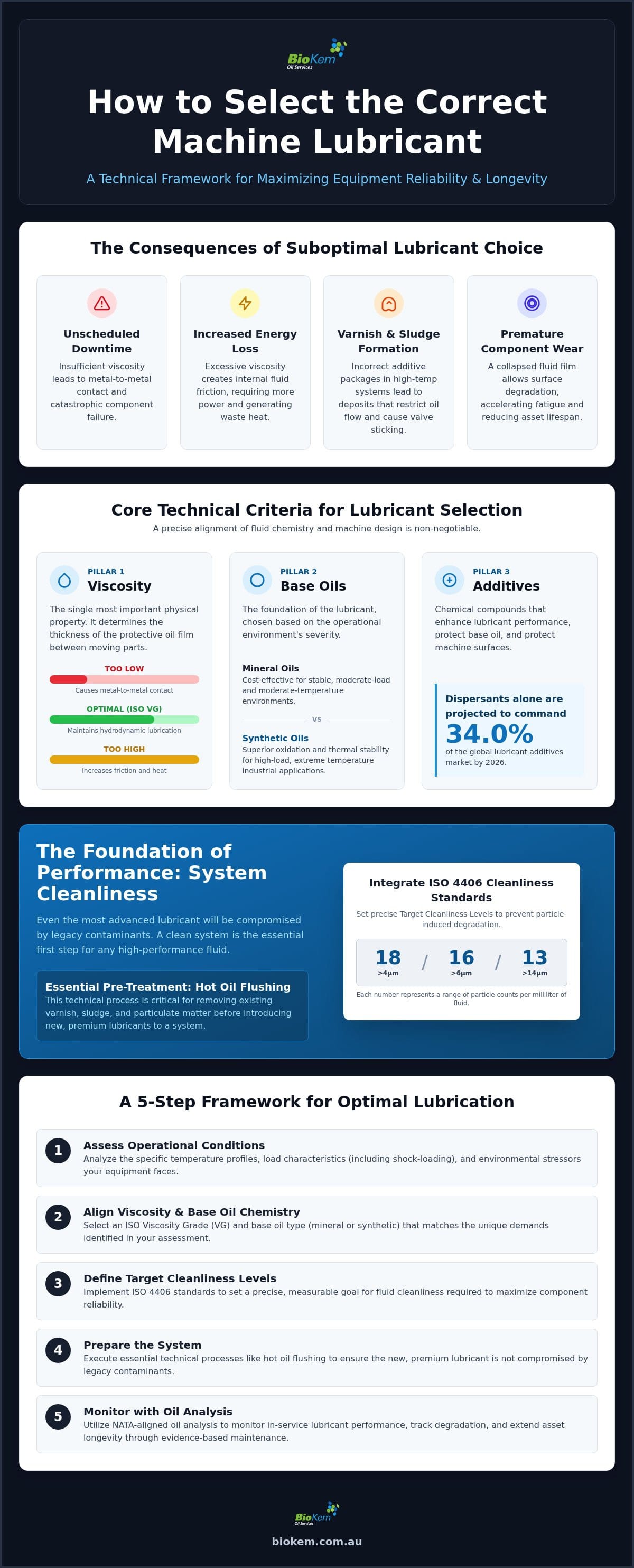
Dispersants are projected to command 34.0% of the global lubricant additives market by 2026, yet even the most advanced chemical packages fail when they’re introduced to contaminated systems. You likely recognize that the high costs of unscheduled downtime and premature component wear often stem from more than just a simple product mismatch. Learning how to select the correct machine lubricant requires a precise alignment between fluid chemistry, specific machine design, and the actual cleanliness of your operational environment.
It’s frustrating to watch critical assets degrade despite following strict maintenance schedules and investing in premium fluids. This article provides a technical framework to help you master the criteria for selecting lubricants that maximize equipment reliability and significantly reduce maintenance intervals. We’ll examine critical performance data, the impact of evolving PFAS regulations on your formulation choices, and why a clean system is the essential foundation for any high-performance oil. You’ll gain a clear strategy for evaluating viscosity grades and additive packages to ensure long-term ecological and operational health.
Key Takeaways
- Identify why viscosity is the critical physical property for maintaining a protective chemical film between moving surfaces under varying industrial loads.
- Discover how to select the correct machine lubricant by aligning specific base oil chemistries with the unique temperature and shock-loading profiles of your equipment.
- Implement ISO 4406 standards to set precise Target Cleanliness Levels that prevent particle-induced degradation and maximize component reliability.
- Learn why technical processes like hot oil flushing are essential before introducing premium lubricants to ensure new fluids aren’t compromised by legacy contaminants.
- Utilize NATA-aligned oil analysis to monitor lubricant performance data and extend asset longevity through evidence-based maintenance intervals.
Beyond Friction: The Strategic Role of Machine Lubricant Selection
Industrial lubrication is often misunderstood as a simple commodity. In reality, it’s a complex chemical film engineered to protect critical asset surfaces from catastrophic failure. Understanding how to select the correct machine lubricant is a foundational skill for technical managers who oversee high-value infrastructure. When you choose a lubricant, you aren’t just buying oil; you’re investing in a fluid reliability pillar that supports the entire mechanical integrity of your operation. This chemical interface must perform three primary functions: reducing friction, dissipating heat, and keeping contaminants in suspension until they can be removed by filtration.
The financial impact of incorrect selection on Australian industrial operations is substantial. Using a fluid that doesn’t meet the specific technical requirements of a system leads to energy loss and mechanical degradation. Proactive maintenance relies on the stability of this fluid. If the lubricant fails, the machine fails. Establishing a framework for how to select the correct machine lubricant ensures that your assets operate within their designed parameters, which directly influences your total cost of ownership.
The Consequences of Suboptimal Lubricant Choice
Selecting an inappropriate viscosity or base oil chemistry has immediate operational penalties. One of the most common issues is increased energy consumption. When a fluid is too viscous for the application, internal fluid friction generates unnecessary heat and requires more power to move components. Conversely, a lubricant with insufficient viscosity allows metal-to-metal contact, leading to accelerated component fatigue and unscheduled downtime. In high-temperature turbine systems, the wrong additive package can also lead to the rapid formation of varnish. This sticky residue coats internal components, restricts oil flow, and causes valves to stick, necessitating expensive intervention and cleaning.
Lubrication as a Component of Asset Longevity
The right fluid is the cornerstone of a proactive maintenance strategy. It ensures that components like bearings and gears operate in the hydrodynamic lubrication regime, where surfaces are completely separated by a fluid film. Maintaining this state is often a requirement for machine warranty compliance, as manufacturers specify strict lubricant standards to guarantee performance. The Stribeck Curve is a fundamental concept in tribology that maps the relationship between the friction coefficient and the dimensionless lubrication parameter, illustrating how viscosity, speed, and load interact to determine the lubrication regime. By selecting a lubricant that accounts for these variables, you extend the life of your equipment and ensure that your maintenance intervals remain predictable and cost-effective.
Core Technical Criteria: Viscosity, Base Oils, and Additive Packages
Technical proficiency in how to select the correct machine lubricant begins with a deep dive into fluid properties. Viscosity is the single most important physical property because it determines the thickness of the oil film between moving parts. It serves as the primary barrier against metal-to-metal contact. If the viscosity is too low, the film collapses under load; if it’s too high, internal fluid friction causes energy loss and excessive heat generation. Standardized ISO VG (Viscosity Grade) classifications help simplify this choice by measuring flow resistance at 40°C, providing a baseline for comparison across different brands.
Base oil selection depends on the severity of the operational environment. Mineral oils are cost-effective for stable, moderate-load environments. However, synthetic base oils provide superior oxidation stability and performance in high-load industrial applications. These synthetic fluids are more resistant to thermal breakdown, which supports long-term ecological health by extending drain intervals and reducing waste. For systems prone to water ingress, such as steam turbines or outdoor hydraulic units, demulsibility is a critical factor. A lubricant with high demulsibility sheds water quickly, allowing it to be drained or removed before it creates a damaging emulsion.
Understanding Viscosity Index (VI) and Shear Stability
Viscosity Index (VI) measures how much a lubricant’s viscosity changes in response to temperature fluctuations. In the variable Australian climate, a high VI is essential. It ensures the fluid stays thick enough to protect components during a 45°C summer afternoon while remaining fluid enough for a cold start. You must also account for shear stability. High-stress environments can physically tear apart the polymer chains used as viscosity index improvers, leading to a permanent loss of protection. Selecting a shear-stable fluid ensures that the ISO VG rating you start with is the one that remains in the machine months later.
Selecting Additives for Specific Machine Demands
Additive packages tailor the base oil to meet specific mechanical requirements. Matching AW (Anti-wear) additives to hydraulic pump requirements is standard practice to prevent scuffing. For gearboxes facing heavy or shock loading, Extreme Pressure (EP) additives are necessary to handle the increased stress. Detergents and dispersants also play a vital role in maintaining system cleanliness by keeping contaminants in suspension. It’s vital to avoid mixing different lubricant chemistries, as incompatible additives can react to form sludge or “snot,” which clogs filters and causes system failure. To verify your current fluid’s health and additive levels, professional oil analysis provides the empirical data needed to validate your selection strategy.
Operational Realities: Temperature, Load, and Environmental Stress
Technical specifications alone don’t guarantee performance; the environment dictates the outcome. When determining how to select the correct machine lubricant, you must account for the specific stresses of the Australian industrial landscape. High ambient temperatures and airborne particulates create a hostile environment that can quickly degrade even premium fluids. A lubricant that performs well in a climate-controlled facility may fail catastrophically in an arid mining site or a humid coastal processing plant. Effective selection requires a balance between the fluid’s chemical resilience and the mechanical demands of the system.
Load characteristics are equally vital. Steady-state operations allow for a consistent hydrodynamic film, but heavy industry often involves shock loading. These sudden bursts of pressure can rupture a standard oil film, leading to boundary lubrication where metal surfaces collide. In these scenarios, the selection must prioritize high film strength or specialized additive packages that chemically bond to the metal. Integrating a robust strategy for oil contamination control into your selection process ensures that the fluid’s integrity isn’t compromised by the very environment it’s meant to protect.
Thermal Stability and Oxidation Resistance
Heat is the primary enemy of lubricant longevity. The Arrhenius rate rule states that for every 10°C increase in operating temperature above its design baseline, the oxidative life of the oil is halved. In high-cycle hydraulic systems, this thermal stress accelerates the breakdown of base oils and the depletion of additives. The thermal degradation of base oils produces insoluble by-products that act as the primary precursors for varnish formation throughout the lubrication circuit. Selecting a fluid with superior thermal stability is essential for preventing these deposits from seizing valves or clogging narrow oil galleries. For facility owners who also wish to protect their physical infrastructure from environmental stress, you can explore cleaning and sealing of all Natural stone finishes to ensure long-term durability.
The physical properties of a lubricant can either attract or repel environmental contaminants. In open systems, the tackiness of the fluid affects how easily dust and grit adhere to moving parts. For wash-down or high-moisture environments, you need a lubricant with high water resistance and excellent demulsibility to prevent the formation of sludge. Beyond the fluid itself, protecting the system requires hardware like desiccant breathers and specialist oil filters to exclude particulates and moisture. Understanding how to select the correct machine lubricant involves looking beyond the reservoir to the entire operational ecosystem, ensuring that the chosen fluid remains clean and effective for its entire service life.
Cleanliness Standards: Integrating ISO 4406 into Your Selection Process
Selecting a lubricant based solely on technical data sheets is a common oversight in industrial maintenance. True operational efficiency requires integrating cleanliness standards into your procurement and maintenance protocols. ISO 4406 serves as the international benchmark for quantifying particulate contamination. When you evaluate how to select the correct machine lubricant, you must define the Target Cleanliness Level (TCL) for each specific asset. High-pressure hydraulic systems or high-speed turbines have much tighter tolerances than a standard gearbox. Without a cleanliness target, even the most expensive synthetic oil will fail to prevent premature wear.
It’s a common misconception that new oil is clean oil. During the manufacturing, blending, and transport process, fluids often pick up environmental particulates that exceed the sensitivity limits of modern components. Introducing unfiltered oil into a critical system negates the benefits of the advanced additive packages discussed in previous sections. Achieving and maintaining these targets requires high-efficiency Filters S.p.A. hardware designed to capture microscopic contaminants before they cause component fatigue. By aligning your lubricant selection with a strict filtration strategy, you ensure the fluid provides the chemical protection it was engineered for.
Decoding ISO 4406: 4μm, 6μm, and 14μm Particles
The ISO 4406:2021 standard provides a three-part code representing the number of particles larger than 4μm, 6μm, and 14μm per millilitre of fluid. These specific sizes are critical because they correspond to the internal clearances in sensitive components like servo valves and precision bearings. Silt-sized particles, specifically those in the 4μm to 6μm range, are particularly dangerous because they can accumulate in tight clearances. This accumulation leads to hydraulic valve sticking and erratic machine behaviour. Setting a TCL allows you to establish a measurable goal, ensuring your lubricant selection translates into tangible equipment reliability.
Achieving Cleanliness Through Filtration and Flushing
Maintaining selection-grade purity is an active process that begins before the oil even enters the machine. Before introducing a fresh lubricant, you must ensure the internal system is free of legacy contaminants and debris. This is why hot oil flushing is a non-negotiable step during lubricant changeovers. This process utilizes high-velocity, turbulent flow to dislodge particulates and varnish from internal surfaces that standard filtration cannot reach. Once the system is operational, bypass filtration and online particle counters provide the verification needed to confirm your lubricant remains within its specified cleanliness range. To ensure your assets are protected by the highest standards of fluid purity, explore our range of specialist oil filters to secure your system’s integrity.
Maximising Asset Longevity with BioKem’s Lubrication Services
Understanding how to select the correct machine lubricant is a vital technical prerequisite, but selection alone cannot guarantee long-term reliability if the fluid is not managed correctly within the system. BioKem serves as a national technical partner, providing the onsite execution and analytical oversight required to ensure your chosen lubricants perform to their full potential. While selection focuses on the chemical and physical properties of the oil, our services focus on maintaining those properties against the constant threat of contamination and thermal degradation. This proactive approach transforms lubrication from a routine task into a strategic asset management function.
We provide a comprehensive suite of services designed to validate your selection and extend the service life of your fluids. Our expertise in critical systems, such as turbines and high-pressure hydraulics, allows us to identify and mitigate risks before they manifest as unscheduled downtime. Whether through specialist equipment hire for temporary purification projects or ongoing maintenance contracts, we ensure that your operational environment remains as clean as the technical specifications of your lubricant require.
Onsite Purification: Vacuum Dehydration and Varnish Removal
Replacing large volumes of industrial oil is both expensive and environmentally taxing. BioKem’s onsite purification services, including vacuum dehydration and varnish mitigation, allow you to restore lubricant properties without a full fluid replacement. Vacuum dehydration effectively removes both free and dissolved water, which is essential for maintaining the demulsibility of the fluid. For turbine systems, integrating varnish removal systems into your maintenance schedule is critical; these systems extract sub-micron oxidation by-products that standard filters miss. This process not only protects your assets but also supports corporate sustainability goals by reducing the volume of waste oil generated by your facility.
Laboratory Analysis and Technical Reporting
Empirical evidence is the only way to truly validate how to select the correct machine lubricant for your specific application. Our NATA-aligned oil analysis goes beyond basic sampling to provide deep insights into additive depletion, wear metals, and particle morphology. For immediate visual confirmation of fluid health, we utilize patch test kits that provide a clear indication of contamination levels on the factory floor. By interpreting this data, we help you customize maintenance schedules based on real-time fluid health rather than arbitrary time intervals. This data-driven strategy ensures that your assets remain protected by a lubricant that is chemically intact and physically clean, maximizing both component life and operational efficiency.
Securing Operational Integrity through Strategic Fluid Management
Achieving peak industrial efficiency requires a synergy between chemical properties and system cleanliness. We’ve explored how viscosity index, environmental stressors, and ISO 4406 targets define the success of your maintenance strategy. Mastery of these criteria ensures that your assets operate within their designed parameters, protecting them from the hidden costs of varnish and component fatigue. Understanding how to select the correct machine lubricant is the foundation of a proactive reliability program.
BioKem supports this mission as the sole Australian distributor for Filters S.p.A. and a national leader in industrial fluid management. Our specialists provide the hot oil flushing and vacuum dehydration services needed to maintain the integrity of your turbines and hydraulic systems. Contact BioKem for a professional oil analysis and system cleanliness audit to validate your selection and secure your equipment’s future. With a data-driven approach and the right technical partner, you can achieve superior levels of equipment uptime and long-term ecological health.
Frequently Asked Questions
How do I determine the correct viscosity for my machine?
Determine the required viscosity by consulting the Original Equipment Manufacturer (OEM) specifications for your specific operating temperature and load. The OEM defines the minimum viscosity needed to maintain a hydrodynamic film at peak operating heat. You must also consider the Viscosity Index (VI) if the machine operates in varying Australian climates. Selecting a fluid that balances pumpability during startup with film strength at high temperatures ensures mechanical protection.
What is the difference between mineral and synthetic lubricants for industrial use?
Synthetic lubricants offer superior thermal stability and resistance to oxidation compared to mineral oils. While mineral oils are suitable for moderate, stable environments, synthetics are engineered for high-load or extreme temperature applications. This chemical resilience leads to longer drain intervals and reduced environmental impact. Synthetics also typically feature a higher Viscosity Index, providing more consistent protection across a wider temperature range than their mineral counterparts.
Why is new oil from a drum not considered clean enough for use?
New oil from a drum often contains particulates from the blending, packaging, and transport processes. These contaminants can exceed the sensitivity limits of high-precision components like servo valves or turbine bearings. It’s common for new oil to have an ISO 4406 code that is several levels dirtier than what a critical system requires. Filtering new oil before it enters the machine is a standard reliability practice to prevent internal damage.
How often should I perform oil analysis on critical machinery?
Critical machinery typically requires oil analysis every quarter, though high-stress assets like steam turbines may need monthly monitoring. The frequency depends on the machine’s criticality, the volume of the reservoir, and the harshness of the environment. Consistent sampling allows you to detect additive depletion and wear metals early. This data-driven approach is essential when learning how to select the correct machine lubricant and validating its performance over time.
Can I mix different brands of lubricants if they have the same specifications?
You shouldn’t mix different brands of lubricants even if they share the same ISO VG and specifications. Different manufacturers use unique additive chemistries that may be chemically incompatible. Mixing can lead to additive precipitation, which forms sludge or “snot” that clogs filters and restricts oil flow. To maintain system integrity, it’s best to perform a full hot oil flush before switching to a different lubricant brand or formulation.
What are the signs that my lubricant is failing due to oxidation?
Primary signs of lubricant oxidation include a noticeable darkening of the oil, a pungent sour odour, and an increase in viscosity. Oxidation occurs when heat and oxygen cause the base oil to break down chemically. This process leads to the formation of organic acids and insoluble by-products, which eventually manifest as varnish on internal surfaces. Regular analysis helps detect these chemical changes before they cause mechanical seizing or valve sticking.
How does temperature affect the lifespan of my machine lubricant?
Temperature has a direct, exponential impact on lubricant lifespan as described by the Arrhenius rate rule. Generally, every 10°C increase in operating temperature above its design baseline halves the oxidative life of the oil. High heat accelerates the depletion of antioxidant additives and promotes the formation of sludge. Managing system temperature through cooling and proper lubricant selection is vital for maintaining fluid health and ensuring the longevity of your mechanical assets.
What role does ISO 4406 play in lubricant selection?
ISO 4406 provides a standardized language for reporting the particulate cleanliness of a fluid. It helps you set Target Cleanliness Levels (TCL) based on the specific sensitivities of your machine’s components. When you evaluate how to select the correct machine lubricant, the ISO code tells you if the fluid meets the required purity standards. It serves as a benchmark for filtration efficiency and overall system reliability in sensitive industrial environments.