

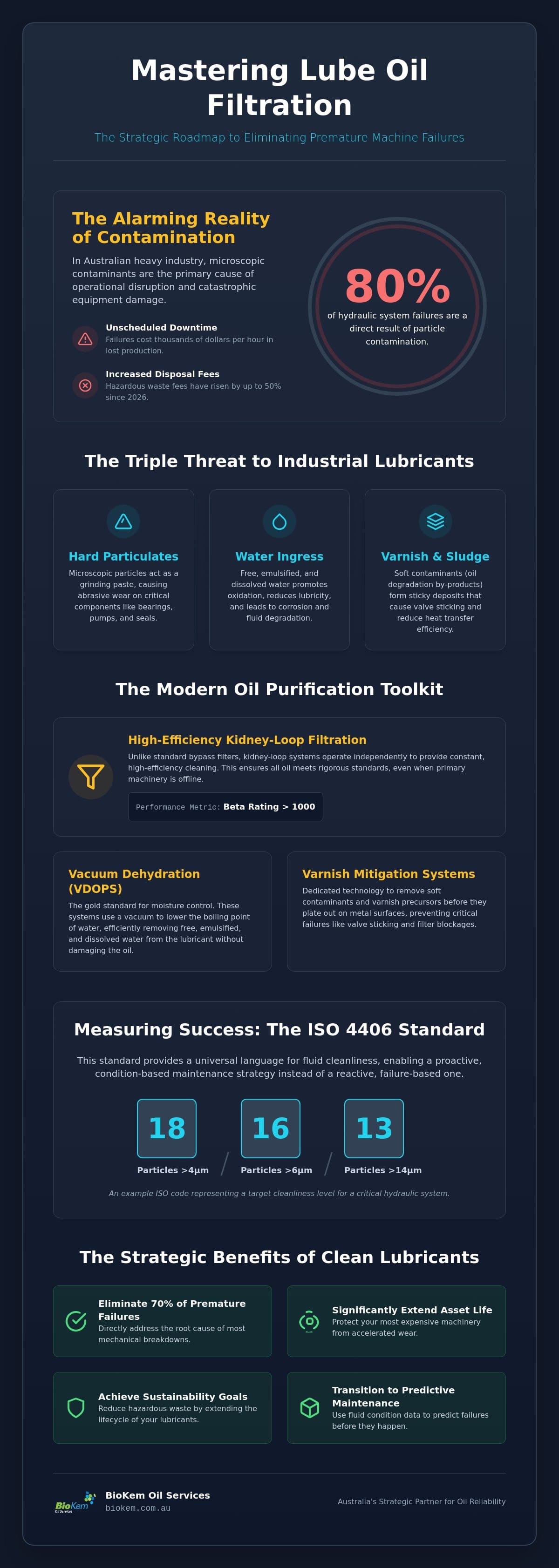
Did you know that approximately 80% of hydraulic system failures in Australian heavy industry are a direct result of particle contamination? It’s a sobering reality for maintenance managers who face unscheduled downtime costing thousands of dollars every hour. Whether it’s varnish causing valve sticking or water ingress in a critical turbine, the reliability of your lube oil filtration system determines the operational lifespan of your most expensive assets. We understand the pressure to maintain peak performance while navigating rising hazardous waste disposal fees, which have increased by up to 50% in some regions as of 2026.
You’re likely looking for a way to stop reacting to failures and start predicting them. This guide provides the technical and strategic roadmap to eliminate 70% of premature machine failures. We’ll show you how to achieve specific ISO 4406:2017 cleanliness targets and transition to a sophisticated condition-based maintenance model. By combining high-performance hardware with advanced purification methods like vacuum dehydration and varnish mitigation, you can extend asset life and meet your sustainability goals simultaneously.
Key Takeaways
- Understand how microscopic contamination triggers 70% of premature mechanical breakdowns and the strategic steps required to mitigate this risk.
- Explore the core mechanisms of a modern lube oil filtration system, including vacuum dehydration and varnish mitigation, to eliminate water and soft contaminants.
- Determine whether equipment hire, hardware purchase, or managed services offer the best ROI for your specific operational requirements and maintenance budget.
- Master the ISO 4406 cleanliness standard to accurately measure fluid quality and implement a proactive, condition-based maintenance strategy.
- Reduce your facility’s environmental impact and hazardous waste fees by significantly extending the lifecycle of your industrial lubricants through professional purification.
What is a Lube Oil Filtration System and Why is it Critical?
A lube oil filtration system is far more than a simple mechanical sieve. It represents a coordinated array of technologies engineered to preserve the chemical and physical integrity of industrial lubricants by removing particulates, water, and varnish. While basic Filtration focuses on larger debris, a comprehensive system addresses the entire lifecycle of the fluid. In 2026, the Australian industrial sector has largely moved away from the wasteful “drain and fill” mentality. Instead, we see a shift toward continuous purification as a standard practice. This transition reflects a dual commitment to operational readiness and environmental responsibility by reducing hazardous waste.
The industry follows a strict “70% failure rule” which dictates that seven out of ten premature mechanical breakdowns are caused by fluid contamination. Microscopic particles, often invisible to the naked eye, act as grinding paste between moving surfaces. To combat this, high-performance kidney-loop lube oil filtration system configurations have become the preferred choice over standard bypass filters. Unlike bypass filters that only treat a fraction of the flow during operation, kidney-loop systems operate independently of the main lubricant circuit. This allows for constant, high-efficiency cleaning that ensures every drop of oil meets rigorous standards, even when the primary machinery is offline.
To better understand how these systems transform contaminated fluids, watch this helpful video:
The Real Cost of Poor Oil Cleanliness
Common Contaminants: Particles, Water, and Varnish
We identify the “Triple Threat” of industrial oil as hard particulates, emulsified water, and soft contaminants known as varnish. Standard filters often fail to capture sub-micron varnish precursors, which eventually plate out on cool metal surfaces. This leads to valve sticking and reduced heat transfer efficiency. Implementing a dedicated varnish mitigation strategy is essential to prevent these sticky deposits from compromising your system’s precision components. Water contamination is equally dangerous, as it promotes oxidation and reduces the lubricant’s load-carrying capacity, necessitating advanced removal techniques like vacuum dehydration.
Core Technologies in Modern Oil Purification
Achieving 2026 reliability standards requires more than a single filter. A high-performance lube oil filtration system integrates multiple stages of purification to address diverse contamination types. We prioritize high-efficiency elements with Beta ratings exceeding 1000. This rating ensures that for every 1000 particles of a specific micron size entering the media, only one remains. As the Australian distributor for Filters S.p.A., BioKem Oil Services provides hardware that aligns with global critical lubrication system design standards to protect your most valuable machinery from catastrophic wear.
Vacuum Dehydration Oil Purification Systems (VDOPS)
Vacuum Dehydration Oil Purification Systems (VDOPS) are the gold standard for moisture control in industrial fluids. These systems remove free, emulsified, and dissolved water by manipulating physical laws. By creating a vacuum, the system lowers the boiling point of water significantly. This allows moisture to “boil” off as vapor at temperatures safe for the oil, typically between 40°C and 50°C. This process is critical because it preserves the oil’s additive package while achieving water levels as low as 50 ppm. It’s ideally suited for large turbine reservoirs and hydraulic systems where water ingress is a constant threat to bearing life.
Varnish Mitigation and Removal
Varnish is the result of oil oxidation and thermal degradation. These chemical byproducts are initially soluble but precipitate as sticky resins when the oil cools or becomes saturated. Mechanical filtration alone is often insufficient because varnish precursors are sub-micron in size. We employ specialized varnish mitigation that uses chemical or electrostatic principles to attract and capture these polar contaminants. This prevents the “plating out” effect that causes turbine valves to stick. If you’re experiencing sluggish control response, exploring varnish mitigation services is a logical first step to restoring system precision.
High-Flow Particulate Filtration
For rapid cleanup, high-flow particulate filtration skids are essential. These portable units are often used during commissioning or after a system breach to reach ISO cleanliness targets in a fraction of the time required by standard onboard filters. We frequently deploy paddle flushing screens during these high-velocity flushes to provide a visual and physical check of debris removal. For permanent, full-flow protection, the robust design of Filters S.p.A. products provides a dependable barrier against particulate ingress, ensuring the system stays within its design parameters.
Purchase, Hire, or Service: Selecting the Right Commercial Model
Deciding on a lube oil filtration system involves balancing technical necessity with financial strategy. This decision shapes your maintenance budget, moving costs between CAPEX and OPEX depending on your specific operational goals. For business owners in the industrial sector managing these complex financial decisions, you can click here to discover specialized mortgage brokerage services designed for the self-employed. BioKem Oil Services helps organizations evaluate the frequency of use and the technical complexity of their contamination issues to determine the most effective commercial path. By aligning your procurement model with asset criticality, you can optimize your total cost of ownership while maintaining peak fluid health.
When to Buy: Permanent Filtration Installations
Critical assets that operate continuously, like power generation turbines, demand permanent filtration installations. High-quality hardware from Filters S.p.A. provides a reliable, long-term ROI by preventing the steady accumulation of particulates. For these mission-critical systems, having a dedicated unit integrated into the lubrication circuit is essential. Even stringent federal regulations for oil filtration systems highlight the importance of bypass protection and contamination monitoring, which are best managed through permanent, high-spec assemblies. Investing in ownership also ensures that your internal maintenance teams have immediate, 24/7 access to filtration without waiting for logistical deployment.
When to Hire: Short-Term Decontamination and Outages
Not every contamination event requires a permanent purchase. Sudden water ingress or post-overhaul system cleaning often requires a temporary, high-intensity intervention. The equipment hire services offered by BioKem Oil Services provide a flexible alternative to capital expenditure. This “try before you buy” model allows maintenance teams to evaluate specific technologies on their own assets before committing to a larger investment. Our national fleet ensures that specialized gear is available for rapid deployment to any site in Australia, providing a critical bridge during emergency contamination crises without straining your annual capital budget.
When to Book Onsite Services: Expert-Led Projects
For highly complex projects like hot oil flushing, booking professional onsite services is often the safest and most efficient choice. These projects require specialized technical knowledge and high-velocity equipment to achieve strict ISO 4406 targets without risking equipment damage. By engaging the technicians at BioKem Oil Services, you transfer the technical risk and liability to specialists. This ensures the job is done right the first time, using advanced technologies that might be too complex or expensive to maintain in-house. Professional execution also guarantees that all waste disposal and regulatory documentation are handled according to current standards, allowing your team to focus on core production tasks.
Achieving and Maintaining Oil Cleanliness Standards
Measuring the efficacy of a lube oil filtration system requires moving beyond simple visual inspection. While high-performance hardware does the heavy lifting, the ISO 4406:2017 standard provides the definitive data needed to validate system performance. This three-digit code represents the quantity of particles larger than 4, 6, and 14 microns per milliliter of fluid. Without this metric, you’re essentially operating in the dark. High-performance filtration must be integrated into a broader proactive maintenance strategy that prioritizes data-driven decisions over traditional, schedule-based oil changes.
The Role of Oil Analysis and Sampling
Regular oil analysis serves as a “blood test” for your machinery. It reveals the internal health of components before a catastrophic failure occurs. For immediate visual confirmation on the shop floor, patch test kits allow technicians to quickly assess particulate levels and varnish precursors. When deeper insight is required, advanced techniques like a filter ferrogram can identify specific wear modes by analyzing the shape and composition of captured debris. This level of analysis ensures your lube oil filtration system is targeting the right contaminants at the right time, preventing the 80% of hydraulic failures caused by particle contamination.
Setting Realistic Cleanliness Targets
Setting appropriate targets is vital for operational reliability. A gearbox might operate reliably at an ISO code of 17/16/13, but high-precision servo valves often require a much cleaner 14/12/9 to prevent sticking. The impact of these numbers is significant. Industry data suggests that reducing a system’s ISO code by just one level can effectively double the life of critical components. To achieve these results, you must establish consistent, repeatable sampling points. Sampling from a “dead-leg” or the bottom of a tank will provide skewed data. Always sample from an active flow line to get a representative view of the fluid currently protecting your assets.
If you’re ready to validate your current fluid health and set new reliability benchmarks, consider booking a comprehensive oil analysis and ferrogram service to identify hidden wear patterns before they cause downtime.
Why BioKem Oil Services is Australia’s Strategic Partner for Oil Reliability
BioKem Oil Services serves as a specialized bridge between global technological innovation and the practical requirements of the Australian industrial sector. We don’t simply supply components; we deliver a comprehensive reliability framework. This “Triad of Reliability” integrates forensic oil analysis, high-performance hardware, and expert execution to ensure your lube oil filtration system performs at its peak. By choosing a local partner, you gain access to specialists who understand the nuances of regional environmental standards and the logistical complexities of our domestic heavy industries. Our focus remains on providing sustainable, long-term solutions that replace immediate, synthetic interventions with technical precision.
National Reach and Specialist Expertise
Our capability extends to the most remote mining and power generation sites across the continent. BioKem Oil Services recognizes that mission-critical assets often operate in harsh, isolated environments where technical support must be both rapid and expert. Our founding expertise is built on a commitment to safety and strict adherence to Australian regulatory standards. Through strategic partnerships with world-class brands like Filters S.p.A. and Swift Filters, we deploy international-grade technology with local agility. This ensures your site receives the necessary support without the delays typically associated with overseas logistics. We provide the “boots on the ground” expertise required for complex onsite projects while maintaining global engineering standards.
Sustainability and the Circular Oil Economy
The shift toward a circular oil economy is both an environmental and an economic imperative in 2026. Implementing advanced fluid management practices allows facilities to reduce oil waste by 50% to 80% through continuous purification. This reduction directly minimizes the carbon footprint associated with lubricant production and the transport of hazardous materials. With waste disposal levies reaching historic highs in metropolitan and regional zones, the “oil for life” strategy has moved from a theoretical ideal to an operational standard. Securing the longevity of your assets requires a partner that values long-term ecological health as much as operational efficiency.
If you’re ready to modernize your maintenance strategy, contact BioKem Oil Services for a system audit or equipment hire quote to begin your transition to a condition-based reliability model. Our team is ready to help you validate your fluid health and implement a world-class contamination control program.
Securing the Future of Industrial Reliability
Transitioning from traditional maintenance to a sophisticated reliability model requires more than just high-quality hardware. It demands a technical synergy between precise oil analysis and advanced purification technologies. By implementing a robust lube oil filtration system, your facility can significantly reduce mechanical failures while meeting the stringent environmental standards of 2026. We’ve explored how specific technologies like vacuum dehydration and varnish mitigation protect mission-critical assets from the cumulative damage of contamination.
BioKem stands as your strategic partner in this journey. As the sole Australian distributor for Filters S.p.A. and with over 25 years of combined industrial expertise, we provide the technical depth required for complex lubrication challenges. Whether you need a national hire fleet for an emergency outage or a permanent onsite service solution, our team delivers results that align with your operational and ecological goals. We’re committed to helping you achieve specific ISO cleanliness targets that can effectively double component life.
Optimise Your Oil Reliability with BioKem’s Filtration Solutions
Take the proactive step today to ensure your machinery operates with the precision and longevity it was designed for.
Frequently Asked Questions
What is the difference between a filter and an oil filtration system?
A single filter is a mechanical component designed to capture debris, whereas a lube oil filtration system is an integrated assembly of multiple technologies. These systems often combine particulate filters, vacuum dehydration units, and monitoring sensors to address water, gasses, and soft contaminants simultaneously. While a filter provides basic protection, a system ensures total fluid health by managing the chemical and physical integrity of the lubricant over its entire lifecycle.
How often should I run my portable filtration system on a hydraulic reservoir?
The frequency depends on your specific ISO 4406 cleanliness targets and the environmental ingress rate of your facility. For critical hydraulic systems, we recommend running a portable unit until the fluid reaches at least two ISO codes below your target. In high-dust environments like mining sites, many operators find that implementing a periodic kidney-loop schedule every quarter effectively maintains fluid integrity between major service intervals.
Can a filtration system remove water from oil that looks milky?
Yes, a lube oil filtration system utilizing vacuum dehydration can effectively remove water from oil that has reached a milky, emulsified state. While standard centrifugal or coalescing methods struggle with emulsified water, vacuum dehydration lowers the boiling point to vaporize moisture without damaging the oil. This process can return milky oil to a clear and bright state, often achieving water levels below 50 ppm in industrial applications.
What ISO 4406 cleanliness code should I aim for in my turbine oil?
For critical power generation turbines, a standard target is ISO 16/14/11 or cleaner. Achieving this level is vital because turbine bearings rely on a very thin oil film that can be easily breached by particles larger than 5 microns. Maintaining this standard significantly reduces the risk of bearing wipe and ensures the reliable operation of governor and control valves, which are sensitive to even minor particulate buildup.
Is it more cost-effective to hire or buy oil purification equipment in Australia?
Hiring is generally more cost-effective for short-term decontamination projects, emergency water ingress, or post-overhaul cleaning. It avoids large capital expenditure and provides access to the latest technology without maintenance overhead. Conversely, buying is the preferred strategic choice for assets that require 24/7 dedicated protection. For many Australian sites, a hybrid approach of owning primary hardware and hiring specialized gear for outages offers the best financial balance.
How does varnish mitigation differ from standard particulate filtration?
Standard particulate filtration captures hard, solid debris like metal shavings or silica. Varnish mitigation targets soft, polar contaminants that are often sub-micron in size and soluble at operating temperatures. While a standard filter might miss these precursors, varnish removal systems use chemical or electrostatic technologies to extract oxidation byproducts before they can plate out on cool metal surfaces and cause sluggish control response or valve sticking.
What are the benefits of using Filters S.p.A. products over generic alternatives?
Filters S.p.A. products offer superior Beta ratings, often exceeding Beta 1000, which ensures a much higher particle capture efficiency than generic alternatives. These components are engineered for safety-critical industrial applications and offer robust construction that withstands high pressure and flow fluctuations. As the sole Australian distributor, BioKem ensures these high-spec products are backed by local technical support and a reliable supply of genuine replacement elements for long-term reliability.
Does hot oil flushing require the system to be offline?
Yes, hot oil flushing is a maintenance or commissioning procedure that requires the primary machinery to be offline. The process involves bypassing sensitive components and using high-velocity external pumps to circulate heated oil through the pipework. This high-energy flow creates turbulence that dislodges internal scale and construction debris. Once the target ISO cleanliness is achieved and verified, the system is reconnected for normal operational service.

Article by
James McAllister
James McAllister is an industry professional with BioKem Oil Services, specialising in lubrication reliability, oil filtration, contamination control and asset performance. Drawing on BioKem's extensive field experience across turbines, compressors, hydraulic systems and critical rotating equipment, James writes practical, insight-driven articles that help maintenance and reliability teams improve equipment performance, extend asset life and reduce operational risk.