


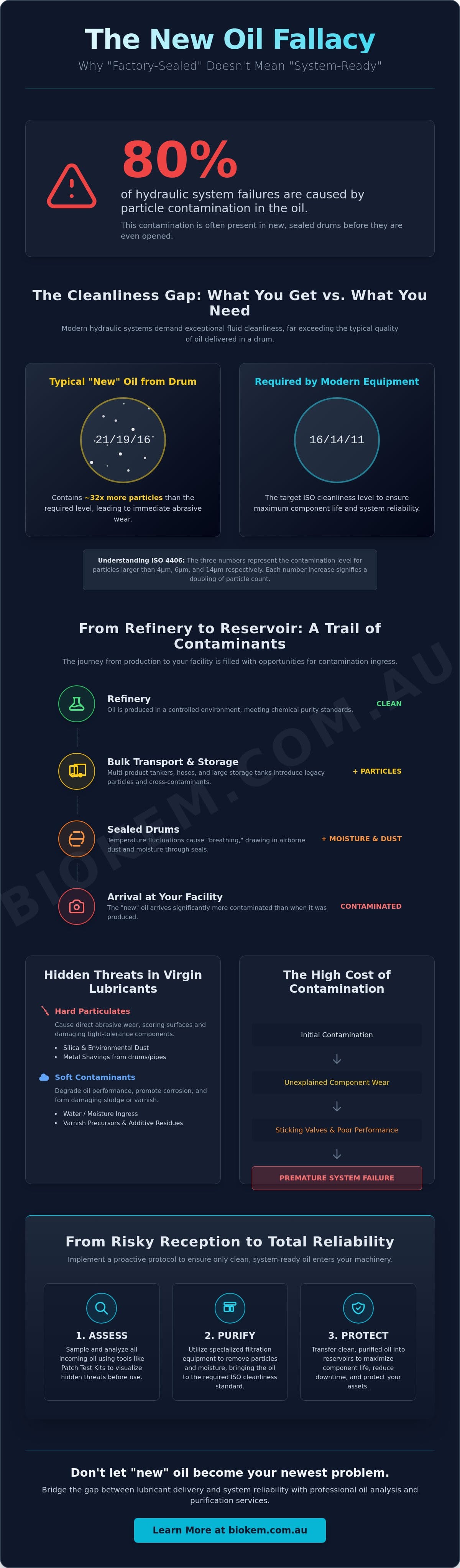
Approximately 80% of hydraulic system failures in heavy industry are the direct result of particle contamination, often introduced before the machinery even starts. It’s a startling statistic that highlights a fundamental misunderstanding in maintenance departments: the belief that “new” equals “clean.” The technical reality of Why New Oil is not always Clean Oil is evident when you compare specifications. While modern equipment typically demands an ISO 4406 cleanliness level of 16/14/11, oil arriving directly from a drum often tests at a significantly more contaminated 21/19/16.
You’ve likely experienced the frustration of unexplained component wear or sticking valves in critical circuits, even after a fresh oil change. It’s natural to trust that a sealed container protects your investment, but moisture ingress and microscopic particulates are persistent threats during transport. With lubricant prices seeing cumulative increases of nearly 30% in early 2026, protecting your fluid has never been more vital for operational sustainability. This guide explains why relying on visual clarity is a significant risk to your assets and how to implement a professional purification strategy for maximum reliability. We’ll examine how to transform raw lubricant into a high-performance asset through rigorous oil analysis and advanced contamination control.
Key Takeaways
- Identify the “New Oil Fallacy” to understand how transport infrastructure compromises lubricant integrity before it reaches your facility.
- Discover Why New Oil is not always Clean Oil by learning to interpret ISO 4406 standards as the benchmark for operational fluid cleanliness.
- Assess the operational risks of trusting factory-sealed drums, including the chain reaction of wear caused by initial particulate contamination.
- Implement a five-step proactive reception protocol that prioritizes sampling and purification before decanting oil into main reservoirs.
- Utilize professional oil analysis and specialized equipment hire to bridge the technical gap between lubricant delivery and system reliability.
The ‘New Oil’ Fallacy: Why Industrial Lubricants Arrive Contaminated
The “New Oil Fallacy” is a pervasive misconception in industrial maintenance. It’s the assumption that because a lubricant is unused and arrives in a sealed drum, it inherently meets the stringent cleanliness requirements of modern high-pressure hydraulic systems or precision gearboxes. In reality, refineries are highly controlled environments that produce chemically pure products. However, the transport infrastructure used to deliver these products is rarely held to the same standard. This logistical gap is the primary reason Why New Oil is not always Clean Oil. While the chemical purity might be within specification, the particulate cleanliness often falls short of what sensitive machinery requires for long-term reliability.
To better understand this concept, watch this helpful video:
It’s vital to distinguish between chemical purity and particulate cleanliness. Chemical purity refers to the molecular composition, viscosity, and additive balance of the oil, which refineries manage with high precision. Particulate cleanliness, however, refers to the absence of solid contaminants. Even chemically perfect oil can be heavily laden with microscopic debris by the time it reaches your facility. This distinction is critical for maintenance professionals who must ensure that the fluid entering their systems won’t cause immediate abrasive damage.
The Journey from Refinery to Reservoir
In the Australian industrial landscape, lubricants often traverse vast distances through a complex supply chain. From bulk storage terminals to regional distribution hubs, the fluid passes through various tanker trucks and transfer lines. Each transfer point presents an opportunity for ingress. Multi-product transport vessels are a particular concern; if a pump or hose isn’t thoroughly purged between batches, cross-contamination occurs. This risk is amplified in remote operations where equipment might be used for multiple types of fluid delivery.
Effective contamination control strategies must account for the environmental conditions during this transit. In many Australian regions, extreme temperature fluctuations between day and night cause “breathing” in supposedly sealed drums. As the air inside the drum expands and contracts, it draws in ambient moisture and airborne dust through the bungs. This process introduces water and fine particulates before the drum is even opened on-site. The result is a product that is technically “new” but functionally contaminated.
Common Contaminants Found in Virgin Lubricants
Virgin lubricants frequently contain a variety of debris that can be categorized as hard or soft contaminants. Hard particulates include silica, environmental dust, and even metal shavings from the drum manufacturing or filling process. Soft contaminants often consist of moisture, residues from line-flushing agents, or leftover additives from previous production runs. These substances compromise the oil’s performance and accelerate the degradation of system components.
- Hard Particulates: Silica, metal shards, and atmospheric dust.
- Soft Contaminants: Water, varnish precursors, and cross-pollinated additives.
Latent contamination consists of microscopic particles that bypass standard visual inspections but cause significant abrasive wear within tight-tolerance components. To accurately assess these hidden threats, maintenance teams often utilize patch test kits to visualize the debris that remains invisible to the naked eye. Recognizing that Why New Oil is not always Clean Oil is a result of these hidden factors allows for a more proactive approach to fluid reception and system protection.
The Science of Cleanliness: Understanding ISO 4406 Standards
Precision is the cornerstone of modern industrial maintenance. To manage fluid health effectively, operators rely on ISO 4406, the global benchmark for quantifying particulate contamination. This standard, last revised in 2021, provides a consistent three-number code that represents the quantity of particles per millilitre of fluid at three specific sizes: 4 microns, 6 microns, and 14 microns. Understanding these metrics is the only way to verify Why New Oil is not always Clean Oil. While a drum might arrive with an ISO code of 21/19/16, high-performance systems often require a much leaner 16/14/11. This numerical difference isn’t just a minor variance; it represents a logarithmic scale where each increase in the code number indicates a doubling of the contaminant level.
Relying on the traditional “bright and clear” visual test is a dangerous gamble for critical assets. A fluid can look perfectly transparent to the human eye while still carrying a destructive load of microscopic debris. Because industrial standards have evolved, maintenance teams must transition from subjective observations to data-driven verification. Utilizing a digital particle counter allows for real-time monitoring of delivery specifications, ensuring that no fluid enters a reservoir without meeting its required cleanliness profile.
Why Visual Inspection Fails the Modern Asset
The human eye has a resolution limit of approximately 40 microns. In contrast, the critical clearances in modern high-pressure hydraulic pumps and servos are often between 3 and 5 microns. This means that particles ten times smaller than what you can see are capable of causing catastrophic “stiction” or abrasive wear. Clear oil can easily contain millions of particles per litre that fall within this invisible, destructive range. This is why professional oil analysis is essential. It moves beyond simple visual checks to identify the specific nature and quantity of contaminants that threaten your system’s internal surfaces.
Matching Oil Cleanliness to Component Sensitivity
Different components have vastly different tolerances for contamination. A heavy-duty industrial gearbox might operate reliably with an ISO code of 18/16/13, but a high-pressure hydraulic servo system will suffer rapid degradation if the fluid isn’t maintained at 15/13/10 or better. The stakes are high: industry data suggests that every one-point drop in an ISO cleanliness code can potentially double the life of a rolling-element bearing. By matching the lubricant’s cleanliness to the most sensitive component in the circuit, you prevent the “chain reaction of wear” that starts the moment contaminated new oil is introduced. Precise measurement is the only way to bridge the gap between “new” and “clean.”
Operational Risks: The Cost of Trusting the Drum
Neglecting the quality of incoming lubricants creates a hidden vulnerability during the most sensitive phase of an asset’s life: commissioning. When a system is first charged, any “built-in” contamination from the delivery container begins an immediate abrasive process. This is a central danger in Why New Oil is not always Clean Oil. These initial particles don’t just sit in the fluid; they act as cutting tools that generate secondary wear debris. This “chain reaction of wear” means that a single gram of dirt in a new drum can produce several grams of metallic debris within the first few hours of operation, significantly shortening the system’s mean time between failures.
The financial burden of this oversight extends beyond part replacement. If a new charge of oil is heavily contaminated, it prematurely exhausts the sacrificial additives designed to protect metal surfaces. This often forces an early oil change, doubling your lubricant spend and increasing the volume of waste fluid your facility must process. It’s a costly cycle that undermines both maintenance budgets and corporate sustainability goals.
Varnish Formation and Valve Sticking
Microscopic metallic particulates, especially copper and iron fines, serve as catalysts for thermal degradation. These particles provide a surface for oxidation to occur, accelerating the transition of fluid from a stable state to a state of varnish formation. In high-tolerance systems like turbine governors or EHC units, this varnish creates “stiction” that leads to erratic valve behavior or total system trips. To address these existing deposits and prevent future accumulation, BioKem Oil Services provides varnish mitigation services that restore the chemical and particulate balance of your critical fluids.
Impact on System Longevity and Warranty
Warranty protection often hinges on the cleanliness of the fluid used during the initial fill. Many OEMs now require documented ISO 4406 codes before they’ll honor claims on pumps or valves. Introducing contaminated fluid can lead to “infant mortality,” where expensive components fail long before their projected service life. Beyond the parts themselves, you’ll encounter the hidden costs of increased filter consumption and energy loss due to internal friction. Treating Why New Oil is not always Clean Oil as a baseline assumption allows you to protect these warranties and ensure your equipment reaches its intended design life.
The Proactive Reception Protocol: Purification Strategies
Establishing a documented protocol for lubricant reception transforms a vulnerability into a quality control checkpoint. This proactive strategy is the only way to manage the reality of Why New Oil is not always Clean Oil before it enters your sensitive machinery. The process follows a logical five-step sequence: documentation verification, sampling, analysis, purification, and protected storage. If your site doesn’t have the permanent infrastructure for high-volume purification, BioKem Oil Services offers specialized equipment hire, providing access to vacuum dehydrators and kidney-loop units on demand. These tools allow you to strip out dissolved water and microscopic particulates that are often present in new shipments but invisible to the naked eye.
Purification isn’t a one-time event but a condition of entry. By treating incoming oil as a raw material that requires conditioning, you ensure that every litre of fluid adds value to your system rather than introducing a destructive load. This approach is particularly vital for critical assets like high-pressure hydraulic servos or turbine control systems where tolerances are measured in single microns. Adopting this standard of care reflects a commitment to both operational reliability and environmental responsibility by maximizing the service life of the lubricant.
Sampling and Verification Procedures
A representative sample is non-negotiable for any quality control program. For drums, use a clean manual vacuum pump to draw from the center of the volume. For bulk deliveries, sample from the tanker’s discharge port after a brief initial flush to ensure you aren’t just testing stagnant residue in the valve. Using patch test kits provides an immediate on-site visual of the contaminant load, offering a “go/no-go” decision before the oil is decanted into your main tanks. This allows you to set clear “Acceptance Limits” with your supplier. By having a protocol that allows for the rejection of substandard batches, you hold suppliers accountable for the cleanliness of the fluid they deliver.
Conditioning New Oil Before Use
Once the fluid is accepted, it must be conditioned through kidney-loop filtration. This involves circulating the oil through a high-efficiency filter with a 3-micron absolute rating or better until the target ISO code is achieved. For newly installed systems or those undergoing a major overhaul, hot oil flushing is the most efficient way to remove both the oil’s initial contaminants and any residual debris from the manufacturing process. This dual-action approach ensures the entire circuit is clean, not just the fluid. Finally, protect the clean fluid in storage with desiccant breathers to prevent the moisture ingress discussed in previous sections. To ensure your lubricants are ready for service immediately, consider a professional filtration and flushing service to safeguard your assets.
BioKem Oil Services’ Lifecycle Approach to Lubrication Management
BioKem Oil Services operates as a technical bridge, closing the gap between the bulk delivery of lubricants and their functional application in high-precision machinery. While refineries focus on molecular purity, our focus is on ensuring that the fluid entering your system meets the specific cleanliness requirements of your most sensitive components. This intervention is essential because the technical reality of Why New Oil is not always Clean Oil means that raw lubricants are rarely ready for immediate service. By managing this transition, we help you avoid the “built-in” contamination risks discussed earlier, ensuring your assets start their lifecycle with the highest possible level of protection.
Our methodology utilizes high-performance Filters S.p.A. products to condition new oil shipments effectively. These specialist elements are engineered for superior particulate capture, allowing us to reach target ISO codes faster and more reliably than standard off-the-shelf filters. This precision contributes directly to your facility’s environmental goals. By ensuring oil is clean from the first stroke, we significantly extend the lubricant’s service life, which reduces the total volume of waste oil generated and lowers the overall carbon footprint of your operations.
Technical Interventions for Critical Assets
BioKem Oil Services provides a suite of on-site technical solutions designed to verify and maintain fluid health in real-time. Our technicians utilize calibrated particle counters to confirm that target cleanliness levels are achieved before a single drop of oil is decanted into your reservoirs. This rigorous verification process is a core component of advanced fluid management, ensuring that the theoretical reliability of your machinery is matched by the actual purity of its lifeblood. Whether through high-flow hot oil flushing or precise varnish mitigation, we provide the data-backed assurance that your lubricants are a performance asset rather than a liability.
Expertise and Equipment Access
We recognize that maintaining a full fleet of purification equipment isn’t always practical for every site. To solve this, BioKem Oil Services offers specialised equipment hire, giving you access to industrial-grade vacuum dehydrators and kidney-loop filtration units when you need them most. As the Australian distributor for world-class filtration brands, we don’t just provide the hardware; we provide the technical expertise to ensure it’s deployed effectively. This “clean from the start” philosophy is the most sustainable and cost-effective way to manage industrial lubrication programs, ensuring the fundamental challenge of Why New Oil is not always Clean Oil never compromises your operational uptime.
Securing Asset Reliability Through Proactive Lubricant Reception
Recognizing the technical reality of Why New Oil is not always Clean Oil is the first step toward achieving world-class reliability. We’ve established that new oil is a raw material rather than a finished product; it requires professional refinement before it’s fit for high-pressure hydraulic circuits or sensitive gearboxes. By adopting a proactive reception protocol and relying on ISO 4406 data rather than visual clarity, you eliminate the risks of premature component wear and the environmental burden of early fluid degradation. It’s a shift from reactive maintenance to a strategy of quiet confidence and operational precision.
BioKem provides the technical interventions necessary to secure your industrial assets from the moment of delivery. As the sole Australian distributor for Filters S.p.A. with extensive on-site hot oil flushing expertise, we deliver advanced laboratory analysis and reporting to verify every batch meets your specific requirements. Ensure your new oil is truly clean with BioKem’s specialised filtration services. Implementing these rigorous standards today builds a solid foundation for long-term equipment health and a more sustainable industrial future.
Frequently Asked Questions
Is it really necessary to filter new oil before putting it into my machine?
Yes, filtering new oil is a critical requirement for protecting modern, high-pressure industrial systems. Most new lubricants arrive with particulate levels that exceed the tolerances of sensitive components like hydraulic servos or high-speed bearings. By filtering the fluid before it enters your reservoir, you prevent the “chain reaction of wear” and ensure you aren’t inadvertently voiding OEM warranties on new equipment.
What is the typical ISO cleanliness code for new oil straight from the refinery?
While refineries produce chemically pure oil, the transport infrastructure typically delivers it at an ISO 4406 level of approximately 21/19/16. This is significantly dirtier than the 16/14/11 target required by most modern machinery. Understanding these figures is the key to recognizing Why New Oil is not always Clean Oil, as the delivery process introduces millions of microscopic particles per litre.
Can visual ‘bright and clear’ tests replace laboratory oil analysis?
No, visual inspections are fundamentally insufficient for modern contamination control. The human eye can’t see particles smaller than 40 microns, yet the most destructive debris in a hydraulic system is often between 3 and 5 microns. Laboratory analysis or digital particle counters are the only reliable methods for verifying that a lubricant meets the specific cleanliness standards required for asset reliability.
How does moisture get into a sealed drum of new oil?
Moisture enters through a process known as “thermal breathing.” As drums experience temperature fluctuations during transit or outdoor storage, the air inside expands and contracts. This pressure change draws in ambient, humid air through the bungs. Once inside, the moisture condenses into the fluid, leading to oil oxidation and potential component corrosion even before the drum is opened for the first time.
What are the most common contaminants found in new industrial lubricants?
The most frequent contaminants include silica, environmental dust, and metal shavings from the drum manufacturing or filling process. You’ll also often find soft contaminants like moisture and residues from previous fluid batches left in transfer lines. These diverse pollutants are the primary reason Why New Oil is not always Clean Oil and must be addressed through a rigorous reception protocol.
Does pre-filtering new oil affect the chemical additives in the lubricant?
Standard particulate filtration doesn’t remove dissolved chemical additives. Additive molecules are significantly smaller than the pore sizes of high-efficiency 3-micron or 1-micron filters. Using professional filtration equipment ensures that you remove harmful solid debris while leaving the essential additive package intact. This process refines the oil into a functional lubricant without compromising its designed chemical properties.
How can I hold my oil supplier accountable for dirty oil deliveries?
You should establish clear “Acceptance Limits” based on ISO 4406 standards within your procurement contracts. Use on-site sampling and patch test kits to verify the cleanliness of every delivery before it’s decanted into your main storage tanks. If the analysis shows the oil exceeds your agreed-upon limits, you have the data-backed evidence needed to reject the batch and request a cleaner replacement.
What equipment is best for cleaning new oil on an industrial site?
Dedicated kidney-loop filtration units and vacuum dehydrators are the gold standard for on-site purification. Kidney-loop systems using high-efficiency specialist filters remove solid particulates, while vacuum dehydration is necessary for stripping out dissolved water. If your facility doesn’t have permanent units, specialized equipment hire provides a flexible way to condition bulk deliveries and maintain system integrity without a large capital outlay.