

Clean oil requires more than removing visible particles. A vacuum dehydration oil purification system (VDOPS) uses vacuum, heat and filtration to remove water, entrained gases and particulate contamination. To assess why BioKem’s OFS VDOPS are the best in the world, look at how these processes address different contaminants rather than relying on filtration alone.
For Australian operations, the right treatment depends on the oil’s condition, the contaminants present and the equipment’s operating requirements. This article explains how VDOPS purification works, what it is designed to remove and which technical factors to consider when assessing oil treatment.
Key Takeaways
- Learn how portable vacuum dehydration systems can treat oil in a kidney-loop setup while equipment remains operational.
- See how vacuum distillation and particulate filtration target water, entrained gases and solid contaminants through different mechanisms.
- Assess performance through practical measures such as water removal, filtration efficiency and suitability for the oil’s viscosity.
- Understand when professional vacuum dehydration, oil analysis or varnish mitigation can support cleaner oil and reliable equipment operation.
What Is A Vacuum Dehydration Oil Purification System (VDOPS)?
A vacuum dehydration oil purification system (VDOPS) removes water and gases from oil under reduced pressure. Portable systems can operate in kidney-loop mode, treating oil while plant and equipment remain online. This can avoid draining the entire reservoir for treatment.
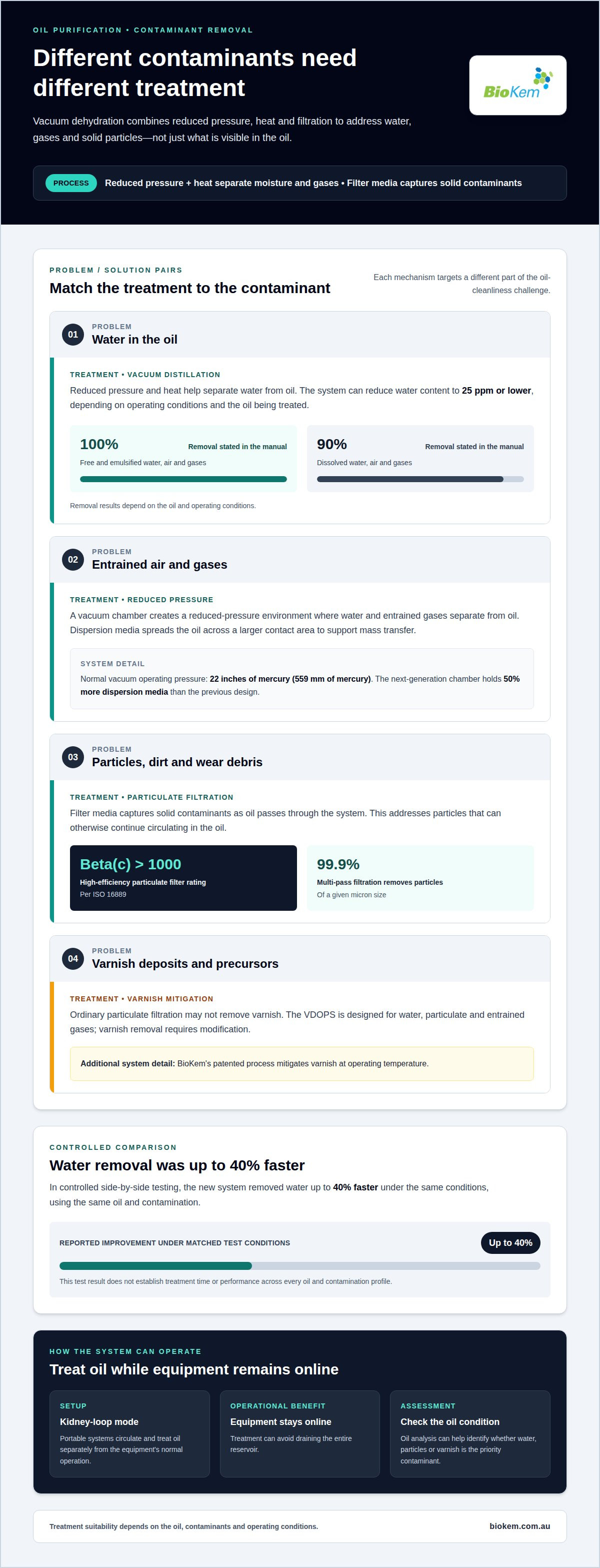
A vacuum chamber is the vessel where reduced pressure helps contaminants leave the oil. The normal vacuum operating pressure is 22 inches of mercury (559 mm of mercury). In the next-generation design, the chamber holds 50% more dispersion media than the previous design, increasing the media available for the process.
Dispersion media spreads oil into a larger contact area inside the chamber. This supports mass transfer as water and entrained gases separate from the oil. The vacuum tower provides the space for this treatment, while the vacuum pump maintains reduced pressure. An oil pump moves fluid through the system; available models span flow rates from 2 to 100 GPM.
Applicable requirements in Australia depend on the equipment installation and worksite. A VDOPS description does not establish a universal approval pathway, so any assessment should account for the specific site and equipment.
Technical details include the stated 22-inch Hg operating pressure, the 50% increase in dispersion-media capacity and a maximum oil viscosity of 323.7 cSt. The system is designed for water, particulate and entrained gases; varnish removal requires modification. These specifications help describe operating scope, not every possible oil condition.
Limitations follow from the oil and system conditions: viscosity, contamination type and operating setup affect treatment. The 323.7 cSt maximum is a practical boundary, and a VDOPS doesn’t address every cause of oil degradation. For Australian project coordination, use the Australian contact page.
Oil purification and contaminant removal
Vacuum distillation separates water and gases from oil by exposing the fluid to reduced pressure and heat. This process supports moisture removal without treating every contaminant as if it were the same. The system can reduce oil water content to 25 ppm or lower, depending on operating conditions and the oil being treated.
Water removal varies by form. The VDOPS manual states that the system removes 100% of free and emulsified water, air and gases, and 90% of dissolved water, air and gases. In controlled side-by-side testing, the new system removed water up to 40% faster under the same conditions, using the same oil and contamination.
Particulate filtration captures solid contaminants as oil passes through filter media. The high-efficiency particulate filter is rated Beta(c) > 1000 per ISO 16889, while multi-pass filtration removes 99.9% of particles of a given micron size. This matters because dirt and wear debris can continue circulating if filtration does not capture them.
Varnish mitigation targets deposits and precursors that ordinary particulate filtration may not remove. The VDOPS is designed to remove water, particulate and entrained gases; varnish removal requires modification. Oil viscosity also shapes the treatment approach, with the system listed as suitable for high-viscosity gear oils rated ISO VG 150-680.
For an operational decision, oil analysis can help identify whether water, particles or varnish is the priority contaminant. A discussion about oil purification requirements can help relate the contamination profile to a suitable treatment approach.
BioKem’s mobile systems dewater in kidney-loop mode with equipment online; OilQuip elements span 2.5 up to 22 microns. Glass media provides absolute filtration to 99.99 (Beta 1000); its patented process mitigates varnish at operating temperature.
How do BioKem OFS VDOPS compare with competing products on performance and reliability?
A fair comparison uses documented specifications and matched operating conditions, not broad claims of superiority. For Australian sites, compare flow requirements, oil viscosity, temperature control, filtration performance and discharge limits against the equipment’s duty. Reliability also depends on correct setup, maintenance and the oil being treated.
Temperature control is one useful technical measure. The programmable thermostat maintains fluid temperature within 0.1°F, and the normal heater set point is 150 degrees Fahrenheit. These figures describe control capability, but they don’t establish treatment time or performance across every oil and contamination profile.
Drive configuration offers another point of comparison. Models rated at 5 GPM and above use a variable frequency drive. Maximum discharge pressure is 100 PSI (689.5 kPa). Matching these specifications to the required flow and site arrangement helps assess whether a system suits a particular application.
Reliability comparisons require evidence from comparable duty cycles, operating conditions and maintenance records. A stated filtration rating or temperature tolerance is useful, but does not by itself demonstrate uptime. A controlled water-removal test can inform performance only when the oil and contamination conditions are comparable. One specification alone cannot establish that every competing system performs worse.
New oil also deserves attention: it may not meet the required OEM specification unless ordered as certified-clean lubricant. The choice between purification systems should account for the oil’s condition, required cleanliness and operating demands, rather than brand claims alone. To discuss a performance assessment for your application, contact the team about VDOPS requirements.
BioKem Oil Services
BioKem Oil Services helps Australian operators manage oil contamination with services suited to the fluid and equipment. Consider the team when moisture, particulate contamination, varnish or wear debris analysis informs an oil-maintenance decision.
Vacuum Dehydration addresses moisture contamination, while Oil Analysis helps inform decisions about oil condition. Hot Oil Flushing supports oil-system cleaning, and Varnish Mitigation targets varnish-related concerns. Matching the treatment to the issue avoids treating every contamination problem alike.
For example, an oil sample showing moisture points to a different treatment need than evidence of varnish or wear debris. Relating the contamination profile to operating conditions helps identify an appropriate next step. BioKem Oil Services can discuss your oil-treatment needs and relevant service options.
Contact BioKem Oil Services to discuss your oil purification requirements.
Make Your Next Oil-Maintenance Decision Evidence-Led
To assess whether BioKem’s OFS VDOPS suit a particular operation, start with the equipment’s condition and the treatment objective. Connect oil analysis findings with the operational issue, then determine whether purification, flushing or varnish mitigation is relevant. This grounds the decision in the fluid and equipment rather than broad product claims.
BioKem Oil Services provides Vacuum Dehydration, Hot Oil Flushing and Varnish Mitigation for different oil-maintenance requirements. The appropriate approach depends on the issue affecting your system and the treatment objective. Discussing the requirement with BioKem can help identify a relevant service without assuming every problem calls for the same treatment.
Discuss your oil-treatment requirements with BioKem Oil Services and take a considered next step towards maintaining your equipment.
Frequently Asked Questions
What are BioKem OFS VDOPS and what does OFS VDOPS stand for?
VDOPS stands for Vacuum Dehydration Oil Purification Systems. “OFS VDOPS” identifies the system discussed here; knowing what OFS stands for is not necessary to understand its purpose. BioKem supplies these systems and provides professional vacuum dehydration for industrial oil. The key distinction is between the purification equipment and the service used to treat oil in an operating system.
What products, services, or technology does BioKem offer under OFS VDOPS?
BioKem supplies Vacuum Dehydration Oil Purification Systems and provides Vacuum Dehydration as a service. Oil Analysis can inform decisions about fluid condition, while Hot Oil Flushing or Varnish Mitigation may address other maintenance needs. These options address different issues, so choose an approach based on the oil’s condition and treatment objective, rather than assuming one system solves every concern.
What evidence supports claims that BioKem OFS VDOPS are the best in the world?
Available evidence describes system specifications and a controlled water-removal comparison, but does not establish a universal ranking above every competing product. The comparison is useful when its test conditions match the intended application, including the oil type and contamination. For an Australian site, assess documented performance against the treatment objective, operating conditions and equipment requirements before deciding whether a system is suitable.

Article by
James McAllister
James McAllister is an industry professional with BioKem Oil Services, specialising in lubrication reliability, oil filtration, contamination control and asset performance. Drawing on BioKem's extensive field experience across turbines, compressors, hydraulic systems and critical rotating equipment, James writes practical, insight-driven articles that help maintenance and reliability teams improve equipment performance, extend asset life and reduce operational risk.