

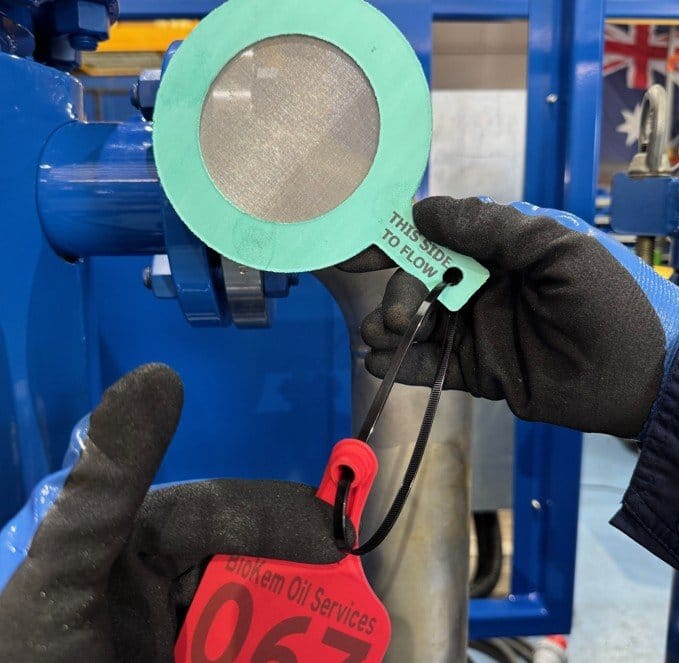
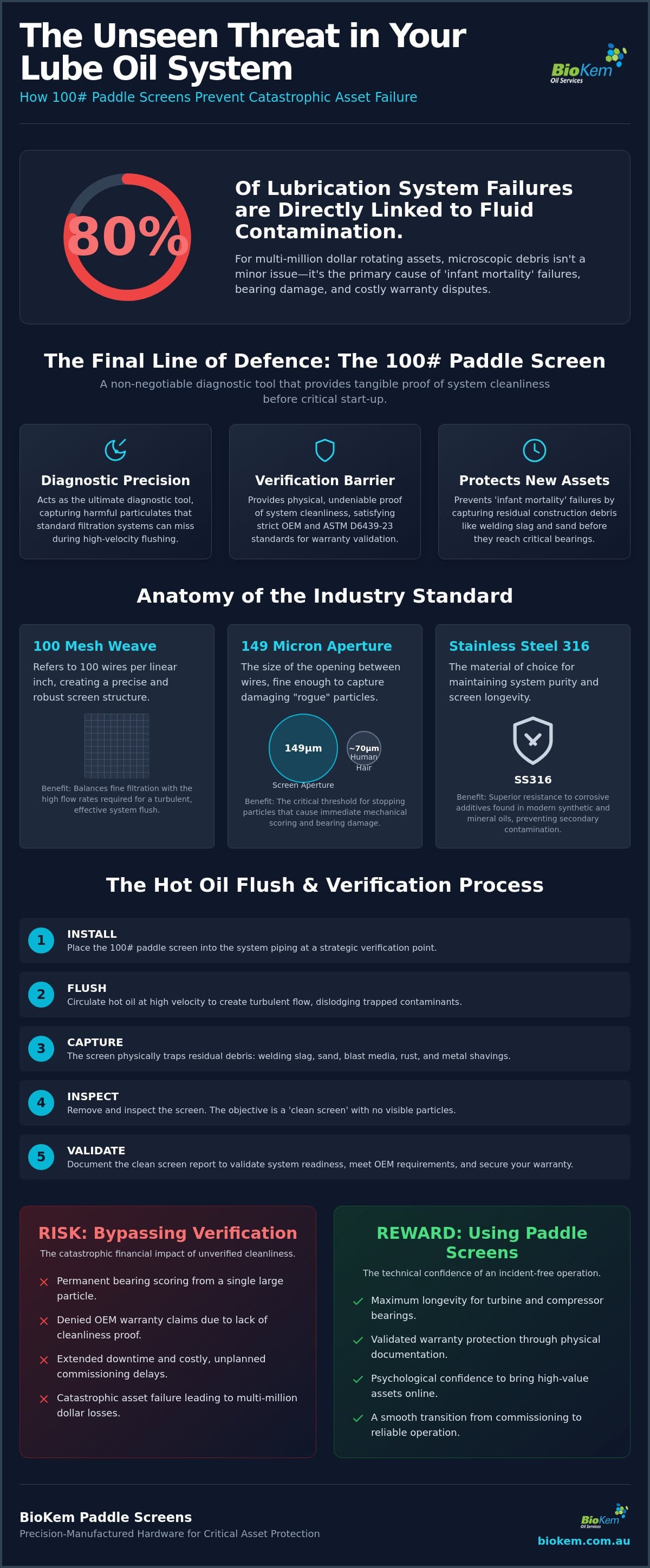
Did you know that approximately 80% of lubrication system failures are directly linked to fluid contamination? For engineers managing multi-million dollar rotating assets, this statistic represents the thin line between a successful start-up and a catastrophic bearing failure. This is exactly why BioKem’s range of 100# paddle screens should be an essential product for all lube oil system maintenance and commissioning of rotating assets. These screens act as the ultimate diagnostic tool, capturing the particulates that standard filtration might miss during the high-velocity turbulence of a hot oil flush.
You likely recognize that even a microscopic fragment can jeopardize a successful commissioning phase and lead to denied warranty claims. We understand the pressure of meeting strict OEM cleanliness standards while avoiding extended downtime. This article demonstrates why these 149 micron aperture screens are the non-negotiable final line of defence for protecting your equipment during critical system start-ups. We will examine how validating system cleanliness according to ASTM D6439-23 standards ensures maximum longevity for your turbine and compressor bearings, providing you with the technical confidence required for incident-free operation.
Key Takeaways
- Understand why the 149-micron aperture of a 100# mesh is the industry benchmark for balancing high-velocity flow with the capture of damaging particulate matter.
- Discover why BioKem’s range of 100# paddle screens should be an essential product for all lube oil system maintenance and commissioning of rotating assets to prevent permanent bearing scoring.
- Learn the precise steps for integrating verification screens into a Hot Oil Flushing programme to validate system cleanliness according to OEM and ASTM D6439-23 standards.
- Evaluate the risk-to-reward ratio of utilizing specialized hardware versus the catastrophic financial impact of bearing failure and denied warranty claims.
- Leverage BioKem’s national distribution network and technical expertise to ensure your rotating assets are protected by precision-manufactured hardware.
The Critical Role of 100# Paddle Screens in Lube Oil System Commissioning
A 100# paddle screen is a specialized verification tool designed to capture particulate matter during the high-velocity flushing of lubrication systems. Unlike standard filters that continuously clean the fluid, these screens act as a final diagnostic barrier. They utilize a precise physical separation process to trap any remaining debris before it reaches sensitive internal components. This is why BioKem’s range of 100# paddle screens should be an essential product for all lube oil system maintenance and commissioning of rotating assets. By providing a tangible record of system cleanliness, these screens bridge the gap between theoretical oil quality and operational safety.
To better understand how high-visibility lubrication and cleanliness protect components during critical phases, watch this helpful video:
The 100# designation refers to the mesh count per inch, which equates to an aperture size of approximately 149 microns. This specific dimension is the industry standard for protecting precision bearings in turbines and compressors. While primary filtration systems are designed to achieve specific ISO 4406 cleanliness codes, they don’t always account for localized debris within the piping network. Verification screening is the only way to ensure the entire system is free from damaging contaminants, which can often be mitigated at the source by utilizing specialized industrial linings from BIS Group.
Protecting High-Value Rotating Assets from ‘Infant Mortality’
New lubrication systems are often prone to ‘infant mortality’ failures caused by residual construction debris. Items like welding slag, sand, and blast media can evade standard filtration by hiding in pipe bends or dead legs until a high-velocity flush dislodges them. These particles are incredibly abrasive. Even a single millimeter of slag can score a bearing surface beyond repair during the first hours of operation. Using paddle flushing screens allows commissioning teams to identify these threats before they cause permanent damage. It’s a critical step in reaching the ‘Target Cleanliness’ required for a successful asset handover.
Final Verification of System Cleanliness Standards
Beyond mechanical protection, paddle screens provide physical proof of cleanliness to Original Equipment Manufacturers (OEMs) and insurers. Documentation often requires a ‘clean screen’ report before a warranty is validated. Transitioning from the flushing phase to the operational phase requires more than just a lab report; it requires visual confirmation. For commissioning teams, the sight of a clear screen provides the psychological confidence needed to bring a multi-million dollar asset online. It moves the project from a state of risk to a state of validated readiness.
Technical Specifications: Understanding the 100 Mesh (149 Micron) Standard
The term "100 mesh" refers to the number of wires per linear inch in the screen’s weave. This specific configuration creates a precise aperture size of 149 microns. In the context of industrial lubrication, this dimension serves as a critical threshold. It’s fine enough to capture the "rogue" particles that cause immediate mechanical damage but open enough to maintain the high flow rates required for turbulent flushing. This technical balance is a primary reason why BioKem’s range of 100# paddle screens should be an essential product for all lube oil system maintenance and commissioning of rotating assets.
Material choice is equally vital for maintaining system purity. BioKem utilizes Stainless Steel 316 for its screen range. This material provides superior resistance to the corrosive additives often found in modern synthetic and mineral oils. Unlike carbon steel alternatives, stainless steel won’t introduce secondary contamination through oxidation. This ensures the integrity of the international standard for system cleanliness is upheld throughout the commissioning process. The durability of the mesh ensures it won’t fray or shed wires under the stress of high-velocity oil flow.
The Science of Mesh Sizing and Particle Capture
Mesh count and micron ratings are inversely related. As the mesh count increases, the micron rating decreases. While some engineers consider 60# or 80# screens, these often allow particles large enough to bridge the oil film in precision bearings. Conversely, moving to a 200# screen can cause excessive pressure drops during high-velocity flushing, potentially triggering low-pressure trips. The 100# standard represents the "sweet spot" for turbine and compressor applications. It effectively traps the metallic shards and construction debris that ISO 4406 laboratory tests might overlook due to sampling locations.
Paddle Screen Design vs. Temporary Conical Strainers
The structural design of a verification tool is just as important as the mesh size itself. Many projects rely on temporary conical strainers, often called "witch’s hats." These are prone to collapsing or "telescoping" under the intense pressure of a 2-3x normal flow rate flush. Once a strainer fails, the captured debris is released directly into the bearing housing. BioKem’s paddle design features a robust handle and a flat, reinforced surface. This architecture allows for easy insertion and removal between pipe flanges without risking structural failure. If you’re preparing for a critical start-up, you can view the technical specifications of these paddle screens to ensure they meet your site requirements. The precision engineering behind these tools reflects a commitment to both operational efficiency and long-term asset health.
Risk Mitigation: The Financial Impact of Bypassing Proper Screening
The financial disparity between preventive hardware and reactive repair is staggering. A single 100# paddle screen is a minor investment compared to the replacement of a white-metal bearing or a damaged journal. In the context of large-scale power generation or mining operations, unscheduled downtime can cost hundreds of thousands of dollars per day in lost production. This economic reality explains why BioKem’s range of 100# paddle screens should be an essential product for all lube oil system maintenance and commissioning of rotating assets. Bypassing this step introduces a level of risk that insurers and asset owners simply cannot justify during critical project phases.
Preventing Bearing Scoring and Catastrophic Failure
Abrasive wear occurs when solid contaminants enter the narrow clearance between the bearing and the rotating shaft. Under high-speed operation, even microscopic particulates can gouge the soft babbitt material of the bearing. Bearing scoring is the primary threat during commissioning because it creates permanent surface damage that compromises the hydrodynamic oil film. Once a surface is scored, it often generates its own wear debris; this triggers a destructive chain reaction that leads to total component failure. Following established lube oil flushing best practices ensures that these "rogue" particles are physically removed from the circuit before they reach critical load zones.
Regulatory and Warranty Compliance for New Assets
Modern OEMs like GE, Siemens, and Rolls-Royce have rigorous cleanliness requirements for asset handover. Documentation proving that the system has passed a "clean screen" test is often a non-negotiable prerequisite for warranty activation. Without physical evidence from a 100# screen, an operator may be left liable for any early-life failures. Insurers increasingly mandate these verification steps to mitigate the risk of infant mortality in high-value machinery. This requirement is not just a bureaucratic hurdle; it is a technical necessity for long-term reliability.
Successful commissioning requires a holistic approach to fluid health. Beyond the physical capture of debris, maintaining the chemical integrity of the oil is paramount. You can learn more about Hot Oil Flushing & Filtering to understand how integrated services protect your investment. By prioritizing these verification tools, organizations ensure they meet regional regulatory standards while maximizing the operational lifespan of their core assets. It is a logical sequence: identify the challenge, deploy the technical mechanism, and secure the operational result. This structured flow mirrors the scientific processes required to keep industrial systems running at peak efficiency.
Integrating Paddle Screens into Your Hot Oil Flushing Programme
A successful Hot Oil Flushing (HOF) programme is defined by its methodology rather than just its equipment. Integrating BioKem’s range of 100# paddle screens into your workflow ensures that theoretical cleanliness targets are validated by physical evidence. This structured approach is why BioKem’s range of 100# paddle screens should be an essential product for all lube oil system maintenance and commissioning of rotating assets. To achieve the best results, the flushing process should follow a logical sequence that prioritizes asset safety and data accuracy.
- Step 1: Installation. Secure 100# paddle screens at the most critical bearing inlets. This placement ensures the screens capture any debris immediately before it can enter the bearing housing.
- Step 2: High-Velocity Flushing. Initiate the flush at 2-3x the normal operational flow rate. This increased velocity creates the turbulent flow necessary to dislodge particles from pipe walls and dead legs.
- Step 3: Periodic Inspection. Remove and clean the screens at set intervals to monitor the debris load. This provides real-time feedback on the effectiveness of the flush.
- Step 4: ‘Clean Screen’ Criteria. The system is considered ready only when a screen remains free of visible particulates after a sustained period of high-velocity flushing.
- Step 5: Documentation. Photograph and log every screen result. These records form a vital part of the final commissioning report for OEMs and insurers.
When to Install and Inspect Screens
Timing is everything when validating system cleanliness. Screens shouldn’t be installed during the initial "bulk" flush, as heavy construction debris can damage the fine 100# mesh. Instead, they should be introduced once primary filtration has stabilized the oil’s ISO code. Safety is paramount during inspection; always ensure the system is depressurized and locked out before removing screens from pipe flanges. For a deeper look at the entire flushing lifecycle, refer to The Ultimate Guide to Hot Oil Flushing.
Interpreting Debris Patterns for System Diagnostics
The material captured on a paddle screen serves as a forensic record of the upstream system. Identifying ‘rogue’ particles allows engineers to pinpoint specific failure points, such as failing seals or deteriorating pipe coatings. It’s important to distinguish between ‘new system’ debris, like welding beads, and active component wear, like metallic flakes. If you encounter complex particulates, utilizing Advanced Filter Ferrogram Analysis can provide a microscopic breakdown of the wear mechanisms at play. This diagnostic capability transforms a simple screen into a powerful maintenance tool. If you are ready to secure your assets, you can purchase precision-manufactured paddle flushing screens here to ensure your next commissioning project meets the highest industrial standards.
Why BioKem’s Paddle Screens are the Industry Benchmark in Australia
BioKem has established itself as the technical authority for lubrication services across Australia. This leadership is built on a foundation of precision and reliability. It’s exactly why BioKem’s range of 100# paddle screens should be an essential product for all lube oil system maintenance and commissioning of rotating assets. While generic alternatives might offer similar mesh counts, they often lack the structural integrity required for the extreme conditions of industrial flushing. BioKem’s solutions are engineered to withstand turbulent flow without bypass, ensuring that your multi-million dollar assets remain protected throughout their entire lifecycle.
Logistics play a vital role in industrial maintenance. BioKem maintains a robust national supply chain to facilitate the rapid dispatch of 100# screens for emergency maintenance or scheduled shutdowns. This availability prevents costly project delays and ensures that commissioning teams always have access to the correct hardware. Our role as the sole Australian distributor for Filters S.p.A. further reinforces our ability to provide high-specification components that meet global industrial standards.
Precision Engineering and Material Integrity
The effectiveness of a verification tool depends entirely on its construction. BioKem utilizes high-grade 316 stainless steel to ensure every screen maintains its aperture size under intense pressure. This material choice prevents oxidation and eliminates the risk of chemical interference with specialized lubricants. Beyond standard specifications, BioKem offers custom sizing options for non-standard pipework, ensuring a perfect fit between flanges. You can view our paddle flushing screens to see the variety of configurations available for specific industrial applications. This attention to detail ensures that no "rogue" particles bypass the screen during the final verification phase.
Comprehensive Support for Commissioning and Maintenance
Choosing BioKem means gaining access to a single-source provider for filtration, analysis, and hardware. We support national projects from the initial design phase through to final OEM certification. This holistic approach is a core part of our oil contamination control framework. Our experts provide specific advice on mesh selection for assets like the GE LM6000 or Bergen B36:45V20, ensuring your site meets every regulatory and technical requirement. This level of specialized support is what differentiates a standard supplier from a true technical partner.
Our commitment to Australian industrial excellence is reflected in the durability of our products and the depth of our technical expertise. By partnering with a localized expert, you secure the longevity of your rotating assets while maintaining the highest standards of environmental and operational responsibility. BioKem provides the quiet confidence required to manage complex industrial challenges through scientific precision and dependable service.
Securing Your Assets for Long-Term Operational Reliability
Protecting multi-million dollar rotating assets requires more than just high-quality oil; it requires the physical verification that only precision-engineered hardware can provide. By capturing rogue particulates before they reach critical load zones, 100# paddle screens mitigate the financial risks associated with bearing scoring and unscheduled downtime. These tools serve as the definitive final line of defence, ensuring your system meets the rigorous cleanliness standards demanded by modern OEMs. This technical necessity is Why BioKem’s range of 100# paddle screens should be an essential product for all lube oil system maintenance and commissioning of rotating assets.
As the sole Australian distributor for Filters S.p.A., BioKem offers proven results in GE and Siemens turbine commissioning. Our team provides expert technical support for national industrial projects, ensuring every flush is validated with scientific precision. Don’t leave your asset’s health to chance during the critical start-up phase. Secure your critical assets with BioKem’s precision 100# paddle screens and proceed with the quiet confidence of a fully validated system. We look forward to supporting your next successful commissioning project.
Frequently Asked Questions
What is a 100# paddle screen and how does it differ from a standard filter?
A 100# paddle screen is a temporary diagnostic tool designed for physical particle capture, whereas a standard filter is a permanent system component for continuous fluid polishing. Standard filters are often rated for microscopic efficiency to meet ISO codes, but paddle screens provide the visual evidence needed to confirm that larger, damaging particulates are no longer present in the circuit. They act as the final gatekeeper before an asset begins rotation.
Why is 100 mesh (149 microns) the required size for turbine commissioning?
This mesh size is the global benchmark because it aligns with the minimum oil film thickness and internal clearances of precision bearings. Capturing particles down to 149 microns prevents the initial scoring that leads to premature failure. This technical standard is Why BioKem’s range of 100# paddle screens should be an essential product for all lube oil system maintenance and commissioning of rotating assets.
Can I reuse 100# paddle screens after they have been cleaned?
Yes, these screens can be reused provided the mesh remains structurally intact and free from distortion. After each inspection, the screen must be cleaned with an approved solvent and inspected under magnification to ensure no wires are frayed or broken. If any deformation is detected, the screen should be replaced immediately to prevent bypass. Maintaining the integrity of the stainless steel weave is vital for accurate diagnostics.
How often should paddle screens be inspected during a hot oil flush?
Initial inspections typically occur every 1 to 4 hours depending on the initial system cleanliness and debris load. As the flushing process progresses and particle capture rates decrease, intervals can be extended to 12 or 24 hours. The goal is to achieve two consecutive "clean screen" results over a sustained period of high-velocity flow to meet most OEM handover requirements and warranty conditions.
What are the risks of using a lower mesh count (e.g., 60#) for rotating assets?
Using a 60# screen allows significantly larger particles, approximately 250 microns, to pass through the system. These larger contaminants can cause immediate abrasive wear on bearing journals and are often the primary cause of early-life failures in new assets. A 100# screen provides the finer resolution necessary to catch debris that a coarser mesh would simply overlook, ensuring the safety of precision surfaces.
Do paddle screens cause significant pressure drops in lube oil systems?
While any obstruction in the flow path creates resistance, 100# screens are engineered to balance particle capture with minimal pressure differential. During high-velocity flushing, it’s vital to monitor the pressure drop across the screen housing. If the differential increases rapidly, it indicates a high debris load, necessitating an immediate stop for cleaning. This monitoring prevents the risk of over-pressurizing the temporary flushing circuit.
Where can I buy 100# paddle screens for industrial systems in Australia?
You can source precision-manufactured 100# paddle screens directly from BioKem, the authorized Australian distributor for Filters S.p.A. We maintain a national stock to ensure rapid dispatch for both planned commissioning projects and emergency maintenance requirements. Our technical support team can also assist with selecting the correct dimensions and material specifications for your specific industrial pipework and flange configurations.
Are paddle screens required for both new installations and routine maintenance?
Yes, they are essential whenever the lubrication circuit has been opened, modified, or repaired. For new installations, they capture residual construction debris; for routine maintenance or major overhauls, they verify that no contaminants were introduced during the work. This versatility is another reason Why BioKem’s range of 100# paddle screens should be an essential product for all lube oil system maintenance and commissioning of rotating assets.