

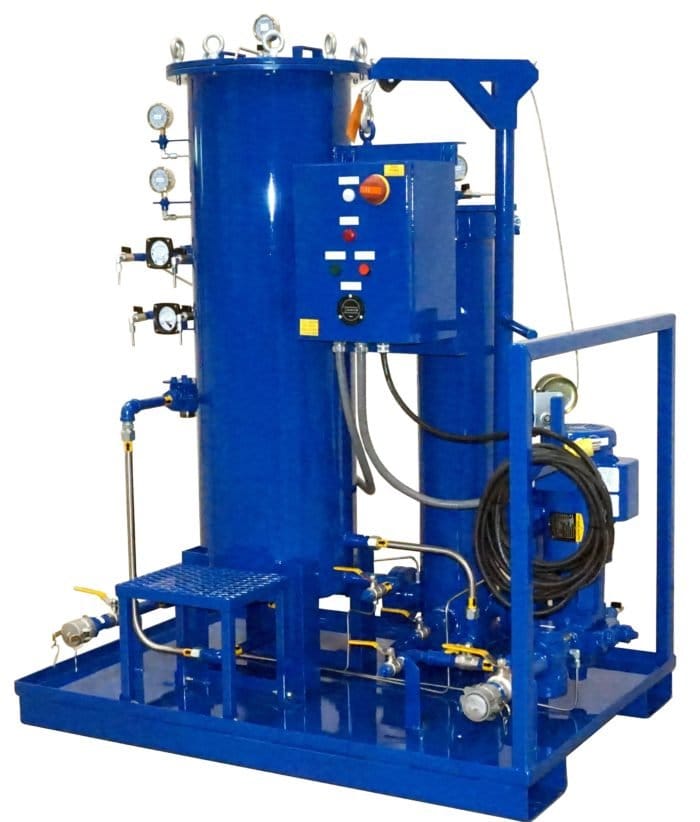
What if each treatment removes particles, but the system keeps putting them back? Repeated cleanliness failures can make it hard to tell whether contamination is genuine or the result of inconsistent sampling. If you’re asking, “Why Does My Turbine Oil Keep Failing ISO Cleanliness Targets?”, the answer may lie beyond the filter.
It’s frustrating to see another result miss the required target after corrective action. This guide explains how to separate sampling issues from real contamination, investigate likely sources such as particle ingress, water and wear debris, and choose a response based on oil analysis and the applicable client or OEM specification. You’ll also see how consistent sampling and trend monitoring can help distinguish a one-off result from a recurring problem. BioKem’s oil analysis, patch analysis, filtration and flushing capabilities support an evidence-led approach to turbine oil cleanliness across Australia.
Key Takeaways
- Why Does My Turbine Oil Keep Failing ISO Cleanliness Targets? Start by separating a sampling problem from contamination that is genuinely recurring in the system.
- Compare particle-count trends with sampling conditions and operating history before linking a change to equipment or treatment.
- Trace likely contamination pathways before selecting a corrective response, rather than relying on repeated treatment alone.
- Use oil analysis and the applicable client or OEM specification to guide whether filtration, flushing, dehydration or varnish mitigation is appropriate.
Why turbine oil keeps failing ISO cleanliness targets
A repeat ISO cleanliness failure means oil analysis continues to report a particle count outside the target that applies to the turbine system. That target should come from the relevant client or OEM specification, not from a general rule of thumb. A result that misses the requirement is a signal to investigate, but it doesn’t identify the source of contamination on its own.
What can a failed turbine oil cleanliness result tell you?
ISO 4406 codes describe solid-particle cleanliness. The three-number code represents particle counts at defined size thresholds: a result such as 18/16/13 is not a complete assessment of oil condition or equipment health. It doesn’t, by itself, establish whether particles came from external ingress, component wear, maintenance activity or sampling.
Interpret the result alongside the sample’s collection point, method and timing, as well as previous results. A change in sampling practice can affect comparisons; a consistent trend from comparable samples gives stronger evidence of a system change. Broader Turbine oil properties and contaminants also matter, since particle counts don’t report water or oil degradation. For example, varnish-related concerns call for evidence beyond the cleanliness code and may warrant investigation of varnish in lube oil.
So, Why Does My Turbine Oil Keep Failing ISO Cleanliness Targets? The code confirms that a measured particle-count target has been missed, but repeated failures require checking whether the samples are comparable and tracing what is introducing or generating particles. That distinction helps prevent a treatment from addressing the reading while leaving the underlying pathway unresolved.
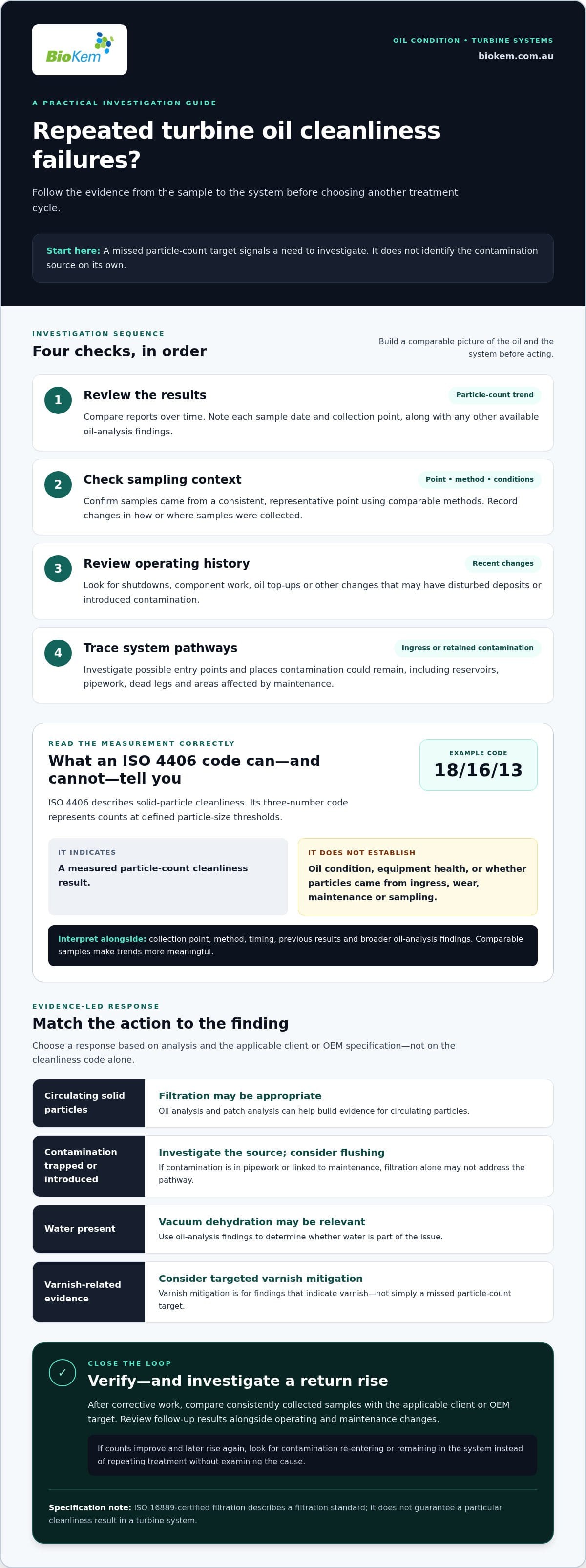
How to investigate repeated turbine oil cleanliness failures
Start with the evidence, not another treatment cycle. A disciplined investigation helps establish whether a reported change is real, when it began and where contamination may be entering or remaining in the lubrication system.
- Review the results. Compare particle-count reports over time, noting the sample date, sampling point and any other available oil-analysis findings.
- Check sampling context. Confirm whether samples were collected from a consistent, representative point using comparable methods. Record any changes in collection conditions that could affect comparisons.
- Review operating and maintenance history. Look for recent shutdowns, component work, oil top-ups or other changes that may have disturbed deposits or introduced contamination.
- Trace system pathways. Investigate possible ingress points and locations where contamination could remain, including reservoirs, pipework, dead legs or areas affected by maintenance.
In short, review results, verify sampling conditions, check operating history, then investigate system pathways.
Separate sampling uncertainty from a recurring contamination source
Consistent, representative sampling makes trends more meaningful. A sample taken from a different point or under different conditions may not be directly comparable with earlier results, so record how and where each sample was collected before attributing a shift to equipment or treatment. If comparable samples continue to show elevated counts, investigate for a persistent source or contamination retained in the system. Oil analysis and patch analysis can help build that evidence; lubrication oil filtration is one option to consider when findings point to circulating particles.
Still asking, “Why Does My Turbine Oil Keep Failing ISO Cleanliness Targets?” BioKem can help interpret oil-analysis findings and assess filtration options against system requirements. Discuss your turbine oil cleanliness issue with the team.
Choose a corrective response that addresses the turbine oil failure
Treatment should follow the evidence. If analysis identifies circulating solid particles, filtration may be appropriate; if contamination is trapped in pipework or introduced during maintenance, filtration alone may not address the source, and flushing may be considered. Where water is present, vacuum dehydration may be relevant. Consider varnish mitigation only when analysis or other findings indicate varnish-related issues, not simply because a particle-count target was missed.
Set treatment goals against the applicable client or OEM specification. The required cleanliness target and the system’s condition should guide the method and the verification plan. ISO 16889-certified filtration describes a filtration standard, but it doesn’t guarantee a particular cleanliness result in a turbine system. The outcome still depends on factors such as contamination pathways, operating conditions and how the oil is sampled.
Verify the result and prevent the same failure from returning
After corrective work, use oil analysis to assess whether the result meets the applicable target. Compare samples collected under consistent conditions, and review follow-up results alongside operating and maintenance changes. If particle counts improve but later rise again, investigate whether contamination is re-entering or remains within the system instead of repeating treatment without examining the cause.
Where findings point to deposits or varnish, varnish mitigation may form part of a targeted response. For a recurring cleanliness failure, the practical question is, “Why Does My Turbine Oil Keep Failing ISO Cleanliness Targets?” Answering it means linking analysis to the system issue, selecting a proportionate corrective action and checking the result against the specification. Discuss your turbine oil cleanliness challenge with BioKem’s team to consider evidence-led options for your system.
Make the next cleanliness decision evidence-led
Use the next sampling and maintenance cycle to build a clearer picture of how the turbine system responds. A documented baseline, consistent follow-up sampling and records of maintenance or oil treatment can help your team make better-informed decisions over time.
If you’re still asking, “Why Does My Turbine Oil Keep Failing ISO Cleanliness Targets?”, BioKem can support the investigation with onsite and lab-based patch analysis, alongside oil analysis and filtration options selected for the system’s needs. BioKem provides Australia-wide service coverage and ISO 16889-certified filtration, without treating certification as a guarantee of a particular cleanliness result.
Take the next step with a plan grounded in your oil data and system requirements. Plan an evidence-led discussion with BioKem about your turbine oil cleanliness challenge. With a clearer diagnostic path, you can move towards more informed maintenance decisions.
Frequently Asked Questions
Can turbine oil meet its viscosity requirements and still fail an ISO cleanliness target?
Yes. Viscosity and particle cleanliness are separate properties, so oil can fall within its specified viscosity range while its particle count exceeds the system’s cleanliness target. For example, a viscosity result within specification doesn’t rule out contamination from particles. Review both measurements alongside the applicable requirements; a viscosity result alone can’t establish whether the oil is clean enough for the turbine.
Does new turbine oil automatically meet the system’s ISO cleanliness target?
No. New oil isn’t necessarily clean enough for a turbine system’s specified target. Oil supplied in drums can contain particles above the required cleanliness level, so storage and transfer practices matter too. Check the oil analysis against the system requirement before adding it, and consider pre-filtration if the results show it’s needed. Don’t assume “new” means ready for sensitive equipment.
How often should turbine oil cleanliness be tested?
There isn’t one testing interval that suits every turbine. Follow the applicable client or OEM maintenance requirements, and consider the asset’s operating conditions, oil-analysis history and recent maintenance when planning sampling. A shutdown, system intervention or unexplained change in operating condition may justify additional analysis. Keep a consistent schedule and sampling method so results can be compared meaningfully over time.
What information should I provide when asking for help with a failed oil cleanliness result?
To investigate “Why Does My Turbine Oil Keep Failing ISO Cleanliness Targets?”, share the latest and previous analysis reports, the required target, oil type and sample dates. Include where and how samples were collected, recent top-ups or maintenance, operating changes, and any treatment already performed. Note other findings, such as water content or wear debris, so the assessment has useful context beyond the particle count.

Article by
James McAllister
James McAllister is an industry professional with BioKem Oil Services, specialising in lubrication reliability, oil filtration, contamination control and asset performance. Drawing on BioKem's extensive field experience across turbines, compressors, hydraulic systems and critical rotating equipment, James writes practical, insight-driven articles that help maintenance and reliability teams improve equipment performance, extend asset life and reduce operational risk.