

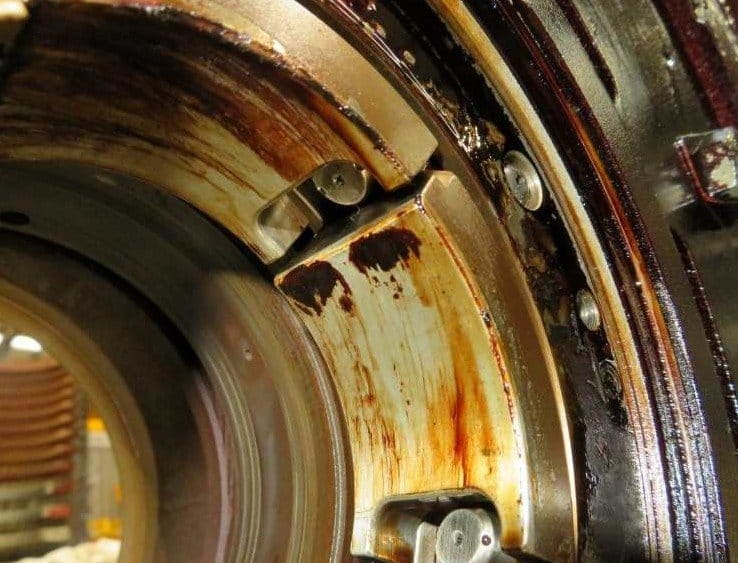
What if the gearbox repair is only the first line on the failure invoice? The financial impact of catastrophic gearbox failure can extend well beyond repair or replacement. Lost production, idle labour, urgent freight and disrupted delivery commitments may all add to the total exposure.
The challenge is estimating what an outage means for your specific operation. Costs depend on the gearbox’s role, recovery requirements, production constraints and customer or contractual obligations. A single industry-wide figure cannot capture those variables.
This article explains how to identify direct, indirect and consequential costs, then build a practical estimate using inputs your operations and finance teams can verify. It also compares reactive recovery with reliability measures, so you can assess prevention against a credible failure scenario rather than an assumed average.
You’ll learn how to account for downtime and recovery, which site-specific figures to gather, and when lubrication-system cleanliness measures such as filtration, vacuum dehydration or varnish removal may be relevant. These measures form part of a broader reliability assessment, not a guarantee against failure. The aim is to give your team a clearer basis for decisions about gearbox risk, maintenance and operational resilience.
Key Takeaways
- Define the failure scenario around the gearbox’s duty, configuration and operating context before estimating exposure.
- Look beyond the repair bill. Use site records to assess downtime, labour, recovery and delivery consequences.
- Compare reactive recovery, planned inspection and condition monitoring by the evidence each requires, its potential value and its limitations.
- Build a site-specific estimate from verified inputs, document uncertainty and use a clear formula rather than relying on a generic cost figure.
- Consider whether lubrication-system findings warrant measures such as oil analysis, filtration, vacuum dehydration or hot oil flushing as part of a broader reliability assessment.
What does catastrophic gearbox failure mean for an industrial asset?
Catastrophic gearbox failure is a severe loss of function that prevents the unit from safely transmitting power or meeting its operating requirements, often requiring major repair or replacement. It differs from routine wear or a repairable defect that can be managed without taking the driven process out of service. The financial impact of catastrophic gearbox failure includes both the direct cost of restoring the gearbox and the wider business consequences of lost or disrupted operation.
The failure scenario depends on the gearbox’s design, configuration, duty and operating environment. Gearboxes, gear trains and pinion drivers can serve different roles, so damage to one unit may affect a single machine or constrain a larger process. To see how lubricant loss can contribute to damage, watch this video:
Which failure scenarios can stop a gearbox-driven operation?
Gear damage can involve wear, scuffing, pitting or fatigue, among other mechanisms. The sources of gear failure provide a technical overview, but a specific mechanism should not be assumed without inspection. Severe internal damage may prevent the gearbox from transmitting power as required. A less extensive defect may still allow controlled operation or repair, subject to competent assessment.
Separate confirmed findings from suspected causes. An inspection may document damaged teeth, abnormal debris or lubricant condition, but those observations do not automatically establish what initiated the failure. Record potential consequences separately, such as stopping a driven asset, reducing process capacity or affecting connected equipment. BioKem Oil Services’ listed applications include gearboxes, gear trains and pinion drivers of all configurations, as well as lubrication systems where oil must meet a client or OEM specification.
Why is the financial impact different at every site?
A gearbox’s role in the process shapes the exposure. Redundancy or an available alternative may limit disruption, while a single critical asset can constrain production until repair or recovery is complete. Operating schedules, spare-part availability, access requirements, restart procedures and the ability to reschedule work also influence the scenario.
Build the assessment from asset-owner records, not a universal failure-cost estimate. Confirm the gearbox type and duty, its production role, available redundancy, repair or replacement scope, labour and recovery requirements, and the operational effect of an outage. Separate documented inputs from assumptions that need validation. This is a calculation framework, not a gearbox appraisal or quotation; actual repair scope and site costs must be confirmed for the asset.
Which direct and hidden costs shape the financial impact of gearbox failure?
A repair estimate captures only part of the financial impact of catastrophic gearbox failure. The full exposure combines verified recovery costs with site-specific operational impacts. Support each cost with evidence and check that it does not overlap with another category.
Start by separating the cost categories. This makes it easier to see what the repair scope covers and which business effects need their own assessment.
- Inspection and diagnosis: Record the inspection, testing and engineering assessment needed to establish the damage and recovery scope.
- Repair or replacement: Document the proposed work, parts, replacement-unit requirements and any connected equipment or lubrication-system assessment the engineering team considers necessary.
- Labour and logistics: Include specialist labour, transport of parts or equipment, and site-specific access or handling requirements.
- Testing and recommissioning: Confirm the required testing, restart and return-to-service activities, and identify who estimated them.
- Operational impacts: Assess delayed output or service, rescheduling, lost capacity and contractual exposure where applicable.
What belongs in the direct gearbox recovery estimate?
For every input, record its source, date, assumptions and exclusions. Separate uncertain scope from confirmed findings. This prevents provisional estimates from being treated as committed costs and makes later revisions traceable.
How should downtime and knock-on impacts be assessed?
Build the outage estimate from the operating plan and recovery sequence. Consider when the asset can be isolated, what must happen before restart, and whether production or service can be rescheduled or transferred elsewhere. Confirm the sequence and timing with the people responsible for the asset and its recovery instead of applying a standard outage duration.
Use finance-approved methods and site records to value delayed output or service. Distinguish measured impacts from potential risks, such as late delivery, contractual consequences or loss of customer confidence. Include a consequential cost only when the organisation can document the impact and reasonably attribute it to the failure. Avoid counting the same lost production in multiple categories.
Premature failure can also warrant investigation beyond the immediate repair. In the specific context of wind turbines, the U.S. Department of Energy discusses research into gearbox bearing issues and why units often do not reach their expected 20-year lifetime. This is not a universal lifespan benchmark for industrial gearboxes. It illustrates why failure evidence and asset context matter.
If findings point to lubrication-system cleanliness as a relevant factor, an asset owner may wish to discuss applicable oil services with BioKem. Contact BioKem about lubrication support as part of a broader, evidence-led reliability assessment.
How should you compare reactive recovery with reliability measures?
Preventive work has a cost, and its value depends on the gearbox’s role, failure exposure, inspection findings and the practicality of intervention. The aim is not to assume maintenance will prevent every failure or guarantee savings. Compare credible options using evidence from the asset and the site.
Reactive repair restores function after a fault. Planned inspection looks for developing issues at scheduled intervals, while condition monitoring uses repeated or targeted measurements to inform whether follow-up may be warranted. Each approach has different purposes, evidence needs and limitations:
| Approach | Decision factors and evidence | Potential benefit | Limitations |
|---|---|---|---|
| Reactive recovery | Failure symptoms, inspection results, repair scope, parts and recovery plan. | Directs resources to a confirmed fault and its required repair. | Unplanned outage and damage scope may be uncertain until inspection is complete. |
| Planned inspection | Operating history, inspection records, access requirements and relevant OEM guidance. | Creates scheduled opportunities to assess condition and plan work. | Findings reflect the inspection scope and timing; some defects may not be apparent. |
| Condition monitoring | Trended measurements, lubricant condition, operating context and follow-up inspection. | Can help identify changes that warrant investigation or maintenance planning. | A single indicator is not a complete diagnosis, and monitoring does not eliminate failure risk. |
What evidence supports a maintenance decision?
Bring together operating history, inspection findings, lubricant condition and relevant OEM requirements. Look for changes over time and interpret them in the context of load, operating conditions and previous maintenance. A condition-monitoring result should guide follow-up, not stand alone as proof of a particular fault. Where debris findings are relevant, oil filter debris analysis is one related diagnostic reference.
When might a lubrication-system intervention be relevant?
Filtration, flushing or varnish removal addresses defined fluid or system conditions, not every mechanical gearbox fault. First establish whether findings indicate contamination, moisture, varnish or a need to meet a client or OEM cleanliness requirement. Then match the proposed work to the confirmed condition and scope. BioKem’s hot oil flushing and filtration capabilities may be relevant where system work is indicated.
Compare each option with the site-specific exposure established earlier, including likely recovery needs, operating constraints and the consequences of an outage. The financial impact of catastrophic gearbox failure can help frame that comparison, but the result depends on verified site inputs. Discuss uncertainty openly, and do not treat any maintenance measure as a guarantee against failure or a promise of savings.
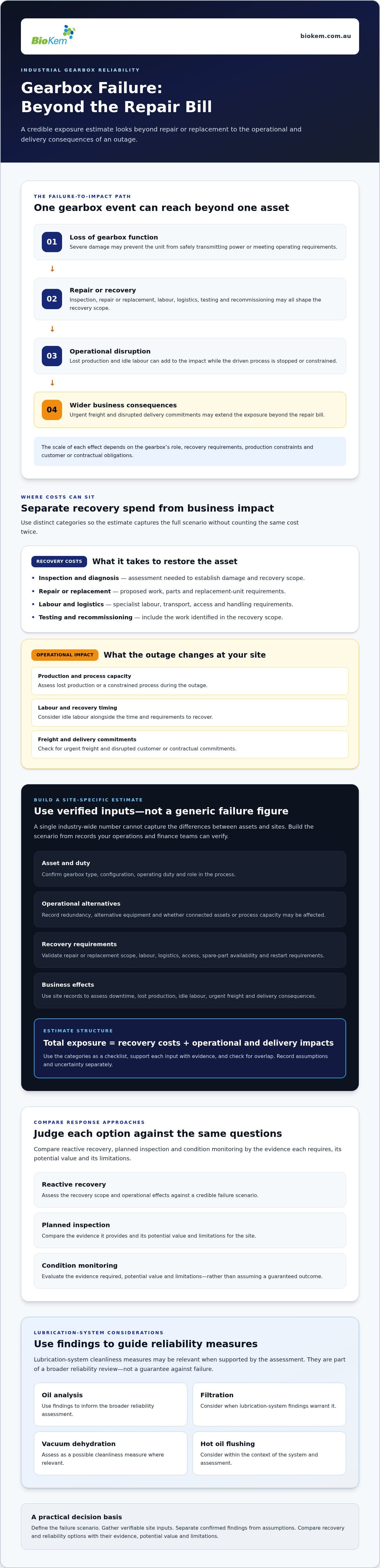
How can you estimate gearbox failure exposure and prepare a response?
A useful estimate turns a possible failure into a defined scenario, a set of traceable inputs and a response plan. It should make assumptions visible and use evidence specific to the site.
Use this workflow to develop an estimate that maintenance, operations and finance can review:
- Define the scenario. Identify the gearbox, its operating duty and the failure or damage scenario being assessed. State what is included and what is outside scope.
- Confirm recovery scope. Ask engineering to identify likely inspection, repair or replacement work, including any connected equipment that may need assessment.
- Quantify verified inputs. Gather repair or replacement estimates, labour, parts, transport, testing and recovery costs. Estimate downtime using the site’s operating plan and a finance-approved method for valuing production or service impacts.
- Document uncertainty. Mark confirmed figures, provisional estimates and unknowns separately. Assign an owner and verification date to each unresolved input.
- Review options. Compare the exposure with feasible response and reliability measures, including operational contingencies and any planned shutdown opportunities.
A simple calculation is: Estimated exposure = verified direct recovery costs + finance-approved downtime impact + documented consequential costs. Keep each component distinct and check for overlap, such as counting the same lost output under both downtime and a contractual impact. Use Australian dollars for site cost inputs and retain the source and basis for each figure.
What information should a gearbox failure assessment collect?
Record the asset configuration, duty, criticality, redundancy and applicable client or OEM requirements. Gather maintenance history, inspection findings, lubricant information, recovery estimates and the assumptions used to value production or service disruption. List information gaps, such as an unconfirmed repair scope or unverified parts availability, and assign each to a responsible person before approving the estimate.
Involve maintenance and engineering in assessing condition and scope; operations in production priorities and contingencies; procurement in parts and supplier inputs; finance in cost assumptions; and safety representatives in applicable site controls and approvals. One accountable coordinator should consolidate revisions so decision-makers work from the same estimate.
How can teams plan recovery without assuming a standard timeline?
Map the dependencies: diagnosis, repair or replacement, parts, access, safe work planning, testing and return to service. Confirm which tasks can run in parallel and which depend on earlier findings. Set contingencies and escalation responsibilities under the site’s established procedures rather than assigning a generic outage duration.
If the asset schedule makes planned shutdown or commissioning support relevant, include that option in the scope review. BioKem provides Hot Oil Flushing for commissioning and shutdown applications. To discuss whether this may fit a defined gearbox or lubrication-system scope, contact BioKem about your requirements.
How can BioKem support gearbox lubrication-system reliability in Australia?
After defining the failure scenario and estimating site exposure, consider whether the evidence points to a lubrication-system issue that could be addressed within a broader reliability plan. BioKem’s listed applications include gearboxes, gear trains and pinion drivers of all configurations, as well as lubrication systems where oil must meet a client or OEM specification.
Depending on the findings and agreed scope, relevant capabilities include Condition Monitoring, Hot Oil Flushing, Vacuum Dehydration (VDOPS), and Fuel & Oil Filtration and coalescing. These services may support lubrication-system cleanliness or condition where appropriate. They do not address every mechanical fault, and they cannot guarantee that a gearbox will not fail or deliver a particular financial saving.
Which BioKem capabilities may fit a gearbox-related scope?
BioKem lists Hot Oil Flushing for commissioning, shutdown and breakdown applications. Where inspection findings support system work, the proposed scope should identify the target condition, applicable client or OEM requirements and how results will be assessed. Learn more about hot oil flushing and filtration.
Condition Monitoring and onsite or lab-based patch analysis can contribute evidence to an assessment, but results need to be interpreted alongside operating context and other findings. Vacuum Dehydration or Fuel & Oil Filtration and coalescing may be considered where the confirmed fluid condition and system requirements make them relevant.
BioKem provides Australia-wide service coverage, tailored turnkey solutions and rapid national mobilisation. The appropriate work still depends on asset access, operating constraints, available evidence and the scope agreed with the asset owner.
What should you include in an initial technical discussion?
Bring information that helps establish the gearbox and lubrication-system context:
- Gearbox configuration, duty and operating conditions.
- Known symptoms, inspection findings and relevant maintenance history.
- Available oil-analysis or patch-analysis information.
- Client or OEM specifications and the required outcome.
- Site access constraints, operating schedule and any shutdown or commissioning window.
This information can help determine whether a lubrication-focused scope is relevant to the financial impact of catastrophic gearbox failure being assessed, or whether further mechanical investigation is needed first. BioKem’s services should form part of an evidence-led response, not a substitute for gearbox diagnosis.
Discuss your gearbox lubrication-system requirements with BioKem using the available findings and scope.
Turn gearbox risk into a practical reliability plan
The financial impact of catastrophic gearbox failure depends on more than the repair scope. A useful assessment accounts for verified recovery costs, site-specific downtime and documented operational consequences. It also makes uncertainty visible, helping teams compare reactive recovery with maintenance measures based on actual findings rather than assumed savings.
Where evidence points to lubrication-system concerns, oil condition and cleanliness can inform a broader reliability assessment. They do not guarantee that a gearbox will avoid failure, but they can help teams determine whether a scoped intervention is relevant. BioKem supports industrial assets Australia-wide, with rapid national mobilisation, onsite and lab-based patch analysis, and over 70 years of combined industry experience among staff. BioKem reports Zero Lost Time Injuries (LTI) since establishment in 2012.
Bring together the asset details, inspection or oil-analysis information, operating requirements and known constraints before deciding on next steps. To discuss a suitable scope, contact BioKem about your gearbox lubrication-system requirements. An evidence-led plan gives your team a clearer basis for reliability decisions.
Frequently Asked Questions
What is the financial impact of catastrophic gearbox failure?
The financial impact can include gearbox inspection, repair or replacement, labour, parts, transport, testing and recommissioning, as well as operational effects. If the failure stops a critical process, delayed output, rescheduling or contractual exposure may also matter. The total depends on the asset’s role, available redundancy, recovery scope and site operating conditions. Estimate it from verified records and finance-approved methods rather than relying on a universal cost figure.
What costs should be included in a gearbox failure assessment?
Include inspection and diagnosis, repair or replacement scope, parts, specialist labour, transport, testing and return-to-service work. Then assess downtime effects, such as delayed production or service, rescheduling and documented contractual impacts where applicable. Ask engineering whether connected equipment or the lubrication system needs assessment. Record the source, assumptions, exclusions and uncertainty for each input, and check that the same operational loss is not counted in multiple categories.
Can gearbox failure cause production downtime?
Yes. If a gearbox can no longer transmit power as required and no suitable alternative is available, the driven asset or process may need to stop or operate at reduced capacity. The operational effect depends on the gearbox’s function, redundancy, production schedule and recovery requirements. A failure does not always stop an entire site, so assess which processes depend on the asset and whether output can be transferred or rescheduled.
How do you calculate the cost of gearbox downtime?
Use the site’s recovery plan to estimate the outage period, then apply a finance-approved method for valuing the affected production or service. A practical structure is: downtime impact = verified outage duration × approved impact rate, adjusted for recoverable or rescheduled output. Confirm both inputs with the relevant teams. Add documented consequential impacts separately and avoid counting the same lost output twice. Do not assume a standard outage duration or generic daily loss.
Can oil analysis predict catastrophic gearbox failure?
Oil analysis can provide evidence about lubricant condition and may identify changes that warrant investigation, but it cannot predict every catastrophic failure or diagnose a gearbox on its own. Interpret results alongside operating history, inspection findings, equipment condition and applicable client or OEM requirements. Trends and follow-up checks are more informative than treating one result as a complete diagnosis. Use oil analysis as one input to a broader reliability assessment, not a guarantee against failure.
Is preventive maintenance always cheaper than repairing a failed gearbox?
No. Preventive work has a cost, and its value depends on the asset’s criticality, failure exposure, available evidence and operational constraints. Compare the proposed maintenance scope with a credible failure scenario, including verified recovery costs and site-specific downtime impacts. Inspection or condition monitoring may help guide decisions, but neither eliminates risk. Document assumptions and limitations, then determine whether the proposed work is proportionate to the exposure.
When should a gearbox lubrication system be assessed after a failure?
Assess it as part of the failure investigation and recovery scope when inspection findings, lubricant condition or operating history make it relevant. Coordinate the timing with the engineering team and site procedures, particularly before deciding what system work is needed and how the asset will return to service. Oil analysis, condition monitoring or patch analysis may contribute evidence. Any filtration, flushing or dehydration scope should match confirmed findings and client or OEM requirements.

Article by
James McAllister
James McAllister is an industry professional with BioKem Oil Services, specialising in lubrication reliability, oil filtration, contamination control and asset performance. Drawing on BioKem's extensive field experience across turbines, compressors, hydraulic systems and critical rotating equipment, James writes practical, insight-driven articles that help maintenance and reliability teams improve equipment performance, extend asset life and reduce operational risk.