

What if the lubricant you currently treat as a consumable waste product is actually a permanent asset waiting to be reclaimed? Transitioning to a strategic lube oil solution is no longer just about lubrication. It’s about shifting from the expensive cycle of reactive replacement to a model of continuous reliability. You’re likely familiar with the frustration of unscheduled downtime caused by valve sticking or the mounting costs of frequent oil changes and disposal fees. Meeting stringent ISO cleanliness standards often feels like a moving target, especially with 2026 regulatory shifts like the updated EU CLP labeling requirements and the global push toward fluorine-free, PFAS-compliant formulations.
This guide will show you how to transition to a proactive lube oil solution that extends equipment life, reduces your environmental footprint, and ensures zero unexpected failures. We’ll explore how precision analysis, varnish mitigation, and advanced filtration technologies like those from Filters S.p.A. create a predictable maintenance schedule. By integrating these scientific mechanisms, you can protect both your high-spec machinery and your long-term ecological health.
Key Takeaways
- Understand why modern high-precision machinery requires a holistic lube oil solution that integrates precision analysis, filtration, and purification instead of simple oil changes.
- Learn the technical distinctions between basic inline filtration and advanced purification methods like varnish mitigation to prevent critical valve sticking and bearing failure.
- Discover a strategic framework for choosing between professional onsite services, such as Hot Oil Flushing, and equipment hire based on your facility’s internal capabilities.
- Identify how to utilize laboratory-grade oil analysis and onsite patch test kits to move from reactive maintenance to a proactive, data-driven reliability model.
- Explore the environmental and operational advantages of advanced fluid management that prioritizes oil reclamation and reuse over disposal and replacement.
What is a Comprehensive Lube Oil Solution?
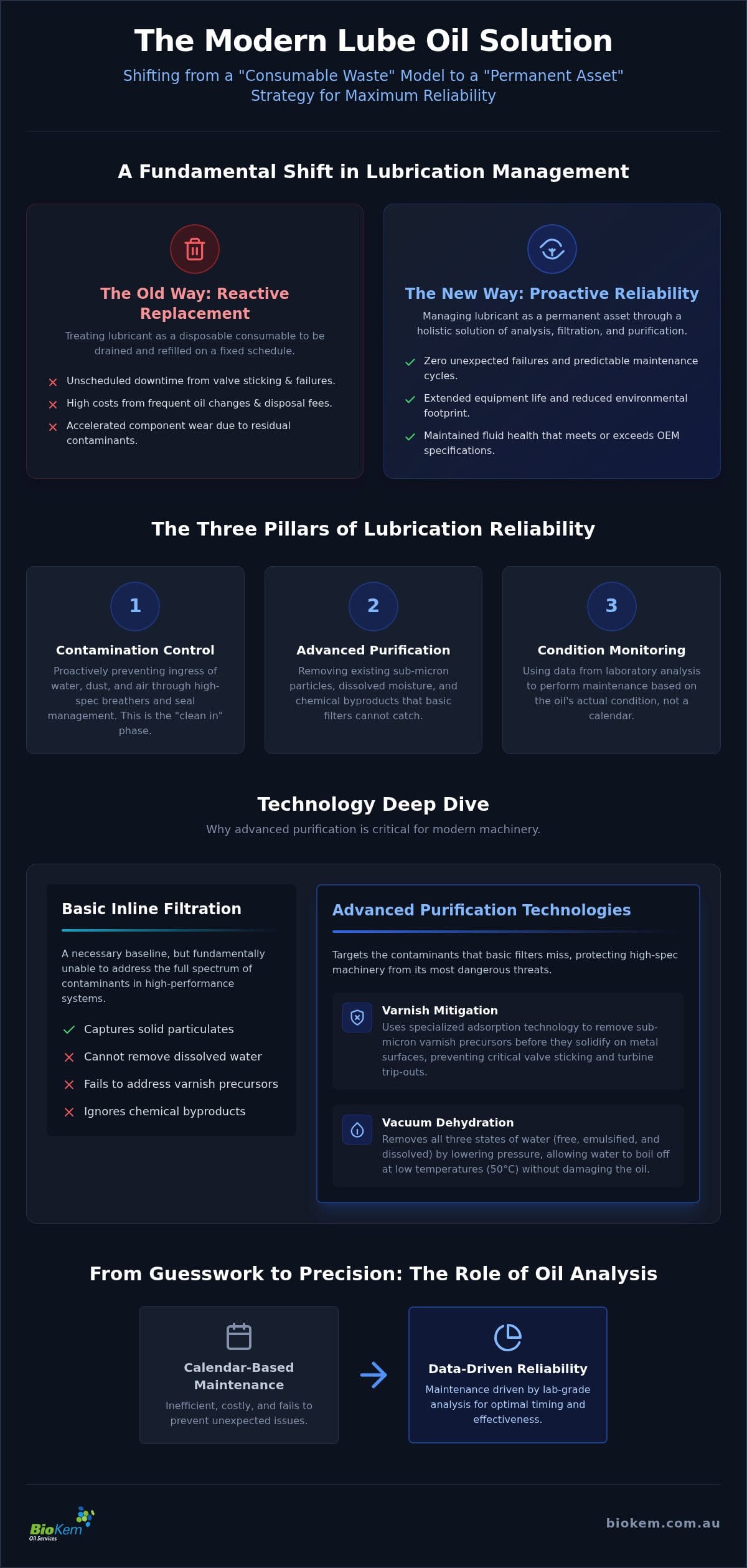
A comprehensive lube oil solution isn’t a single product or a scheduled service call. It’s a holistic methodology that synchronizes oil analysis, high-performance filtration, and advanced purification to maintain lubricant health indefinitely. Traditionally, industrial operators treated oil as a consumable waste product to be replaced periodically. This reactive “drain and fill” approach is no longer viable for modern, high-precision machinery. Today’s turbines, compressors, and hydraulic systems operate under tighter tolerances and higher pressures, making them hypersensitive to even microscopic contamination.
Relying solely on oil changes leaves behind a significant percentage of contaminants trapped in the system’s dead zones and internal surfaces. A true lube oil solution integrates specialized hardware, such as Filters S.p.A. technology, with deep technical expertise to ensure the fluid remains within OEM specifications. This represents a fundamental shift toward a proactive maintenance strategy that prioritizes asset uptime over lubricant disposal.
The Three Pillars of Lubrication Reliability
- Contamination Control: This focuses on the “clean in” phase. It involves preventing the ingress of water, ambient dust, and air through high-spec breathers and seal integrity management.
- Purification: Standard filters often miss sub-micron particles or dissolved moisture. Purification uses technologies like vacuum dehydration and varnish mitigation to remove existing contaminants that basic inline filters cannot catch.
- Condition Monitoring: Data drives the process. Instead of following a calendar, maintenance is performed based on the actual chemical and physical state of the oil, using laboratory-grade analysis to identify trends before they become failures.
The True Cost of Poor Lubrication Management
The price of a barrel of oil is only a fraction of the total cost of poor lubrication. Unscheduled downtime in a critical turbine or compressor can result in lost production costs that dwarf the annual maintenance budget. Beyond downtime, businesses must account for the environmental impact and the rising disposal fees for contaminated fluids. Poor oil health accelerates component wear, leading to premature bearing failure and valve sticking. By purifying oil rather than replacing it, you reduce your environmental footprint while ensuring predictable maintenance cycles and zero unexpected failures.
Advanced Technologies: Purification vs. Basic Filtration
Standard inline filters are designed to capture solid particulates of a specific micron size. While they’re a necessary baseline, they represent only one component of a total lube oil solution. They’re fundamentally unable to address dissolved water or the chemical byproducts of oil oxidation. For high-spec industrial needs, relying on basic filtration is a reactive gamble that often leads to internal component damage. High-performance Filters S.p.A. products provide a significantly more reliable barrier than generic alternatives, yet even these require complementary purification technologies to manage the fluid’s chemical integrity.
Varnish Mitigation: The Silent Killer of Turbines
Varnish is a thin, insoluble film that results from the chemical degradation and oxidation of the lubricant. As oil ages or undergoes thermal stress, it loses its ability to hold these degradation products in solution. These sub-micron particles then plate out on cooler metal surfaces, such as servo valves and bearings. In power generation, this is the primary cause of valve sticking and sudden unit trip-outs. BioKem’s approach to Varnish Mitigation utilizes specialized adsorption technology to remove these precursors before they can solidify. This ensures smooth mechanical operation and prevents the costly downtime associated with varnish-related failures.
Vacuum Dehydration for Water Contamination
If you’re noticing signs of cloudiness or inconsistent valve performance, utilizing onsite patch test kits can help determine if your current filtration is leaving your assets vulnerable.
Onsite Services vs. Equipment Hire: A Decision Framework
Determining whether to deploy a full technical team or manage filtration internally is a critical step in your lube oil solution. Complex contamination events, system startups, or recovering from a major component failure usually demand the precision and specialized hardware of onsite specialists. Conversely, routine maintenance or minor moisture ingress might be effectively managed through strategic equipment hire. The decision framework rests on your team’s technical capacity, the risk profile of the industrial asset, and the specific cleanliness targets required by ISO standards. Choosing the wrong path can lead to incomplete purification and recurring mechanical issues.
The Hot Oil Flushing Process
For new system commissioning or major overhauls, Hot Oil Flushing is the industry standard for ensuring long-term reliability. This process involves achieving a high-velocity turbulent flow, specifically targeting a Reynolds number above 4,000 to dislodge internal debris that standard laminar flow cannot move. To verify the results, technicians use paddle flushing screens that capture and display any remaining particulates. This method is non-negotiable for hydraulic and EHC systems where even microscopic silt can lead to catastrophic component failure. It ensures that the system is chemically and physically clean before the first hour of operation.
Selecting the Right Hire Equipment
If your facility has the internal expertise to monitor and operate specialized machinery, industrial oil filtration equipment hire offers a cost-effective path for routine lubricant polishing and preventative care. You must choose hardware based on the specific contaminant profile identified during oil analysis. Filter carts are ideal for particulate removal, while vacuum dehydration units are required for persistent moisture issues. Varnish removal systems target the chemical precursors of sludge before they solidify on metal surfaces. BioKem facilitates this by providing high-performance Filters S.p.A. Australia hardware for short or long-term deployment. However, hiring specialized machinery requires technical support and training to ensure the equipment is configured correctly for your specific lube oil solution. National availability of BioKem technicians ensures that even for hire projects, expert guidance is available to anchor global scientific standards in a dependable, localized context.
Data-Driven Decisions: The Role of Oil Analysis
Oil analysis is the diagnostic foundation of a comprehensive lube oil solution. It functions as a high-precision blood test for your industrial machinery, revealing internal health issues before they manifest as mechanical failures. Without regular sampling and interpretation, any filtration effort is merely guesswork. Accurate data allows you to identify the specific nature of contaminants, whether they’re environmental silica, metallic wear debris, or chemical oxidation byproducts. This intelligence transforms maintenance from a reactive chore into a strategic advantage, ensuring your assets operate within their designed tolerances.
While basic sensors might indicate a general problem, specialized techniques like filter ferrogram analysis provide a deeper look. This method involves microscopic examination of particles to identify specific wear patterns, such as adhesive scuffing or fatigue spalling. By understanding the morphology of these particles, technicians can pinpoint exactly which component is degrading. This level of detail is essential for high-value turbines and compressors where early intervention prevents multi-million dollar replacement costs.
Interpreting Oil Cleanliness Standards
The ISO 4406 code is the universal language of oil cleanliness, expressed as three numbers representing particle counts at 4, 6, and 14 microns. It’s a common misconception that “new” oil arriving in drums is clean enough for immediate use. In reality, refinery-fresh oil often carries a high contaminant load from the filling and transport process, frequently failing to meet the stringent requirements of modern hydraulic systems. The ISO 4406 code is a standardized classification system that quantifies particulate contamination levels per milliliter of fluid, serving as the primary benchmark for maintaining industrial asset longevity. Achieving a target like 16/14/11 often requires pre-filtering new oil before it ever enters your system.
Onsite Diagnostics vs. Laboratory Analysis
Effective monitoring requires a balance between speed and depth. The Particle Pal range offers real-time, onsite laser particle counting, giving maintenance teams immediate feedback on filtration performance. These portable units are ideal for verifying the success of a recent purification cycle. However, onsite tools should be supplemented with laboratory-grade analysis to check for chemical health, such as additive depletion and Total Acid Number (TAN). Integrating these results into a proactive maintenance strategy ensures that your lube oil solution remains effective over the long term.
If you suspect internal component wear is accelerating, you can schedule a filter ferrogram analysis to identify the specific metallic signatures within your system.
Implementing Your Lube Oil Solution with BioKem
Transitioning from reactive oil changes to a managed lubrication program requires a shift in operational philosophy. It’s about moving away from the assumption that oil is a consumable and recognizing it as a critical asset that can be maintained indefinitely. Implementing a successful lube oil solution involves a structured integration of onsite services, such as Varnish Mitigation and Vacuum Dehydration, alongside precision hardware. As the sole Australian distributor for Filters S.p.A., BioKem provides access to high-spec filtration technology that meets the most rigorous international standards. This partnership ensures that your facility isn’t just buying equipment, but is investing in a verified reliability framework supported by technical expertise.
BioKem’s national reach provides a significant advantage for organizations managing multiple industrial sites. Consistency in lubrication standards across different regions is often a challenge, yet it’s essential for predictable asset performance. By utilizing a single reliability partner, you ensure that every turbine, compressor, and hydraulic system follows the same data-driven protocols. This unified approach eliminates the variability that often leads to unscheduled downtime and premature component failure. For organizations managing such assets in Canada, Al Kendi offers specialized commercial real estate services to support your physical facility and portfolio needs.
Sustainability and the Circular Oil Economy
Adopting advanced fluid management is a decisive step toward meeting corporate ESG goals. Traditional maintenance relies on the extraction, transport, and eventual disposal of synthetic and mineral oils, each step carrying a heavy carbon footprint. By purifying and reclaiming oil onsite, you can extend its operational life by 300% or more. This circular approach drastically reduces waste oil volumes and the associated disposal fees. The financial ROI is clear. You lower your procurement costs while demonstrating a firm commitment to long-term ecological health through reduced resource consumption.
Getting Started: The BioKem Audit
The first step in designing your custom solution is a comprehensive BioKem audit. Our technical team assesses your current lubrication state, identifying contamination entry points and analyzing existing wear patterns through laboratory-grade reporting. We don’t just provide a one-off service like Hot Oil Flushing; we build a roadmap for ongoing reliability. This assessment allows us to recommend the precise mix of onsite services and specialized equipment hire needed to reach your ISO cleanliness targets. Whether you’re commissioning a new system or recovering a degraded one, our specialists provide the localized expertise needed to anchor global scientific standards in your facility.
If you’re ready to eliminate unscheduled downtime and optimize your lubricant lifecycle, contact the BioKem technical team for a national consultation to design your proactive lube oil solution.
Securing the Future of Your Industrial Assets
Industrial reliability is no longer a matter of chance or frequent oil changes. It requires a paradigm shift toward a managed lube oil solution that prioritizes the chemical and physical integrity of your lubricants. By integrating laboratory-grade oil analysis with advanced technologies like varnish mitigation and high-velocity hot oil flushing, you eliminate the root causes of unscheduled downtime. This strategic approach doesn’t just protect your high-value turbines and compressors. It also aligns your operations with modern ESG goals through the circular oil economy.
As the sole Australian distributor for Filters S.p.A., BioKem provides the technical expertise and hardware necessary to maintain your systems at peak performance. Our national onsite service capability and extensive equipment hire range ensure your facility remains compliant with the latest ISO standards while reducing its environmental footprint. Reliability is built on precision, and we’re ready to help you achieve it.
Consult with BioKem’s technical experts for a national lube oil solution today to transition your maintenance from reactive to proactive.
Frequently Asked Questions
What is included in a complete lube oil solution?
A complete lube oil solution integrates high-performance hardware, onsite technical services, and laboratory-grade data analysis. It moves beyond simple filtration to include contamination control, varnish mitigation, and vacuum dehydration. This holistic approach ensures your lubricants maintain their chemical and physical integrity indefinitely, protecting your high-value assets from unscheduled downtime. By combining these elements, you create a predictable maintenance schedule that prioritizes reliability over reactive oil replacement.
How does varnish mitigation differ from standard oil filtration?
Standard oil filtration is designed to capture solid particulates of a specific micron size, while varnish mitigation targets dissolved oxidation byproducts. Varnish is a soft contaminant that exists in solution before plating out as a sticky film on internal surfaces. Specialized adsorption technology is required to remove these chemical precursors before they solidify and cause critical valve sticking or bearing failure. Standard filters are simply unable to capture these sub-micron chemical threats.
Can contaminated industrial oil really be restored to ‘as-new’ condition?
Yes, advanced purification technologies can restore contaminated oil to ISO cleanliness levels that often exceed the quality of new oil from a drum. By removing dissolved moisture, sub-micron particulates, and oxidation byproducts, the fluid’s original performance characteristics are reclaimed. This process supports a circular oil economy, allowing businesses to treat lubricants as permanent assets rather than consumable waste. It’s a sustainable alternative that significantly reduces your environmental footprint and disposal costs.
How much water in oil is considered dangerous for hydraulic systems?
Any moisture level that exceeds the oil’s saturation point, typically ranging from 200 to 500 ppm for most mineral oils, is considered dangerous. When water becomes free or emulsified, it triggers corrosion, accelerates oil oxidation, and leads to pump cavitation. Maintaining moisture levels well below the saturation point is essential for preserving the additive package and ensuring bearing longevity. Professional vacuum dehydration is the most effective method for achieving these ultra-low moisture targets.
What are the benefits of hiring oil filtration equipment vs. buying it?
Hiring filtration equipment provides immediate access to specialized technology without the burden of high capital expenditure or ongoing maintenance responsibilities. It’s an ideal strategy for short-term projects, such as recovering from a contamination event or performing routine system polishing. BioKem provides technical support and training with every hire, ensuring the hardware is configured correctly for your specific operational needs. This flexibility allows you to deploy advanced purification only when your data indicates it’s necessary.
How often should I perform an oil analysis on my critical assets?
Critical industrial assets like power generation turbines or high-pressure hydraulics should undergo laboratory-grade oil analysis every month or quarter. The exact frequency depends on the asset’s risk profile, age, and the harshness of its operating environment. Consistent sampling allows you to identify trends in metallic wear and chemical degradation before they manifest as mechanical failures. This data-driven approach is the foundation of any proactive maintenance strategy, ensuring your interventions are timely and effective.
What is hot oil flushing and when is it required?
Hot oil flushing is a high-velocity cleaning process that utilizes turbulent flow to dislodge internal system debris that standard laminar flow cannot move. It’s required during the commissioning of new systems or after major overhauls to ensure the entire circuit is clean before operation begins. By achieving a Reynolds number above 4,000, technicians can remove construction debris, welding slag, and preservatives. This process establishes a clean baseline, preventing premature component wear during the asset’s early life cycle.
How do Filters S.p.A. products improve system reliability?
Filters S.p.A. products improve reliability through superior dirt-holding capacity and precision-engineered micron ratings designed for high-spec industrial environments. These components function as a robust barrier against particulate ingress, ensuring your fluid remains within stringent ISO cleanliness standards. As the sole Australian distributor, BioKem integrates these high-performance products into a broader lube oil solution. Utilizing these specialized filters reduces the frequency of element changes and provides more consistent protection for sensitive internal components like servo valves.

Article by
James McAllister
James McAllister is an industry professional with BioKem Oil Services, specialising in lubrication reliability, oil filtration, contamination control and asset performance. Drawing on BioKem's extensive field experience across turbines, compressors, hydraulic systems and critical rotating equipment, James writes practical, insight-driven articles that help maintenance and reliability teams improve equipment performance, extend asset life and reduce operational risk.