

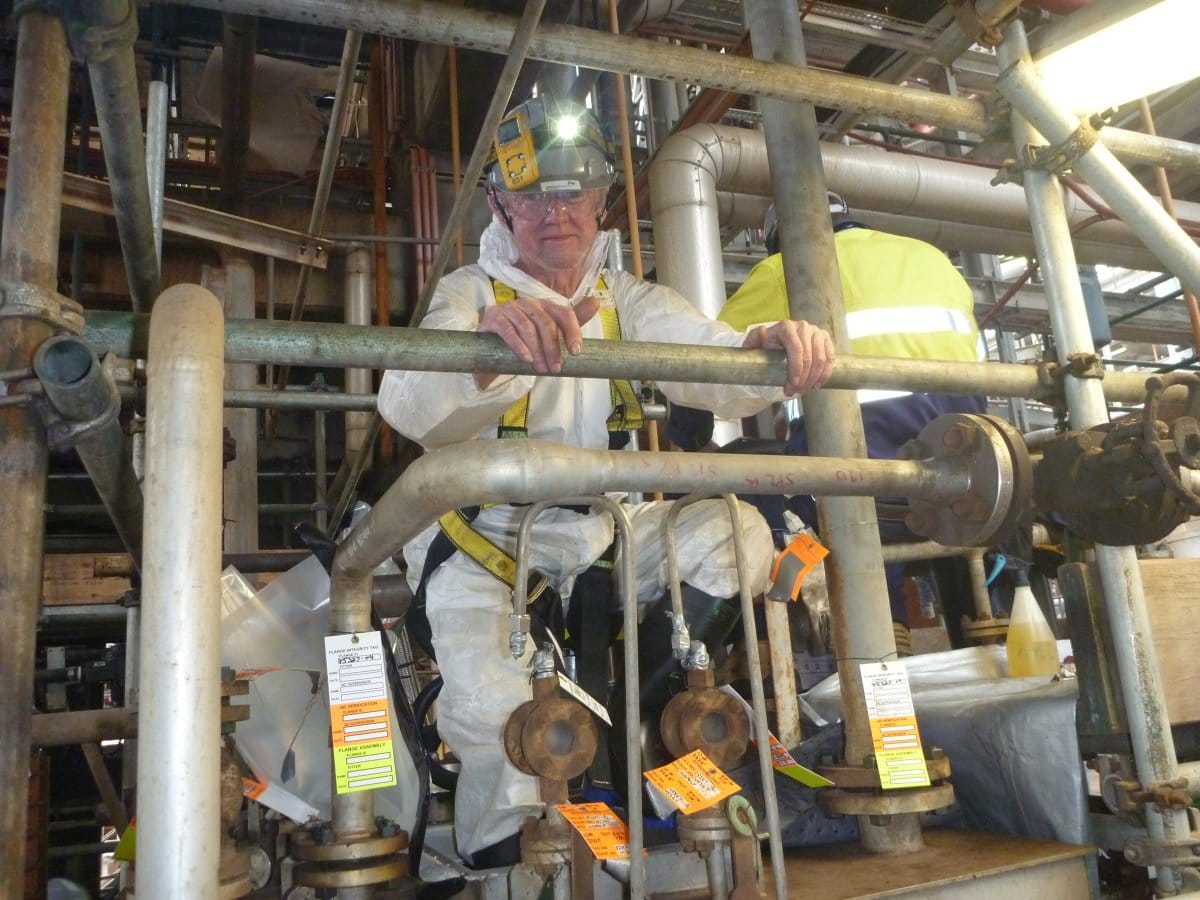
What if the most dangerous moment for your facility isn’t during peak operation, but the moment a technician steps inside a storage vessel? Industrial tank maintenance is a high-stakes environment where technical precision meets strict regulatory oversight. Managing the Confined Space Entry and Cleaning of Bulk fuel/oil tanks requires more than just a checklist. It demands a sophisticated understanding of atmospheric safety and contaminant mitigation. You likely feel the weight of responsibility when navigating AS 2865 compliance or worrying about the residual sludge that could compromise your equipment’s reliability. It’s a complex balance to maintain safety while minimizing the downtime that stalls your operations.
This article provides the technical framework you need to master the regulatory and safety requirements for large-scale industrial storage. We promise to guide you through the complexities of maintaining your fuel assets without risking personnel or equipment integrity. By following this structured approach, you’ll gain the full documentation needed for audit trails and the confidence that your oil quality meets precise ISO standards. We will examine the latest November 2024 Safe Work Australia standards and the scientific mechanisms behind effective, zero-incident decontamination.
Key Takeaways
- Understand how sludge and sediment accumulation in bulk storage triggers oxidation and varnish formation, compromising your broader lubrication strategy.
- Identify the core requirements of AS 2865:2009 to ensure your facility meets Australian Work Health and Safety (WHS) laws for every entry.
- Learn to select the most effective decontamination methodology for Confined Space Entry and Cleaning of Bulk fuel/oil tanks, ranging from high-pressure water blasting to specialized sludge extraction.
- Follow a rigorous two-phase planning process that starts with fluid sampling and ends with a secure Lock-Out Tag-Out (LOTO) procedure for maximum safety.
- Discover how integrating tank cleaning with professional oil analysis creates a comprehensive reliability program that protects your high-value assets.
The Strategic Importance of Bulk Fuel and Oil Tank Maintenance
Industrial operators often mistake tank cleaning for a simple waste management exercise. This is a costly misconception. In reality, the hygiene of your storage vessel dictates the health of every downstream component. When sediment and sludge accumulate at the base of a vessel, they don’t stay dormant. They act as a catalyst for chemical degradation. Utilizing professional Confined Space Entry and Cleaning of Bulk fuel/oil tanks allows for the complete removal of these “dead zones” where moisture and particulates settle.
The presence of these contaminants makes it nearly impossible to maintain strict ISO 4406 cleanliness codes. Even with high-efficiency filters, a dirty tank will continuously shed particulates back into the system. This cycle accelerates the wear on high-precision valves and pumps. Safety is paramount during these interventions. Every confined space presents unique atmospheric and physical hazards that require specialized training and equipment.
To better understand the technical precision required for these environments, watch this helpful video:
Preventing System-Wide Contamination
Stagnant tank bottoms serve as a reservoir for pollutants. As fluid levels rise and fall, settled particulates are swept back into circulation. This re-entrainment creates a constant burden on your secondary filtration systems. If the source tank remains contaminated, your filters will reach their holding capacity prematurely. This leads to increased consumable costs and higher risks of bypass events that expose sensitive turbine components to abrasive debris. Simple filtration isn’t a substitute for a clean vessel floor.
Varnish and Oxidation Management
Cleaning is a critical component of any varnish mitigation strategy. Oxidation by-products often adhere to tank walls, forming a sticky layer that attracts further particulates. These deposits are difficult to remove through fluid processing alone. By integrating thorough hygiene into a proactive maintenance strategy, you address the root cause of fluid aging. This also prevents the proliferation of microbial growth, commonly known as “diesel bug,” which thrives in the water-fuel interface. Consistent Confined Space Entry and Cleaning of Bulk fuel/oil tanks ensures these biological and chemical threats are neutralized before they compromise your entire inventory.
Regulatory Framework for Confined Space Entry in Australia
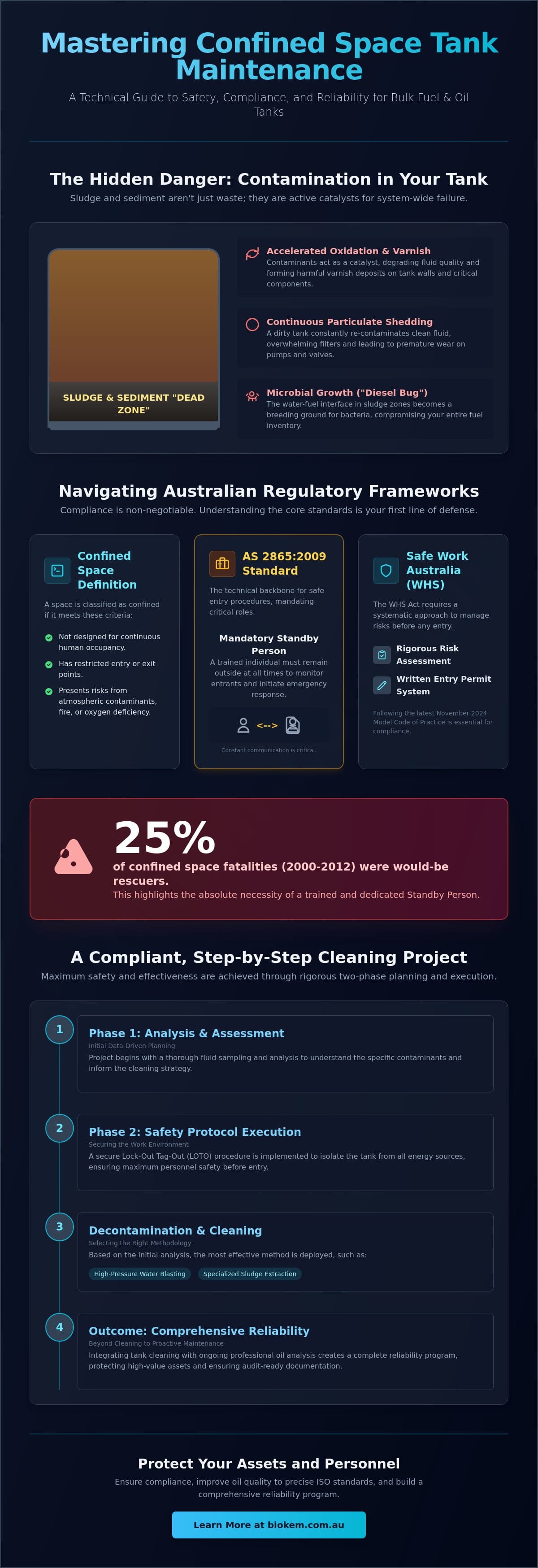
In Australia, the legal definition of a confined space is strictly governed by the Work Health and Safety (WHS) Regulations. A space is classified as confined if it’s not intended for human occupancy, has restricted entry or exit, and presents specific risks such as atmospheric contaminants, fire, or oxygen deficiency. For those overseeing the Confined Space Entry and Cleaning of Bulk fuel/oil tanks, the November 2024 update to the Model Code of Practice by Safe Work Australia provides the most current guidance. Compliance isn’t optional. It’s a fundamental requirement of the WHS Act to ensure every entry is preceded by a rigorous risk assessment and a written permit.
The technical backbone of these safety systems is AS 2865:2009. This standard outlines the minimum requirements for safe entry, including the mandatory appointment of a Standby Person. This individual remains outside the tank at all times, maintaining constant communication with the workers inside. They’re the critical link in the Emergency Response Plan. Historical data from 2000 to 2012 indicates that would-be rescuers accounted for approximately 25% of confined space fatalities in Australia. This underscores why a Standby Person must never enter the space to attempt a rescue without proper breathing apparatus and a pre-verified extraction strategy.
Atmospheric Testing and Gas-Free Certification
Atmospheric hazards are the primary cause of fatalities in industrial tanks. Before any technician enters, the internal environment must be tested using calibrated equipment. Oxygen levels must sit between 19.5% and 23.5%. For fuel and oil assets, monitoring the Lower Explosive Limit (LEL) is vital; concentrations must remain below 5% of the LEL for a space to be deemed safe. Because cleaning processes often disturb settled sludge and release trapped vapors, continuous monitoring is necessary throughout the entire shift. Once these parameters are verified, a “Safe for Entry” certificate is issued, which must be displayed at the entry point alongside the Job Safety Environmental Analysis (JSEA).
Legal Responsibilities of the Asset Owner
Asset owners hold a non-delegable “Duty of Care” to ensure the safety of everyone on their site. This involves performing thorough due diligence when selecting specialized cleaning contractors. You must verify that the cleaning team possesses the necessary competencies and utilizes equipment that meets industrial standards. Comprehensive record-keeping, including signed permits, JSEAs, and atmospheric logs, is essential for compliance audits and insurance verification. Integrating these safety protocols with professional hot oil flushing and filtering services ensures your maintenance window is both safe and operationally productive.
Technical Methodologies for Industrial Tank Decontamination
Selecting the correct decontamination strategy is a technical decision based on the specific fluid type and the nature of the accumulated debris. Managing the Confined Space Entry and Cleaning of Bulk fuel/oil tanks requires a choice between mechanical and chemical methods. Mechanical cleaning typically involves high-pressure water blasting to strip stubborn scale and vacuum-assisted sludge extraction to remove settled particulates. This approach is highly effective for heavy sediment. Chemical circulation, on the other hand, utilizes specialized solvents or surfactants to break down the molecular bonds of varnish and oxidized oil. This is often necessary for assets where chemical degradation has left a resilient film on the internal surfaces. We use paddle flushing screens during the process to provide real-time verification of the debris being removed from the system.
Post-Cleaning Oil Purification
Cleaning the vessel is only half the battle. If you’re returning the original fluid to the tank, it must be restored to its optimal state. We utilize vacuum dehydration to eliminate any residual moisture introduced during the cleaning process or through atmospheric condensation. This technology is vital for preventing the re-initiation of oxidation. While the tank is offline, it’s also the ideal window to perform hot oil flushing on the associated pipework. This ensures that the entire fluid circuit, not just the storage vessel, meets the required cleanliness standards before the system is brought back online.
Verifying Results Through Laboratory Analysis
Success in a decontamination project isn’t defined by a visual inspection alone. It requires empirical proof. We conduct a comprehensive oil analysis once the cleaning and purification cycles are complete. This confirms the removal of microscopic contaminants and validates that the fluid’s additive package remains intact. For immediate onsite verification, patch test kits provide a visual representation of the particulate levels remaining in the oil. By interpreting these particle counts and comparing them against OEM specifications, we provide a clear audit trail that proves the intervention has restored your asset’s reliability. This scientific approach transforms a standard cleaning task into a verified reliability milestone for your facility.
Step-by-Step: Planning a Compliant Tank Cleaning Project
Successful project management for bulk storage maintenance relies on a rigorous, phased framework. A haphazard approach doesn’t just risk equipment damage; it jeopardizes lives. The lifecycle of Confined Space Entry and Cleaning of Bulk fuel/oil tanks begins long before a technician approaches the manway. It starts with a comprehensive pre-intervention assessment. During this initial phase, we perform fluid sampling to understand the contaminant profile. This data informs the choice of cleaning chemistry and waste handling protocols, ensuring the Confined Space Entry and Cleaning of Bulk fuel/oil tanks proceeds with a clear technical roadmap.
Phase two focuses on achieving a zero-energy state through Lock-Out Tag-Out (LOTO) procedures. This involves isolating all mechanical and electrical energy sources, including pumps, heaters, and agitators. Once the tank is drained, phase three introduces atmospheric testing and forced ventilation. Only after the environment is certified gas-free can a permit be issued. Phase four covers the physical entry and extraction of sludge, followed by phase five: a final inspection, sealing the vessel, and restoring the purified fluid to the system.
The Importance of Isolation and Ventilation
Achieving a zero-energy state is the most critical safety barrier in industrial maintenance. Mechanical isolation through blanking or physical disconnection prevents the accidental ingress of fluids while personnel are inside. Simultaneously, electrical isolation ensures that no powered components can activate. Ventilation is equally vital. We calculate specific air exchange rates based on the tank’s volume and the volatility of the stored product. This continuous airflow manages hazardous vapors and prevents the accumulation of toxic gases, ensuring the atmosphere remains within the safe parameters established during initial testing.
Waste Management and Disposal
Environmental responsibility is a core pillar of our operational strategy. The oily sludge and regulated waste extracted during the cleaning process require compliant handling and transport. We provide the full documentation needed for audit trails, ensuring every liter of waste is tracked from your site to a certified disposal facility. Our process prioritizes efficient fluid recovery to minimize the volume of waste generated. This approach reduces your environmental footprint while ensuring full compliance with regional environmental regulations. If you’re ready to schedule your next maintenance window, contact us for a professional tank cleaning and varnish mitigation assessment.
BioKem Oil Services’ Integrated Approach to Tank and Oil Reliability
BioKem Oil Services approaches the Confined Space Entry and Cleaning of Bulk fuel/oil tanks through a unique lens that merges high-risk safety protocols with advanced oil chemistry. We recognize that a clean tank is only effective if the fluid within it is stabilized and the infrastructure is protected from future degradation. As the Australian distributor for Filters S.p.A., we integrate world-class filtration technology directly into our maintenance workflows. This allows us to provide customized solutions that maintain tank hygiene long after the initial cleaning is complete. Whether your facility requires full-service project management or specialized equipment hire, our engagement models are designed to fit your specific operational constraints.
Our methodology ensures that the Confined Space Entry and Cleaning of Bulk fuel/oil tanks isn’t just a janitorial task, but a strategic reliability milestone. By addressing the root causes of contamination, such as oxidation and microbial growth, we prevent the rapid re-accumulation of sludge. This technical depth is what distinguishes BioKem Oil Services from standard industrial cleaning contractors. We focus on the long-term ecological and operational health of your assets, ensuring that every intervention adds measurable value to your maintenance lifecycle.
Specialized Equipment and Technical Expertise
BioKem Oil Services utilizes high-performance particle pal technology to provide real-time monitoring of fluid cleanliness during and after the intervention. This data-driven approach ensures that our technicians, who are certified for the most demanding confined space environments, can make informed decisions onsite. Our access to global filtration innovations means we can solve unique industrial challenges that standard cleaning contractors often overlook. We combine this technical reach with local expertise to ensure every project meets the specific regulatory requirements of the Australian industrial sector.
Long-Term Reliability Partners
Our goal is to help your facility transition from reactive cleaning cycles to a proactive maintenance strategy. This shift reduces the frequency of intrusive interventions and extends the life of your high-value assets. BioKem Oil Services provides ongoing support through comprehensive laboratory testing and onsite analysis to monitor the health of your bulk storage. By ensuring your storage assets support rather than hinder production, we position ourselves as a reliable partner in your facility’s long-term operational success. This integrated methodology guarantees that your maintenance results in a zero-incident window and restored oil quality that meets the highest ISO standards.
Securing the Future of Your Industrial Storage Assets
Achieving total fluid reliability requires a transition from viewing tank hygiene as an isolated event to recognizing it as a critical maintenance pillar. While the technical complexities of Confined Space Entry and Cleaning of Bulk fuel/oil tanks are significant, the operational risks of neglect are far greater. By neutralizing contaminants at the source, you eliminate the catalysts for varnish and accelerated component wear. This structured approach ensures your facility operates with the transparency and efficiency required for modern industrial standards, backed by full audit trails and verified cleanliness results.
BioKem Oil Services acts as your specialized partner in managing these high-risk interventions. As a specialist in AS 2865 compliant protocols and an authorized distributor for Filters S.p.A., we provide the technical expertise needed to restore your storage assets to peak performance. Our integrated oil analysis and purification services ensure that your maintenance window results in long-term asset longevity rather than just a temporary fix. We invite you to Request a Technical Consultation for Your Bulk Tank Maintenance and take the first step toward a proactive, zero-incident maintenance strategy. Secure your facility’s operational health with a partner dedicated to technical excellence and environmental responsibility.
Frequently Asked Questions
What is the Australian Standard for confined space entry in tank cleaning?
AS 2865:2009 is the primary technical standard that outlines the minimum requirements for establishing a safe system of work in these environments. It provides the mandatory framework for risk assessments, entry permits, and the duties of standby personnel. Adhering to this standard is essential for ensuring your facility meets the requirements of the Work Health and Safety (WHS) Act and Regulations.
How often should bulk fuel and oil tanks be professionally cleaned?
Most industrial operators adopt a three to five year cleaning cycle, though the actual frequency should be dictated by regular oil analysis. If your particle counts consistently exceed ISO 4406 targets or if you detect microbial growth, an immediate intervention is necessary. Proactive maintenance prevents the accumulation of sludge that leads to system-wide varnish and equipment failure.
Can tank cleaning be performed without personnel entering the space?
Non-entry methods, such as utilizing high-pressure water jets or robotic equipment, are preferred whenever possible to lower the risk profile. However, Confined Space Entry and Cleaning of Bulk fuel/oil tanks is often still required for complex decontamination projects. Manual entry allows for a thorough physical inspection and the complete removal of stubborn, heavy sludge that automated systems might miss.
What are the most common hazards found in bulk oil storage tanks?
Atmospheric hazards are the most significant threat, including oxygen deficiency and the presence of flammable or toxic vapors. Physical risks such as slips on oily surfaces, engulfment by fluid, and mechanical hazards from internal components also require strict control. Every entry must be preceded by continuous gas monitoring to ensure the environment remains safe for the duration of the task.
How do I know if my tank requires a full confined space clean?
A full clean is typically indicated when bottom sampling reveals a significant buildup of sediment or microbial contamination. You should also consider a clean if you’re experiencing rapid filter blinding or if your Confined Space Entry and Cleaning of Bulk fuel/oil tanks records show the asset hasn’t been serviced in several years. Oil analysis results showing high oxidation levels are another key technical trigger.
What documentation is required for a compliant tank cleaning project in Australia?
Compliance requires a comprehensive suite of documents including a written entry permit, a Job Safety Environmental Analysis (JSEA), and atmospheric monitoring logs. You must also maintain records of personnel training and competency. For fuel assets, waste transport certificates are mandatory to prove the legal disposal of oily sludge and regulated waste in accordance with environmental laws.
Does BioKem Oil Services provide equipment for us to perform our own tank filtration?
BioKem Oil Services provides a comprehensive equipment hire service for facilities that prefer to manage their own fluid purification and maintenance. We offer specialized filtration units, vacuum dehydrators, and particle monitoring technology. This allows your onsite team to maintain fluid cleanliness between major cleaning intervals using the same high-performance equipment utilized by our technical specialists.