

Replacing oil can seem like the safer, simpler choice, but it may cost more than purifying it and protecting the equipment it serves. For maintenance managers, calculating the ROI of oil purification means looking beyond lubricant purchase costs to the effects of oil condition on asset life and operational uptime. Contamination can affect both, while unscheduled downtime and used-oil disposal add further pressure to maintenance budgets.
It’s reasonable to ask whether purifying existing oil is cheaper than replacing it. The answer depends on your equipment, oil condition, purification costs and the financial impact of downtime. A clear comparison can help you present stakeholders with a defensible ROI percentage, identify opportunities to reduce annual lubricant procurement and assess the potential to extend turbine and compressor life.
This guide breaks down the costs and benefits to include, shows how to build a practical ROI calculation, and explains how to account for oil reuse, avoided downtime and disposal. BioKem Oil Services brings 70 years of specialist experience to turnkey oil purification solutions, helping Australian businesses evaluate asset health with a practical, sustainability-conscious approach.
Key Takeaways
- Build a practical ROI model that weighs oil and labour savings against purification, energy and filtration costs.
- Use oil cleanliness data and annual consumption as a baseline when calculating the ROI of oil purification.
- Include the full impact of an unscheduled failure in your comparison, not just the cost of replacement oil.
- Assess how contamination control may help protect critical equipment and reduce avoidable oil changes.
- Explore how BioKem’s turnkey solutions and VDOPS can support asset health while reducing internal labour demands.
The Financial Case for Proactive Oil Purification
Oil purification ROI is the financial gain from extending usable lubricant and protecting asset life, minus the cost of the purification service and related operating inputs. A sound calculation compares the cost of treating oil with the costs it may help avoid: replacement lubricant, oil-change labour, disposal and disruption from contamination-related equipment problems. Oil purification covers methods for removing contaminants; the business case depends on how well a chosen approach addresses the oil and equipment’s actual condition.
This shifts maintenance from a reactive “drain and fill” cycle to proactive contamination control. Instead of replacing oil on a schedule alone, teams use condition information to decide whether it can remain in service and what intervention is appropriate. BioKem’s 70 years of specialist experience can help maintenance teams examine these decisions for hidden cost-saving opportunities, without assuming that purification is suitable for every oil or asset.
Reliability-Centred Lubrication treats oil condition as a contributor to equipment reliability and business performance, not simply a consumable expense. The return may include less oil purchased and fewer avoidable interventions, alongside the value of protecting critical assets. To make the case credible, track these benefits against actual maintenance records and service costs.
Shifting from CAPEX to OPEX with Purification
For assets that consume large volumes of lubricant, extending oil life may reduce the need to keep as much replacement stock on hand. That can ease purchasing pressure and the working capital tied up in inventory. Purification services may also fit an operational maintenance budget rather than require a major equipment purchase, depending on the delivery model and your organisation’s accounting policy. Confirm the treatment with your finance team. Consistent oil contamination control can make oil-related spending easier to plan by linking interventions to condition and operating needs.
The Environmental and Regulatory ROI
Used oil creates handling, disposal and record-keeping work. These costs vary, so use your own collection invoices, disposal records and staff time rather than relying on a generic estimate. Reducing oil turnover may lower the volume requiring disposal and support corporate sustainability goals by keeping usable lubricant in service for longer. While industrial facilities focus on lubricants, operations in food service and hospitality face similar disposal challenges; for commercial kitchen oil solutions, check out Cash 4 Waste Oil. Include the associated process and reporting requirements in your financial model, and confirm applicable obligations with your environmental compliance team.
Microbial contamination is another risk to assess. If it goes undetected, contamination can compromise oil condition and lead to further investigation, treatment or replacement. The cost of remediation depends on the affected system and should be evaluated using inspection and oil-analysis findings. Include a realistic allowance for this risk, but avoid treating it as a guaranteed saving from purification.
Identifying the Key Variables in Your ROI Equation
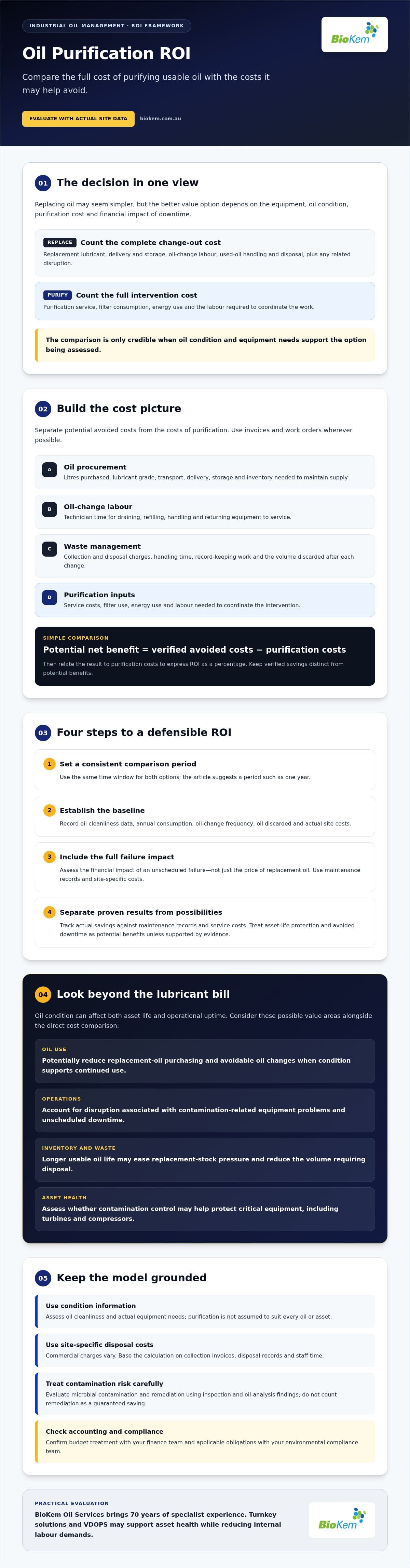
A useful ROI model captures more than the price of replacement oil. Start with a consistent comparison period, such as one year, and record the costs purification could reduce alongside the costs of the intervention. When calculating the ROI of oil purification, separate verified savings from potential benefits so stakeholders can see what the numbers actually support.
- Oil procurement: litres purchased, lubricant grade, transport, delivery and storage costs.
- Oil-change labour: technician hours for draining, refilling, handling and returning the equipment to service.
- Waste management: collection and disposal charges, plus staff time for handling and required records.
- Purification inputs: service costs, filter consumption, energy use and labour needed to coordinate the work.
Use invoices and work orders rather than estimates wherever possible. Disposal costs are often missed in ROI models: use the actual fees and handling time associated with your site’s contaminated oil, since commercial charges are not standardised. Also record how much oil is discarded after each change. This creates a fair baseline against which to assess whether extending oil life changes purchasing and waste volumes.
Hard Costs: The “Price per Litre” Fallacy
The delivered cost of oil can include transport, storage and the inventory needed to maintain supply, not just the supplier’s price per litre. Compare those costs with the cost of vacuum dehydration for the specific oil volume and condition, without assuming purification will always be the lower-cost option. Account for filter consumption, too. BioKem uses ISO 16889-certified filtration to support filtration performance assessment and oil quality management.
Soft Costs: Labour and Logistics
Compare labour using site records: multiply the hours for draining, refilling and cleanup by your loaded labour rate, then compare with the hours required to coordinate and oversee a kidney-loop treatment. Include access, isolation and production scheduling in both cases. For remote Australian sites, record oil delivery and mobilisation expenses; BioKem’s national mobilisation capability may be relevant when assessing logistics. Teams reviewing site-specific requirements can discuss oil purification needs.
Then capture effects that don’t appear as a separate oil invoice. Varnish deposits can contribute to sticking valves, interrupting control response and disrupting production cycles. Depending on equipment and operating conditions, deposits and restricted flow can also increase system losses and power demand. Track the events and energy data available at your site rather than assigning an unsupported saving. BioKem’s varnish in lube oil service information explains this contamination concern.
Finally, test the model with conservative assumptions. Count measured savings from reduced oil purchases, labour and disposal separately from harder-to-attribute benefits such as avoided production interruptions or lower energy use. That distinction makes the business case transparent and easier to update as operating data accumulates.
Quantifying the High Cost of Unscheduled Downtime
A planned intervention can be scheduled around maintenance windows; an emergency shutdown may force repairs during lost production time. Compare the total cost of each scenario, not simply the service cost against the price of oil. BioKem’s hot oil flushing service may be considered where system flushing is appropriate. For a fair ROI model, compare its quoted scope and timing with your site’s own costs for lost output, emergency labour, replacement components, restart and any knock-on production delays.
The production impact can be especially material in high-output operations such as LNG and power generation, where an unavailable asset may constrain output or interrupt a supply commitment. Estimate lost opportunity cost using site-specific production and margin data. Avoid treating every hour of downtime as equivalent: a planned outage, partial-capacity operation and full shutdown can carry very different financial consequences.
Contamination is one potential contributor to premature bearing wear and failure. Particles, water or degradation products can compromise lubrication, while a failed bearing may damage connected components or require extensive repair. That risk makes oil condition relevant to asset protection, but purification is not a guarantee against failure. BioKem brings 70 years of specialist experience to oil condition and contamination challenges, and reports Zero Lost Time Injuries (LTI) since establishment in 2012, a relevant safety record when assessing work around critical operating assets.
Bearing Life and the ISO Cleanliness Connection
Cleaner oil can support bearing reliability, but don’t assume that moving one cleanliness code cleaner automatically doubles bearing life. The effect depends on bearing design, operating conditions, contaminant type and the cleanliness target. Set targets against equipment guidance and trend oil samples over time. Oil filter debris analysis can help investigate wear evidence and inform maintenance decisions; include analysis findings in your ROI model rather than assigning an unverified lifespan extension. Consider any proposed turbine overhaul deferral only when condition data and engineering assessment support it.
The “Bathtub Curve” of Asset Reliability
The bathtub curve describes higher failure risk early in an asset’s life, a steadier useful-life period and rising wear-related failures later. Purification cannot flatten this curve by itself, but contamination control may address one preventable contributor. During commissioning, clean oil and suitable flushing can help manage residual contaminants before operation. Pair these measures with inspection and monitoring as part of a proactive maintenance strategy, then track failures and interventions to determine whether reliability improves.
For a defensible business case, compare planned purification and monitoring costs with documented downtime, repair and production impacts. Use conservative assumptions, and distinguish measured savings from potential avoided losses.
A Step-by-Step Framework for Calculating Your Returns
Use a consistent period, such as one year, and compare the current maintenance approach with a realistic purification scenario. Keep measured savings separate from risk-based estimates so stakeholders can see which assumptions drive the result.
- Establish the baseline. Record oil cleanliness from representative analysis, annual lubricant consumption, change intervals and disposal volumes for each asset.
- Cost a failure event. Combine repair and replacement parts, emergency labour, lost production, restart costs and disposal or cleanup expenses. Use actual site records where available.
- Price the intervention. Include the quoted turnkey purification scope or equipment hire, plus internal labour, energy, filter consumption and any required oil analysis.
- Project oil and asset-life effects. Estimate potential changes to lubricant replacement intervals and asset maintenance plans using condition data, equipment guidance and historical trends. Treat asset-life extension as a supported scenario, not a guaranteed outcome.
- Calculate ROI. Use ROI (%) = (total gains − total costs) ÷ total costs × 100. Define gains over the same period and avoid counting the same avoided cost twice.
Hard Savings Calculation
Hard savings are direct reductions in lubricant procurement and disposal spend. Estimate oil life extension value as baseline annual oil and disposal cost − projected annual oil and disposal cost after purification, then subtract the purification-related costs in the ROI calculation. For a short-term project, compare purchasing equipment with oil purification equipment hire, including mobilisation, operating inputs and the duration you need the equipment.
Risk Mitigation and Asset Longevity
To include failure risk, multiply the estimated cost of an event by its probability within the chosen period, then compare the baseline with a post-intervention scenario. Use maintenance history and engineering judgement to support both probabilities. If evidence is limited, show a range of outcomes rather than presenting an assumed reduction as certain. Avoided downtime and greater confidence in asset condition may matter to high-risk operations, but quantify those benefits with site-specific evidence.
Safety should also inform supplier evaluation and work planning, particularly around critical operating equipment. BioKem brings 70 years of specialist experience and reports Zero Lost Time Injuries (LTI) since establishment in 2012. These details support due diligence, but they don’t replace a review of the proposed work scope, site controls and risk assessment.
For a site-specific comparison of turnkey purification and equipment hire, discuss your oil purification requirements with BioKem.
Optimising Asset Health with BioKem’s Turnkey Solutions
A sound ROI model depends on what happens after the calculation: selecting an intervention that fits the asset, oil condition and operating schedule. BioKem provides turnkey oil purification solutions across Australia, including vacuum dehydration, varnish mitigation and hot oil flushing. A turnkey approach can reduce the internal labour burden by limiting the coordination required to plan and manage the work. The right scope should be based on asset needs and condition data, not an assumed return.
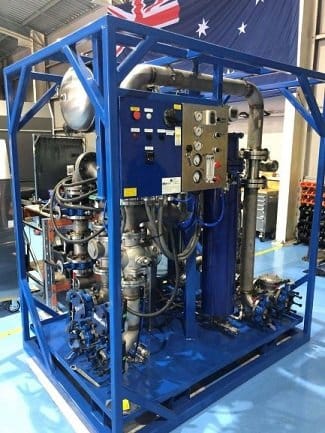
BioKem’s Vacuum Dehydration Oil Purification Systems (VDOPS) are one option to assess where moisture removal is relevant. Review the vacuum dehydration oil purification system alongside the oil’s condition, operating constraints and expected service requirements. For maintenance managers calculating the ROI of oil purification, compare the quoted scope and operating inputs with the costs the intervention could reasonably reduce. Purification can support a financial case, but it doesn’t guarantee a specific ROI.
Advanced Filtration Technology
Best-of-breed international equipment can support effective contamination management when it is matched to the application and operated within the required parameters. BioKem is the Australian distributor for Filters S.p.A. and Swift Filters, and offers ISO 16889-certified filtration. Similarly, teams looking into industrial separation systems for processing and fluid recovery can discover Sacor Engineering. Varnish removal systems can help address deposits associated with sticking valves, while the appropriate solution depends on system condition and assessment. Measure the outcome through oil analysis and relevant equipment performance data.
Hire may suit a defined shutdown or short-term project, while purchase can be worth evaluating where equipment will see sustained, repeat use. Compare the full costs: equipment, mobilisation, operation, maintenance, storage and the internal time needed to manage the work. BioKem offers equipment hire, allowing teams to assess a project-specific option without assuming ownership is always the better investment.
National Mobilisation and Expert Support
BioKem’s national mobilisation capability supports critical asset health across Australia. Planning work around shutdown requirements can help teams coordinate access and minimise avoidable disruption, while specialist experience in varnish and moisture mitigation helps inform the service scope. BioKem brings 70 years of specialist experience to this work. Keep the evaluation grounded in asset records, oil analysis and a clearly defined operating objective.
For a tailored discussion of your equipment, oil condition and project scope, contact BioKem about an ROI assessment.
Turn Oil Condition into a Stronger Business Case
Oil purification earns its place in a maintenance plan when the numbers reflect the whole system: lubricant purchases, labour, disposal, intervention costs and the potential impact of equipment failure. A consistent baseline and conservative assumptions make calculating the ROI of oil purification more credible, while oil analysis helps teams assess whether projected changes to oil life and asset maintenance are supported by condition data.
For critical equipment, the decision isn’t simply whether to reuse oil or replace it. It’s whether a well-matched purification approach can support reliability, reduce avoidable oil turnover and help protect operational uptime. BioKem provides turnkey oil purification solutions across Australia, backed by 70 years of specialist experience and national mobilisation. BioKem reports Zero Lost Time Injuries (LTI) since establishment in 2012.
Use your site data to identify the opportunity, then compare the relevant service scope with your operational requirements. Request a Turnkey Oil Purification Quote from BioKem to discuss a solution for your assets. A clear, evidence-based assessment can help you make a confident next move toward stronger asset health and more responsible lubricant use.
Frequently Asked Questions
How much does oil purification typically save compared to replacement?
There’s no reliable universal saving figure; the result depends on oil volume, condition, replacement frequency, disposal charges and purification costs. Compare your actual annual spend on new lubricant, change-out labour and used-oil handling with the cost of purification and its operating inputs. Include only oil that remains suitable for service after treatment. Site records and oil analysis provide a stronger estimate than a generic percentage or assumed saving.
What is the most significant factor in calculating oil purification ROI?
The largest factor varies by asset, but the cost of an unscheduled failure can dominate where downtime disrupts high-value production. Build the calculation from your own records: repair costs, lost output, emergency labour and restart impacts. Then compare these potential avoided costs with measurable lubricant, labour and disposal savings. When calculating the ROI of oil purification, keep documented savings separate from estimated risk reduction so decision-makers can assess each assumption.
Can vacuum dehydration remove 100% of water from my oil?
Don’t assume vacuum dehydration will remove 100% of water in every application. Performance depends on factors such as the oil’s starting condition, system operation and the treatment setup. Set a target based on equipment requirements, then use oil analysis to assess the result. BioKem provides vacuum dehydration and oil analysis services, but the appropriate treatment and achievable outcome should be confirmed for the specific oil and operating system.
Is equipment hire more cost-effective than purchasing a purification unit?
Hire can be a practical option for a defined shutdown, trial or occasional need, while purchase may warrant consideration where equipment will be used regularly. Compare the full cost over your expected period of use, including acquisition or hire, mobilisation, operation, maintenance, storage and internal labour. BioKem offers equipment hire as well as filtration equipment for purchase. The better option depends on utilisation, project duration and your organisation’s ownership costs.
How does oil cleanliness impact the energy efficiency of my industrial systems?
Contamination can contribute to wear, restricted flow or component behaviour that affects how a system operates. In some situations, deposits such as varnish may contribute to sticking valves or increased system losses, potentially affecting energy use. The impact varies by equipment and operating conditions, so avoid assuming a fixed energy saving from cleaner oil. Compare operating data before and after intervention, alongside oil analysis and maintenance records.
What happens if I skip oil flushing during a system commissioning?
Skipping flushing may leave installation debris or other contaminants in a lubrication system, depending on the commissioning process and equipment condition. Those contaminants can affect oil cleanliness and contribute to wear or operating problems. Follow the asset manufacturer’s requirements and commissioning plan to determine the appropriate preparation. BioKem provides hot oil flushing and commissioning support. Discuss the system’s condition and specifications with the responsible engineering team before deciding to omit flushing.
How long does a typical ROI cycle take for industrial oil purification?
There isn’t one standard payback period. It depends on the intervention cost, oil consumption, change frequency, disposal expenses, equipment utilisation and the time required for savings to be realised. Choose an evaluation period that matches your maintenance and budget cycle, then track actual oil purchases, treatment costs and maintenance events against the baseline. Treat avoided failures as risk-weighted estimates unless operating evidence demonstrates a measurable change.
Does BioKem provide onsite analysis to prove the ROI of its services?
BioKem provides oil analysis and onsite and lab-based patch analysis to help assess oil condition and filtration results. These measurements can contribute evidence to an ROI review, but they don’t independently prove a financial return. Pair condition results with purchasing invoices, disposal records, labour hours and downtime data. BioKem also offers turnkey oil purification solutions across Australia, with the scope determined by the asset and project requirements.

Article by
James McAllister
James McAllister is an industry professional with BioKem Oil Services, specialising in lubrication reliability, oil filtration, contamination control and asset performance. Drawing on BioKem's extensive field experience across turbines, compressors, hydraulic systems and critical rotating equipment, James writes practical, insight-driven articles that help maintenance and reliability teams improve equipment performance, extend asset life and reduce operational risk.