


Your latest oil analysis report might show perfect viscosity and low particle counts, yet your turbine could still be on the verge of a varnish-induced shutdown. This discrepancy occurs because traditional tests often miss the chemical depletion that precedes physical failure. It’s a frustrating reality for maintenance professionals who face unscheduled downtime and sticking valves despite following standard protocols. You’re likely looking for a way to stop guessing and start predicting exactly when your lubricant will lose its protective capabilities.
In this guide, we’ll demonstrate how RULER – Remaining Usefull life in lubricants testing provides a proactive early warning system by measuring antioxidant levels. By identifying the chemical depletion of lubricants before varnish forms, you can prevent costly premature oil changes and safeguard your critical assets. We’ll examine the technical mechanisms behind voltammetric analysis and show how it serves as the essential diagnostic precursor to effective varnish mitigation. You’ll learn how to extend oil drain intervals safely while maintaining the highest standards of turbine and compressor reliability.
Key Takeaways
- Understand how RULER testing quantifies the specific concentration of antioxidant additives to monitor the chemical health of your lubricants.
- Discover why RULER – Remaining Usefull life in lubricants acts as a critical early warning system, identifying depletion before insoluble varnish damages your equipment.
- Compare RULER and RPVOT methodologies to select the most effective diagnostic tool for your turbine and compressor maintenance programs.
- Learn how to integrate routine sampling and baseline data into a proactive strategy that safely extends lubricant drain intervals.
- Leverage BioKem’s 70 years of specialist experience to transition from diagnostic testing to turnkey onsite remediation and varnish mitigation.
What is RULER Testing for Lubricants?
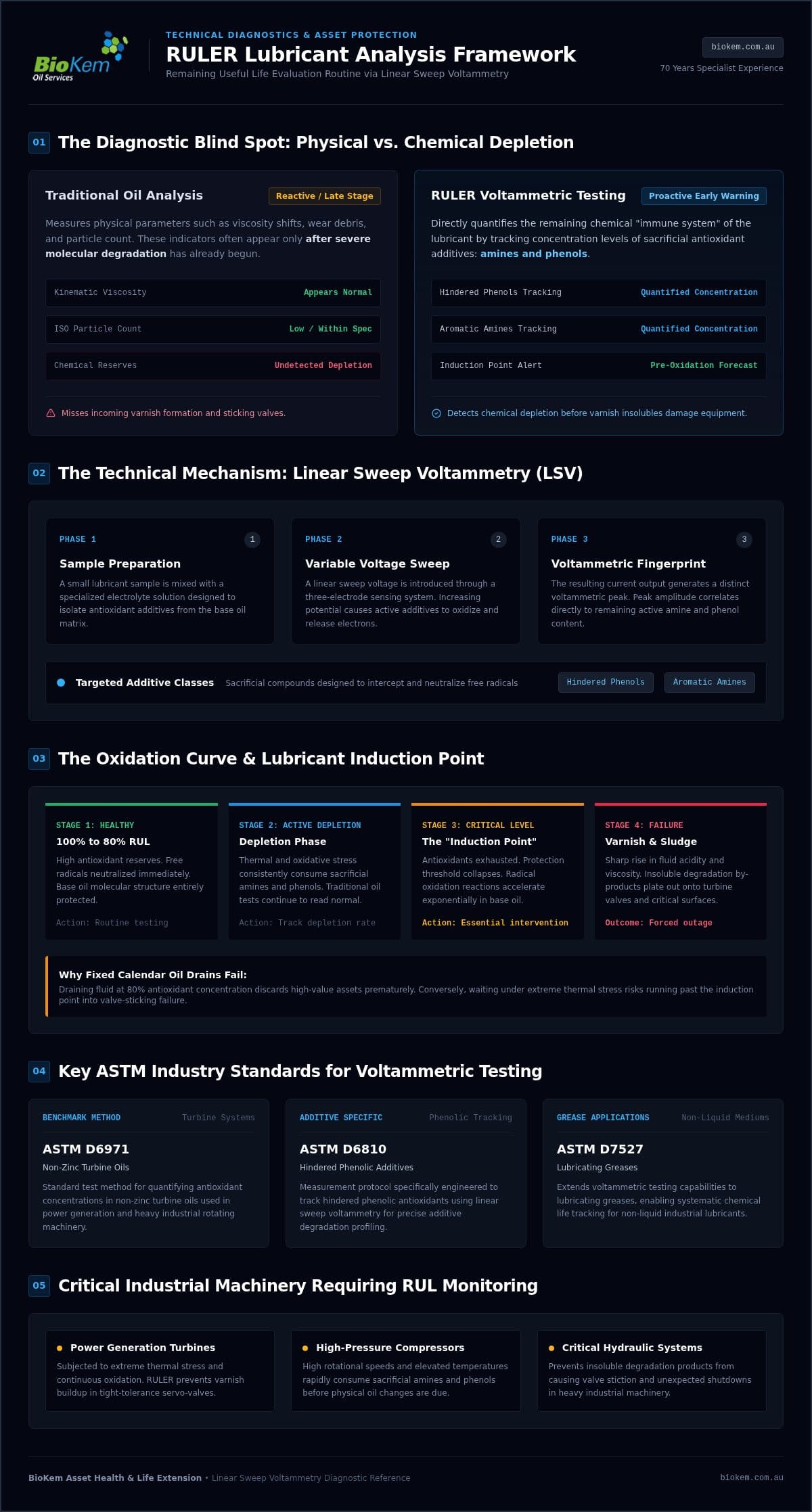
RULER stands for Remaining Useful Life Evaluation Routine. It’s a specialized diagnostic technique that evaluates the chemical health of a lubricant rather than just its physical condition. While standard oil analysis often focuses on wear debris or viscosity shifts, these indicators typically appear only after significant degradation has occurred. RULER – Remaining Usefull life in lubricants provides a window into the future of the fluid by measuring the concentration of sacrificial antioxidant additives, specifically amines and phenols.
For operators of high-speed rotational assets like turbines, compressors, and complex hydraulic systems, this testing is essential. These machines operate under high thermal and oxidative stress, relying entirely on these additives to prevent the base oil from breaking down. Identifying when these chemical reserves are low allows for proactive maintenance before the oil reaches its “induction point,” where rapid oxidation begins and varnish formation becomes inevitable.
To better understand this concept, watch this helpful video:
The Science: Linear Sweep Voltammetry (LSV)
The technical foundation of RULER – Remaining Usefull life in lubricants is Linear Sweep Voltammetry. During this process, a technician mixes a small oil sample with a specific electrolyte and applies a variable voltage through a three-electrode sensing system. As the voltage increases, different antioxidants in the oil react and release electrons, creating a measurable current response. This current creates a unique “fingerprint” or voltammetric peak that corresponds to the remaining concentration of amines and phenols.
LSV is significantly more accurate than measuring oxidation products like sludge or acid. By the time you detect oxidation products, the damage to the oil’s molecular structure has already started. LSV identifies the depletion of the “immune system” of the oil. It tells you exactly how much protection remains, allowing for a steady and logical approach to oil replacement or additive replenishment.
Key ASTM Standards for RULER
To ensure global consistency and technical accuracy, RULER testing follows specific regulatory standards. These protocols anchor our scientific aspirations in dependable, localized contexts for Australian industrial operators:
- ASTM D6971: This is the standard test method for measuring antioxidant content in non-zinc turbine oils. It’s the primary benchmark for power generation and large scale industrial turbines.
- ASTM D6810: This protocol focuses specifically on measuring hindered phenolic antioxidants using linear sweep voltammetry, ensuring precise tracking of this critical additive class.
- ASTM D7527: This standard extends the voltammetric method to lubricating greases, allowing for the same level of chemical health monitoring in non-liquid lubricants.
Why Monitoring Remaining Useful Life (RUL) is Critical
Antioxidants act as sacrificial agents within a lubricant. They are engineered to react with and neutralise free radicals, protecting the base oil from molecular breakdown. Once these chemical reserves are exhausted, the base oil oxidises rapidly, leading to a sharp increase in acidity and viscosity. RULER – Remaining Usefull life in lubricants provides the data needed to switch from reactive to proactive maintenance. By identifying the exact moment these additives are depleted, you can prevent the “induction point” where oil degradation becomes irreversible.
The economic benefits of this monitoring are substantial. Many industrial sites still change oil based on fixed operating hours or calendar dates. This approach is often wasteful and environmentally irresponsible. If your antioxidants remain at 80% of their original concentration, you’re discarding a high-value asset prematurely. Conversely, if high thermal stress has depleted your additives faster than expected, waiting for a scheduled change could result in catastrophic component failure. Monitoring the chemical health allows you to safely extend oil change intervals based on the actual condition of the fluid.
Varnish Prevention: The RULER-MPC Connection
Effective varnish management requires understanding the difference between leading and lagging indicators. Membrane Patch Colorimetry (MPC) is a lagging indicator. It measures the presence of insoluble contaminants that have already formed in the fluid. By the time an MPC report shows a high “delta E” value, varnish in lube oil is likely already depositing on cool metal surfaces and sensitive valve internals.
RULER – Remaining Usefull life in lubricants serves as the leading indicator. It identifies the “Varnish Window,” which is the period when antioxidant levels drop below 25% of their initial baseline. During this window, the oil loses its ability to hold oxidation by-products in solution. Acting during this phase allows you to implement filtration or additive top-ups before the varnish precipitates out. If you’re concerned about the chemical stability of your critical fluid reserves, you can speak with our technical team for a detailed analysis strategy.
Impact on Power Generation and Mining
In power generation, gas and steam turbines operate under extreme thermal stress. Even minor varnish deposits can lead to servo-valve hunting or unexpected trips, costing thousands in lost production. Similarly, in mining applications, mill trunnions and large gearboxes face heavy loads and fluctuating temperatures. BioKem utilizes a “best of breed” equipment approach to protect these critical assets. By combining RULER data with our specialized varnish removal systems, we ensure that your machinery maintains peak reliability. This integrated approach bridges the gap between laboratory diagnostics and onsite remediation, providing a complete lifecycle solution for your lubricants.
RULER vs. RPVOT: Choosing the Right Analysis
Maintenance managers often face a choice between two primary oxidation tests: RPVOT and RULER. The Rotating Pressure Vessel Oxidation Test (RPVOT) has historically been the industry standard. It measures the total oxidation resistance of an oil by placing a sample in a pressurized vessel with water and a copper catalyst. The test continues until a specific pressure drop occurs, indicating the oil has oxidized. While this provides a general sense of stability, it lacks the surgical precision offered by RULER – Remaining Usefull life in lubricants.
The most immediate practical difference is the turnaround time. An RPVOT test can take several days to complete, as it relies on the physical failure of the oil under stress. In contrast, RULER results are available in minutes. This rapid feedback makes it the superior choice for routine condition monitoring programs where immediate decisions are required to protect critical assets. By the time an RPVOT report reaches your desk, the chemical state of your turbine oil may have already shifted.
Technical Breakdown: Accuracy and Specificity
RPVOT results can be misleading, particularly if a system has been “topped up” with fresh oil. Adding new oil increases the total oxidation resistance, which can mask the fact that the original fluid is severely degraded. This creates a false sense of security. RULER – Remaining Usefull life in lubricants bypasses this issue by identifying exactly which antioxidants, such as amines or phenols, are depleting. It tracks individual additive health over time, providing a clear trend line that RPVOT cannot match.
From a budget perspective, RULER is more cost-effective for high-frequency sampling. It allows you to monitor the specific “staying power” of your lubricant without the high costs and long wait times associated with pressure vessel testing. This specificity is vital for modern Group II and Group III base oils, which behave differently under oxidative stress than older formulations. Using a more targeted diagnostic tool ensures you aren’t paying for lengthy tests that provide less actionable data.
When to Use Both Tests
While RULER is the preferred tool for trending, RPVOT still holds value in specific scenarios. It’s an excellent tool for baseline certification of new oils or when conducting a major audit of fluid health. BioKem recommends a balanced approach to oil analysis that leverages the strengths of both methodologies. We use our 70 years of specialist experience to help you establish a routine that prioritizes RULER for quarterly monitoring while utilizing RPVOT for annual deep dives.
Our laboratory provides comprehensive analysis that integrates these findings into actionable maintenance plans. If your RULER results indicate a rapid drop in phenols, we can immediately suggest varnish mitigation strategies. This proactive stance ensures your equipment remains operational while maximizing the environmental and economic value of your lubricant investment.
Integrating RULER into Your Proactive Maintenance Strategy
Successful integration of RULER – Remaining Usefull life in lubricants into a maintenance program requires a disciplined approach to data collection. It begins with establishing a precise baseline. You must test a sample from every new batch of oil delivered to your site, as even identical product codes can show minor variations in additive concentration. This “new oil” sample serves as the 100% reference point for all subsequent tests. Without this baseline, your percentage results are merely estimates rather than scientific certainties.
Routine sampling frequency should reflect the criticality of the asset. For high-value turbines and compressors, quarterly testing is the industry standard. This frequency allows you to build a trend line, identifying whether antioxidant depletion is steady or accelerating due to specific operational stresses. To provide a complete picture, correlate your RULER data with other key metrics:
- ISO Cleanliness: High particle counts can act as catalysts for oxidation, accelerating additive consumption.
- Acid Number (AN): A rising AN often indicates that antioxidants are already exhausted and the base oil is breaking down.
- Water Content: Moisture significantly increases the rate of chemical breakdown through hydrolysis.
Most reliability professionals set a “Warning” limit at 50% and a “Critical” limit at 25% of the original antioxidant levels. Once the 25% threshold is crossed, the risk of varnish precipitation increases exponentially, as the oil can no longer hold oxidation by-products in solution.
Interpreting the RULER Report
The primary metric in a RULER report is the ‘Antioxidant Remaining %’. This number represents the current chemical health relative to your batch-specific baseline. If the report indicates a sharp drop in one specific additive class, such as amines, while phenols remain stable, it signals a specific type of thermal stress. Understanding these nuances is a core part of professional oil analysis interpretation.
In some cases, the report may suggest “sweetening” the oil. This involves a partial bleed-and-feed where a portion of the aged oil is replaced with fresh fluid to replenish additive levels. It’s an environmentally conscious alternative to a full oil change, extending the life of the bulk fluid while maintaining system protection.
Actionable Steps After a ‘Low RUL’ Result
When RULER – Remaining Usefull life in lubricants indicates your oil is entering the “Varnish Window,” immediate intervention is required. Implementing Varnish Removal Systems (VRS) can capture polar contaminants before they settle on critical internals. If the depletion is severe, you should schedule a Hot Oil Flush during your next planned shutdown to ensure the system is chemically clean before introducing new fluid.
Taking these steps prevents the sticking valves and unscheduled trips that plague unmonitored systems. If you’re ready to implement a more sophisticated testing regime for your facility, you can contact our technical specialists to design a customized sampling schedule that aligns with your operational goals.
BioKem: Australia’s Experts in Lubricant Life Extension
BioKem bridges the gap between complex laboratory data and practical onsite reliability. With over 70 years of combined industry experience, we understand that a test result is only valuable if it leads to an effective operational outcome. Our team provides national Australian service coverage, ensuring that critical facilities in remote mining hubs or metropolitan power stations receive a rapid response for urgent lubricant issues. We position RULER – Remaining Usefull life in lubricants as the essential diagnostic precursor to our broader suite of remediation services.
Safety and technical rigor are the foundations of our operations. Since our establishment in 2012, we’ve maintained a record of Zero Lost Time Injuries (LTI). This commitment to responsibility mirrors our scientific approach to oil health. We don’t just identify a problem; we provide the turnkey solutions required to resolve it. This creates a sense of transparency and efficiency for maintenance managers who need dependable results without unnecessary flourish. Our localized expertise anchors global scientific aspirations in a practical, dependable context for the Australian industry.
Onsite and Laboratory Analysis Services
BioKem offers a sophisticated suite of diagnostic tools, including specialized varnish testing and ferrogram analysis. These methods complement RULER – Remaining Usefull life in lubricants by identifying the physical wear and chemical by-products present in the system. As a specialist in lube oil purification, we act as the Australian distributor for world-class filtration and monitoring hardware, including Filters S.p.A. products. This allows us to provide the same high-tier equipment used in our own service contracts directly to our clients for their internal reliability programs.
Total Asset Health and Reliability
Our goal is to help clients exceed OEM specifications for oil cleanliness and chemical stability. When a RULER report indicates antioxidant depletion, we provide the immediate resources needed for intervention. This includes equipment hire for high-flow filtration or the deployment of our proprietary Varnish Removal Systems (VRS). We maintain a comprehensive inventory of specialist oil filters and consumables to ensure maintenance windows are never delayed by supply chain issues.
Managing the chemical health of your lubricants is a steady process of monitoring and intervention. For a technical consultation on how to integrate RULER testing into your facility’s reliability program, contact Mike Smith on 0413 951 112. We provide the localized expertise and global scientific standards required to keep your critical assets running at peak efficiency while supporting your long-term sustainability goals.
Securing the Future of Your Critical Assets
Transitioning from reactive oil changes to a data-driven maintenance strategy is essential for modern industrial reliability. By monitoring the specific depletion of sacrificial antioxidants, you gain a clear window into the staying power of your fluid before physical degradation begins. RULER – Remaining Usefull life in lubricants provides the scientific precision needed to prevent varnish formation and avoid the high costs of unscheduled downtime. This proactive approach doesn’t just protect your machinery; it also supports your sustainability goals by reducing unnecessary waste and extending the functional life of your lubricant investment.
BioKem combines over 70 years of specialist experience with a commitment to technical excellence and safety, maintaining a Zero LTI record since 2012. As Australian oil filtration specialists, we provide the turnkey laboratory and onsite services required to transform diagnostic data into long-term asset health. Whether you’re managing high-stress turbines or heavy mining equipment, we have the localized expertise to help you maintain peak operational efficiency. Contact BioKem for a Comprehensive Oil Analysis Strategy to secure your machinery’s future.
Frequently Asked Questions
What is the RULER test for oil?
RULER is a voltammetric analysis technique designed to quantify the concentration of active antioxidants in a lubricant. It utilizes Linear Sweep Voltammetry to identify the specific chemical fingerprints of amine and phenolic additives. Unlike physical tests that measure damage after it occurs, this method evaluates the chemical health of the fluid. It provides an early warning of the lubricant’s induction point, allowing maintenance managers to take action before the base oil begins to oxidize.
How often should RULER analysis be performed on turbine oil?
For critical assets like power generation turbines, RULER – Remaining Usefull life in lubricants should ideally be performed on a quarterly basis. This frequency allows for the development of a steady trend line, which is essential for identifying accelerated antioxidant consumption due to operational stress. In less critical systems, bi-annual testing may suffice. Establishing a consistent sampling schedule ensures that any sudden shifts in chemical stability are detected well before they manifest as mechanical failures.
What is the difference between RULER and RPVOT?
RULER measures the remaining concentration of specific antioxidant additives, providing results in minutes. RPVOT, or the Rotating Pressure Vessel Oxidation Test, measures the total time an oil can resist oxidation under high-pressure oxygen and heat, often taking days to complete. While RPVOT offers a general stability rating, it can be skewed by fresh oil top-ups. RULER is the preferred diagnostic tool for routine trending because it identifies exactly which chemical defenses are depleting.
Can RULER testing prevent varnish in hydraulic systems?
Yes, RULER testing is a vital component of varnish prevention in hydraulic systems. By monitoring antioxidant levels, you can identify when the fluid enters the “Varnish Window,” typically when levels drop below 25%. This early detection allows you to implement Varnish Mitigation strategies or oil sweetening before insoluble contaminants precipitate and cause valve sticking. It shifts your maintenance approach from reactive cleaning to proactive chemical management, safeguarding sensitive hydraulic internals from deposit-related damage.
What does a 25% RULER result mean for my maintenance schedule?
A 25% result indicates that your lubricant has reached a critical depletion limit. At this stage, the sacrificial antioxidants are nearly exhausted, and the base oil is vulnerable to rapid molecular breakdown. You should immediately schedule an intervention, such as a Varnish Removal System (VRS) deployment or a partial oil change. Waiting longer increases the risk of varnish formation, which can lead to sticking servos, increased bearing wear, and costly unscheduled system shutdowns.
Is RULER testing suitable for all types of industrial lubricants?
RULER testing is highly effective for a wide range of industrial lubricants, including turbine oils, hydraulic fluids, and gear oils. It is particularly valuable for modern Group II and Group III base oils that rely heavily on specific antioxidant packages. The method is also applicable to greases under ASTM D7527. However, the accuracy of the test depends on having a “new oil” baseline sample from the specific batch currently in use at your facility.
How do I take an oil sample for RULER analysis?
To ensure accurate results, take the sample from a live zone where the oil is circulating at operating temperature. Use a clean, dry, laboratory-grade bottle and flush the sampling port thoroughly before collecting the fluid to remove stagnant contaminants. Clearly label the bottle with the asset name, date, and the specific oil brand. Providing a sample of the fresh oil batch is also necessary to establish the 100% baseline required for precise chemical analysis.
Does BioKem provide onsite RULER testing services in Australia?
BioKem provides comprehensive oil analysis services throughout Australia, offering both laboratory-based and onsite testing capabilities. Our national service coverage ensures that industrial facilities across the country can access specialized diagnostics for critical assets. We integrate these results into turnkey reliability solutions, ranging from initial analysis to onsite Varnish Mitigation and Hot Oil Flushing. This approach leverages our 70 years of specialist experience to solve complex lubrication challenges wherever your facility is located.

Article by
James McAllister
James McAllister is an industry professional with BioKem Oil Services, specialising in lubrication reliability, oil filtration, contamination control and asset performance. Drawing on BioKem's extensive field experience across turbines, compressors, hydraulic systems and critical rotating equipment, James writes practical, insight-driven articles that help maintenance and reliability teams improve equipment performance, extend asset life and reduce operational risk.
Disclaimer
The information contained in this article is provided by BioKem Oil Services for general informational and educational purposes only. While every effort has been made to ensure the accuracy and relevance of the information at the time of publication, BioKem Oil Services makes no representations or warranties, express or implied, regarding its completeness, accuracy, reliability, suitability or availability.
Readers should seek professional advice before making maintenance, operational, engineering or investment decisions based on the content of this article. BioKem Oil Services accepts no liability for any loss, damage or consequential loss arising from the use of, or reliance upon, the information presented.
Unless otherwise stated, all content, including text, graphics, images and technical information, is the property of BioKem Oil Services and is protected by applicable copyright and intellectual property laws. No part of this publication may be reproduced, copied, distributed, republished, stored, transmitted, modified or used in any form without the prior written permission of BioKem Oil Services.
© BioKem Oil Services. All rights reserved.