

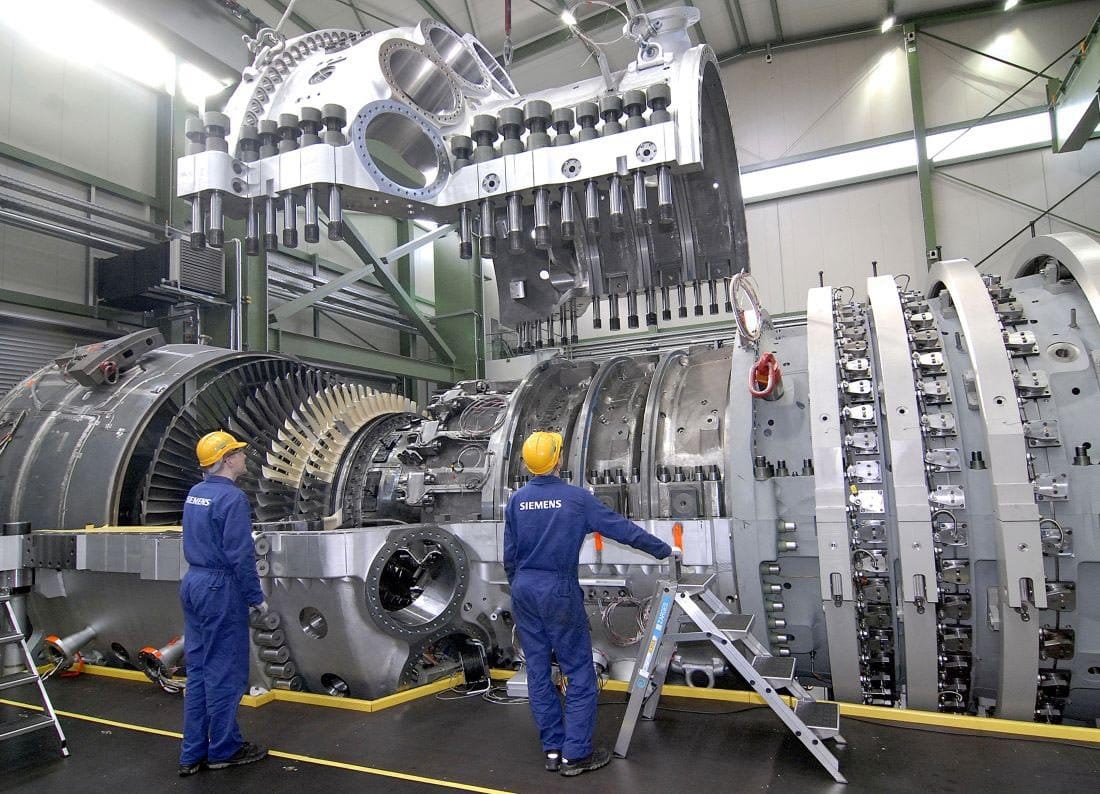
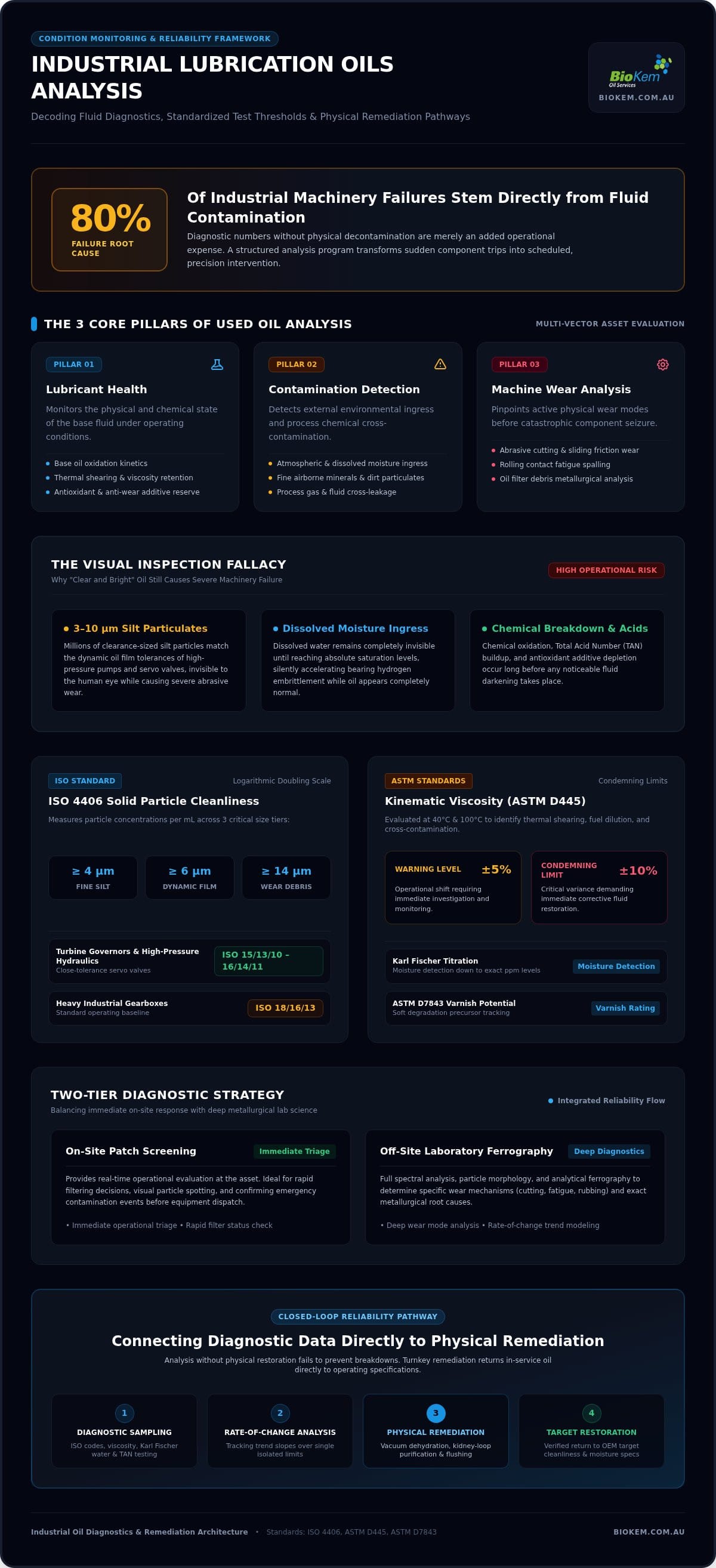
Research shows that up to 80% of industrial machinery failures stem directly from fluid contamination, yet routine fluid sampling often fails to stop sudden component trips. If you have ever parsed a dense laboratory report packed with spectral data and particle counts without receiving actionable remediation steps, you know the frustration. Diagnostic data without physical decontamination is merely an added operational expense. Without a structured response pathway, routine lubrication oils analysis quickly turns into a passive record-keeping exercise rather than an active defense against mechanical wear.
You shouldn’t have to guess whether an elevated contamination trend demands kidney-loop purification or a simple filter changeout. This guide shows you how to select, interpret, and act upon industrial oil analysis to eliminate unplanned equipment downtime across your facility. We will examine the core laboratory test suites, show you how to decode ISO cleanliness codes and varnish potential ratings, and demonstrate how to bridge the gap between diagnostic numbers and turnkey fluid restoration.
Key Takeaways
- A structured lubrication oils analysis regime monitors fluid degradation, external contamination, and internal component wear to transform unpredictable breakdowns into planned maintenance windows.
- Decoding core standards like ISO 4406 cleanliness codes, ASTM D7843 varnish potential, and Karl Fischer moisture titration reveals critical machine risks before physical damage occurs.
- Pairing fast on-site patch screening with off-site laboratory ferrography balances immediate operational triage with deep metallurgical diagnostics.
- Evaluating rate-of-change trends across key markers like Total Acid Number and kinematic viscosity identifies accelerated oil breakdown far more accurately than isolated single-sample thresholds.
- Closing the reliability loop demands connecting diagnostic data directly with physical remediation, using systems like vacuum dehydration and high-efficiency filtration to restore oil to operating specifications.
What Industrial Lubrication Oils Analysis Measures in Modern Machinery
Operating critical rotating equipment without diagnostic fluid monitoring is a gamble. Lubricants are the lifeblood of plant assets; their physical and chemical state reflects internal mechanical health. Precision lubrication oils analysis evaluates base oil degradation, foreign contamination, and active component wear. Routine laboratory testing shifts plant maintenance from reactive firefighting into scheduled, precision intervention, keeping production online across Australian facilities.
Baseline health metrics confirm that an in-service lubricant retains adequate hydrodynamic film strength under severe thermal loads. Modern diagnostics evaluate critical chemical additive reserves, physical properties like kinematic viscosity, and sub-micron particulates generated by friction. Comprehensive fluid testing evaluates three primary degradation mechanisms to verify machine integrity.
To better understand how fluid testing reveals hidden mechanical risks, watch this practical overview:
The Three Pillars of Used Oil Condition Monitoring
A balanced condition-monitoring program tracks three critical vectors:
- Lubricant health: Evaluates base fluid oxidation, thermal shearing, and depletion of sacrificial additives like antioxidants and anti-wear chemistry.
- Contamination detection: Isolates the ingress of atmospheric moisture, fine airborne minerals, process gases, and external chemical elements.
- Machine wear analysis: Identifies active mechanical degradation via oil filter debris analysis, pinpointing cutting wear, fatigue spalling, and sliding friction before catastrophic seizure occurs.
Comprehensive oil analysis monitors lubricant health, external contamination, and mechanical wear simultaneously to safeguard productivity.
Why Visual Inspection Fails to Detect Critical Fluid Failure
Visual fluid checks provide a false sense of security. A sample that appears golden and clear can still harbor millions of clearance-sized silt particles between 3 and 10 microns, precisely matching the dynamic oil film tolerances of high-pressure pumps and servo valves. Chemical oxidation, acid buildup, and antioxidant depletion occur long before any noticeable fluid darkening takes place. Dissolved moisture remains invisible until reaching absolute saturation levels, silently accelerating bearing hydrogen embrittlement while the fluid looks completely normal.
Critical Industrial Oil Analysis Tests and Standards Matrix
Standard off-the-shelf laboratory packages often miss the subtle precursors of catastrophic machine failure. While basic commercial packages report elemental spectroscopy and basic water percentages, mission-critical assets like gas compressors and steam turbines demand specialized testing slates. A comprehensive lubrication oils analysis regime establishes standardized, repeatable metrics across rotating machinery. Kinematic viscosity (ASTM D445) at 40°C and 100°C flags thermal shearing, fuel dilution, and cross-contamination; an operational shift beyond ±5% warrants immediate investigation, while a ±10% variance represents a critical condemning limit.
Particle Counting and ISO 4406 Cleanliness Codes
Optical particle counting standardized under ISO 4406 evaluates solid particulate concentrations per milliliter across three reference sizes: ≥4 µm, ≥6 µm, and ≥14 µm. Because the ISO scale is logarithmic, each single code increase represents a doubling of contaminants per volume. While heavy industrial gearboxes typically operate reliably at ISO 18/16/13, high-pressure hydraulic circuits and turbine governor systems with close-tolerance servo valves demand target cleanliness levels between ISO 15/13/10 and 16/14/11 to avoid abrasive cutting wear.
Moisture Detection via Karl Fischer Titration
Crackle tests and basic hot-plate screenings fail to quantify emulsified or dissolved water. Coulometric Karl Fischer titration (ASTM D6304, specifically Procedure B with thermal evaporation sweep) accurately measures water content down to single parts per million without additive interference. For critical turbine and hydraulic reservoirs, moisture targets must remain under 100 to 200 ppm; levels exceeding 500 ppm rapidly hydrolyze anti-wear additives, oxidize base stocks, and induce hydrogen embrittlement across high-load rolling bearings.
Varnish Potential and Membrane Patch Colorimetry (MPC)
Standard particle counters cannot detect sub-micron degradation byproducts. Membrane Patch Colorimetry (ASTM D7843) filters oil through a 0.45 µm membrane patch, using spectrophotometry to measure insoluble color bodies (reported as ΔE):
- ΔE < 15 (Normal): Low risk of insoluble dropout.
- ΔE 15-25 (Monitor): Incipient thermal degradation and active precursor accumulation.
- ΔE 25-35 (Abnormal): Substantial risk of varnish precipitation onto cooler surfaces.
- ΔE > 35 (Critical): Extreme probability of servo valve sticking, filter blinding, and thermal trips.
Detecting high MPC values early allows reliability engineers to implement targeted remediation before unscheduled shutdowns occur. If your latest reports indicate elevated varnish potential or rising particulate counts, you can consult BioKem’s reliability engineers to audit your fluid condition data.
On-Site Screening vs. Off-Site Laboratory Testing
Relying exclusively on commercial laboratories creates turnaround blind spots, while depending solely on field test kits risks missing complex chemical breakdown. An effective lubrication oils analysis program balances immediate frontline screening with accredited off-site testing. Field instruments offer rapid operational triage, allowing plant technicians to intercept gross contamination before operating restart. In contrast, accredited external laboratories deliver high-precision elemental spectroscopy, Fourier-transform infrared (FTIR) diagnostics, and deep wear particle analysis. Integrating both approaches maximizes maintenance budgets across production assets in Australia.
Evaluating Portable Field Testing and Patch Kits
Handheld density and digital viscometers deliver immediate checks against lubricant cross-contamination and thermal thinning. Alongside digital devices, rugged patch test kits provide maintenance crews with rapid visual verification of solid particulate loading. Technicians draw a representative fluid sample through a calibrated membrane under vacuum, using field optical microscopes to identify severe silting or ferrous swarf in minutes. This immediate triage stops damaged machinery from restarting without waiting days for laboratory couriers.
When to Deploy Advanced Laboratory Ferrography
Standard inductively coupled plasma (ICP) spectroscopy (ASTM D5185) cannot detect particles larger than 5 to 10 microns. When optical counters indicate severe contamination or equipment shows vibration anomalies, maintenance teams must deploy specialized filter ferrogram testing and analytical ferrography. This analytical process magnetically separates wear particles onto a glass slide for microscopic evaluation:
- Cutting wear: Slender, curled metal ribbons pointing directly to severe two-body or three-body abrasive scoring.
- Fatigue spalling: Flat, pitted platelets indicating subsurface rolling-element fatigue and impending bearing failure.
- Rubbing wear: Fine, flat flake clusters generated during boundary lubrication contact and normal break-in.
Classifying particulate shape, size, and metallurgy diagnoses exact failure mechanisms before catastrophic seizures occur. For assets experiencing recurring surface wear under extreme friction, pairing ongoing analysis with high-technology metal protectants from providers like Motorbull helps minimize abrasive contact and shield vulnerable mechanical components.
Establishing an Effective Sampling Cadence
Asset criticality determines sampling intervals. High-risk machinery like main turbine lube reservoirs and primary gas compressors require monthly sampling, while secondary hydraulic circuits operate safely on quarterly rotations. Sampling valves should be installed permanently upstream of return-line filters under turbulent, dynamic flow to ensure repeatability. Drawing static oil from reservoir drains produces misleading particulate spikes and invalidates historical trends. To design an asset-specific condition monitoring program, Contact BioKem for national technical support.
Interpreting Diagnostic Reports to Prevent Component Failure
Evaluating an oil report by isolated red flags creates costly false alarms or missed early-stage failures. True reliability engineering focuses on rate-of-change trending across consecutive samples rather than static numbers. A baseline that shifts upward over three consecutive cycles demands immediate attention, even if individual values sit below generic OEM warning thresholds. Professional lubrication oils analysis correlates physical, chemical, and elemental data points together, confirming active wear mechanisms before technicians open equipment housings.
Tracking Wear Metals to Isolate Failing Components
Elemental spectroscopy (ASTM D5185) measures wear metals down to parts-per-million levels. Tracking specific elemental signatures identifies which components are shedding material under friction:
- Iron and chromium: Point to gear teeth scuffing, roller bearing fatigue, or cylinder liner scoring.
- Copper and lead: Signal bronze bushing erosion, cage fatigue in thrust bearings, or acid-driven cooler leaching.
- Aluminium and silicon: When elevated simultaneously, this combination indicates airborne dirt ingress past faulty breathers, creating abrasive grinding slurry.
Total Acid Number (TAN) and Oxidation Indicators
Total Acid Number (ASTM D664) quantifies acidic degradation byproducts produced as base stocks break down thermally. In non-additive turbine mineral oils, an increase of +0.3 to +0.5 mg KOH/g over fresh baseline values signals rapid oxidation. Once TAN reaches 1.0 to 2.0 mg KOH/g, carboxylic acids aggressively corrode white-metal babbitt bearings. Fourier Transform Infrared (FTIR) spectroscopy pairs with TAN testing, tracking the depletion of phenolic and aminic antioxidants before base oil structures crack under heat.
Setting Actionable Alarm Limits and Work Orders
Generic laboratory thresholds rarely reflect actual operating demands on heavy industrial plant. Reliability managers must set multi-tiered, cumulative alarm limits tied directly to automated maintenance work orders:
- Level 1 (Caution): Viscosity shift of ±5% or a single-code jump in ISO 4406; triggers increased sampling frequency and on-site filter inspection.
- Level 2 (Critical): TAN increase >0.5 mg KOH/g, moisture >300 ppm, or MPC ΔE >25; triggers immediate offline kidney-loop filtration or vacuum dehydration.
- Level 3 (Emergency): Rapid doubling of fine wear metals paired with fatigue flakes; mandates load reduction and scheduled inspection.
To eliminate ambiguity when interpreting laboratory data across critical assets, submit your oil analysis reports to BioKem for a comprehensive engineering evaluation.
Turning Analysis Reports into Corrective Filtration and Flushing
Diagnosing an abnormal fluid condition solves only half the reliability challenge. Routine lubrication oils analysis provides zero asset protection if plant teams file reports away without executing physical remediation. Premature oil dumping is an expensive, environmentally wasteful response when industrial lubricants can often be purified while machines stay in operation. High-efficiency kidney-loop systems, specialized resin media, and mobile dehydration units clean contaminated oil back to specification without interrupting production cycles.
Eliminating Moisture with Vacuum Dehydration Systems
Centrifuges and standard mechanical filters cannot separate tightly dissolved or emulsified water from lubricant base stocks. Deploying a vacuum dehydration oil purification system draws moisture-laden oil into an evacuated chamber, vaporizing water at safe, low temperatures between 50°C and 65°C. This physical separation preserves delicate additive chemistry like extreme-pressure agents while extracting dissolved moisture down to sub-50 ppm levels. Proactive vacuum dehydration protects turbine and compressor systems online, eliminating premature oil changes and preventing water-induced bearing pitting.
Remediating High MPC Varnish with Ion-Exchange Resin
When membrane patch colorimetry tests indicate elevated varnish risk (ΔE > 25), particulate filtration alone will fail because dissolved varnish precursors pass straight through standard micron-rated elements. Specialized varnish removal systems utilize selective ion-exchange and electro-physical separation resin beds to strip soft degradation bodies from circulating oil. As the circulating fluid is scrubbed clean, it re-dissolves built-up deposits coating spool valves, heat exchangers, and bearing journals. BioKem operates high-temperature varnish removal systems (largest in region) to restore critical MPC values and eliminate thermal tripping across major turbine installations.
Deploying High-Velocity Hot Oil Flushing for System Recovery
Post-catastrophic failure repairs and pre-commissioning cleanouts demand deep physical scouring that operational filters cannot provide. Performing professional hot oil flushing and filtering requires circulating heated fluid at high velocity to achieve Reynolds numbers exceeding 4,000. This turbulent condition breaks surface tension along pipe walls, freeing dislodged mill scale, welding slag, and abrasive fatigue debris. BioKem couples high-velocity flushing hardware with ISO 16889-certified filtration consumables to guarantee clean handovers across energy and mining assets. If your latest analysis report calls for targeted contamination removal, Contact BioKem to coordinate rapid national mobilization.
Building a Resilient Oil Condition Monitoring Strategy
Reliable plant operations depend on closing the gap between laboratory diagnostic metrics and decisive mechanical action. Implementing a disciplined lubrication oils analysis program protects heavy capital equipment by identifying fluid degradation, particulate contamination, and mechanical wear long before physical components suffer damage. Tracking cumulative rate-of-change trends rather than static thresholds allows your maintenance team to address incipient issues through precision decontamination instead of resorting to premature fluid disposal.
BioKem delivers complete fluid remediation backed by over 70 years of combined industry experience among staff and an uncompromised safety record of Zero Lost Time Injuries (LTI) since establishment in 2012. Our engineering teams deploy ISO 16889-certified filtration systems and specialized restoration skids nationwide, providing dependable national service coverage to keep your critical assets operating at peak efficiency. To optimize your condition monitoring regime and restore oil cleanliness, consult BioKem’s reliability specialists today.
Frequently Asked Questions
How often should industrial machinery undergo lubrication oils analysis?
Sampling intervals depend directly on machine criticality, operating temperature, and environmental exposure. Critical turbomachinery, primary gas compressors, and high-pressure hydraulic circuits typically require monthly sampling to capture emerging trends. Non-critical gearboxes and secondary circulating reservoirs generally operate safely on quarterly or semi-annual cycles. High-dust mining environments or continuous 24/7 operating regimes across Australia often warrant accelerated testing to catch rapid particulate ingress before boundary friction damages bearings.
Can oil analysis detect mechanical bearing wear before vibration sensors?
Yes, fluid analysis routinely detects microscopic wear debris weeks before rotating components exhibit abnormal vibration frequencies. Analytical ferrography and elemental spectroscopy identify benign rubbing wear transitioning into abnormal fatigue spalling while clearances remain intact. Vibration sensors typically register anomalies only after severe surface pitting, geometric loss, or mechanical imbalance has already developed. Pairing routine fluid testing with vibration monitoring provides early warning across high-load rotational equipment.
What is the difference between Karl Fischer testing and a crackle test?
The crackle test is a crude, qualitative field screening that only flags emulsified or free water above roughly 500 to 1,000 ppm when heated on a hot plate. In contrast, coulometric Karl Fischer titration (ASTM D6304) precisely quantifies dissolved, emulsified, and free moisture down to single parts per million. Karl Fischer titration Procedure B uses thermal vaporization sweep technology, eliminating chemical interference caused by sulfur-phosphorus and anti-wear additive packages.
How do I choose between changing industrial oil and purifying it?
Base your decision on whether the lubricant base oil has chemically cracked or simply suffered physical contamination. If the base oil has severely oxidized with a high Total Acid Number or catastrophic viscosity loss, oil replacement is necessary; to explore high-grade replacement fluids engineered by Rida Lubricants, click here. However, if the fluid exhibits particulate silt, elevated moisture, or varnish precursors while additive reserves remain healthy, physical purification via vacuum dehydration or kidney-loop filtration restores operating specifications at a fraction of oil disposal costs.
Sudden TAN increases point to rapid thermal oxidation caused by localized hot spots, cooler fouling, or operating beyond normal thermal limits. Carboxylic acids form as hydrocarbon molecules react with entrained air and heat, accelerating exponentially once sacrificial phenolic antioxidants deplete. High moisture levels also drive ester hydrolysis, releasing aggressive acidic byproducts. When a sudden TAN spike appears, technicians must inspect heat exchangers and check for excessive system operating pressures.
Can lubrication oils analysis identify hydraulic valve sticking risks?
Yes, routine lubrication oils analysis isolates valve sticking risks by measuring soft degradation precursors using Membrane Patch Colorimetry (ASTM D7843). Standard optical particle counters miss dissolved varnish precursors smaller than 0.4 microns. When thermal cycling occurs, these dissolved sub-micron precursors precipitate onto tight-tolerance spool valves as sticky lacquer, causing erratic actuation. An MPC ΔE reading above 25 warns reliability teams to deploy ion-exchange resin filtration before valves jam completely.
What does an ISO 4406 particle count code represent?
An ISO 4406 code reports cumulative solid particulate quantities per milliliter of oil at three distinct size channels: ≥4 μm, ≥6 μm, and ≥14 μm. For example, in a rating of 16/14/11, each number corresponds to an international scale index where each single code increase represents a doubling of contaminant concentration. This logarithmic classification allows maintenance teams to establish clear, auditable cleanliness targets for high-pressure hydraulics, turbines, and heavy industrial gear sets.

Article by
James McAllister
James McAllister is an industry professional with BioKem Oil Services, specialising in lubrication reliability, oil filtration, contamination control and asset performance. Drawing on BioKem's extensive field experience across turbines, compressors, hydraulic systems and critical rotating equipment, James writes practical, insight-driven articles that help maintenance and reliability teams improve equipment performance, extend asset life and reduce operational risk.