

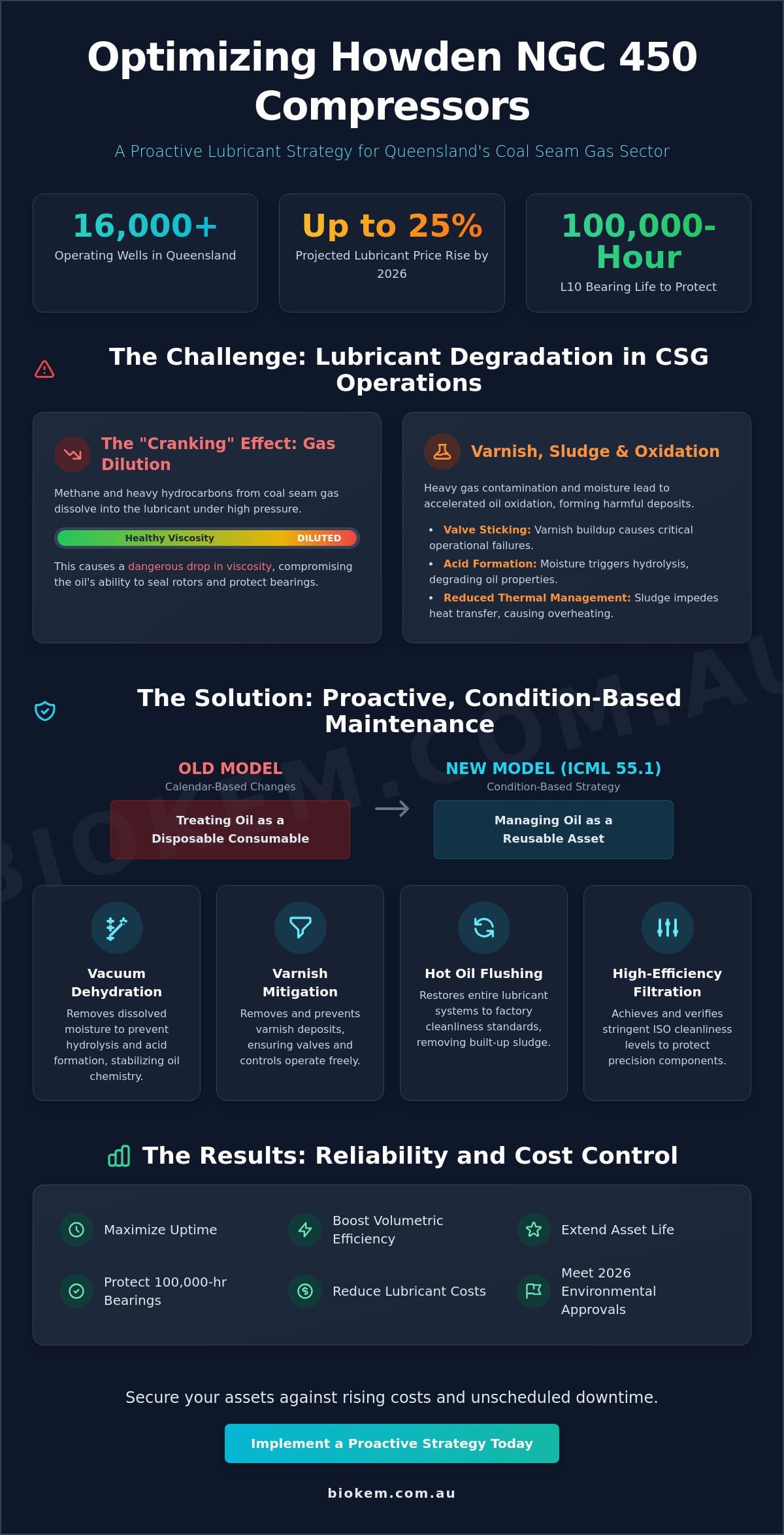
With bulk lubricant prices in Australia rising by up to 25% in early 2026, viewing your compressor oil as a disposable consumable is a costly mistake. You’re likely already dealing with the operational headaches of valve sticking and accelerated oxidation caused by heavy gas contamination. For the 16,000 wells currently operating across the state, effective lubricant maintenance for Howden NGC 450 series screw compressors for Queensland coal seam gas is the only way to prevent unscheduled downtime. It’s about shifting from a calendar-based schedule to a proactive, condition-based strategy that treats your fluid as a critical, reusable asset.
We’ll show you how to master the technical requirements for maintaining these compressors to ensure maximum uptime in demanding environments like the Condamine Alluvium. You’ll learn how to stabilize oil chemistry despite gas dilution and achieve verified ISO cleanliness levels that protect your 100,000-hour bearing life. This article outlines the precise steps for implementing ICML 55.1 standards, utilizing vacuum dehydration and varnish mitigation to extend asset life and meet the strict environmental conditions of the latest 2026 federal approvals.
Key Takeaways
- Understand the critical role of lubricants in thermal management and gas sealing beyond basic friction reduction in Howden NGC 450 units.
- Identify the “cranking” effect where methane and heavy hydrocarbons dissolve into the oil, causing a dangerous viscosity drop that threatens bearing longevity.
- Master precise lubricant maintenance for Howden NGC 450 series screw compressors for Queensland coal seam gas to eliminate varnish buildup and prevent unscheduled valve sticking.
- Learn why standard oil changes are insufficient for high-uptime CSG operations and how hot oil flushing restores system cleanliness to factory standards.
- Transition to a proactive maintenance model using detailed oil analysis to treat your industrial fluids as reusable assets rather than disposable costs.
The Critical Role of Lubrication in Howden NGC 450 Series Compressors
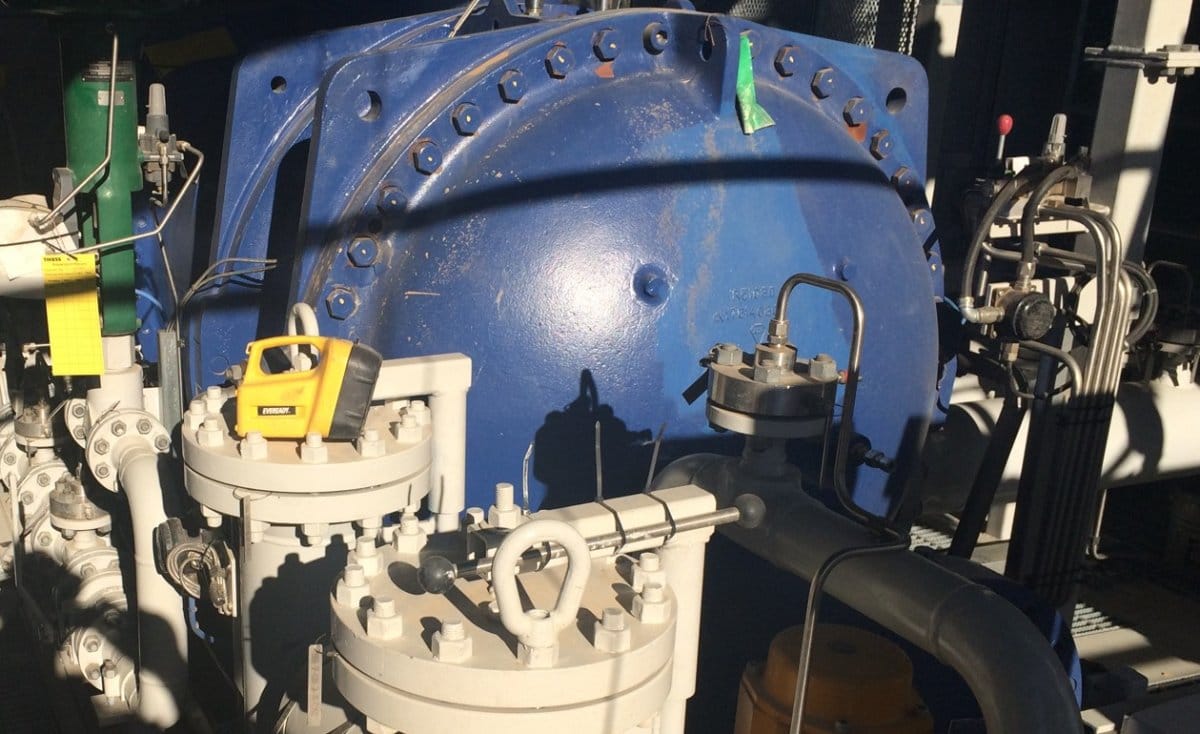
The Howden NGC 450 series is the undisputed workhorse of the Queensland coal seam gas sector, with over 16,000 wells relying on its consistent performance. In these high-pressure environments, the lubricant does far more than just reduce friction between moving parts. It serves as a critical cooling medium and a mechanical seal within the Rotary-screw compressor framework. Without precise lubricant maintenance for Howden NGC 450 series screw compressors for Queensland coal seam gas, the machine’s ability to manage the heat of compression and maintain gas pressure quickly degrades.
To better understand the mechanical advantages of this specific series, watch this helpful video:
Screw compressors are uniquely sensitive to oil viscosity changes because they rely on the fluid to fill the clearances between the rotors. If the oil becomes too thin due to gas dilution, it can’t maintain the necessary pressure. This leads to internal leakage and a significant drop in volumetric efficiency. It’s a delicate balance; the oil must be heavy enough to seal but light enough to flow and cool effectively. This thermal management is vital, as the lubricant absorbs the heat generated during gas compression and carries it to external heat exchangers.
Understanding the NGC 450 Screw Profile
Oil injected into the compression chamber prevents metal-to-metal contact between the high-speed rotors by creating a hydrodynamic wedge. This wedge supports the mechanical load during the compression cycle. The injected oil acts as a dynamic sealant between the rotor lobes and the housing to prevent high-pressure gas from bypassing back to the intake. When gas solubility reduces the oil’s viscosity, this sealing capability vanishes, forcing the compressor to work harder and consume more energy to achieve the same output.
CSG Environment Challenges for Lubricants
Raw coal seam gas often contains high moisture levels, which triggers oil hydrolysis in certain synthetic base stocks. This chemical breakdown leads to acid formation and permanent loss of lubricating properties. Additionally, heavier hydrocarbons found in CSG streams can physically displace the protective oil film, a phenomenon known as ‘washout.’ This leaves internal components vulnerable to rapid wear. Implementing rigorous lubricant maintenance for Howden NGC 450 series screw compressors for Queensland coal seam gas ensures that these chemical interactions are monitored before they cause catastrophic mechanical failure.
Managing Gas Solubility and Dilution in CSG Compression
In the high-pressure environment of the Condamine Alluvium, methane and heavier hydrocarbons like ethane or propane don’t just pass through the compressor; they dissolve into the lubricant. This process follows Henry’s Law, where gas solubility increases proportionally with pressure. For operators, this leads to a “cranking” effect, a sudden and significant drop in viscosity that compromises the lubricant’s ability to protect internal components. Understanding these compressor lubrication fundamentals is essential for preventing premature wear in the NGC series.
Effective lubricant maintenance for Howden NGC 450 series screw compressors for Queensland coal seam gas requires constant vigilance over the fluid’s flash point. As light-end hydrocarbons accumulate, the flash point drops, signaling a high level of contamination that increases fire risk and reduces film strength. With bulk lubricant prices rising by up to 25% in early 2026, simply disposing of diluted oil is an unsustainable practice. Treating the fluid as a reusable asset through purification is both economically and environmentally responsible. It reduces the volume of hazardous waste while maintaining the 100,000-hour L10 bearing life designed for these machines.
Viscosity Control Strategies
Selecting lubricants with a high Viscosity Index (VI) ensures the fluid remains stable across the wide temperature fluctuations common in Queensland’s climate. Operators should manage the discharge port temperature carefully; keeping it high enough to prevent gas condensation but low enough to avoid thermal cracking. Regular oil analysis allows technical teams to track these viscosity trends over time, providing a clear window into the health of the system. This proactive approach identifies dilution issues before they lead to metal-to-metal contact.
Degassing and Purification Mechanisms
The oil separator is the primary defense, recovering lubricant from the gas stream before it exits the unit. However, standard separators often struggle during surges of high-moisture coal seam gas. When mechanical separation hits its limit, vacuum dehydration becomes necessary. This process uses a vacuum to lower the boiling point of contaminants, effectively boiling off dissolved gases and water without damaging the base oil. If you’re seeing persistent viscosity drops, implementing a customized purification program can restore your fluid to its original specifications without requiring a full oil change.
Varnish Mitigation: Preventing Valve Sticking and Thermal Failures
Varnish is more than just a sign of aging oil; it’s a sticky, insoluble byproduct of lubricant oxidation and thermal stress that can cripple a compressor’s internal mechanics. In the continuous-duty cycles of the Queensland gas fields, Howden NGC 450 units are particularly susceptible to this resinous buildup. When lubricants are pushed to their thermal limits, chemical bonds break down, creating polar molecules that eventually plate out on cooler metal surfaces. This process is documented extensively in academic research on compressor lubrication, which emphasizes how temperature spikes accelerate the transition from soluble to insoluble contaminants.
Varnish acts as a “silent” efficiency killer by coating the internal surfaces of heat exchangers. This layer of lacquer serves as an insulative barrier, significantly reducing the cooling system’s ability to dissipate heat. As operating temperatures rise because of this insulation, the rate of oil oxidation doubles for every 10-degree Celsius increase, creating a destructive feedback loop. Effective lubricant maintenance for Howden NGC 450 series screw compressors for Queensland coal seam gas must address this chemical degradation to prevent the premature failure of seals and expensive rotor sets.
Identifying Varnish in the System
Standard Membrane Patch Colorimetry (MPC) testing is a useful baseline, but it often provides a false sense of security. MPC measures the varnish potential of the oil, but it doesn’t account for the varnish that has already adhered to the metal surfaces of your compressor. Operators should look for visual indicators like brown, lacquer-like stains on internal housings or sight glasses. A primary operational red flag is “hunting” in control valves. When varnish accumulates on valve stems, it increases friction, causing erratic movements and inconsistent gas flow that disrupts the entire gathering string.
Effective Removal Technologies
Mechanical filtration, while necessary for removing particulate matter, is largely ineffective against dissolved varnish precursors. To truly clean a system, you must implement a dedicated varnish removal system that can strip these deposits while the compressor remains in operation. Relying on a traditional “drain and fill” oil change is a common mistake. New oil has a high natural solvency; it will immediately begin stripping the old varnish off the internal walls, becoming saturated and degraded within hours of the restart. By using specialized mitigation technology, you extend the life of your critical components and ensure the NGC 450 maintains its designed 100,000-hour bearing life without the need for chemical-heavy flushes.
Proactive Maintenance: Hot Oil Flushing and High-Efficiency Filtration
Standard oil changes are often insufficient for high-uptime CSG compressors because they leave up to 15% of contaminated residual fluid in dead legs, coolers, and housing low points. This remaining fluid immediately seeds new oil with oxidation precursors and particulates. To achieve the 100,000-hour L10 bearing life designed for these units, operators must look beyond simple fluid replacement. Effective lubricant maintenance for Howden NGC 450 series screw compressors for Queensland coal seam gas utilizes hot oil flushing to restore the entire system to factory-level cleanliness.
The mechanics of a successful flush rely on achieving turbulent flow. By heating the oil to approximately 65°C and utilizing external high-flow pumps, we increase the Reynolds number beyond 4,000. This creates a scouring effect on the internal pipework, dislodging settled silt and metal fines that laminar flow cannot move. This process ensures that the system reaches stringent ISO 4406 cleanliness targets, typically aiming for 16/14/11 or better to protect the precision-engineered rotor profiles of the NGC 450 series.
Designing a Flushing Program
A structured approach is necessary to ensure the intervention is both safe and effective. We follow a logical sequence to maximize the removal of contaminants:
- Step 1: Perform a comprehensive system audit and baseline oil analysis to identify specific contamination profiles and wear metals.
- Step 2: Integrate external high-capacity filtration units and install paddle flushing screens at critical points to monitor the capture of debris in real-time.
- Step 3: Execute the high-velocity flush at elevated temperatures, cycling through various flow paths to ensure every internal surface is cleaned.
Selecting High-Performance Filtration Hardware
Maintaining these cleanliness levels during continuous operation requires superior hardware. We utilize Filters S.p.A. technology because it offers high Beta ratios, which are far more critical than simple micron ratings in demanding CSG environments. A Beta ratio of 1000 at 3 microns means the filter captures 99.9% of particles at that size, whereas a nominal filter may only capture 50%. Sub-micron filtration is required to capture varnish precursors because these soft contaminants are typically smaller than 0.8 microns and easily pass through standard industrial filters. If your current filtration strategy isn’t meeting these benchmarks, consider an engineered filtration upgrade to stabilize your asset’s performance.
Achieving Long-Term Reliability for Howden CSG Assets
The 15% to 25% increase in bulk lubricant prices recorded in early 2026 has transformed fluid management from a routine task into a critical financial strategy. For operations utilizing the Howden NGC 450 series, the economic case for advanced fluid management is undeniable. Reactive repairs are no longer viable in an environment where global supply chain disruptions drive costs upward. Integrating detailed oil analysis into a proactive maintenance strategy allows for the early detection of wear patterns and chemical instability. This proactive stance ensures that your assets remain compliant with the 126 environmental conditions mandated by the Australian federal government for major CSG expansions approved in March 2026.
Compliance remains a moving target in the Queensland gas fields. The introduction of the Regional Planning Interests and Other Legislation Amendment Bill on March 25, 2026, highlights the increasing scrutiny on subsidence and water resource impact. Effective lubricant maintenance for Howden NGC 450 series screw compressors for Queensland coal seam gas plays a vital role in this regulatory landscape. By preventing leaks through superior seal preservation and reducing waste through purification, operators demonstrate the environmental responsibility required under the Safeguard Mechanism. BioKem Oil Services’ approach aligns technical expertise with these local standards, ensuring your operation meets net-zero targets while maintaining peak mechanical performance.
The Value of Onsite Technical Support
Reducing the time between sampling and action is critical during high-pressure maintenance windows. Utilizing onsite testing provides immediate data on particulate levels and varnish potential without waiting for external lab results. This immediate feedback loop is essential for training staff to recognize the subtle shifts in oil color or odor that precede mechanical failure. For short-term purification needs or intensive cleaning projects, utilizing equipment hire allows you to address contamination spikes without the capital expenditure of permanent installations.
Conclusion: A Commitment to Asset Longevity
The maintenance framework for the NGC 450 requires a fundamental shift in perspective. It’s time to stop treating oil as a consumable and start treating it as a critical mechanical asset. By mastering the technical requirements of gas solubility management, varnish mitigation, and high-velocity flushing, you protect the 100,000-hour life of your bearings. Lubricant maintenance for Howden NGC 450 series screw compressors for Queensland coal seam gas is the cornerstone of a reliable and sustainable CSG operation. Contact BioKem Oil Services today for a comprehensive system audit to secure your infrastructure’s future.
Securing the Future of Your Gas Compression Infrastructure
Achieving the full potential of your mechanical assets requires moving beyond traditional lubrication schedules. By focusing on the chemical stability of the fluid and the cleanliness of the entire system, you safeguard the high-precision rotor profiles against the unique contaminants found in Australian gas fields. This approach directly supports the long-term operational goals of modern coal seam gas infrastructure while reducing the environmental footprint of frequent oil disposal. Transitioning to a proactive model ensures your site remains resilient against the rising costs of industrial lubricants and the tightening of environmental regulations.
Effective lubricant maintenance for Howden NGC 450 series screw compressors for Queensland coal seam gas is the foundation of site reliability. BioKem Oil Services brings specialized expertise in varnish mitigation and high-velocity flushing to ensure your compressors operate at peak thermal efficiency. As the authorized Australian distributor for Filters S.p.A., we provide the sub-micron filtration technology necessary to capture oxidation precursors before they manifest as mechanical failure. Our national onsite technical deployment capabilities ensure your team has the support needed to navigate the evolving industrial landscape.
Request a technical consultation for your Howden NGC 450 maintenance program and partner with BioKem Oil Services to secure your asset’s future.
Frequently Asked Questions
What is the recommended ISO 4406 cleanliness level for Howden NGC 450 compressors?
The target ISO 4406 cleanliness level for Howden NGC 450 compressors is 16/14/11. Maintaining this benchmark is critical to protecting precision-engineered rotor profiles and achieving the 100,000-hour bearing life designed by the manufacturer. Deviations from this standard increase the risk of mechanical wear and internal leakage, which reduces the compressor’s volumetric efficiency in high-pressure CSG environments.
How often should I perform MPC varnish testing on my CSG lubricant?
You should perform Membrane Patch Colorimetry (MPC) testing at least quarterly or every 2,000 operating hours. Frequent testing is essential in Queensland gas fields because high thermal stress accelerates oil degradation. Since standard oil analysis can miss the early stages of varnish formation, regular MPC checks provide a proactive warning before control valves begin to hunt or heat exchangers lose efficiency.
Can hot oil flushing be performed while the compressor is online?
Hot oil flushing is an offline procedure that cannot be performed while the compressor is operating. It requires the system to be drained of service oil and connected to external high-velocity pumps and heating units. This setup achieves the turbulent flow, with Reynolds numbers exceeding 4,000, necessary to scour internal pipework and remove settled contaminants that standard filtration cannot reach during normal operation.
What are the first signs of gas dilution in a screw compressor lubricant?
The first signs of gas dilution are a measurable drop in oil viscosity and a reduction in the fluid’s flash point. These changes occur as methane and heavier hydrocarbons dissolve into the lubricant under pressure. Operators should monitor these trends through monthly oil analysis to prevent the “cranking” effect from compromising the hydrodynamic wedge that protects the compressor’s high-speed rotors.
Why is moisture particularly damaging to synthetic oils used in CSG gathering?
Moisture triggers hydrolysis in synthetic base stocks, forming acids that damage internal seals and bearings. Effective lubricant maintenance for Howden NGC 450 series screw compressors for Queensland coal seam gas utilizes vacuum dehydration to boil off this water at low temperatures. This process preserves the lubricant’s chemistry without the thermal stress of high-heat evaporation, preventing the permanent loss of additive functionality.
How does varnish mitigation differ from standard oil filtration?
Varnish mitigation utilizes specialized media to remove sub-micron polar contaminants, whereas standard filtration only captures hard, insoluble particles. Standard filters typically have a 3-micron or 10-micron rating, which allows soft varnish precursors to pass through and plate out on metal surfaces. Mitigation systems strip these precursors from the oil, preventing the sticky deposits that cause valve sticking and thermal failures.
What is the benefit of using Filters S.p.A. products for Howden compressors?
Filters S.p.A. technology provides Beta 1000 efficiency, capturing 99.9% of targeted contaminants. As the authorized Australian distributor, BioKem Oil Services ensures these specialized components are available for the NGC 450 series. These filters are essential for maintaining the sub-micron cleanliness required to prevent varnish, offering a higher level of protection than nominal industrial filters used in standard gas gathering applications.
Is it more cost-effective to hire or buy oil filtration equipment for a CSG site?
It’s often more cost-effective to hire high-flow skids for one-off flushing events. However, for ongoing lubricant maintenance for Howden NGC 450 series screw compressors for Queensland coal seam gas, purchasing a permanent varnish mitigation unit provides better long-term ROI. BioKem Oil Services offers both options, allowing operators to scale their fluid management strategy based on the specific contamination load and uptime requirements of their CSG site.