


Industry data from the 2023 Lubrication Excellence report reveals that approximately 80% of mechanical wear in heavy machinery is caused by microscopic particles that easily bypass standard OEM filters. You likely recognize the frustration of valve sticking or unexpected component failure during a critical production cycle. It’s an expensive reality for site managers who struggle to maintain strict ISO 4406 cleanliness standards within the harsh, dusty conditions of the Australian outback or humid coastal hubs. You don’t have to accept rising disposal costs as an inevitable part of doing business.
This technical guide explores how modern industrial oil filtration systems australia can transform your lubricants from a consumable expense into a long-term asset. We’ll outline the specific hardware configurations and professional intervention strategies needed to achieve a 60% reduction in oil consumption while securing your equipment’s reliability for 2026 and beyond. We’re covering everything from high-efficiency bypass systems to the latest biological monitoring techniques that ensure your fleet remains operational, profitable, and environmentally compliant.
Key Takeaways
- Master the “80% Rule” to identify how fluid contamination drives mechanical failure and transition your maintenance strategy from reactive to proactive.
- Compare surface and depth filtration technologies to determine the most effective mechanism for removing both solid particulates and soft varnish from your critical systems.
- Evaluate the strategic benefits of equipment hire versus permanent capital investment for industrial oil filtration systems australia to optimize operational costs during emergency purifications or scheduled shutdowns.
- Ensure technical compliance by benchmarking fluid cleanliness against ISO 4406:2017 standards and utilizing NATA-accredited laboratory analysis for precise performance validation.
- Discover why integrated solutions like Hot Oil Flushing are essential for deep-system decontamination when standard filtration alone cannot restore asset reliability.
Table of Contents
-
Advanced Filtration Technologies: From Particulates to Varnish
-
Selecting the Right System: Hire vs. Purchase & Distribution
The Role of Industrial Oil Filtration in Asset Reliability
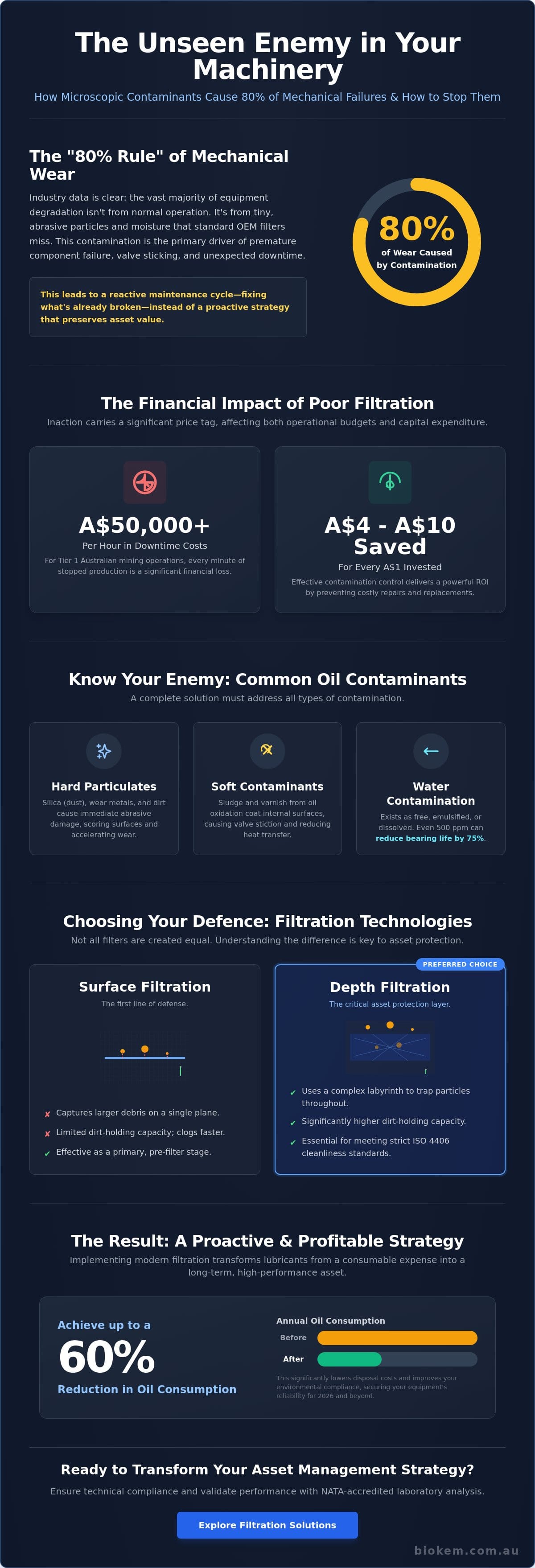
Industrial oil filtration is a foundational pillar of proactive maintenance. It’s not just about cleaning fluid; it’s about extending the operational life of multi-million dollar assets. Industry research consistently confirms the "80% Rule," stating that 80% of mechanical wear and subsequent failures result directly from fluid contamination. By implementing robust contamination control principles, Australian operators can shift from reactive repairs to predictive reliability. This shift is essential for maintaining a competitive edge in sectors where equipment uptime is the primary driver of profitability.
To better understand how these systems function in a factory setting, watch this demonstration:
Effective industrial oil filtration systems australia wide reduce the economic burden of premature oil changes and component replacements. Beyond the direct costs, poor filtration leads to excessive oil waste, which conflicts with Australia’s 2030 emissions reduction targets and corporate ESG mandates. Maintaining oil at peak cleanliness levels supports a circular economy by keeping lubricants in service for years rather than months, significantly lowering the environmental footprint of heavy industry.
The Cost of Contamination in Australian Industry
Australia’s mining and manufacturing sectors face unique challenges. High ambient temperatures and airborne dust accelerate oil oxidation and abrasive wear. Varnish, a soft contaminant, often goes undetected until a valve sticks or a bearing fails, leading to downtime that can cost upwards of A$50,000 per hour in Tier 1 mining operations. For Australian mining enterprises, achieving ISO 4406 cleanliness targets through advanced filtration delivers an ROI where every A$1 spent on contamination control typically saves A$4 to A$10 in repair and replacement costs. Operators often find that varnish removal systems are essential for preventing these hidden failures.
Understanding the Types of Oil Contaminants
Contaminants aren’t all the same. Hard particulates like silica or wear metals cause immediate abrasive damage. Soft contaminants, including sludge and varnish, result from chemical degradation and oxidation, coating internal surfaces and reducing heat transfer. Water is another critical threat. It exists in three states: dissolved, emulsified, and free. Even at levels as low as 500 ppm, water can reduce bearing life by 75%. Integrated industrial oil filtration systems australia must address all three phases of water to ensure long-term asset health. Using specialised filtration systems ensures that both particulate and moisture levels remain within safe operating limits.
Advanced Filtration Technologies: From Particulates to Varnish
Modern industrial oil filtration systems australia have evolved beyond basic mechanical straining. To meet the reliability standards of 2026, assets require a multi-stage approach that addresses both solid contaminants and chemical degradation. Surface filtration serves as the first line of defence, capturing larger debris on a single plane. However, depth filtration is the preferred choice for critical assets. It utilizes a complex labyrinth of fibres to trap particles throughout the entire thickness of the media, providing a significantly higher dirt-holding capacity.
Beyond traditional media, electrostatic oil purification offers a non-mechanical alternative. While mechanical filters are limited by their pore size, electrostatic systems use high-voltage fields to attract polar contaminants. This process removes sub-micron particles and soft contaminants that typically pass through even the finest 3-micron filters. Integrating these technologies ensures that lubricants maintain their intended viscosity and additive balance over longer service intervals.
-
Interception: Particles are physically blocked by the filter matrix.
-
Adsorption: Molecular forces bind fine contaminants to the filter fibres.
-
Inertial Impaction: Heavy particles collide with the media due to fluid velocity.
Vacuum Dehydration and Water Removal
Water is a primary catalyst for oil oxidation and bearing fatigue. Vacuum Dehydration units (VDU) are essential for removing dissolved, emulsified, and free water without damaging the oil’s molecular structure. By creating a vacuum, these units allow water to boil off at temperatures as low as 45°C, which is critical for preserving heat-sensitive additives. For applications involving massive water ingress, coalescing technology remains the most efficient method for rapid bulk separation.
Varnish Mitigation Systems
Varnish is a common cause of sticking valves and bearing failures in high-speed turbines. It begins as soluble oxidation by-products that precipitate out of the oil during temperature or pressure changes. Dedicated Varnish Removal Systems target these sub-micron precursors before they can form hard deposits on internal surfaces. This proactive approach prevents the costly "stick-slip" phenomenon in servo valves, a frequent issue in Australian power generation facilities. Maintaining low Membrane Patch Colorimetry (MPC) values is the most effective way to ensure long-term system stability.
Specialist Oil Filters and Particle Removal
In the demanding environments of Australian mining and heavy industry, filter efficiency is measured by Beta ratings. A Beta ratio of 1000 (βx[c] ≥ 1000) indicates that a filter captures 99.9% of particles at a given micron size. Utilizing specialist oil filters with high-efficiency media is vital for protecting high-pressure hydraulic circuits from the abrasive dust found in regions like the Pilbara. High-quality filtration reduces the environmental impact of industrial operations by extending the life of the oil and reducing the volume of waste generated annually.
If you’re looking to enhance your asset reliability, you can browse our range of high-performance filtration products designed for local conditions.
Selecting the Right System: Hire vs. Purchase & Distribution
Choosing between capital investment and operational hire is a pivotal decision for maintenance managers across the country. For facilities with stable, long-term production schedules, permanent industrial oil filtration systems Australia wide offer the most consistent protection against fluid degradation. These fixed installations integrate directly into your existing infrastructure, providing 24/7 monitoring and purification. This proactive approach prevents the accumulation of varnish and micro-particles before they can trigger a component failure. It’s a strategic move that shifts maintenance from a reactive cost center to a reliability-focused asset.
Engineering teams must evaluate technical specifications with precision before committing to a specific hardware configuration. Flow rates, oil viscosity, and system pressure are the primary variables that dictate performance. For instance, high-viscosity gear oils like ISO VG 460 require specialized pump sets to avoid cavitation, while high-pressure hydraulic lines demand housings rated for 315 bar or higher. Ignoring these parameters often leads to bypass events where contaminated oil avoids the filter media entirely, rendering the system ineffective. BioKem provides the technical oversight necessary to ensure hardware matches the specific rheological properties of your lubricants.
Filters S.p.A. Technology in Australia
BioKem serves as the sole Australian distributor for Filters S.p.A. hardware, bringing European engineering excellence to the local market. These systems are the global standard for high-performance purification because they prioritize dirt-holding capacity and modularity. The Filters S.p.A. Australia range includes stainless steel housings designed for the harsh conditions found in Pilbara mining sites and offshore platforms. These units feature advanced sensor arrays that provide real-time data on ISO 4406 cleanliness codes. This level of transparency allows operators to see the exact impact of the filtration process on fluid health, ensuring compliance with 2026 reliability standards.
The Economics of Equipment Hire
Permanent hardware doesn’t always fit the immediate needs of a facility, especially during emergency contamination spikes or scheduled shutdowns. Equipment hire solves these temporary challenges without requiring a massive capital expenditure. Many operators find that hiring a Vacuum Dehydration Unit (VDU) or a high-speed flushing rig is the most cost-effective way to handle water ingress or post-overhaul debris. This flexibility is vital when you consider that a large-scale permanent system can cost between A$50,000 and A$150,000 depending on the complexity.
The BioKem hire fleet includes specialized VDU units, portable filter carts, and high-volume flushing rigs. These tools are maintained to strict standards, ensuring they arrive on-site ready to perform. Hiring also provides a practical "proof of concept" for teams considering a permanent purchase. It allows you to verify the effectiveness of the technology on your specific oil chemistry before making a long-term financial commitment. This approach ensures your industrial oil filtration systems Australia strategy remains both biologically sound and fiscally responsible.
Implementation: Standards, Analysis, and Compliance
Operational reliability for industrial oil filtration systems australia relies on rigorous adherence to international benchmarks and local regulatory frameworks. It isn’t enough to simply install hardware; engineers must integrate a systematic approach to fluid management that prioritises data over assumptions. This begins with the ISO 4406:2017 standard, which serves as the universal language for fluid cleanliness. By establishing baseline metrics, Australian facilities can move from reactive maintenance to a predictive model that significantly reduces the A$1.5 billion lost annually to fluid-related machinery downtime across the domestic mining and manufacturing sectors.
Interpreting ISO 4406 Cleanliness Codes
The ISO 4406:2017 system uses a three-digit code to represent the quantity of particles larger than 4μm, 6μm, and 14μm per millilitre of fluid. For example, a code of 18/16/13 indicates a specific range of particle counts for each size category. High-pressure hydraulic systems typically require a stricter target, such as 16/14/11, to protect sensitive servo-valves. Conversely, large scale turbine systems may operate reliably at 18/16/13. Target cleanliness levels must be asset-specific because the clearance tolerances of internal components determine the sensitivity to specific particle sizes.
The Importance of Oil Analysis
While particle counting provides a snapshot of cleanliness, comprehensive oil analysis offers a deeper diagnostic view. Advanced techniques like Filter Ferrogram Analysis allow technicians to identify the shape, composition, and size of wear debris. This process distinguishes between normal "break-in" wear and catastrophic fatigue. Varnish potential testing is also critical, as it measures the sub-micron soft contaminants that standard filters often miss. Using these analytical tools validates the performance of your industrial oil filtration systems australia, ensuring the biological and chemical integrity of the lubricant remains intact over thousands of operating hours.
Australian operations must also maintain compliance with state-based EPA regulations regarding waste oil disposal and spill prevention. Proactive sampling schedules, conducted every 250 to 500 operating hours for critical assets, create a transparent audit trail for environmental reporting. This data-driven approach demonstrates a commitment to sustainability while protecting the long-term health of the machinery. Biokem assists partners in establishing these schedules using NATA-accredited laboratory results to guide every filtration decision.
Ensure your fluid assets meet the highest international standards for reliability and environmental compliance. Explore our high-performance filtration hardware to secure your facility’s operational future.
The BioKem Advantage: Integrated Oil Management
BioKem provides a holistic approach to fluid health that exceeds the capabilities of standard industrial oil filtration systems australia. While stationary or kidney-loop filters remove suspended particles, they often fail to address the varnish and sludge adhered to internal pipework surfaces. BioKem’s methodology integrates advanced filtration with technical onsite interventions to ensure total system integrity. This integrated strategy reduces unplanned downtime by up to 45% in heavy industrial applications. We don’t just supply hardware; we deploy custom engineered solutions that address the root causes of fluid degradation.
Hot Oil Flushing: The Ultimate System Cleanse
Standard filtration operates at laminar flow rates, which often leaves heavy contaminants trapped in dead legs and elbows of complex machinery. BioKem utilizes high-velocity Hot Oil Flushing Services to achieve turbulent flow, typically targeting a Reynolds Number exceeding 4,000. This process dislodges sub-micron particles and oxidation by-products that permanent filters can’t reach. By combining this aggressive cleansing with high-efficiency filtration, operators can achieve ISO 4406 cleanliness levels as low as 14/12/9. This significantly extends the service life of critical components like servo valves and high-speed bearings.
-
Removes built-up debris and scale from internal pipe walls.
-
Prepares new systems for commissioning to prevent infant mortality of components.
-
Synergises with permanent industrial oil filtration systems australia for sustained reliability.
BioKem’s "Green" oil management philosophy focuses on fluid life extension rather than disposal. This approach aligns with Australian environmental regulations and corporate ESG targets. By maintaining hydrocarbons at peak molecular stability through precision filtration and bioremediation techniques, we help clients reduce oil consumption by 30% to 50% annually. We treat oil as a high-value asset to be preserved, which reduces both the ecological footprint and the total cost of ownership for industrial lubricants.
Partnering for Long-Term Reliability
Moving from reactive repairs to proactive fluid management requires technical precision and local expertise. BioKem supports Australian industry through a network of specialists who deploy onsite to solve complex contamination issues. We provide the equipment and the analytical data needed to make informed maintenance decisions. Our commitment to sustainability ensures that your operations remain compliant with evolving environmental standards while maximizing machine uptime. This partnership ensures that your fluid systems remain optimized for the long term. Contact BioKem for a Technical Consultation to secure your facility’s operational future.
Securing Operational Longevity Through Precision Oil Management
Maintaining asset reliability in 2026 requires a strategic shift toward integrated oil management. Effective contamination control focuses on achieving strict ISO 4406 cleanliness levels and addressing chemical degradation like varnish before it triggers a system failure. Transitioning from reactive maintenance to proactive industrial oil filtration systems australia allows operators to significantly extend component life and reduce unnecessary waste. Industry data suggests that maintaining fluid purity can reduce wear-related failures by over 70% in high-pressure hydraulic circuits.
BioKem provides the technical infrastructure and local expertise required to navigate these complex industrial demands. We’re the sole Australian distributor for Filters S.p.A. and provide expert onsite technical services delivered nationally. Our team specialises in ISO 4406 compliance and varnish mitigation to ensure your lubricants remain within specification for longer. Consult with our technical team for a custom filtration solution that aligns with your operational goals and environmental commitments. Protecting your machinery today ensures a more sustainable and profitable production cycle tomorrow.
Frequently Asked Questions
What is the most effective way to remove water from industrial oil?
Vacuum dehydration is the most effective method for removing all three states of water from industrial lubricants. This process utilizes a vacuum to lower the boiling point of water, allowing it to evaporate at temperatures around 50°C without damaging the oil’s molecular structure. It’s capable of reducing water content from 5,000 ppm to less than 100 ppm. This is essential for preventing microbial growth and maintaining chemical stability in Australian hydraulic systems.
How often should I change filters in a high-contamination environment?
You should change filters when the differential pressure reaches the manufacturer’s limit, which is typically 1.5 to 2.0 bar. In high-contamination Australian mining environments, this often occurs every 750 operating hours. Relying on fixed dates is risky because a 20% increase in particulate load can saturate a media element weeks ahead of schedule. Monitoring pressure gauges ensures you don’t bypass contaminants into sensitive components or waste money on premature replacements.
What is the difference between a standard filter and a varnish mitigation system?
Standard filters remove solid particles through mechanical straining, while varnish mitigation systems target dissolved oxidation by-products. Standard media usually stops at 3 microns, but varnish precursors are often smaller than 0.1 microns. These specialized systems use ion exchange resins or cellulose-based depth filtration to chemically or electrostatically attract polar contaminants. This prevents the sticky lacquer that causes valve sticking in 70% of high-pressure hydraulic failures.
Can I meet ISO 4406 standards with a portable filter cart?
Portable filter carts are highly effective for achieving ISO 4406 cleanliness targets through offline kidney-loop filtration. By utilizing high-efficiency elements, these industrial oil filtration systems australia can take a reservoir from a dirty 22/20/18 rating down to a pristine 16/14/11 within 24 hours of continuous operation. It’s a versatile solution for pre-filtering new oil, which often arrives from the refinery exceeding ISO limits by 300% or more.
Is it better to hire or buy oil filtration equipment for a short-term project?
Hiring equipment is the superior choice for projects lasting less than six months or for one-off decontamination tasks. Choosing to rent avoids an initial capital outlay that can exceed A$15,000 for a high-quality vacuum dehydrator. It also ensures you’re using the latest 2026 technology without the long-term burden of maintenance and storage. For permanent installations where equipment runs 24/7, purchasing usually provides a better return on investment over a three-year period.
What are the benefits of using Filters S.p.A. products in Australia?
Filters S.p.A. products provide exceptional dirt-holding capacity and are engineered to meet rigorous Australian environmental and safety regulations. These elements often feature a Beta 1000 rating, meaning they capture 99.9% of targeted particles. Biokem integrates these biological-friendly components to ensure that industrial operations maintain high efficiency while reducing their ecological footprint. Their robust construction handles the 45°C+ temperatures common in remote Australian industrial sites without compromising structural integrity.
How does hot oil flushing differ from standard oil filtration?
Hot oil flushing is a high-velocity cleaning process used during commissioning, whereas standard filtration is a maintenance task. Flushing requires heating the oil to 60°C and achieving a Reynolds number above 4,000 to create turbulent flow. This turbulence scours the internal walls of pipes to remove scale and welding slag. Standard filtration uses laminar flow to remove particles from the bulk oil during normal machine operation without the aggressive scouring action.
What does an oil analysis report tell me about my filtration efficiency?
An oil analysis report provides a quantitative audit of your filtration system’s performance by measuring the ISO 4406 particle count and moisture levels. If the report shows a 15% rise in iron or copper particles, it’s a clear signal that your current filtration isn’t managing wear rates effectively. These reports also track the Acid Number (AN). An AN increase of 0.5 mg KOH/g often suggests that oxidation is occurring, indicating a need for enhanced varnish mitigation.