

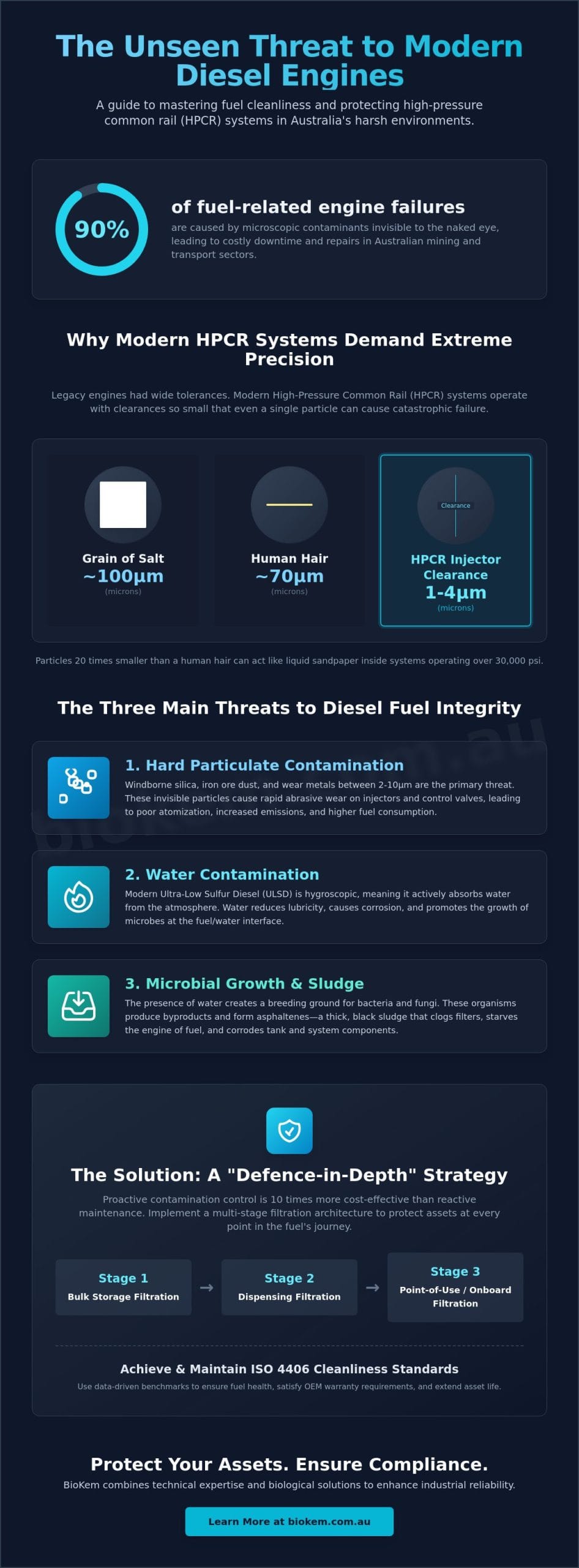
According to industry data, up to 90% of fuel-related engine failures in Australian mining and transport sectors are caused by microscopic contaminants that the naked eye cannot see. You already know that even a single micron of particulate can lead to premature injector failure or unexpected engine derating. These technical hurdles frequently result in lost productivity and frequent component replacements that strain operational budgets. Effective diesel filtration is no longer just a standard maintenance task; it’s a critical safeguard for the survival of your high-pressure common rail systems.
This 2026 guide provides the technical roadmap you need to master fuel cleanliness and protect your heavy assets from the harsh realities of microbial growth and particulate contamination. We promise to equip you with the knowledge to achieve strict ISO 4406 standards and satisfy OEM warranty requirements even in the most remote Australian environments. We will examine the latest filtration technologies and nature-based solutions that extend asset life, ensure compliance, and significantly reduce the total cost of ownership for your fuel systems.
Key Takeaways
- Understand why modern High-Pressure Common Rail (HPCR) systems require a multi-stage diesel filtration process to prevent catastrophic component failure and unscheduled downtime.
- Identify the three primary fuel threats—particulates, water, and microbial growth—that often remain invisible to the naked eye but compromise long-term asset integrity.
- Transition from reactive maintenance to a “Defence-in-Depth” strategy by implementing a strategic architecture that balances bulk storage and point-of-use filtration.
- Master the technical application of ISO 4406 cleanliness standards to establish measurable, data-driven benchmarks for fuel health across your Australian operations.
- Discover how BioKem’s synergy of technical expertise and biological solutions ensures compliance with local regulatory standards while enhancing industrial reliability.
The Evolution of Diesel Filtration: Why HPCR Systems Demand Precision
Modern diesel filtration is no longer a secondary maintenance concern; it’s a sophisticated, multi-stage process designed to eliminate sub-visible particulates and emulsified water. This technological shift was necessitated by the industry’s transition from traditional mechanical injection to High-Pressure Common Rail (HPCR) systems. While legacy engines operated with relatively generous tolerances, modern HPCR injectors feature internal clearances measuring between 1 and 4 microns. To put this in perspective, a single grain of table salt is approximately 100 microns. Maintaining fuel purity at this microscopic scale is the primary defense for industrial assets operating under the Fuel Quality Standards Act 2000 in Australia.
To better understand this concept, watch this helpful video:
Effective diesel filtration ensures that the fuel serves its dual purpose: providing energy and lubricating sensitive moving parts. In the Australian mining and transport sectors, where dust and humidity are constant variables, a robust filtration strategy is the only way to meet stringent environmental compliance and operational uptime targets.
The Anatomy of an HPCR Failure
When microscopic contaminants bypass a low-quality fuel filter, they enter a high-velocity environment. HPCR systems operate at pressures exceeding 30,000 psi. At these levels, tiny particles act like liquid sandpaper, causing rapid abrasive wear on injector nozzles and control valves. This erosion leads to "stiction" and poor fuel atomization, which increases tailpipe emissions and fuel consumption. For an Australian fleet operator, a single day of unscheduled downtime for a heavy haul truck can cost upwards of A$5,000 in lost revenue. Utilizing a filter-ferrogram analysis can help identify these wear patterns before they result in catastrophic engine failure.
Diesel as a Complex Hydrocarbon Fluid
Modern ultra-low sulfur diesel (ULSD) is a chemically sensitive fluid. The hydro-desulfurization process used to meet Australian environmental standards also makes the fuel more hygroscopic. This means ULSD actively attracts water from the atmosphere. Moisture in the fuel tank leads to microbial contamination and the formation of asphaltenes. These are heavy, polar organic molecules that precipitate out of the fuel, creating a thick sludge that can choke even the most advanced filters S.p.A
Identifying the Three Main Threats to Diesel Fuel Integrity
Fuel that appears clear to the naked eye is often heavily contaminated. Effective diesel filtration is not about visual aesthetics; it’s about technical compliance with engine manufacturer requirements. Contamination follows a consistent path known as the “Chain of Contamination,” beginning at the refinery and gaining volume during every transfer point, including ship tankers, rail cars, and local storage tanks. By the time fuel reaches an Australian mine site or construction hub, its particle count often exceeds the tolerances of modern high pressure common rail systems. Implementing proactive contamination control is roughly 10 times more cost-effective than attempting bioremediation or replacing damaged components after a failure occurs.
Hard Particulate Contamination
Hard particulates, specifically those between 2μm and 10μm, pose the greatest risk to fuel systems. These particles are invisible because the human eye cannot detect objects smaller than 40μm. In Australian industrial environments, windborne silica and iron ore dust are the primary culprits. Implementing ISO 4406 Standards allows operators to measure these microscopic threats with precision. A Beta Rating is the industry standard used to define filter efficiency by comparing the particle count before and after the filtration process.
The Water Problem: Free, Emulsified, and Dissolved
Water enters diesel through condensation or poor storage practices and exists in three distinct states. Free water settles at the tank bottom, while emulsified water is chemically suspended in the fuel, and dissolved water is completely absorbed. Water is a primary driver of component failure because it strips the fuel of its lubricity and promotes rapid corrosion on internal surfaces. High efficiency diesel filtration systems utilize coalescing technology as the gold standard for separating water from hydrocarbons, ensuring the fuel remains stable and dry. You can explore our range of advanced filtration systems to see how these technologies protect high value assets.
Microbial Growth (The “Diesel Bug”)
Microbial contamination involves bacteria, yeast, and fungi that thrive at the fuel-water interface. These organisms consume hydrocarbons and excrete acidic waste, creating a thick, dark slime that quickly plugs filters. Common symptoms include foul odors, decreased fuel economy, and severe pitting corrosion in storage tanks. Once a colony is established, standard filtration is insufficient to resolve the issue. Long term storage health requires professional industrial tank cleaning to physically remove the biological film and prevent recurring outbreaks. Maintaining a dry tank environment is the most sustainable way to inhibit this growth without relying on harsh chemical biocides.
Strategic Filtration Architectures: Bulk vs. Point-of-Use
Relying on a single factory-installed filter to manage diesel filtration is a significant risk to industrial asset reliability. Modern high-pressure common rail (HPCR) engines operate at tolerances as tight as 2 microns. This means standard filters often fail to meet the required ISO 4406 cleanliness levels on their own. A “Defence-in-Depth” model is the only way to ensure fuel integrity. This strategy uses multiple layers of protection to capture contaminants at every stage of the fuel lifecycle, from delivery to combustion. By distributing the filtration load, operators reduce the pressure on individual components and extend the service life of expensive injectors.
Bulk Fuel Filtration and Storage Management
Fuel contamination often begins during transport or offloading. High-flow filtration systems at the fill point are necessary to capture bulk particulates before they settle in storage tanks. Preventing moisture ingress is equally critical. Desiccant breathers stop humid air from entering the tank as fuel levels fluctuate. This prevents the condensation that fuels microbial growth and hydrocarbon degradation. Biokem supplies high-capacity solutions through Filters S.p.A. products, which are engineered to handle the high flow rates required for bulk Australian mining and transport hubs.
Point-of-Use and On-Engine Protection
On-engine protection serves as the final barrier. This architecture separates primary water separation from secondary particulate removal. Primary filters use centrifugal force and coalescing media to remove free water. Secondary filters focus on fine particulates. It’s vital to use high-efficiency glass-media elements instead of traditional cellulose. Glass media offers a 99.9% efficiency rating, whereas cellulose fibers can swell when wet and restrict flow. Installing high-quality aftermarket diesel filtration upstream of the factory housing provides an extra layer of security without voiding manufacturer warranties.
Kidney Loop Systems for Critical Assets
Stored fuel degrades over time, especially in standby power systems. Kidney looping is the process of continuous, off-line purification. These systems pull fuel from the bottom of the tank, pass it through a filtration circuit, and return it to the top. This constant movement prevents the formation of sediment and microbial colonies. It’s a proactive approach that ensures fuel is always ready for emergency deployment. For sites needing immediate remediation or temporary maintenance, Biokem provides equipment hire for professional fuel polishing and system restoration.
Implementing ISO 4406 Standards for Diesel Cleanliness
ISO 4406 serves as the international language for fluid cleanliness, providing a precise framework for quantifying particulate contamination. This standard is vital for effective diesel filtration, as it translates complex microscopic counts into a manageable three-digit code. Each number represents a range of particles larger than 4, 6, and 14 microns (μm) present in a 1mL sample. Understanding these codes allows Australian operators to move beyond visual inspections and adopt a data-driven approach to fuel health. By adhering to these metrics, businesses align their maintenance with global best practices and Australian regulatory expectations for asset protection.
How to Read and Set ISO Cleanliness Targets
Interpreting the ISO code requires an understanding of its logarithmic scale. Each increase of one in any digit indicates that the particle count has doubled. For example, a code of 18/16/13 denotes between 1,300 and 2,500 particles at the 4μm level. While “typical” fuel delivered to Australian industrial sites often sits at 18/16/13, this level is frequently inadequate for modern machinery. High-Pressure Common Rail (HPCR) engines operate at pressures exceeding 30,000 psi, where microscopic debris causes immediate component wear. Achieving an ISO code of 12/9/6 is the benchmark for high-performance diesel systems. This level of purity ensures that injectors and pumps remain protected from abrasive failure and premature fatigue.
- 4μm (First Digit): Targets the smallest silt particles that cause “sandblasting” wear in high-pressure components.
- 6μm (Second Digit): Identifies larger particles that can jam tight-clearance valves.
- 14μm (Third Digit): Monitors “boulder” particles that cause catastrophic pump failure.
Fuel Sampling and Analysis Techniques
Accurate data depends on representative sampling. Operators shouldn’t draw fuel from the very bottom of the tank, where sediment and water naturally settle, or from the very top. Extracting samples from the middle of the fuel column provides the most accurate reflection of what the engine actually consumes. Laboratory analysis identifies more than just particles; it detects chemical degradation and microbial contamination that physical diesel filtration might miss. For sites requiring immediate results, the particle pal range offers real-time onsite monitoring. This technology allows maintenance teams to verify fuel quality instantly rather than waiting days for external lab reports. Regular analysis acts as a diagnostic tool, identifying potential tank corrosion or seal failures before they result in a total system shutdown.
To ensure your fleet meets the highest standards of fuel purity, book a professional fuel analysis and cleanliness audit today.
BioKem’s Comprehensive Approach to Diesel Reliability
BioKem stands as the primary authority for Australian industrial fluid management, offering a methodology that integrates high-performance hardware with specialized technical services. This holistic strategy ensures that diesel filtration isn’t just a localized fix but a core component of long-term asset health. By maintaining fuel at peak cleanliness standards, operators reduce hydrocarbon waste and minimize particulate emissions. This focus on fuel integrity aligns with the 2026 environmental benchmarks required for the Australian mining, transport, and energy sectors. Clean fuel leads to more efficient combustion, which directly lowers the carbon footprint of heavy machinery.
BioKem’s role extends beyond simple distribution. They act as a technical partner for national industrial projects, providing the expertise needed to manage complex fluid systems in remote and harsh environments. This support includes:
- Engineering consultation for custom filtration skids.
- Site-specific fluid analysis and ISO cleanliness mapping.
- Lifecycle management for critical fuel infrastructure.
- Compliance auditing against Australian environmental and safety standards.
Distributing Global Excellence: Filters S.p.A. & Swift Filters
BioKem serves as the Australian distributor for Filters S.p.A., providing bespoke industrial housings designed for high-flow environments. These housings are essential for large-scale diesel filtration tasks where standard off-the-shelf units fail to meet flow requirements. They also provide specialist oil filters from Swift Filters for high-pressure applications. Every piece of hardware is selected based on specific Australian site conditions, such as the extreme ambient temperatures of the Pilbara or the high humidity levels found in Central Queensland. This data-driven selection process ensures that the hardware performs reliably under the unique stressors of the Australian landscape.
Onsite Technical Support and Equipment Hire
Large-scale fuel system commissioning requires more than just high-quality filters. BioKem deploys experienced technicians to sites across Australia to ensure that new systems meet strict performance parameters from day one. They adapt advanced hot oil flushing techniques for fuel line cleaning, a process that removes legacy varnish and microbial growth that often accumulates in stagnant lines. This proactive partnership prevents the re-contamination of fresh diesel and protects sensitive fuel injectors. By focusing on the entire fuel delivery circuit, BioKem helps operators extend the service life of their assets and avoid the high costs associated with unexpected downtime and component failure.
Future-Proofing Your Fleet Through Precision Contamination Control
Modern industrial operations can’t afford the downtime caused by contaminated fuel. As HPCR technology continues to evolve toward 2026, maintaining strict ISO 4406 cleanliness levels isn’t just a recommendation; it’s a critical requirement for asset longevity. Implementing a multi stage strategy that addresses both bulk storage and point of use delivery ensures your fleet remains operational under the harshest Australian conditions. Effective diesel filtration protects your bottom line by reducing unexpected maintenance costs and extending the service life of high value engine components.
BioKem provides the technical precision required to meet these rigorous global standards. As the sole Australian distributor for Filters S.p.A., we combine world class hardware with a national onsite technical service capability. Our team’s deep expertise in ISO 4406 cleanliness standards allows us to deliver tailored solutions that balance operational efficiency with environmental responsibility. This localized approach ensures your strategy complies with regional regulations while leveraging international engineering excellence.
Consult with a BioKem expert today to design your contamination control strategy and secure your equipment’s future. We’re ready to help you achieve peak fuel integrity and long term reliability.
Frequently Asked Questions
What is the most common cause of diesel engine failure in industrial settings?
Contamination is the primary cause of diesel engine failure, accounting for approximately 80% of fuel system issues in industrial applications. Fine particulates and water compromise High-Pressure Common Rail (HPCR) systems, where clearances are often as small as 2 microns. These contaminants lead to injector erosion and pump cavitation, which increases maintenance costs and reduces asset lifespan. Effective diesel filtration strategies mitigate these risks by maintaining fuel within ISO 4406 cleanliness standards.
Can I rely solely on the factory-installed diesel filters?
You shouldn’t rely solely on factory-installed filters for industrial operations because they’re designed as a final line of defense rather than a comprehensive solution. Standard OEM filters often lack the capacity to handle high volumes of bulk-stored fuel that may already be degraded. Integrating secondary filtration ensures that fuel entering the engine meets the strict 12/9/6 ISO cleanliness levels required by modern Tier 4 and Tier 5 engines.
How does water get into my diesel tank if it is sealed?
Water enters sealed tanks primarily through atmospheric condensation caused by daily temperature fluctuations. As the tank breathes, moist air enters through the vent; when temperatures drop at night, this moisture condenses into liquid water on the tank walls. Industry data shows that even a 10,000-litre tank can accumulate several litres of water annually through this natural process. This creates a breeding ground for microbial growth and accelerates fuel oxidation.
What is the difference between a fuel water separator and a particulate filter?
A fuel water separator focuses on removing free and emulsified water, while a particulate filter targets solid contaminants like dust and rust. Separators use hydrophobic media to bead water so it can settle in a collection bowl. Particulate filters use pleated media to trap solids. Both are essential components of a robust diesel filtration system to ensure fuel meets the technical specifications of engine manufacturers like Cummins or Caterpillar.
How often should I perform fuel analysis on my bulk storage tanks?
You should perform fuel analysis on bulk storage tanks at least every six months to comply with Australian Standard AS 2809. For critical infrastructure or high-turnover sites, quarterly testing provides a more accurate picture of fuel health and microbial activity. Regular sampling identifies issues like oxidative stability loss or water ingress before they cause expensive equipment downtime or require large-scale bioremediation efforts.
Will adding an aftermarket diesel filtration system void my engine warranty?
Installing an aftermarket filtration system won’t void your engine warranty if the system meets or exceeds the original equipment manufacturer’s specifications. Under Australian Consumer Law, manufacturers can’t mandate the use of their own branded parts unless they’re provided free of charge. Using high-quality secondary filtration actually protects your warranty by ensuring the fuel remains cleaner than the minimum requirements specified by the OEM during operation.
What is a “Beta Rating” and why does it matter for diesel filters?
A Beta Rating is a technical formula that measures a filter’s efficiency at removing specific particle sizes. For example, a Beta 200 rating at 4 microns means the filter captures 99.5% of particles that size or larger. This metric is more reliable than nominal ratings because it’s based on the ISO 16889 multi-pass test. Choosing filters with high Beta ratios ensures consistent protection for sensitive engine components against microscopic debris.
How do I know if my diesel has microbial contamination?
Microbial contamination is often identified by the presence of dark, slimy biofilms on filter elements or a distinct rotten egg smell caused by hydrogen sulfide gas. You might also notice frequent, unexplained filter plugging or visible sludge in the bottom of the tank. If you suspect an issue, a professional laboratory test or a field-based ATP test can confirm the presence of bacteria and fungi within 24 hours.