

A “10-micron” filter rating is often little more than a marketing claim that masks significant risks to your machinery. If you’ve experienced premature valve failure despite using supposedly high-quality elements, you’ve seen the limitations of vague specifications firsthand. Understanding Filter Beta Ratios – absolute or nominal is the only way to move past the guesswork of lubrication maintenance. Relying on nominal ratings, which might only capture 50% of contaminants, often leads to the very unscheduled downtime you’re trying to avoid.
You deserve a clear, scientific method for protecting your critical industrial assets. We’ll show you how to master the technical nuances of filtration efficiency by using the ISO 16889:2022 multi-pass test standard as your benchmark. This guide provides a professional framework for reading technical data sheets and selecting filters based on actual system sensitivity. By the end, you’ll know how to eliminate contamination-related failures and ensure your equipment operates with the precision it was designed for. We’ll provide the clarity needed to translate complex data into operational reliability.
Key Takeaways
- Differentiate between marketing-driven “micron” labels and scientific performance to avoid the pitfalls of nominal filter ratings.
- Utilise the ISO 16889:2022 multi-pass test standard as a reliable benchmark for evaluating real-world filter efficiency.
- Apply a strategic framework to select Filter Beta Ratios – absolute or nominal based on the specific sensitivity of your system’s most critical components.
- Identify the direct correlation between high-efficiency absolute filtration and achieving target ISO 4406 oil cleanliness codes.
- Understand how technical filter selection reduces long-term operational costs by preventing premature component wear and unscheduled downtime.
The Micron Rating Myth: Why Nominal and Absolute Labels Confuse
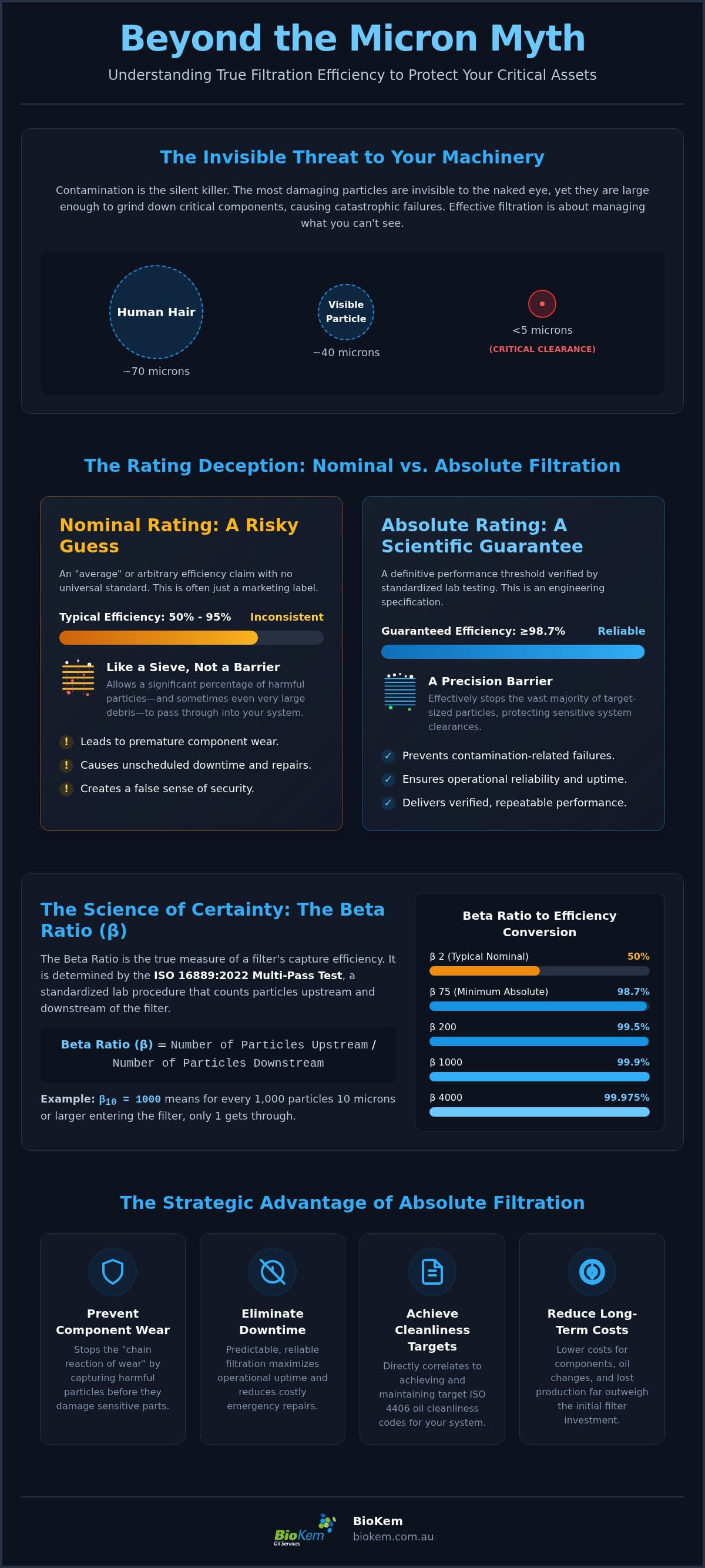
Contamination is the silent killer of industrial machinery. To understand the scale of this challenge, we must first define the micron. A single micron is one-millionth of a metre. For context, the human eye generally perceives particles down to 40 microns, yet the critical clearances in high-performance hydraulic systems are often smaller than 5 microns. Effective filtration is therefore about managing the invisible. However, the industry’s historical reliance on simple “micron ratings” has created a false sense of security. The choice between Filter Beta Ratios – absolute or nominal determines whether you are truly protecting your assets or merely checking a maintenance box.
To better understand the technical foundation of these ratings and how they impact your maintenance strategy, watch this detailed explanation:
The primary issue with basic micron ratings is their lack of standardisation. A manufacturer might label a filter as “10-micron,” but without a Beta Ratio, that number is statistically meaningless. In many cases, a nominal 10-micron filter acts as a sieve rather than a barrier. It might capture a percentage of 10-micron particles while allowing debris as large as 200 microns to pass through during pressure spikes or cold starts. This inconsistency is why micron ratings alone cannot guarantee the reliability of critical assets like turbines or high-speed compressors.
What is a Nominal Filtration Rating?
A nominal rating is essentially an “average” efficiency claim. It typically suggests the filter can retain between 50% and 95% of particles at a given size. Because there is no universal laboratory standard for “nominal,” different manufacturers use different testing parameters. This variance makes it impossible to compare two nominal filters accurately. Choosing the “wrong” nominal rating creates a hidden financial burden. While the upfront cost is lower, the resulting unscheduled downtime and component replacement costs far outweigh the initial savings. In high-pressure systems, using a nominal filter is a gamble with your capital equipment.
What is an Absolute Filtration Rating?
An absolute rating provides a definitive performance threshold. It is generally defined as a filter that is at least 98.7% efficient at a specific micron size, which corresponds to a Beta Ratio of 75. Unlike nominal media, which often uses cellulose, absolute-rated filters typically utilise high-quality synthetic glass-fibre media. This material maintains its pore structure under load. It effectively stops the “chain reaction of wear” where one particle creates several more through internal grinding. Understanding Filter Beta Ratios – absolute or nominal allows engineers to specify media that actually blocks the largest harmful particles from entering sensitive clearances.
The Science of Beta Ratios: Decoding ISO 16889
The ISO 16889:2022 multi-pass method is the technical foundation for evaluating filter performance. It replaced older, less precise methods by circulating fluid through the filter element under controlled laboratory conditions. This test measures the filter’s ability to remove particles while tracking the pressure drop across the media. It’s the only way to move past marketing jargon and understand Filter Beta Ratios – absolute or nominal in a scientific context. By monitoring particle counts upstream and downstream simultaneously, engineers can determine exactly how a filter behaves as it reaches its dirt-holding capacity.
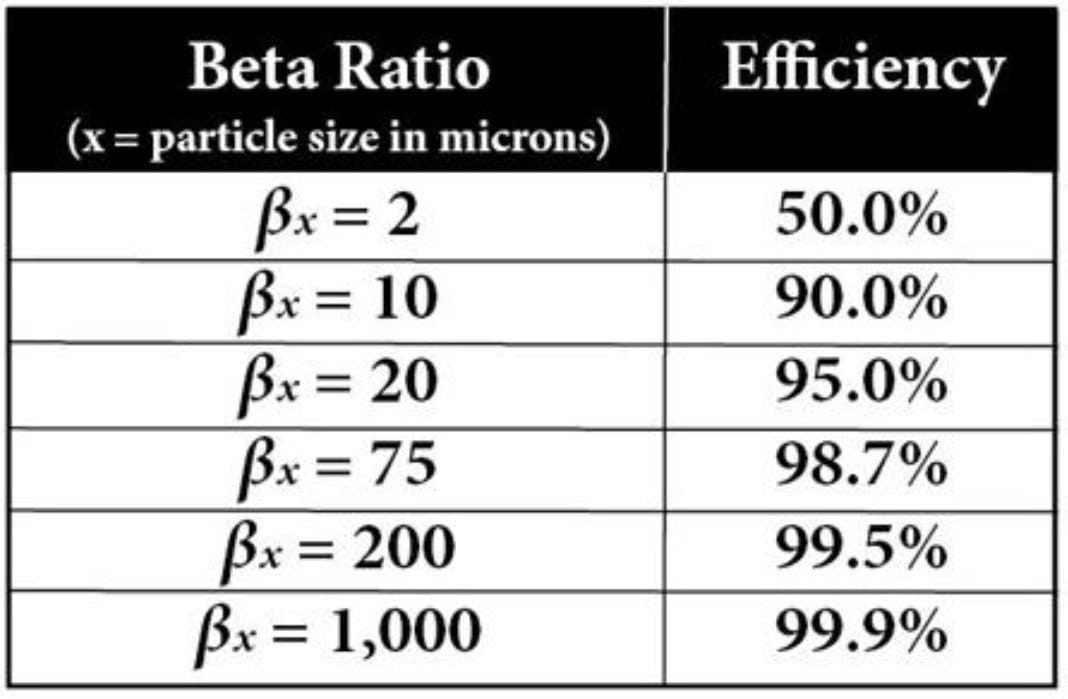
Converting these ratios into a percentage makes technical data sheets more accessible for reporting. To calculate efficiency, you use the formula: ((Beta – 1) / Beta) x 100. For instance, a Beta of 200 equates to 99.5% efficiency. As highlighted in Caterpillar’s filter performance guide, an absolute rating is often defined at a Beta of 75, which translates to 98.7% efficiency. This objective metric allows for a direct comparison between different brands, ensuring you select media based on verified performance rather than manufacturer claims.
How to Read a Beta Ratio (e.g., β10 = 1000)
Technical notation uses the Beta symbol followed by a subscript indicating the micron size. A Beta Ratio is the ratio of particles larger than a given size in the influent fluid to the number of particles in the effluent fluid. In the notation β10 = 1000, the “10” refers to 10-micron particles, while the “1000” means that for every 1000 particles entering, only one passes through. A Beta 1000 rating represents 99.9% efficiency. This provides significantly higher protection than a Beta 200 rating, which allows five times more debris to remain in the system.
The Impact of Dynamic Flow on Beta Ratings
Real-world industrial environments rarely match steady-state laboratory conditions. System surges, cold starts, and cycling valves create dynamic flow conditions that can cause captured contaminants to “unload” from the media. High Beta Ratios, particularly those achieved by Filters S.p.A. products, indicate a stable pore structure that resists these surges. This stability is essential for varnish mitigation strategies, where consistent removal of sub-micron precursors is necessary to prevent deposits on critical surfaces. Understanding Filter Beta Ratios – absolute or nominal helps you choose media that maintains its integrity even under heavy operational stress.
If you’re unsure how your current filters perform under these stresses, a professional filter ferrogram can reveal the types and quantities of particles escaping your filtration system.
Absolute vs. Nominal: A Strategic Comparison for Reliability
Choosing between Filter Beta Ratios – absolute or nominal is a strategic decision that dictates the long-term health of industrial assets. While nominal filters often appear cost-effective at the point of purchase, their performance over the asset lifecycle is frequently insufficient for modern precision machinery. High-performance synthetic media provides the consistency required to meet strict ISO 4406 oil cleanliness codes. This is essential for preventing the accumulation of silt that traditional cellulose media often misses. Absolute filtration serves as the technical foundation for proactive maintenance strategies. By removing particles at the source, these filters extend the service life of both the lubricant and the mechanical components. This approach contrasts with reactive maintenance, where filters are only replaced after a failure occurs.
When Nominal is Sufficient (and When it Isn’t)
Nominal filters have a place in industrial systems, primarily as pre-filters for bulk contaminant removal or in non-critical transfer lines. They are useful for capturing large debris after a tank cleaning or during initial fluid commissioning. However, using them in sensitive hydraulic circuits is a false economy. The cost of a single sticking servo valve or a damaged pump far exceeds the price difference of a premium absolute-rated element. In demanding mining and power generation sectors, the risk of unscheduled downtime makes nominal-only strategies unsustainable. Nominal media often lacks the structural integrity to handle pressure ripples, leading to bypass events that compromise the entire system.
The Superiority of Absolute Rated Elements
Absolute-rated elements are engineered to protect high-precision components like servo valves and high-speed turbine bearings. These systems require constant cleanliness to prevent erosion and stiction. Synthetic glass-fibre media, such as those found in Filters S.p.A. products, offers superior silt control compared to cellulose. This media doesn’t swell or degrade when exposed to moisture, ensuring the pore size remains consistent throughout the filter’s life. By maintaining a high Beta Ratio, these filters significantly extend oil life and reduce the environmental footprint of industrial operations. This consistency allows operators to predict maintenance intervals with greater accuracy, eliminating the guesswork that often leads to premature component wear. Understanding Filter Beta Ratios – absolute or nominal ensures that your filtration strategy aligns with the actual sensitivity of your equipment.
Selection Guide: Matching Filter Ratings to Your Equipment
Selecting an industrial filter is a technical process that requires more than a cursory glance at a micron number. To protect capital-intensive machinery, you must follow a logical selection matrix. The first step involves identifying the most sensitive component within your fluid circuit. If your system relies on high-precision servo valves, your filtration requirements will be significantly more stringent than those for a basic gear pump. Once you’ve identified these components, you can determine the required ISO 4406 cleanliness target for the entire system.
Your third step is to match this target to a specific Beta Ratio. This is the stage where the distinction between Filter Beta Ratios – absolute or nominal becomes an operational reality. You shouldn’t settle for a nominal rating when your equipment manufacturer specifies absolute protection. Additionally, you must factor in your operating environment. Cold-start conditions often lead to high differential pressures. If your filter media isn’t structurally sound, it’ll bypass, allowing unfiltered oil into the system. Finally, always consult with a filtration specialist to verify that your chosen media can handle these specific stresses.
Micron Recommendations by System Type
Industry standards provide a baseline for selection, but specific application needs often dictate more aggressive targets. For turbine lubrication systems, 3-5 micron absolute filtration is the gold standard for maintaining bearing integrity and preventing varnish precursors. High-pressure hydraulic systems, which are prone to rapid wear from silt-sized particles, typically require Beta 1000 ratings at the 10-micron level to protect expensive piston pumps. In contrast, low-pressure circulating systems might find 10-25 micron nominal options sufficient for bulk cleaning, provided they aren’t the primary defense for sensitive downstream components.
Environmental Factors in the Australian Context
The Australian industrial landscape presents unique challenges for fluid cleanliness. In mining applications, high ambient dust loads can quickly overwhelm standard filtration systems, necessitating the use of high-capacity absolute elements. Similarly, humid coastal industrial sites face constant moisture ingress, which can degrade oil performance and promote rust. In these environments, high-efficiency filtration works best when paired with specialist services like vacuum dehydration. This combination ensures that both solid particles and dissolved water are removed before they cause permanent damage. For tailored advice on protecting your fleet in these conditions, you can view our range of high-performance filtration systems.
Maximising Reliability with BioKem Oil Services and Filters S.p.A.
BioKem Oil Services’ partnership with Filters S.p.A. is built on a shared commitment to engineering excellence and operational reliability. In Australia’s demanding industrial sectors, the technical distinction between Filter Beta Ratios – absolute or nominal is often the difference between a productive shift and a catastrophic component failure. BioKem Oil Services selects Filters S.p.A. because their absolute-rated media consistently meets the rigorous ISO 16889:2022 standards required for critical asset protection. This high-performance media is a fundamental component of successful hot oil flushing operations. During the flushing process, absolute filtration ensures that even the smallest abrasive particles are permanently removed from the system’s internal surfaces, preventing them from causing damage during subsequent commissioning.
Validation is the final step in any successful contamination control strategy. BioKem Oil Services utilises onsite oil analysis to verify that your filtration system is achieving its target cleanliness codes. This data-driven approach removes the guesswork from maintenance, providing clear evidence of your return on investment. Our team also provides expert support for custom filtration housing and element design, ensuring that your specific flow rates and pressure requirements are matched with the correct media technology. By focusing on the scientific reality of particle counts rather than marketing labels, we help you maintain the long-term health of your turbines, compressors, and hydraulic systems.
Australia’s Distributor for High-Performance Filtration
BioKem Oil Services serves as the vital link between world-class European engineering and local Australian expertise. As the sole Australian distributor for Filters S.p.A., we provide nationwide access to high-performance filtration solutions designed for the world’s most sensitive machinery. Our technical scope includes providing premium replacement elements for Swift Filters and other major international brands. This allows operators to upgrade their existing systems to absolute-rated performance without the need for costly hardware overhauls. We help businesses reduce downtime by providing strategic spares management and technical deployment across the country, ensuring that critical elements are available when they are needed most.
Taking the Next Step in Contamination Control
Moving beyond basic maintenance requires a technical audit of your current filtration setup. BioKem Oil Services’ specialists evaluate your equipment’s sensitivity and environmental stressors to recommend a tailored filtration path. For rapid, onsite verification of fluid health, we provide patch test kits that allow your technicians to visually confirm contamination levels. These tools help clarify the performance gap between Filter Beta Ratios – absolute or nominal in your specific application. If you are ready to eliminate contamination-related failures and extend the life of your lubricants, contact BioKem Oil Services for professional service and nationwide supply.
Achieving Operational Excellence Through Precision
Transitioning from vague micron claims to a data-driven filtration strategy is the first step toward true operational reliability. By mastering the technical distinction between Filter Beta Ratios – absolute or nominal, you gain the ability to match your filtration media with the specific sensitivities of your equipment. Absolute-rated filters are the foundation of proactive maintenance, providing the consistent performance needed to meet ISO 4406 cleanliness targets and prevent the chain reaction of wear.
As the sole Australian distributor for Filters S.p.A., BioKem Oil Services provides the technical expertise and world-class products required for national industrial projects. Our comprehensive oil analysis and purification services ensure that your filtration investment is validated by empirical data. Whether you’re managing turbine lubrication or high-pressure hydraulic circuits, our specialist support eliminates the guesswork of fluid maintenance and protects your capital assets from unscheduled downtime.
Optimise your system reliability with BioKem Oil Services’ specialist filtration solutions.
Taking control of your contamination levels today ensures the health and longevity of your critical assets for years to come.
Frequently Asked Questions
What is the difference between an absolute and a nominal filter rating?
An absolute rating indicates a definitive performance threshold, typically meaning the filter is at least 98.7% efficient at removing particles of a specific size. In contrast, a nominal rating is an “average” efficiency claim, often representing between 50% and 95% retention. The primary difference lies in the consistency of the pore structure; absolute filters use synthetic media to maintain integrity, while nominal filters often rely on less stable cellulose fibres.
How is a Beta Ratio calculated for an industrial oil filter?
A Beta Ratio is calculated by dividing the number of particles of a specific size counted upstream of the filter by the number of particles of that same size counted downstream. This formula, derived from the ISO 16889 multi-pass test, provides an objective measurement of filtration efficiency. For example, if 100,000 particles enter and 100 exit, the Beta Ratio is 1000, signifying 99.9% efficiency for that particle size.
Is a 10-micron nominal filter the same as a 10-micron absolute filter?
No, a 10-micron nominal filter is significantly less effective than a 10-micron absolute filter. While both mention the same size, the nominal filter might only capture 50% of 10-micron particles, allowing the rest to circulate. The absolute filter, with a Beta Ratio of 75 or higher, ensures that 98.7% or more of those particles are removed. This distinction is critical when evaluating Filter Beta Ratios – absolute or nominal for sensitive machinery.
What Beta Ratio is considered “absolute” in the filtration industry?
The filtration industry generally accepts a Beta Ratio of 75 as the minimum threshold for an “absolute” rating. This value corresponds to an efficiency of 98.7%. Many high-performance elements, such as those from Filters S.p.A., achieve Beta Ratios of 1000 or 2000, representing 99.9% and 99.95% efficiency respectively. These higher ratios provide superior protection for critical components like servo valves and high-speed bearings that require ultra-clean fluid.
Why do Beta Ratios matter for hydraulic system maintenance?
Beta Ratios provide the only reliable metric for predicting how much contaminant remains in your system after fluid passes through the filter. For hydraulic maintenance, relying on vague nominal ratings can lead to accelerated component wear and unexpected valve stiction. By selecting specific Filter Beta Ratios – absolute or nominal, maintenance teams can ensure they meet the precise cleanliness targets required by pump and valve manufacturers, directly reducing the risk of unscheduled downtime.
Can I replace a nominal filter with an absolute filter?
Yes, you can typically replace a nominal filter with an absolute-rated element, provided the physical dimensions and bypass valve settings are compatible. Upgrading to an absolute filter often improves system reliability by capturing the fine silt that nominal filters miss. However, because absolute filters are more efficient, they may reach their dirt-holding capacity faster if the system is heavily contaminated, necessitating more frequent initial changes until the fluid reaches a steady state.
How does filter efficiency affect ISO 4406 cleanliness codes?
Filter efficiency is the primary driver for achieving and maintaining specific ISO 4406 cleanliness codes. An absolute-rated filter with a high Beta Ratio removes a greater percentage of particles in the 4, 6, and 14-micron ranges, which are the three numbers used in the ISO code. Nominal filters often fail to lower the particle count sufficiently to reach the stringent codes required by modern high-pressure systems, such as 16/14/11.
Which filter rating is best for turbine oil varnish mitigation?
Turbine oil varnish mitigation requires high-efficiency, absolute-rated filtration, typically in the 3-micron to 5-micron range. Because varnish precursors are sub-micron in size, they often agglomerate into larger soft contaminants that can be captured by premium glass-fibre media. Using a Beta 1000 absolute filter ensures that these deposits are removed consistently, preventing them from settling on critical surfaces. This approach is far superior to nominal filtration, which lacks the precision to manage fine silt.