

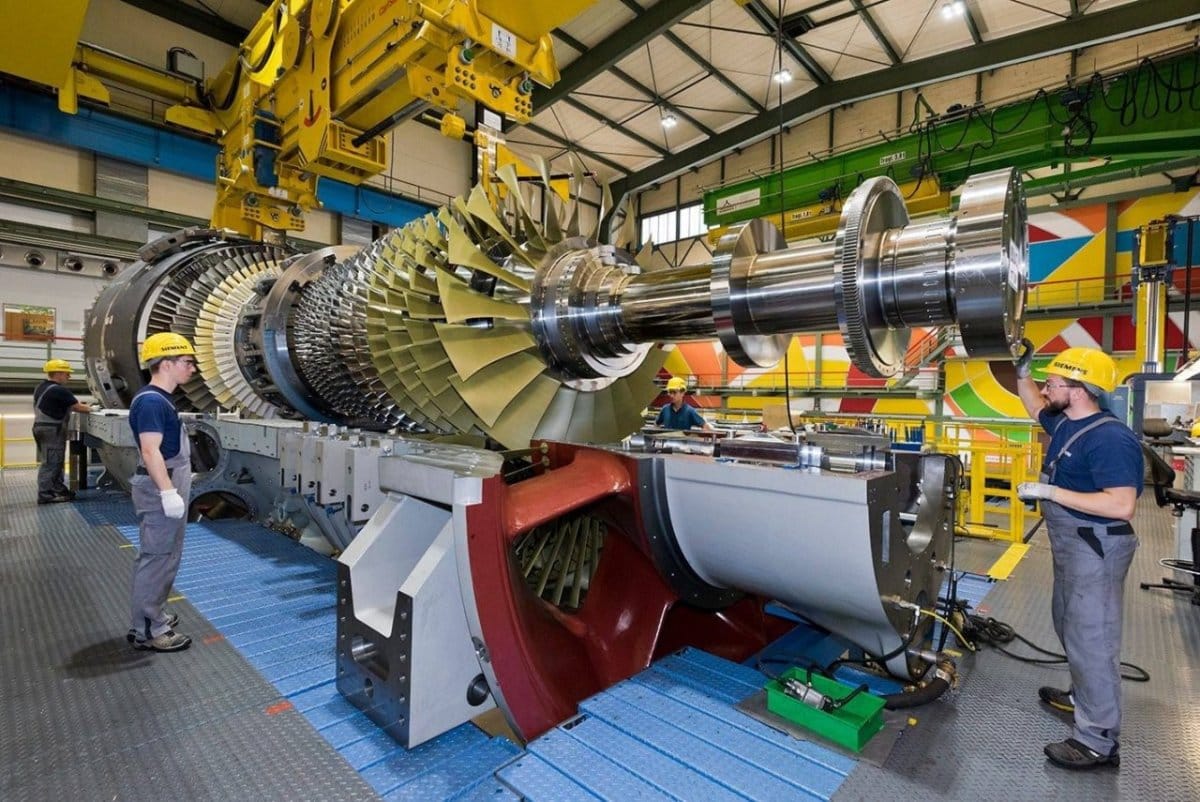
Did you know that approximately 30% of industrial machinery failures stem directly from inadequate lubrication and residual contamination? For operators of high-value Siemens turbines and compressors, this risk is intensified by precision tolerances that leave no room for error. BioKem Oil Services conforms to ASTM D6439 for oil flushing Siemens rotational assets, providing a rigorous technical bridge between standard maintenance and OEM-specific cleanliness mandates. With gas turbine lead times now stretching up to six years, protecting your existing fleet isn’t just about maintenance; it’s a critical strategy for operational continuity.
You likely understand the immense pressure of commissioning deadlines and the fear that a single microscopic particle could trigger a catastrophic bearing failure or unscheduled downtime. This article explains how BioKem achieves ASTM D6439-23 compliance to safeguard your equipment’s operational lifespan and protect your investment. We’ll examine the technical mechanics of high-velocity hot oil flushing, the necessity of achieving turbulent flow with a Reynolds Number exceeding 4,000, and how documented ISO 4406 targets ensure your Siemens fleet remains within warranty and peak performance.
Key Takeaways
- Understand why ASTM D6439-23 serves as the essential engineering benchmark for cleaning and flushing Siemens gas and steam turbine lubrication systems.
- Learn how BioKem Oil Services conforms to ASTM D6439 for oil flushing Siemens rotational assets by utilizing high-velocity rigs to achieve the turbulent flow necessary for debris removal.
- Discover the mechanics of the “Wedge Effect” and why maintaining precise lubricant film thickness is vital for protecting bearings at high rotational speeds.
- Identify why varnish precursors are a silent threat to Siemens assets and how specialized mitigation strategies address contaminants that standard filters miss.
- Explore the verification process that uses onsite laboratory analysis to provide real-time documentation of ISO 4406 cleanliness targets during your maintenance project.
Understanding ASTM D6439: The Standard for Cleaning Siemens Turbine Lubrication Systems
ASTM D6439-23 represents the industry’s most rigorous framework for the cleaning, flushing, and purification of turbine lubrication systems. Unlike basic filtration, which merely targets suspended particulates in the oil, this standard provides a comprehensive procedural roadmap to ensure the internal surfaces of the entire system are free from contaminants. For Siemens gas and steam turbines, adhering to this protocol is a fundamental engineering requirement. It addresses the removal of built-in debris like welding slag and rust, as well as the preservative coatings applied during manufacturing that can interfere with modern lubrication principles once the asset is operational.
The distinction between a standard-compliant flush and simple filtration is significant. Simple filtration is a maintenance task; a compliant hot oil flush is a decontamination process. BioKem Oil Services conforms to ASTM D6439 for oil flushing Siemens rotational assets, ensuring that every internal gallery and pipe run is stripped of the “silent killers” that threaten high-speed bearings. By circulating heated oil at specific velocities, the process dislodges settled solids that traditional kidney-loop filtration would never reach. This level of technical precision is essential for maintaining the operational integrity of assets that represent millions of dollars in capital investment.
The Scope of ASTM D6439 in Power Generation
This standard is specifically designed for high-volume systems found in power generation, including steam turbine generators and high-speed centrifugal compressors. These systems often hold thousands of liters of oil and rely on high-precision bearings with clearances measured in microns. Whether you are commissioning a new Siemens unit or restarting after a major overhaul, the scope of ASTM D6439 ensures that the lubrication system is returned to a “base-line” level of cleanliness. BioKem utilizes specialized hot oil flushing and filtering rigs to meet these exacting requirements nationwide across Australia.
Why OEM Compliance is Non-Negotiable
For Siemens operators, compliance is often a prerequisite for maintaining warranty status. A single bearing wipe caused by residual commissioning debris can lead to millions in repair costs and lost revenue. In an era where gas turbine lead times are extending significantly, the cost of a compliant flush is negligible compared to the risk of unscheduled downtime. BioKem provides the technical expertise and independent verification needed to prove that a system meets the required cleanliness targets. By choosing a partner where BioKem Oil Services conforms to ASTM D6439 for oil flushing Siemens rotational assets, you gain documented assurance that your system is protected from the moment the shaft begins to rotate.
Engineering Requirements for Siemens Rotational Asset Integrity
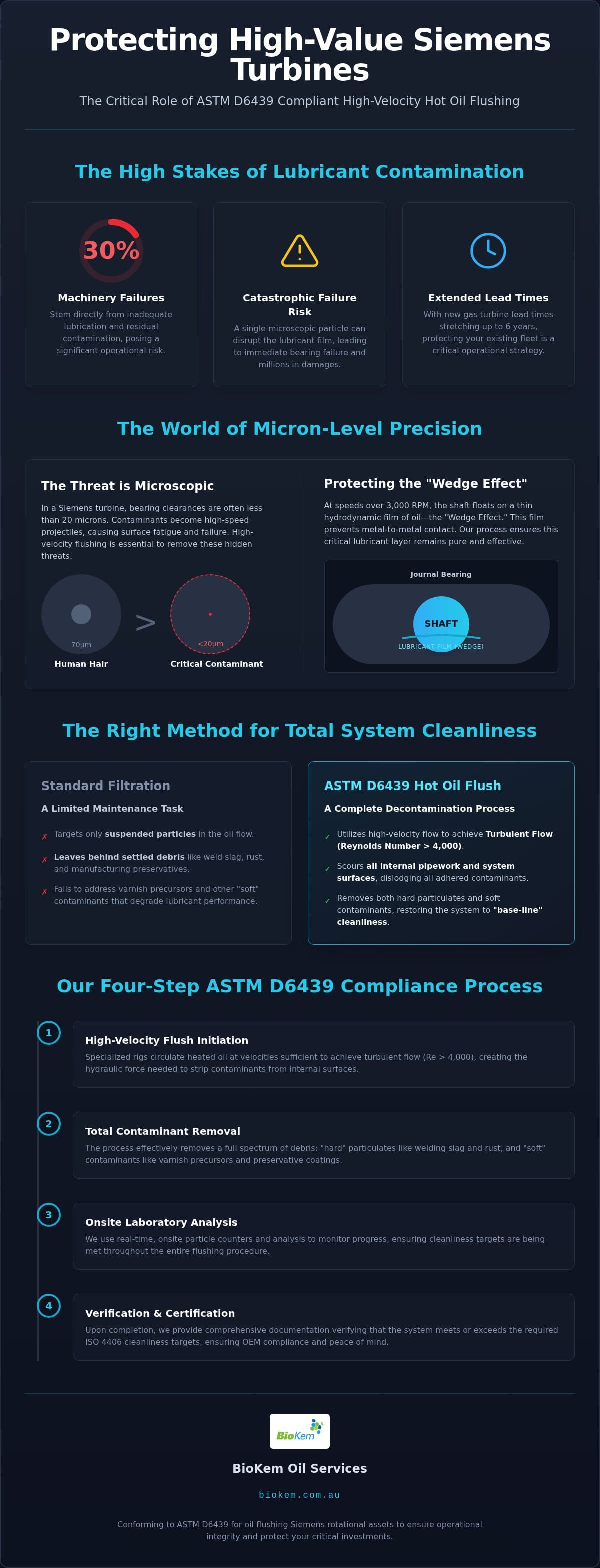
Siemens rotational assets operate under extreme conditions where rotational speeds often exceed 3,000 RPM. At these velocities, the integrity of the lubrication film is paramount. The hydrodynamic bearings in these turbines rely on the “Wedge Effect” to lift the shaft and prevent metal-to-metal contact. Even microscopic particles can disrupt this film, leading to abrasive wear or immediate failure. Because BioKem Oil Services conforms to ASTM D6439 for oil flushing Siemens rotational assets, our technical approach specifically accounts for these high-speed dynamics. We ensure the removal of both “hard” particulates, such as welding slag, and “soft” contaminants like varnish precursors that compromise lubricant chemistry.
Precision Tolerances and Particle Impingement
In a Siemens gas or steam turbine, the gap between the bearing surface and the journal is often less than 20 microns. To put this in perspective, a human hair is roughly 70 microns. When particles enter this narrow clearance, they don’t just sit there; they become high-speed projectiles. This impingement causes surface fatigue and can trigger thermal runaway, where friction-induced heat rapidly degrades the oil and the metal components. Maintaining proper turbine lubrication system maintenance is the only way to prevent these sub-micron threats from compromising the asset’s structural integrity.
Standard vs. Siemens-Specific Cleanliness Targets
While many industrial systems are satisfied with generic ISO 4406 targets like 16/14/11, Siemens rotational assets often require significantly tighter levels to ensure long-term reliability. Achieving these targets requires more than a simple filter change. It demands high-velocity circulation and absolute filtration, often utilizing Beta 1000 rated hardware. BioKem Oil Services conforms to ASTM D6439 for oil flushing Siemens rotational assets, providing the documented verification that your system meets these OEM-mandated cleanliness codes. We utilize specialized hardware to capture even the finest particulates during the flushing phase.
The complex architecture of Siemens oil reservoirs and intricate piping loops creates many “dead zones” where contaminants can settle. ASTM D6439 provides the framework to address these specific design challenges through targeted flow paths and temperature cycling. If you are preparing for a major outage or commissioning a new unit, you can explore BioKem Hot Oil Flushing & Filtering to see how these engineering requirements are met in the field. This proactive stance on cleanliness directly correlates to extended bearing life and reduced lifecycle costs for your power generation fleet.
The Mechanics of High-Velocity Hot Oil Flushing (ASTM D6439 Compliance)
High-velocity hot oil flushing is not merely a circulation exercise; it is a precisely engineered mechanical process designed to scour the internal surfaces of complex piping. While standard filtration relies on the oil passing through a media to catch debris, ASTM D6439 focuses on the kinetic energy of the fluid itself to dislodge contaminants. This scouring action is only possible when the oil achieves turbulent flow. Without sufficient velocity, the fluid moves in a laminar fashion, where the layer of oil closest to the pipe wall remains stationary, effectively shielding debris from removal. BioKem Oil Services conforms to ASTM D6439 for oil flushing Siemens rotational assets by utilizing specialized rigs that generate the massive flow rates required for large-scale Siemens infrastructure.
The distinction between a failed flush and a compliant one is defined by the Reynolds Number. This dimensionless value determines the fluid’s flow regime. ASTM D6439 dictates that a Reynolds Number of 4,000 or higher is necessary to ensure the transition from laminar to turbulent flow. At this threshold, the oil becomes chaotic and multi-directional, creating the energy needed to lift heavy particulates like welding slag and sand from the bottom of horizontal pipe runs. By engineering the flush to exceed this mathematical threshold, we ensure that the entire internal diameter of the lubrication loop is cleaned, not just the center of the stream.
Calculating Reynolds Numbers for Compliant Flushing
The calculation depends on three variables: fluid velocity, internal pipe diameter, and the kinematic viscosity of the oil. As viscosity increases, the velocity required to achieve turbulence also rises. This is why attempting to flush with cold oil or undersized pumps is fundamentally ineffective for Siemens systems. BioKem calculates the specific Reynolds Number requirements for every unique project to ensure the flow regime exceeds the critical 4,000 threshold across all pipe diameters in the loop. This mathematical rigor prevents the common mistake of assuming high pump pressure equates to effective cleaning velocity.
Thermal Management in the Flushing Loop
Temperature control is the second pillar of a compliant flush. By heating the oil to 60-70°C, we significantly reduce its kinematic viscosity, which allows for higher velocities and an easier transition to turbulent flow. This heat also facilitates combating lubricant buildup by increasing the solubility of certain contaminants. Thermal cycling causes the piping to expand and contract, which helps crack and dislodge brittle scale or coatings otherwise bonded to the metal. For a deeper look at these technical parameters, you can consult The Ultimate Guide to Hot Oil Flushing. Using our high-capacity rigs, we maintain these temperatures consistently, ensuring the scouring action remains effective throughout the entire decontamination cycle.
Mitigating Varnish and Micro-Contaminants in Siemens Systems
While the mechanical removal of debris is a primary goal of any flush, the chemical state of the lubricant is equally critical for long-term reliability. Varnish, often called the “silent killer” of power generation assets, consists of soft contaminants that easily bypass standard 10-micron filtration. These sub-micron precursors are highly polar and tend to plate out on cooler metal surfaces or in low-flow areas. BioKem Oil Services conforms to ASTM D6439 for oil flushing Siemens rotational assets, incorporating specific protocols that address these chemical threats alongside traditional particulate removal. This comprehensive approach prevents the sticking of critical components like servo-valves, which can lead to catastrophic governor failure or unit trips during peak demand periods.
In many Siemens systems, mechanical flushing alone is insufficient to remove aged varnish that has already bonded to the internal pipework. In these instances, we utilize chemical cleaning synergy, where specialized cleaners are circulated to strip the varnish and hold it in suspension for capture. This process ensures that the system is truly decontaminated, rather than just filtered. By addressing the root cause of valve sluggishness and bearing temperature spikes, we provide a level of system integrity that simple oil changes cannot match. This proactive decontamination is essential for maintaining the precision control required by modern gas and steam turbines.
Varnish Precursors and the Solubility Gap
Siemens turbines operate under intense thermal stress, which naturally degrades the lubricant over time. This degradation creates a “solubility gap” where the oil can no longer hold oxidation by-products in solution. As the oil temperature fluctuates, these precursors precipitate out, forming sticky deposits on bearings and valves. Our BioKem Varnish Removal System provides the post-flush maintenance necessary to manage these precursors. This technology ensures that the lubricant remains chemically stable, preventing the reformation of varnish long after the initial commissioning or maintenance flush is complete.
Advanced Filtration with Filters S.p.A.
To achieve the stringent cleanliness levels required by Siemens, the choice of filtration hardware is paramount. BioKem is the sole Australian distributor for Filters S.p.A., utilizing their advanced elements for all ASTM-compliant projects. These filters are engineered with high-holding capacity media that can capture massive amounts of debris without a significant drop in flow velocity. This is crucial for maintaining the turbulent flow required by ASTM D6439. By using superior hardware, we reduce the total duration of the flushing project and ensure that the final ISO 4406 cleanliness targets are met with absolute certainty.
If your asset is experiencing sluggish valve response or high bearing temperatures, you should consult BioKem regarding varnish mitigation to restore operational reliability and protect your turbine’s lifespan.
Verification, Certification, and National Onsite Mobilisation
The final phase of a compliant oil flush is the rigorous verification of system cleanliness. Without documented proof, the technical efforts of high-velocity circulation remain anecdotal. BioKem Oil Services conforms to ASTM D6439 for oil flushing Siemens rotational assets by providing onsite laboratory testing that delivers real-time verification of results. This immediate feedback loop is vital for project efficiency, as it prevents the costly delays associated with sending samples to offsite facilities. By verifying cleanliness levels as they are achieved, we ensure that the flushing rigs only stop once the system meets the exact ISO 4406 targets specified by Siemens engineering manuals.
Our mobilisation capability extends across Australia, ensuring that even the most remote power generation sites have access to expert technical support. Whether it’s a gas turbine in the Pilbara or a steam generator in the Hunter Valley, BioKem provides a full-service solution including high-velocity rigs and independent verification hardware. This national reach is critical for operators managing a diverse fleet of Siemens assets under strict commissioning or outage schedules. We don’t just perform the flush; we provide the scientific evidence that the system is ready for high-speed operation.
ISO 4406 Particle Counting and Patch Testing
We utilise electronic laser particle counters to monitor oil cleanliness continuously throughout the flushing process. This data identifies when the system has reached a stable state of cleanliness, but numerical data is only part of the story. To truly understand the nature of residual contaminants, our technicians employ patch test kits. These kits allow for the visual analysis of debris under a microscope, helping to identify if the particles are metallic, silica-based, or organic varnish precursors. This qualitative assessment ensures that the flush has effectively targeted the specific contaminants present in your Siemens lubrication loop.
Documenting Compliance for Asset Longevity
Upon completion, BioKem issues a comprehensive final report that serves as a “Birth Certificate” for the asset’s lubrication system. This documentation is essential for warranty protection and includes final ISO cleanliness codes, recorded Reynolds Numbers, and temperature logs from the duration of the flush. Establishing this baseline is a fundamental step in proactive maintenance, allowing you to monitor the asset’s health more accurately over its lifespan. Understanding why clean oil matters for high-speed rotational assets is the first step toward long-term reliability. BioKem Oil Services conforms to ASTM D6439 for oil flushing Siemens rotational assets, ensuring that your documentation meets the highest regulatory and OEM standards, providing peace of mind for stakeholders and insurers alike.
Securing the Future of Your Siemens Fleet
Protecting the precision tolerances of high-speed turbines requires a transition from basic maintenance to rigorous engineering standards. Adhering to the ASTM D6439-23 protocol ensures that every internal gallery is stripped of contaminants before they can cause catastrophic bearing fatigue or thermal runaway. BioKem Oil Services conforms to ASTM D6439 for oil flushing Siemens rotational assets, providing a specialized technical solution that balances operational reliability with documented compliance. By utilizing high-velocity rigs to achieve turbulent flow, we eliminate the residual debris that traditional filtration often leaves behind.
As the sole Australian distributor for Filters S.p.A., we leverage superior hardware to achieve stringent ISO 4406 targets across your entire fleet. Our specialists focus on high-speed rotational asset reliability, ensuring that your equipment is protected from the moment the shaft begins to rotate. This proactive approach to contamination control isn’t just a service; it’s a critical investment in your facility’s operational continuity. Request a Technical Consultation for Your Siemens Asset Flush and secure the lifespan of your critical power generation infrastructure. Taking these steps now ensures your facility remains online and efficient for years to come.
Frequently Asked Questions
What is the primary difference between ASTM D6439 and standard oil filtration?
Standard oil filtration is a maintenance task that targets suspended particulates in the oil during normal operation. In contrast, ASTM D6439 is a procedural framework for decontaminating the entire lubrication system, focusing on removing built-in debris and preservative coatings from pipe walls using high-velocity turbulent flow. Standard filtration lacks the kinetic energy required to strip these contaminants from the internal surfaces of the piping.
How long does a typical ASTM D6439 compliant flush take for a Siemens turbine?
The duration typically spans between three to ten days, though this depends on the system’s total oil volume and initial contamination levels. Complex Siemens gas turbines with extensive piping loops may require more time to achieve the required ISO 4406 cleanliness targets across all verification points. Factors such as the presence of varnish or heavy welding slag can also influence the project’s timeline.
Why is turbulent flow required for cleaning Siemens rotational assets?
Turbulent flow creates the chaotic fluid energy needed to lift heavy particulates like welding slag and sand from the bottom of horizontal pipe runs. Without achieving a Reynolds Number above 4,000, the oil moves in a laminar fashion where a stationary boundary layer protects contaminants on the pipe walls. This energy is essential for ensuring that every micron of the internal diameter is cleaned before startup.
Can BioKem perform onsite oil analysis during the flushing process?
Yes, BioKem provides onsite laboratory testing to monitor cleanliness levels in real-time. This includes laser particle counting and patch testing, which allows our technicians to verify that BioKem Oil Services conforms to ASTM D6439 for oil flushing Siemens rotational assets without waiting for offsite lab results. This immediate feedback loop significantly improves project efficiency and reduces downtime.
Does BioKem provide flushing services for Siemens assets in remote parts of Australia?
BioKem offers national mobilisation, delivering specialized flushing rigs and technical expertise to remote mining and power generation sites across Australia. Our equipment is designed for rapid deployment to ensure that critical Siemens infrastructure receives OEM-compliant maintenance regardless of geographic location. We manage the entire logistics process to provide a seamless onsite service.
What happens if a Siemens system is not flushed to ASTM D6439 standards before startup?
Failing to meet these standards risks catastrophic bearing failure and the immediate voiding of OEM warranties. Residual debris can cause surface impingement and thermal runaway in high-speed bearings, leading to millions of dollars in repair costs and lost revenue. Inadequate flushing often results in valve sticking and governor instability, which can trigger unit trips during peak demand.
How does BioKem handle varnish mitigation during a hot oil flush?
We integrate varnish mitigation by using chemical cleaning agents that strip polar contaminants from internal surfaces and hold them in suspension. BioKem Oil Services conforms to ASTM D6439 for oil flushing Siemens rotational assets by utilizing Filters S.p.A. hardware to capture these micro-contaminants. This prevents the formation of sticky deposits that cause valve sluggishness and bearing temperature spikes.
What reporting documentation does BioKem provide at the conclusion of a flush?
At the project’s end, we provide a comprehensive technical report detailing final ISO 4406 cleanliness codes, recorded Reynolds Numbers, and temperature logs. This documentation acts as a baseline for your asset’s health and serves as the necessary certification for warranty and insurance compliance. We also include visual evidence from patch tests to confirm the removal of specific contaminant types.