

A particle spike after an oil change is a clue, not a verdict. If your latest report has you asking, “High Particle Counts After an Oil Change: What Went Wrong?”, a higher reading doesn’t automatically mean the replacement oil is dirty or the equipment is failing. Sampling technique, transfer equipment, contamination introduced during the change, or fresh oil lifting existing deposits can all affect the result.
Particles can threaten reliability, but repeating an oil change or filtration without finding the source may waste time and leave the underlying issue in place. First establish whether the sample represents the circulating oil, then trace likely contamination pathways and compare particle-count evidence with the maintenance history. A structured investigation helps match the corrective action to the evidence and avoid unnecessary oil use or intervention.
Key Takeaways
- Trace possible sources of High Particle Counts After an Oil Change: What Went Wrong? Start with replacement oil, transfer pathways and debris disturbed during maintenance.
- Validate the sample before acting by checking the sampling point, collection method, container cleanliness and laboratory report.
- Compare particle results with the oil-change history and other condition-monitoring evidence to narrow down the cause.
- Choose a corrective step that matches the evidence, then verify cleanliness rather than assuming filtration alone has resolved the source.
Why can particle counts rise after an industrial oil change?
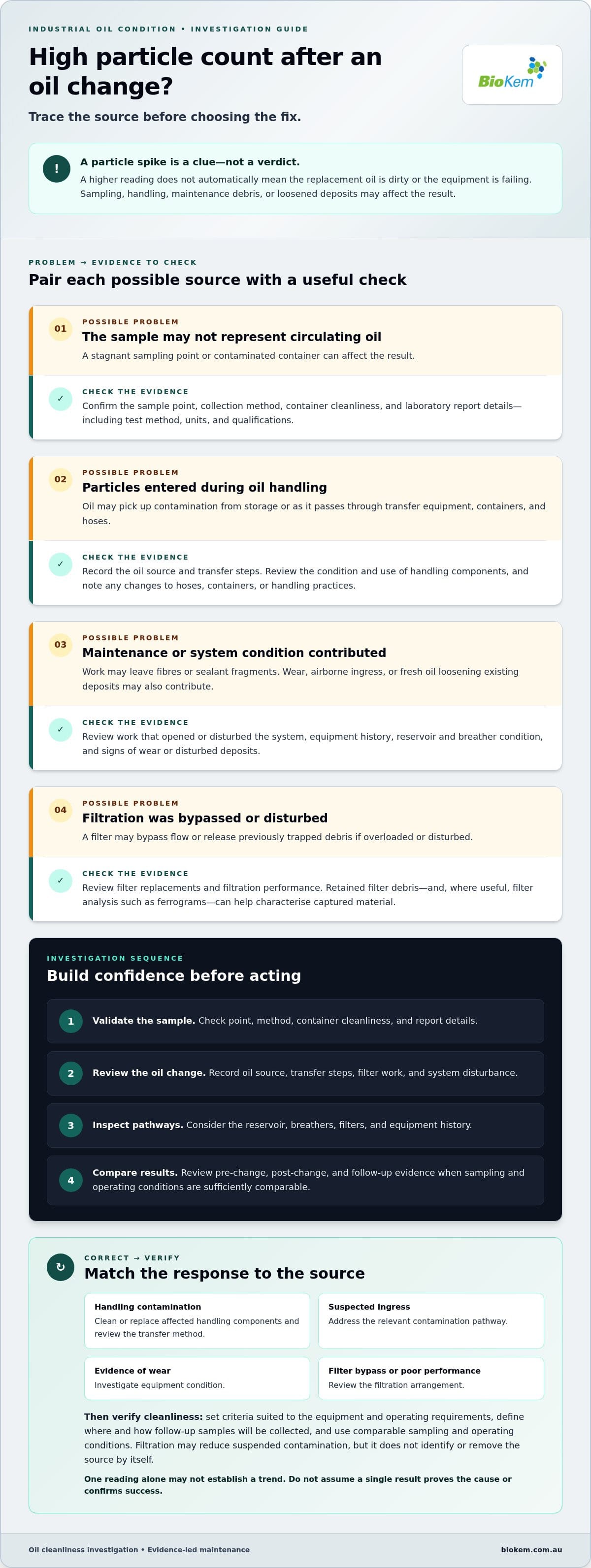
A high particle count signals a cleanliness concern, but it doesn’t identify the source or prove that the replacement oil caused it. When asking, “High Particle Counts After an Oil Change: What Went Wrong?”, start by tracing what changed and when. The sequence can help narrow the investigation, but timing is a lead to investigate, not proof of cause.
Particles may enter during oil handling, or they may already be circulating in the equipment and become more apparent in a sample taken after the change. A particle counter measures particles in a fluid; interpret the result alongside the system history and how the oil was changed.
Could the replacement oil or maintenance work introduce particles?
Oil can pick up contamination as it moves from a drum or tote through transfer equipment, containers and hoses. That doesn’t, by itself, mean the oil was defective: particles may have been introduced during storage or handling. Work on the system can also leave fibres, sealant fragments or other maintenance debris behind. Fresh oil may loosen deposits already on internal surfaces and bring them into suspension.
Check other pathways too. Wear can generate particles during operation, while a breather may allow airborne contamination into a reservoir. A filter may bypass flow or release previously trapped debris if it is overloaded or disturbed. Deposits such as varnish can also be dislodged during maintenance; BioKem’s varnish in lube oil service relates to assessing this type of condition.
- Replacement oil: particles may be present before transfer.
- Transfer path: containers, hoses or equipment may introduce contaminants.
- System condition: wear, ingress or disturbed deposits may contribute.
- Filtration: bypass or debris release may affect the result.
How to investigate a high particle count after an oil change
Work through the evidence before deciding whether the result reflects a sampling issue or contamination in the system. For “High Particle Counts After an Oil Change: What Went Wrong?”, a disciplined investigation helps avoid repeating filtration or maintenance without understanding the cause.
- Validate the sample: Confirm the sample point, collection method and container cleanliness. Check that the laboratory report identifies the test method, units and any qualifications that affect interpretation.
- Review the oil change: Record the oil source and transfer steps, and note any changes to hoses, containers or handling. Include filter replacements and work that opened or disturbed the system.
- Inspect contamination pathways: Consider the relevant reservoir, breathers, filters and equipment history instead of assuming the oil change introduced the particles.
- Compare evidence: Review pre-change, post-change and follow-up results when the sample point, collection approach and operating conditions are sufficiently comparable.
What evidence helps distinguish sampling problems from system contamination?
Compare the report with maintenance records and the exact sampling details. A sample taken from a stagnant point or collected in a contaminated container may not represent circulating oil. Repeat or paired samples can help determine whether a result is consistent, but one result alone may not establish a trend. Retained filter debris offers another line of evidence; filter analysis, including ferrograms, can help characterise material captured by the filter.
Particle counts are most useful alongside operating context and other condition evidence. In hydraulic systems, they can contribute to an assessment of equipment condition. BioKem’s onsite and lab-based patch analysis can support a broader investigation. Discuss an oil-analysis investigation with BioKem to use the available evidence to guide the next step.
What to do next: correct the source and verify cleanliness
Choose a corrective action that matches the evidence, not just the elevated count. If records point to contaminated transfer equipment, clean or replace the affected handling components and review the transfer method. If ingress is suspected, address the relevant pathway. Evidence of wear calls for an investigation of equipment condition, while filter bypass or poor performance may require attention to the filtration arrangement. Disturbed deposits may need a different response from newly introduced particles. When wear indicates underlying hydraulic issues in heavy machinery, read more about mobile repair services designed to inspect and fix components on site.
Filtration can reduce suspended contamination, but it doesn’t establish where particles came from or remove the cause. Set cleanliness criteria that suit the equipment and its operating requirements, then define how and where follow-up samples will be collected. Use comparable sampling and operating conditions to assess whether the corrective action has worked. Don’t assume success from a single reading or apply a universal threshold.
When can specialist filtration and condition monitoring help?
Once the likely source is understood, BioKem’s Fuel & Oil Filtration and coalescing, together with Condition Monitoring, can support a targeted response. Onsite and lab-based patch analysis can provide evidence for assessing oil condition and guiding next steps. For suspended particles, filtration may form part of a broader contamination-control plan, alongside measures that address ingress, handling or equipment wear.
The question “High Particle Counts After an Oil Change: What Went Wrong?” is best answered through a verification loop: identify the source, apply a suitable correction, then assess the oil against agreed criteria using representative follow-up samples. Discuss your oil-contamination requirements with BioKem to align filtration and monitoring with the findings.
Turn the result into a reliability-focused next step
Treat a post-change particle count as a reason to make the next maintenance decision more informed, not as an automatic instruction to replace the oil again. The question “High Particle Counts After an Oil Change: What Went Wrong?” can guide a practical review of what changed, what the evidence shows and what needs attention next. Set cleanliness criteria that suit the equipment, then use comparable follow-up sampling to assess the response.
BioKem can support this process with onsite and lab-based patch analysis, Condition Monitoring and ISO 16889-certified filtration. Aligning measurement and corrective action with the equipment’s requirements can support reliability while avoiding unnecessary intervention. Discuss your post-change particle-count investigation with BioKem to plan a considered next step.
Frequently Asked Questions
Can a particle count alone identify what the particles are?
No. A particle count reports how many particles fall within measured size ranges, but it doesn’t identify their material or origin. Answering “High Particle Counts After an Oil Change: What Went Wrong?” may require further analysis: ferrograms can help characterise particles captured in the oil or filter. This evidence can help guide maintenance decisions beyond what the count alone can show.
Is it safe to keep operating equipment when an oil sample shows high particle counts?
A high result alone can’t determine whether continued operation is safe. Compare it with the equipment’s cleanliness requirements, established operating baseline and applicable OEM guidance. Consider the asset’s criticality and check for alarms, unusual vibration, temperature changes or performance issues. If a limit is exceeded or symptoms appear, follow site procedures and involve the responsible maintenance or reliability team before deciding whether to continue.
Can filtration remove particles without an oil change?
Yes, filtration can remove suspended particles while oil remains in the system, provided the fluid is otherwise suitable for continued use and the contaminants can be captured by the selected filtration method. It won’t correct every oil-condition issue, so assess properties such as viscosity and water content separately. After treatment, use a representative sample to check whether the oil meets the equipment’s agreed cleanliness criteria.

Article by
James McAllister
James McAllister is an industry professional with BioKem Oil Services, specialising in lubrication reliability, oil filtration, contamination control and asset performance. Drawing on BioKem's extensive field experience across turbines, compressors, hydraulic systems and critical rotating equipment, James writes practical, insight-driven articles that help maintenance and reliability teams improve equipment performance, extend asset life and reduce operational risk.